L2's 'Card Swipe' Era: When the Scaling Narrative Ends, Payments Become the Lifeline

marsbit2026-01-22 tarihinde yayınlandı2026-01-22 tarihinde güncellendi

Özet

The article discusses the growing "payment card" trend among Layer-2 (L2) networks as a strategy to survive a severe user activity and transaction crisis. It begins with Solana's criticism of Starknet's low usage (allegedly only 8 daily active users and 10 transactions) despite its high valuation, highlighting a broader issue of low traffic across many L2s, as evidenced by data from L2BEAT and DefiLlama. Key examples include Zero Network, which stopped producing blocks for weeks with minimal impact, and networks like Linea, Starknet, Scroll, and ZKsync exhibiting very low Transactions Per Second (TPS). With Base and Arbitrum dominating 80% of the Total Value Locked (TVL), other L2s face a significant valuation-to-usage disparity. Facing a lack of killer dApps, L2s are turning to cryptocurrency payment cards to generate consistent on-chain activity. Unlike custodial cards from exchanges (which use chains like Tron or Solana for batch settlement), L2s are leveraging non-custodial cards that require on-chain settlement for each transaction. Examples include: - **Scroll**: Partnered with Etherfi for gasless transactions and cashback subsidies. - **Gnosis**: Its Gnosis Pay card converts user assets to stablecoins for euro payments. - **Linea**: Used as a primary settlement layer for the MetaMask card. This shift provides a high-frequency, sustainable use case, driving transaction volume. Even Polygon is pivoting to payments, citing significant non-USD stablecoin transfer volume...

Original Author: Eric, Foresight News

Recently, Solana made a joke about Starknet, mocking an L2 with only 8 daily active users and 10 transactions per day that still has a $15 billion FDV.
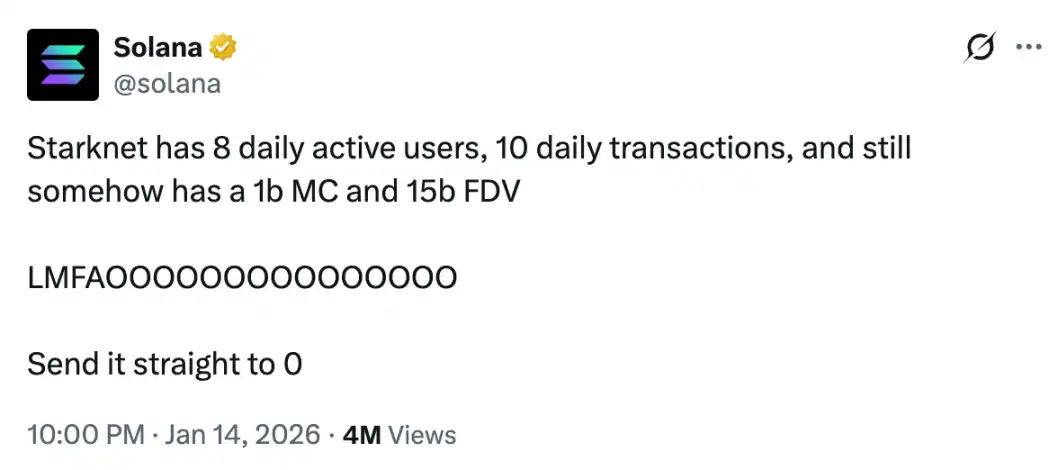
Although, in hindsight, this salt-in-the-wound joke was meant to attract attention and introduce the news of Starknet's token STRK launching on Solana via NEAR Intents. But Solana's criticism is not without reason; the L2s that have sprung up like mushrooms in the past two years are indeed facing a traffic crisis.

The most convincing recent example is on January 8th, when Zero Network, an L2 network incubated by Web3 wallet company Zerion, was exposed to have stopped producing blocks for over 3 weeks, but it seemed to have no impact. The official reaction was even more subtle; Zero Network stopped producing blocks on December 19, 2025, but the official statement on fixing the issue only came on December 23. The last original content posted by Zero Network's official Twitter was in May of the same year.

Despite this, the claim of only 8 users executing 10 transactions per day is an exaggeration. According to data from L2BEAT, Starknet's TPS yesterday was 2.64, meaning there were over 200,000 transactions on the network in a day. But this number is still extremely low; even the Ethereum mainnet's daily transaction volume is 10 times that of Starknet.
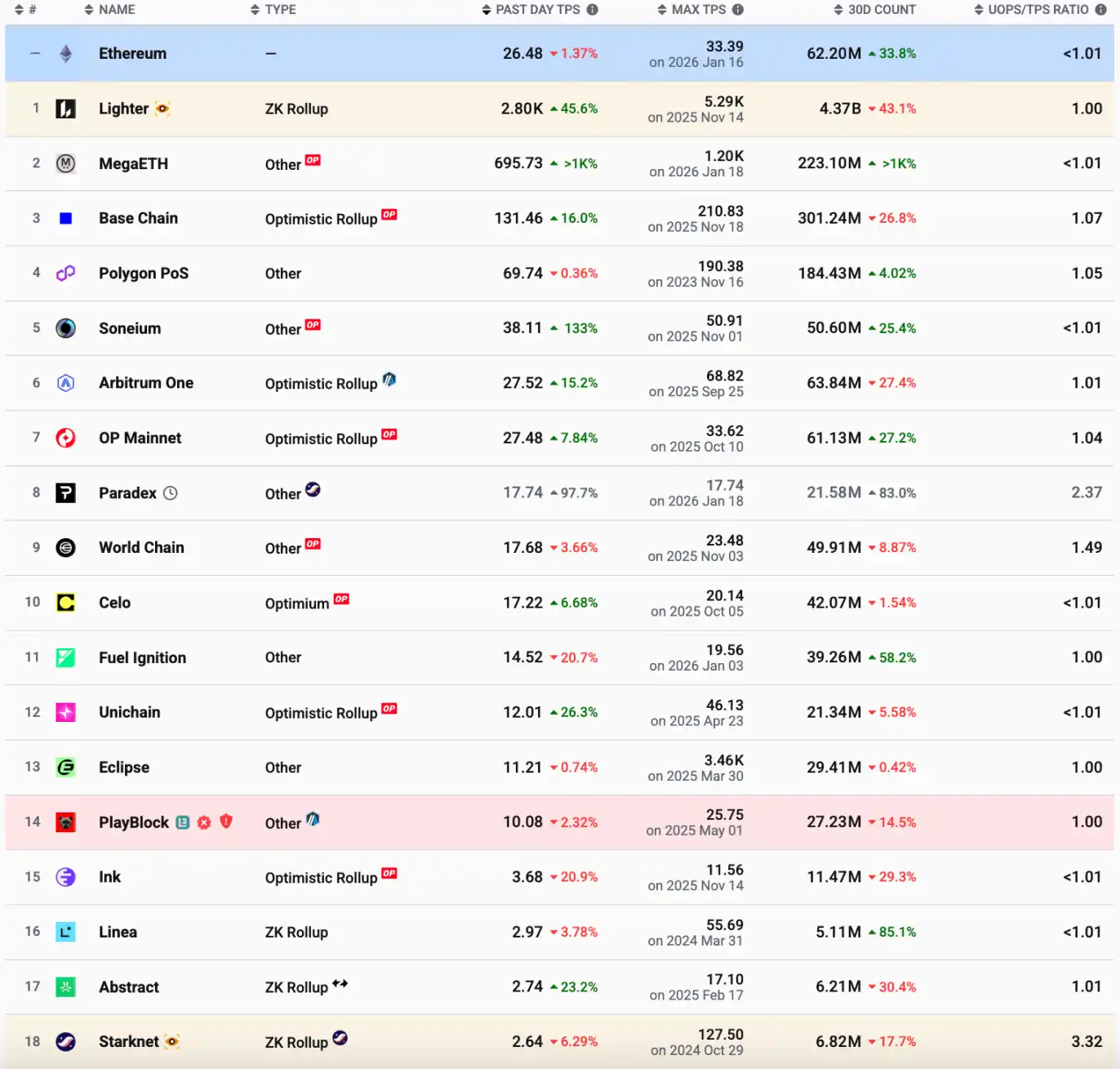
Data shows that among general-purpose L2s, aside from Base and Polygon, even Arbitrum and OP Mainnet's TPS are not significantly higher than Ethereum's. Linea and Starknet have a TPS of less than 3. The parts not shown in the screenshot include Scroll with a TPS slightly over 1, and ZKsync, Blast, etc., with less than 1.
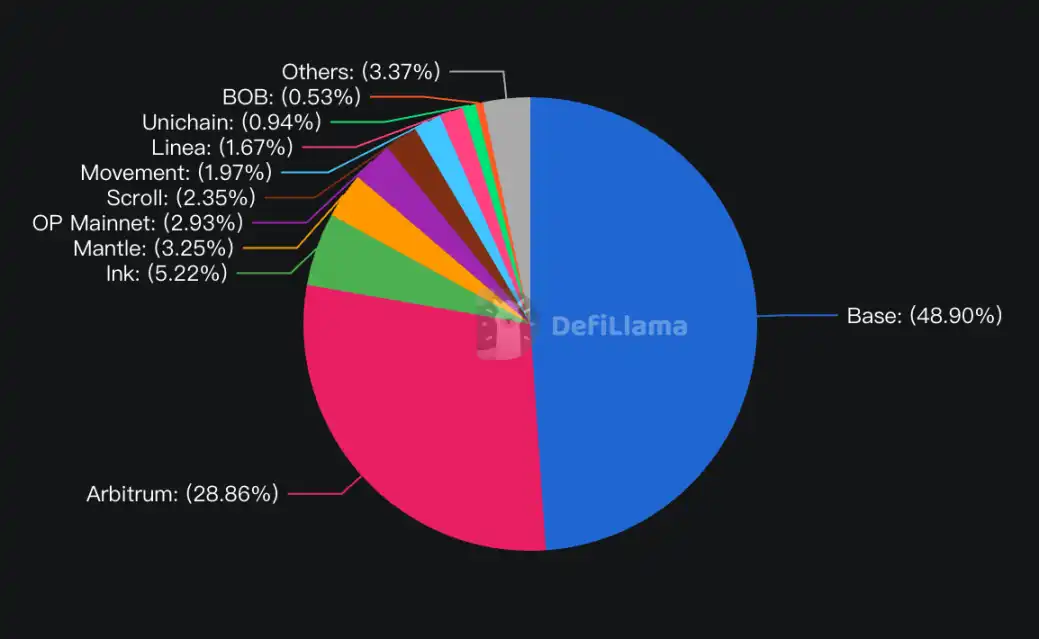
Looking at the TVL data from DefiLlama, Base and Arbitrum together account for nearly 80% of all L2 TVL. The remaining L2s, not in the "Others" category, had a combined valuation conservatively estimated at nearly $10 billion during their private funding rounds, but their combined TVL is less than $2 billion.
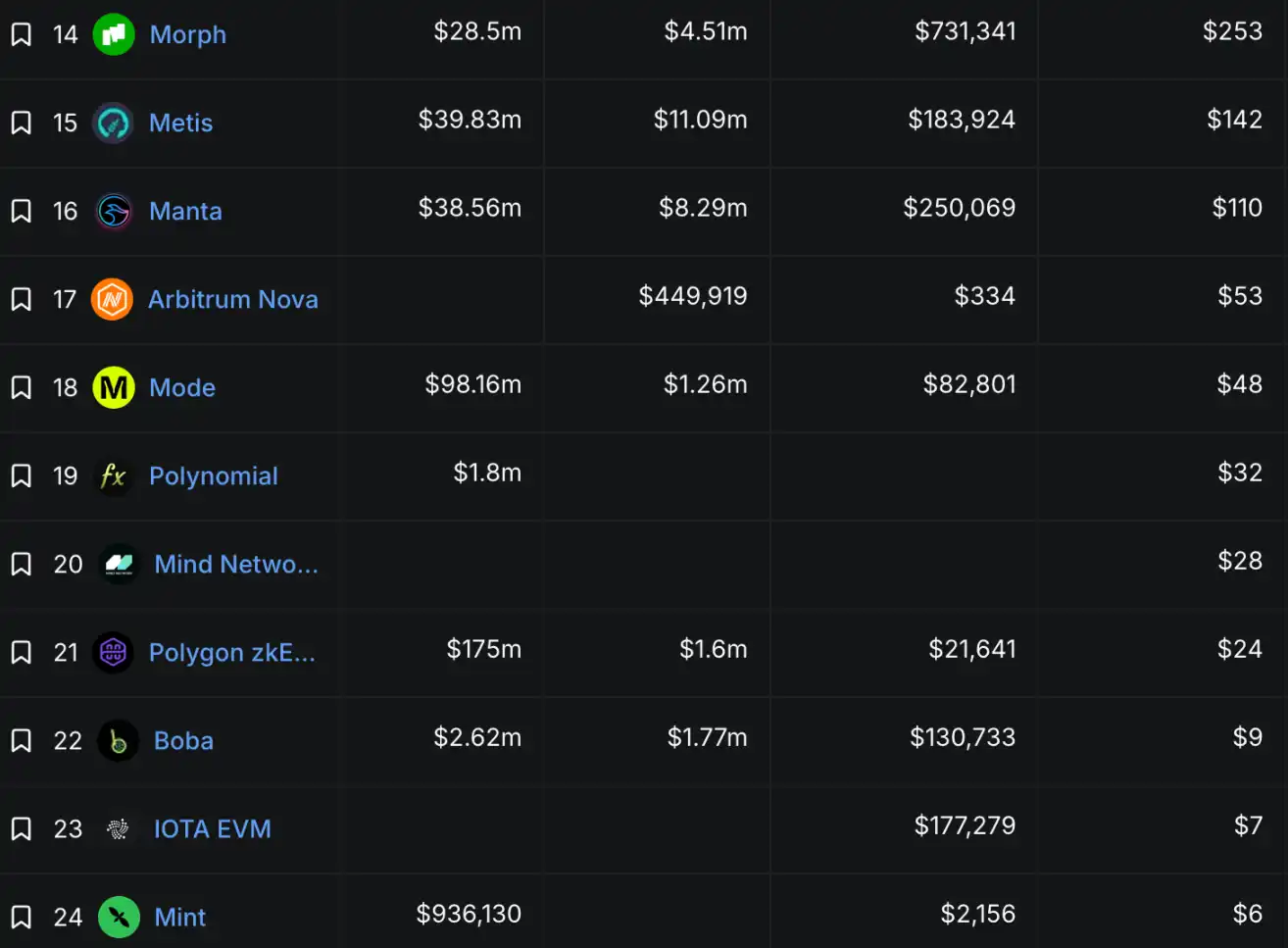
In terms of protocol revenue, only the top 7 protocols had revenues above $1,000 in the past 24 hours. Daily protocol revenues in the three-digit or even two-digit range might not even compare to the interest some large holders earn daily from placing assets in exchange wealth management.

This data very直观地展示了 (intuitively shows) the current predicament of L2s: against the backdrop of a lack of application narratives, hoping for a killer app that doesn't operate as an appchain and willingly runs on a general-purpose L2 has become a pipe dream. On the question of finding an application scenario that can provide stable transaction data, L2s have found the same answer: cryptocurrency cards.

Pavel Paramonov, founder of cryptocurrency research institution Hazeflow, once criticized that cryptocurrency cards are essentially not "cryptocurrency payments" but still fiat payments, not truly promoting cryptocurrency adoption. But he also mentioned that many projects or public chains launching crypto cards are doing so out of necessity, with the goal merely being to keep users within their ecosystem.

Many cryptocurrency cards launched by exchanges currently are a form of "custodial" card. User assets are held in exchange or institutional custody accounts, and upon consumption, settlement is handled by the exchange, off-ramp companies, and the card issuer. The settlement chains for such cards are usually Tron, Solana, or even the slightly higher-cost Ethereum. On one hand, the存量 (存量 - inventory/supply) of stablecoin assets on these chains is sufficient; on the other hand, some cards reduce costs through batch settlement rather than per-transaction settlement. For institutions, liquidity and stability might be more important than the low cost of L2s.

The crypto cards that L2s are eyeing are various forms of "non-custodial cards." Before using such a card for payment, assets reside in the user's own wallet, and each payment is settled individually, which can effectively increase on-chain activity. Typical examples include Scroll (Etherfi card settlement layer), Gnosis, and Linea (MetaMask card settlement layer).

In September 2024, Etherfi announced that its payment card would use Scroll as the settlement layer. Scroll can help Etherfi achieve "gasless transactions" and provide a higher cashback percentage subsidized by the SCR token. Besides the traditional method of directly spending assets on Scroll, the Etherfi card has a special mechanism: users can borrow fiat currency using yield-bearing assets on Scroll as collateral for payments. Supported assets include eETH, weETH, wETH, eBTC, etc.

Gnosis, as a sidechain that has long lacked presence, has successfully made a comeback with its payment card. Its card, Gnosis Pay, primarily operates in Europe. Users can connect non-custodial wallets like MetaMask and Gnosis Safe in the Gnosis Pay App. During spending, Gnosis Pay converts the user's wallet's supported assets (certain Euro, Pound, and Dollar stablecoins) into EURe, a Euro stablecoin issued by Monerium, which is then converted 1:1 into Euros for payment.

The crypto card issued by MetaMask uses ConsenSys's L2 Linea as the primary settlement network, additionally supporting Solana and Base. Users need to deposit supported payment assets (various USD or Euro stablecoins) into their MetaMask wallet before spending. During payment, user assets are transferred to the off-ramp service provider, converted into fiat currency, and then paid to the merchant.
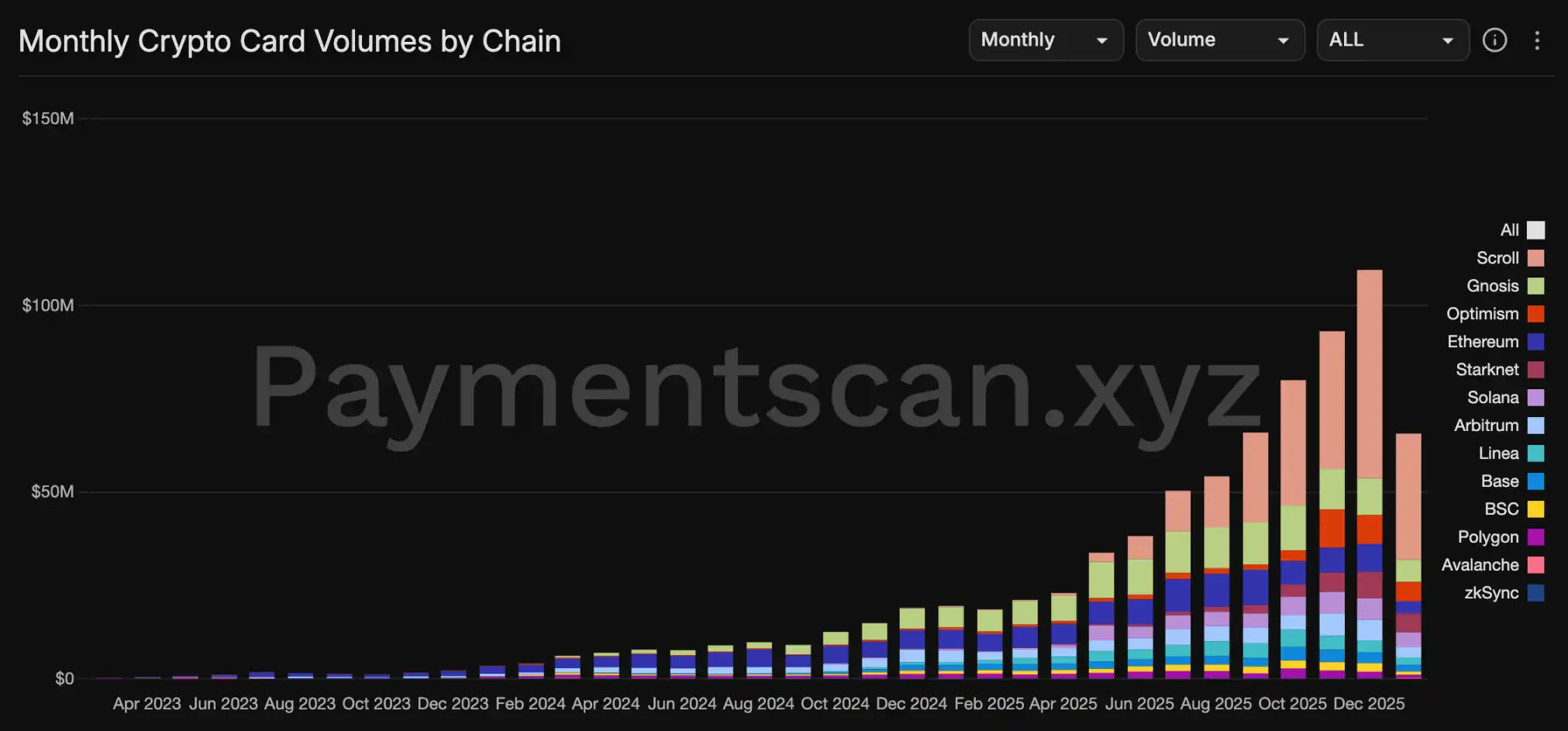
Due to the per-transaction settlement nature of non-custodial cards, each user消费 (消费 - consumption/spending) corresponds to a contract call to verify the remaining asset balance and the on-chain asset transfer. Thus, L2s can rely on payments, an absolutely high-frequency and sustainable scenario, to ensure a certain level of on-chain activity. According to Paymentscan data, Scroll, through its partnership with Etherfi and SCR subsidies, has captured a significant market share in card payments. However, this data is not entirely accurate, as many card payments might not involve on-chain transfers but are settled internally by institutions. Regardless, it's an indisputable fact that L2s have found a practical application scenario through payments.

It's not just emerging L2s that are anxious; Polygon, which cannot be strictly classified as an L2, also recently shifted its strategic focus to payments. By the end of 2025, the transfer volume of non-USD stablecoins on Polygon exceeded $11.1 billion, with the new stablecoin XSGD reaching $2.24 billion in trading volume and the Australian Dollar stablecoin AUDF reaching $2.46 billion. Additionally, Polygon has become one of the main chains used for Stripe's stablecoin payments; its announcement on January 13th to acquire cryptocurrency payment infrastructure Coinme and blockchain development platform Sequence for a consideration of $250 million更是将 (更是将 - further writes) "all in on payments" plainly on its face.

After experiencing the bombardment of various concepts, L2s have come to recognize reality. While they still await novel applications, the urgent task at hand is to utilize their low-cost, high-efficiency characteristics and survive first through payments.


Trend Kriptolar

İlgili Sorular

QWhat is the main issue facing Layer 2 (L2) networks according to the article?

AThe main issue facing L2 networks is a severe lack of user activity and transaction volume, leading to a 'traffic crisis' where many L2s have extremely low TPS and TVL, making it difficult to sustain themselves without finding practical, high-frequency use cases.

QWhat specific example does the article use to illustrate the inactivity of some L2 networks?

AThe article cites Zero Network, an L2 incubated by Web3 wallet company Zerion, which stopped producing blocks for over three weeks without any noticeable impact, and whose official Twitter account had not posted original content since May of the same year.

QWhat solution have many L2 networks turned to generate consistent on-chain activity?

AMany L2 networks have turned to cryptocurrency payment cards, specifically non-custodial cards, as a solution. Each payment with these cards requires an on-chain settlement, creating a high-frequency and sustainable source of transactions.

QWhich L2 networks are mentioned as having partnered with specific crypto cards to increase transactions?

AThe article mentions Scroll (partnering with Etherfi card), Gnosis (with its Gnosis Pay card), and Linea (used as a settlement layer for the MetaMask card) as examples of L2s leveraging payment cards to boost on-chain activity.

QWhy does the article state that Polygon is also shifting its strategic focus?

APolygon is shifting its strategic focus to payment solutions because it has seen significant transaction volume from non-USD stablecoins and has made major acquisitions, such as buying cryptocurrency payment infrastructure company Coinme and blockchain development platform Sequence, effectively going 'all in on payments'.

İlgili Okumalar

Annual Salary of Millions Competing for Electricians, Meta Rushes to Open Its Own Technical School

The AI boom is facing an unexpected bottleneck: a severe shortage of skilled construction workers and electricians. As tech giants like Meta, OpenAI, and Alphabet race to build massive data centers—such as OpenAI's $16 billion "Stargate" project—they are hitting a critical labor wall. The U.S. needs an estimated 130,000 more electricians, 240,000 construction workers, and 150,000 supervisors by 2030 for AI infrastructure alone, but tens of thousands of electrician jobs go unfilled each year. While AI companies offer high premiums, with electricians earning up to $280,000 annually, worker scarcity still causes massive losses—delays on a single project can cost $14.2 million per month. The complexity of building AI data centers, which require immense power (equivalent to powering hundreds of thousands of homes), sophisticated electrical systems, and advanced liquid cooling solutions, demands highly skilled technicians who are in short supply. To combat this, companies are investing heavily in training. Meta has committed $115 million to a free training school offering tuition, housing, and stipends, targeting 5,000 new workers. OpenAI is partnering with unions to secure skilled labor. These efforts are paying off, with a significant rise in Gen Z interest in trade schools over college. However, the power demands are staggering. AI data centers are driving a rapid surge in electricity consumption, projected to account for up to 12% of U.S. power use by 2028 and raising costs for consumers. Furthermore, the construction boom is project-based, leading to a potential future glut of trained workers once building peaks, which could depress wages industry-wide. The race for AI supremacy now depends as much on skilled hands as on advanced chips.

marsbit7 dk önce

Annual Salary of Millions Competing for Electricians, Meta Rushes to Open Its Own Technical School

marsbit7 dk önce

OpenAI No Longer Sells Its Most Expensive Model for Profit

OpenAI is shifting its business strategy away from promoting its most expensive, flagship models for every task. Recent price cuts—80% for GPT-5.6 Luna and 20% for Terra—signal a deeper change: the company now actively advises users that many tasks don't require the most powerful model. Instead, OpenAI recommends a tiered approach: use the high-end GPT-5.6 Sol for complex planning and analysis, then delegate execution to cheaper models like Luna. This mirrors moves by Anthropic, which recently launched Claude Opus 5 at half the price of its top model, Fable 5. Both companies are de-emphasizing flagship models as primary revenue drivers, using them instead for brand prestige and technological showcases. The industry is entering a "mass-market" phase, similar to automotive, where high-volume, cost-effective models handle daily operations and drive scale. OpenAI's price reductions are partly enabled by AI models themselves optimizing underlying code and infrastructure, creating a self-reinforcing cycle of efficiency gains and cost reduction. Competition is shifting from "who is smartest" to "who offers the best value." The goal is no longer selling individual models but fostering widespread API adoption and ecosystem lock-in. By making AI calls cheap and ubiquitous, companies like OpenAI aim to become the indispensable, utility-like infrastructure powering automated workflows—the "water and electricity" of software, quietly embedded everywhere.

marsbit7 dk önce

OpenAI No Longer Sells Its Most Expensive Model for Profit

marsbit7 dk önce

Will the Fed Definitely Raise Interest Rates in September? How Will Crypto and U.S. Stocks Withstand the Pressure?

The market's expectation for a September Fed rate hike surged dramatically in early August, jumping from under 50% to over 80% within a week. This shift followed a contentious July FOMC meeting, where a 9-3 vote to hold rates revealed growing dissent from hawkish members advocating for an immediate hike to combat persistent inflation. The primary catalyst for this repricing is rising oil prices, driven by renewed geopolitical tensions around the Strait of Hormuz, which threaten global supply. Energy costs directly influence inflation metrics, making the upcoming July CPI report (due August 12th) a critical data point. If it shows inflation reaccelerating, the probability of a September hike will solidify. For Bitcoin and crypto assets, this is typically bearish news. Bitcoin continues to behave as a high-beta, liquidity-sensitive risk asset. A rate hike raises the opportunity cost of holding non-yielding assets and could drive capital toward money markets, pressuring crypto prices in the short term. However, historical patterns suggest that if a hike is perceived as the end of a tightening cycle rather than the start, any negative price impact may be brief. U.S. stocks, particularly crypto-linked equities like Coinbase and growth-oriented tech stocks, are also vulnerable. Higher rates increase discount rates in valuation models, putting pressure on high-multiple companies. This coincides with a pivotal tech earnings season where investor focus has shifted from massive AI capital expenditure to tangible revenue and cash flow generation. Companies with negative cash flow and weak growth narratives could face heightened volatility if borrowing costs rise in September. In summary, a September Fed hike has evolved into a mainstream market scenario. Key factors to watch are oil prices, the July CPI report, and Fed communications, which will determine the final decision and its impact on volatile crypto and equity markets.

marsbit18 dk önce

Will the Fed Definitely Raise Interest Rates in September? How Will Crypto and U.S. Stocks Withstand the Pressure?

marsbit18 dk önce

İşlemler

Spot

Popüler Makaleler

ERA Nasıl Satın Alınır

HTX.com’a hoş geldiniz! Caldera (ERA) satın alma işlemlerini basit ve kullanışlı bir hâle getirdik. Adım adım açıkladığımız rehberimizi takip ederek kripto yolculuğunuza başlayın. 1. Adım: HTX Hesabınızı OluşturunHTX'te ücretsiz bir hesap açmak için e-posta adresinizi veya telefon numaranızı kullanın. Sorunsuzca kaydolun ve tüm özelliklerin kilidini açın. Hesabımı Aç2. Adım: Kripto Satın Al Bölümüne Gidin ve Ödeme Yönteminizi SeçinKredi/Banka Kartı: Visa veya Mastercard'ınızı kullanarak anında Caldera (ERA) satın alın.Bakiye: Sorunsuz bir şekilde işlem yapmak için HTX hesap bakiyenizdeki fonları kullanın.Üçüncü Taraflar: Kullanımı kolaylaştırmak için Google Pay ve Apple Pay gibi popüler ödeme yöntemlerini ekledik.P2P: HTX'teki diğer kullanıcılarla doğrudan işlem yapın.Borsa Dışı (OTC): Yatırımcılar için kişiye özel hizmetler ve rekabetçi döviz kurları sunuyoruz.3. Adım: Caldera (ERA) Varlıklarınızı SaklayınCaldera (ERA) satın aldıktan sonra HTX hesabınızda saklayın. Alternatif olarak, blok zinciri transferi yoluyla başka bir yere gönderebilir veya diğer kripto para birimlerini takas etmek için kullanabilirsiniz.4. Adım: Caldera (ERA) Varlıklarınızla İşlem YapınHTX'in spot piyasasında Caldera (ERA) ile kolayca işlemler yapın.Hesabınıza erişin, işlem çiftinizi seçin, işlemlerinizi gerçekleştirin ve gerçek zamanlı olarak izleyin. Hem yeni başlayanlar hem de deneyimli yatırımcılar için kullanıcı dostu bir deneyim sunuyoruz.

633 Toplam GörüntülenmeYayınlanma 2025.07.17Güncellenme 2026.06.02

ERA Nasıl Satın Alınır

Tartışmalar

HTX Topluluğuna hoş geldiniz. Burada, en son platform gelişmeleri hakkında bilgi sahibi olabilir ve profesyonel piyasa görüşlerine erişebilirsiniz. Kullanıcıların ERA (ERA) fiyatı hakkındaki görüşleri aşağıda sunulmaktadır.

活动图片












