KuCoin taps Tomorrowland festivals as MiCA-era on-ramp for European fans

cointelegraph2025-12-17 tarihinde yayınlandı2025-12-17 tarihinde güncellendi

Özet

KuCoin has signed an exclusive multi-year partnership with Tomorrowland music festivals from 2026 to 2028, becoming the event's official crypto and payments partner. This follows KuCoin’s recent acquisition of a MiCA-regulated license in the EU, allowing it to operate as a fully compliant crypto service provider. The collaboration aims to integrate cryptocurrency seamlessly into festival operations—including ticketing, merchandise, and concessions—without disrupting the user experience. Emphasizing security and regulatory compliance, KuCoin seeks to position crypto as a mainstream financial tool, learning from past failed Web3 partnerships like FTX’s with Tomorrowland. The goal is a smooth, invisible integration of digital assets into live events.

KuCoin announced an exclusive multiyear deal with Tomorrowland Winter and Tomorrowland Belgium from 2026 to 2028, making the exchange the music festival’s exclusive crypto and payments partner.

The move comes just weeks after KuCoin secured a Markets in Crypto-Assets Regulation (MiCA) service provider license in the European Union.

KuCoin’s MiCA play goes mass‐market

KuCoin EU Exchange recently obtained a crypto asset service provider license in Austria under the EU’s MiCA regime, giving it a fully regulated foothold in the bloc as Brussels’ new rulebook for exchanges, custody and stablecoins comes into force.

The Tomorrowland deal signals how KuCoin plans to use that status, not just to run a compliant trading venue, but to plug crypto rails directly into mainstream culture.
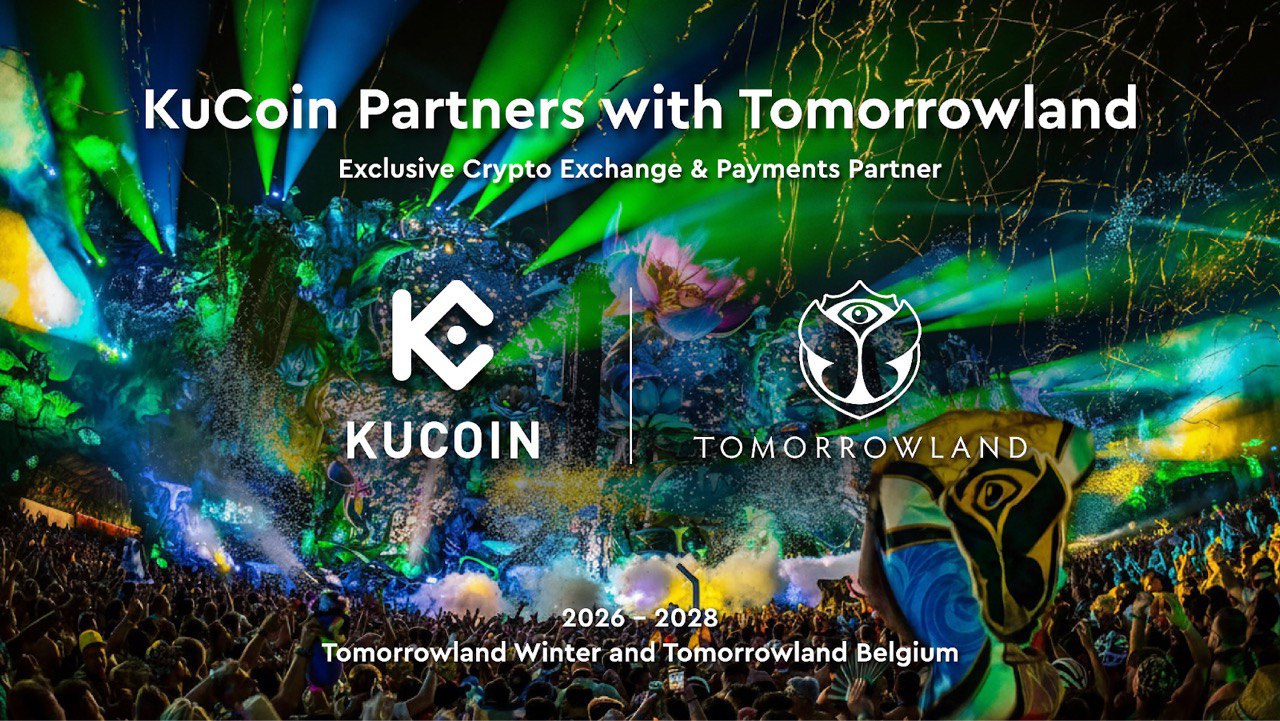
KuCoin joins forces with Tomorrowland. Source: KuCoin

KuCoin said the Tomorrowland deal will cover Tomorrowland Winter 2026 in Alpe d’Huez, France, and Tomorrowland Belgium 2026 in Boom, Belgium, with the same arrangement continuing through 2028.

Related: Burning Man-inspired festival in Bali goes full Web3: Here’s how

From sponsorship to payment rails

KuCoin insists this is not just a logo play. A spokesperson at KuCoin told Cointelegraph that as an exclusive payments partner, the exchange is working with Tomorrowland to weave crypto into the festival’s existing payments stack so that “financial tools” sit behind the scenes of ticketing, merch and food and drink.

The stated goal is to keep the rails “intuitive and invisible,” rather than forcing festivalgoers through clunky wallets or unfamiliar flows, with KuCoin positioning itself as facilitating the secure and efficient movement of value while fans focus on the music.

The company declined to spell out exactly which assets and rails will be supported on‐site, or whether every purchase will run natively onchain, but said that KuCoin’s “Trust First. Trade Next.” mantra runs through its messaging.

The spokesperson stressed advanced security, multi‐layer protection and adherence to EU standards as the foundation for taking crypto beyond the trading screen and into live events.

Related: What is Markets in Crypto-Assets (MiCA)?

Learning from FTX’s Tomorrowland flop

Tomorrowland’s organizers have been here before. In 2022, the festival announced a Web3 partnership with FTX Europe that promised NFTs and “the future of music festivals” before collapsing along with the exchange itself months later.

That experience makes the choice of a MiCA‐licensed partner, and the emphasis on user protection, more than cosmetic; it is a second attempt at bridging culture and crypto (this time with regulatory scaffolding and clearer guardrails).

Rather than setting public hard targets for user numbers or payment volumes by 2028, KuCoin is pitching success as “seamless integration” of crypto into the festival experience:

“We aim to demonstrate that digital assets can be a core component of global digital finance, moving from a niche technology to a mainstream utility. “

Related: Spain’s regulator sets out MiCA transition rules for crypto platforms

İlgili Okumalar

The King of Blind Date Attire in Korea: How SK Hynix Made a Comeback Against Samsung?

In South Korea's dating scene, SK Hynix employees are now highly sought after, a status shift fueled by the company's astronomical profits and employee bonuses, projected to reach up to 6.1 million RMB per person by 2027. This marks a dramatic reversal for the long-time second-place player in memory semiconductors, which has now surpassed its rival Samsung in annual operating profit. The turnaround story began in 2008 when a struggling Hynix, emerging from bankruptcy restructuring, took a risky bet by agreeing to develop High Bandwidth Memory (HBM) with AMD. At the time, HBM had no clear market beyond high-end graphics cards and was a costly, complex technology. Major players like Samsung, pursuing its own HMC technology, declined. For Hynix, with only memory as its core business, it was a gamble born of necessity. The pivotal moment came in 2012 when SK Group Chairman Chey Tae-won acquired Hynix. Defying industry downturns, he invested heavily in R&D and fabrication, sustaining the HBM project through over a decade of commercial uncertainty and internal challenges. A key break occurred around 2016-2017 when Samsung faced production issues supplying HBM2 for Google's TPU, allowing SK Hynix to gain a crucial foothold in the data center market. The AI explosion post-ChatGPT in 2022 was the catalyst, turning HBM into a critical bottleneck for AI accelerators like NVIDIA's GPUs. By 2025, SK Hynix captured 62% of the global HBM market, leaving Samsung at 17%. For the first time, its annual operating profit exceeded Samsung's. Analysts point to the "innovator's dilemma" to explain Samsung's miss: its vast, successful business portfolio made it risk-averse, preventing an all-in bet on the initially niche HBM technology. In contrast, SK Hynix, as a challenger with its back against the wall, had no choice but to commit fully. The story highlights how Korea's chaebol system allows for ultra-long-term bets beyond quarterly pressures. However, SK Hynix's lead isn't guaranteed. Samsung is aggressively catching up on HBM4, and challenges like customer concentration (heavy reliance on NVIDIA) and technical hurdles in advanced packaging remain. The narrative underscores a market truth: the greatest alpha often comes from betting on uncertain, long-term directions others dismiss, much like HBM in 2008.

marsbit24 dk önce

The King of Blind Date Attire in Korea: How SK Hynix Made a Comeback Against Samsung?

marsbit24 dk önce

Understanding Hash in One Article: The "Browser Miner" on Ethereum

Hash is an Ethereum-based ERC-20 token described as a "browser-minable post-quantum token." Its key features include enabling browser-based GPU mining without specialized hardware, a fixed supply cap of 21 million tokens, immutable and permissionless smart contracts with no team allocation or pre-mining, and an emphasis on post-quantum security using Keccak256 hashing. The mining mechanism is a simplified on-chain proof-of-work where miners solve unique challenges tied to their wallet address. Key design elements prevent answer theft, with epochs resetting every 100 blocks (~20 minutes) and a per-block minting limit. Emission follows a Bitcoin-like halving schedule every 100,000 mints, starting at 100 tokens per mint. Projections suggest all tokens could be mined within approximately 294 days if a target rate of one mint per minute is sustained. Hash emphasizes "post-quantum" security by leveraging hash-based primitives like Keccak256, which are considered more resistant to quantum attacks compared to elliptic-curve cryptography. While not a fully post-quantum asset, it aligns with Ethereum's broader post-quantum research narrative. The project completed its Genesis sale at $0.03 and began trading on Uniswap, with its price reaching around $0.19. The initial circulating supply is small, with 5% sold in Genesis and 5% allocated to liquidity. The majority (47.6% of total supply) is allocated to early-stage mining, leading to a front-loaded emission schedule. This structure, combined with low initial liquidity, makes Hash a high-volatility, high-risk project dependent on sustained miner participation and market demand to absorb new supply.

marsbit37 dk önce

Understanding Hash in One Article: The "Browser Miner" on Ethereum

marsbit37 dk önce

OpenAI's Largest Internal Wealth Creation: 600 People Cash Out a Total of $6.6 Billion, 75 Take Home the Maximum $30 Million Each

A Wall Street Journal report reveals OpenAI's unprecedented pre-IPO wealth creation. In a single employee stock sale last October, over 600 current and former employees sold shares, collectively cashing out approximately $6.6 billion. Due to high investor demand, the company tripled the individual sale cap to $30 million, with about 75 employees selling the maximum amount. This event represents the largest such transaction in tech industry history for a private company. OpenAI's valuation was $500 billion for this tender offer. Employees with over two years of tenure were eligible, allowing many post-ChatGPT hires their first liquidity event. The company's stock has reportedly grown over 100-fold in seven years. Following a restructuring, employees collectively hold about 26% of OpenAI. The scale of executive wealth is also staggering. In court testimony related to Elon Musk's lawsuit, President and co-founder Greg Brockman confirmed his OpenAI stake is worth around $30 billion. Analysis indicates about 165 current and former employees hold a combined ~$164.9 billion in equity, averaging nearly $1 billion per person in paper wealth. OpenAI's per-employee stock-based compensation is estimated to be 34 times the average of major tech firms before their IPOs. OpenAI continues its rapid ascent, closing a $122 billion funding round at an $852 billion valuation in March. With monthly revenue hitting $2 billion, over 900 million weekly ChatGPT users, and plans for a potential trillion-dollar IPO in late 2026, this wealth-creation engine shows no signs of stopping.

链捕手1 saat önce

OpenAI's Largest Internal Wealth Creation: 600 People Cash Out a Total of $6.6 Billion, 75 Take Home the Maximum $30 Million Each

链捕手1 saat önce

İşlemler

Spot
Futures

Popüler Makaleler

ERA Nasıl Satın Alınır

HTX.com’a hoş geldiniz! Caldera (ERA) satın alma işlemlerini basit ve kullanışlı bir hâle getirdik. Adım adım açıkladığımız rehberimizi takip ederek kripto yolculuğunuza başlayın. 1. Adım: HTX Hesabınızı OluşturunHTX'te ücretsiz bir hesap açmak için e-posta adresinizi veya telefon numaranızı kullanın. Sorunsuzca kaydolun ve tüm özelliklerin kilidini açın. Hesabımı Aç2. Adım: Kripto Satın Al Bölümüne Gidin ve Ödeme Yönteminizi SeçinKredi/Banka Kartı: Visa veya Mastercard'ınızı kullanarak anında Caldera (ERA) satın alın.Bakiye: Sorunsuz bir şekilde işlem yapmak için HTX hesap bakiyenizdeki fonları kullanın.Üçüncü Taraflar: Kullanımı kolaylaştırmak için Google Pay ve Apple Pay gibi popüler ödeme yöntemlerini ekledik.P2P: HTX'teki diğer kullanıcılarla doğrudan işlem yapın.Borsa Dışı (OTC): Yatırımcılar için kişiye özel hizmetler ve rekabetçi döviz kurları sunuyoruz.3. Adım: Caldera (ERA) Varlıklarınızı SaklayınCaldera (ERA) satın aldıktan sonra HTX hesabınızda saklayın. Alternatif olarak, blok zinciri transferi yoluyla başka bir yere gönderebilir veya diğer kripto para birimlerini takas etmek için kullanabilirsiniz.4. Adım: Caldera (ERA) Varlıklarınızla İşlem YapınHTX'in spot piyasasında Caldera (ERA) ile kolayca işlemler yapın.Hesabınıza erişin, işlem çiftinizi seçin, işlemlerinizi gerçekleştirin ve gerçek zamanlı olarak izleyin. Hem yeni başlayanlar hem de deneyimli yatırımcılar için kullanıcı dostu bir deneyim sunuyoruz.

412 Toplam GörüntülenmeYayınlanma 2025.07.17Güncellenme 2025.07.17

ERA Nasıl Satın Alınır

Tartışmalar

HTX Topluluğuna hoş geldiniz. Burada, en son platform gelişmeleri hakkında bilgi sahibi olabilir ve profesyonel piyasa görüşlerine erişebilirsiniz. Kullanıcıların ERA (ERA) fiyatı hakkındaki görüşleri aşağıda sunulmaktadır.

活动图片













