Kraken Reveals Extortion Demands After Client Data Incident: ‘We Will Not Pay’, Security Chief Says

bitcoinist2026-04-14 tarihinde yayınlandı2026-04-14 tarihinde güncellendi

Özet

Kraken, a major US crypto exchange, has publicly refused extortion demands from a criminal group following two incidents of unauthorized access to limited client support data. Chief Security Officer Nick Percoco stated the exchange identified and terminated access for individuals involved, emphasizing that no systems were breached and user funds remained safe. Approximately 2,000 client accounts (0.02% of users) were affected. Kraken is cooperating with law enforcement and industry partners to investigate what it describes as insider recruitment efforts targeting multiple sectors. The incident has sparked community concerns over insider threats and data security, drawing comparisons to a similar past event at Coinbase.

Kraken, the US’s second-largest crypto exchange, has rejected extortion threats from a criminal group after two incidents of unauthorized access to limited client support data in the past year, reigniting investors’ concerns about insider threats.

Kraken Fights Back Extortion Demands

On Monday, Kraken’s Chief Security Officer (CSO), Nick Percoco, revealed that a criminal group is extorting the crypto exchange, threatening to release videos of their systems exposing client data.

In a security update, the CSO affirmed that Kraken had identified and shut down two instances of inappropriate access to limited client support data since 2025. Per the post, the crypto exchange received a tip about a video shared on a criminal forum. The video reportedly showed access to Kraken’s client support system.

The exchange “immediately launched an investigation and quickly identified the individual involved as a member of our support team,” Percoco explained, “Their access was revoked immediately, a full investigation was conducted, additional security controls were put in place and a limited number of affected clients were notified.”

More recently, they received another tip with a new video showing similar activity, prompting a new investigation to identify the parties involved, terminate their access, and notify the affected clients.

“Shortly after access was terminated, we began receiving extortion demands,” the security chief stated. “The criminals threatened to distribute materials from both the February 2025 incident and the recent incident to media outlets and on social media if we did not comply.”

Percoco emphasized that the exchange’s systems were never breached and funds were never at risk. In addition, he noted that “only a very small number” of client accounts, approximately 2,000 or 0.02% of clients, were potentially viewed across both incidents.

Kraken has now publicly rejected the criminal demands, declaring that they “will not pay these criminals” and “will not ever negotiate with bad actors.”

In the announcement, the exchange highlighted that it has been collaborating with industry partners and law enforcement to “investigate and disrupt insider recruitment efforts targeting not only crypto companies, but also gaming and telecommunications organizations.”

Based on intelligence gathered from the two incidents and extensive analysis, Kraken believes there is sufficient evidence to identify and arrest all individuals involved, but did not share additional details as the investigation continues. However, they urged anyone with relevant information to contact the exchange directly.

This incident comes just a month after Kraken scored a major victory for the crypto industry, becoming the first crypto company with direct access to the Federal Reserve’s core payment system after winning the Kansas City Fed’s approval for a Fed master account.

Crypto Community Raises Insider Access Concerns

Crypto investors and Kraken users online reacted to the news, questioning the exchange about the details of the two incidents and criticizing the exchange for offshoring customer support staff.

“So, basically, you outsourced it to shady third-party companies (or even worse, your internal recruiters are sleeping), and you got hacked twice or more. You made your customers vulnerable to wrench attacks,” an X user wrote under Percoco’s post.

However, details of whether the inappropriate data access was from an in-house support team or an overseas third-party support staff have not been revealed yet.

Another crypto community member pushed back on Kraken’s “very small number” of clients clarification, asserting that “this is not the metric you think it is... of those 2000 accounts, they are probably the ones with balances worth wrench attacking.”

Others drew a parallel between this incident and Coinbase’s data breach controversy from last year. For context, Coinbase CEO Brian Armstrong revealed in May 2025 that malicious actors had bribed a handful of support contractors overseas to access the company’s internal tools.

This led to the leak of names, email addresses, limited transaction records, and partial Social Security numbers of around 1% of the exchange’s users. Then, the attackers attempted to blackmail Coinbase using the breached information, demanding a $20 million Bitcoin (BTC) ransom for the sensitive data.

Reuters later alleged that Coinbase had been aware of the customer data leak months before it disclosed it, also raising concerns about transparency and insider threats.
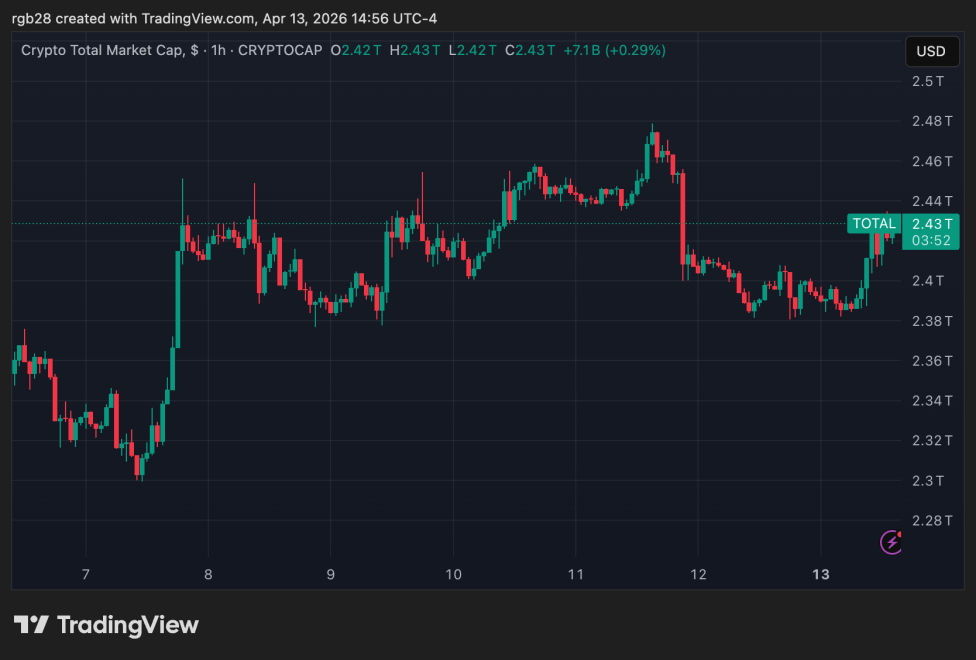
The total crypto market capitalization is at $2.43 trillion in the one-week chart. Source: TOTAL on TradingView


İlgili Sorular

QWhat did Kraken's Chief Security Officer reveal about the extortion demands?

AKraken's CSO Nick Percoco revealed that a criminal group is extorting the crypto exchange by threatening to release videos of their systems exposing client data, and that Kraken will not pay or negotiate with these criminals.

QHow many client accounts were potentially affected by the unauthorized access incidents at Kraken?

AApproximately 2,000 client accounts, or 0.02% of Kraken's clients, were potentially viewed across both incidents.

QWhat was the nature of the security incidents at Kraken, according to the company?

AThe incidents involved two instances of unauthorized access to limited client support data by individuals who were members of the support team, but the company's core systems were never breached and client funds were never at risk.

QHow did the crypto community react to Kraken's announcement of the security incidents?

AThe community questioned the details of the incidents, criticized the exchange for potentially offshoring customer support staff, and expressed concern that the affected accounts might be high-value targets for 'wrench attacks'.

QWhat parallel was drawn between this Kraken incident and another crypto exchange?

AThe incident was compared to Coinbase's data breach from May 2025, where malicious actors bribed overseas support contractors to access internal tools, leading to a data leak and a subsequent extortion attempt.

İlgili Okumalar

In Jinjiang, Fujian, a Storage Super Unicorn Lies Quiet

In Fujian's Jinjiang, a city known for sportswear, lies a quiet semiconductor giant: Fujian Jinhua Integrated Circuit Co. (JHICC). Once a promising domestic DRAM manufacturer alongside Yangtze Memory and ChangXin Memory Technologies (CXMT), its journey was derailed in 2018 when the U.S. placed it on an Entity List and filed criminal charges for alleged trade secret theft. This halted production for years. A turning point came in February 2024 when a U.S. federal court found JHICC not guilty. However, it had lost crucial time. While CXMT soared to become a top-valued A-share company in 2024, JHICC, with an estimated valuation of 80 billion RMB, was just restarting. Its current output is primarily customized DDR4 chips, not the advanced DDR5/HBM demanded for AI, but it still benefits from the broader memory chip upcycle. JHICC's story is tied to Chen Zhengkun, a veteran engineer who left Micron to lead the venture. Founded in 2016 with state-backed funding, JHICC partnered with Taiwan's UMC to develop DRAM technology. Rapid progress was cut short by the U.S. actions, which Micron initiated, partly due to its heavy reliance on the Chinese market. Post-sanctions, Chen's team worked to rebuild the production line with reduced reliance on U.S. technology. According to its records, JHICC achieved small-scale production and revenue growth under immense pressure. It now focuses on the stable "niche" DRAM market (e.g., TVs, routers) with a monthly capacity of ~40,000 wafers, aiming for 60,000 by 2026. It holds over 1,000 patents but remains on the Entity List. For Jinjiang, investing in JHICC was a bold industrial leap. The local government provided unwavering financial and logistical support during the crisis, helping the company survive. JHICC has become the anchor for a growing local semiconductor cluster. Though its scale lags behind domestic peers, JHICC's persistence symbolizes a hard-won foothold in a global market long dominated by Samsung, SK Hynix, and Micron. Having missed one boom, it seeks a place in the new AI-driven memory supercycle.

marsbit1 saat önce

In Jinjiang, Fujian, a Storage Super Unicorn Lies Quiet

marsbit1 saat önce

İşlemler

Spot
活动图片




