Korea Tones Down 20% Crypto Exchange Stake Ban as Regulators Seek Governance ‘Middle Ground’

bitcoinist2026-03-05 tarihinde yayınlandı2026-03-05 tarihinde güncellendi

Özet

South Korean regulators and the ruling party have agreed to impose a 20% ownership cap on major shareholders of cryptocurrency exchanges, following months of debate. The policy includes a three-year grace period for large platforms like Upbit and Bithumb, and up to six years for smaller exchanges. The cap, part of the broader Digital Asset Basic Act, aims to limit founder control while allowing limited exceptions for new businesses. Opposition from industry groups and some lawmakers may still affect the bill's final passage.

South Korean authorities and the ruling party agree on a 20% ownership ceiling for “major shareholders” in crypto and virtual assets exchanges, with a three‐year implementation delay.

From A Strict Proposal To Compromise

After months of friction, the Financial Services Commission (FSC) and the Democratic Party’s digital asset task force have finally converged on a 20% cap for major shareholders, the Korea Herald reports.

South Korea’s 20% cap is the culmination of a long‐running push by FSC, the top financial regulator, to curb founder control at the country’s biggest crypto exchanges. Regulators initially floated a stricter 15–20% range for major shareholders at the leading platforms, a proposal that sparked outrage and fierce opposition from the industry. The backlash was led by the Digital Asset Exchange Alliance (DAXA), a self‐regulatory body representing South Korea’s five major exchanges, including, of course, Upbit and Bithumb.

The Deal Terms

The agreement on a 20% cap and a generous grace period looks like an attempt to find middle ground and defuse tensions. The FSC and the ruling party have endorsed a three‐year grace period to enforce the major shareholder stake restriction, giving Upbit and Bithumb, which together command roughly 90% of the domestic market, some breathing room to start trimming their stakes to meet the new threshold.

Smaller exchanges that do not meet the estimated 20% market‐share bar, such as Coinone, Korbit and GOPAX, will get an even longer runway. South Korean authorities have agreed to grant them an additional three‐year grace period, giving these platforms up to six years in total to prepare for full enforcement of the cap.

Exceptions

The FSC has also carved out narrow exceptions via enforcement decree, allowing stakes of up to 34% only for new businesses, not for existing exchanges. According to The Korea Herald, this threshold appears to mirror the Commercial Act’s 33.3% veto line for general shareholders’ meetings, effectively giving qualified new investors blocking power without restoring full control

The Final Details On The Digital Asset Basic Act

The ruling party’s policy committee is expected to hammer out the final details after a closed‐door meeting with the Financial Services Commission on the morning of the 5th, according to Hankyung. The ownership cap will be folded into a broader Digital Assets Basic Act, an umbrella bill that packages a wide range of crypto policy measures, from stablecoin rules to crypto exchange‐traded funds.

However, the bill’s passage is far from guaranteed. The Korea Herald notes that not only is the opposition party pushing back, but some lawmakers also object to strict limits on major shareholder stakes, casting doubt over whether the cap will clear the National Assembly in its current form.
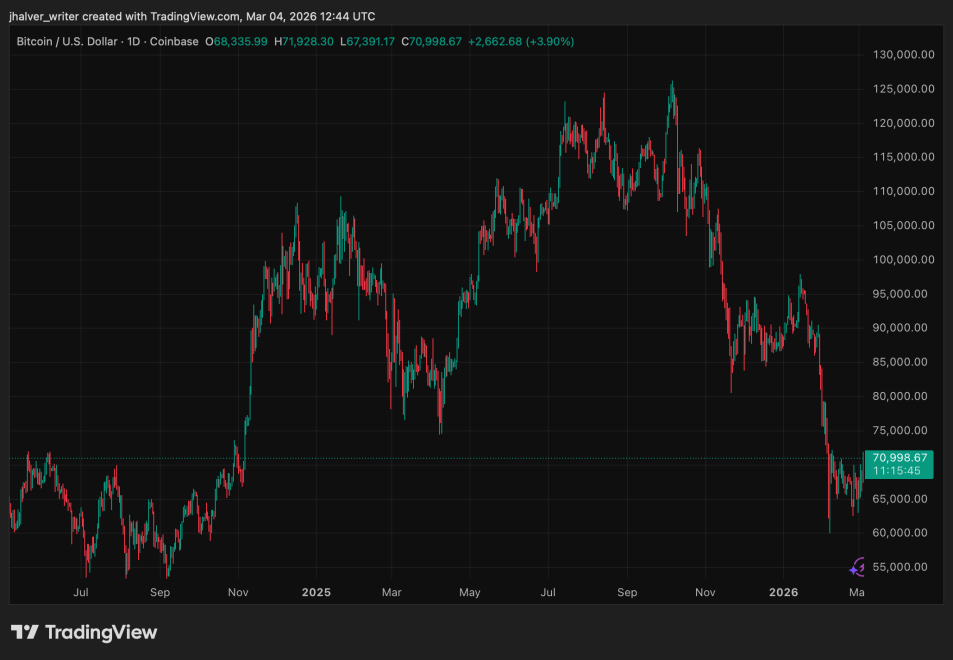
BTC's price trends to the downside on the daily chart. Source: BTCUSD on Tradingview

Cover image from ChatGPT, BTCUSD chart from Tradingview

İlgili Sorular

QWhat is the new ownership cap for major shareholders in South Korean crypto exchanges, and what was the implementation delay agreed upon?

AThe new ownership cap for major shareholders in South Korean crypto exchanges is 20%, with a three-year implementation grace period.

QWhich two major South Korean crypto exchanges, which dominate the market, were given a three-year grace period to comply with the new stake limit?

AUpbit and Bithumb, which together command roughly 90% of the domestic market, were given a three-year grace period.

QHow does the grace period for smaller exchanges like Coinone and Korbit differ from that of the major ones?

ASmaller exchanges that do not meet the 20% market-share bar will be granted an additional three-year grace period, giving them up to six years in total to comply.

QWhat is the exception to the ownership cap, and what specific power does it grant to qualified new investors?

AAn exception allows stakes of up to 34% for new businesses (not existing exchanges), which mirrors the Commercial Act's 33.3% veto line, giving qualified new investors blocking power in shareholders' meetings.

QInto what larger legislative package will the ownership cap be incorporated, and what is a major obstacle to its passage?

AThe ownership cap will be folded into the broader Digital Assets Basic Act. A major obstacle to its passage is opposition from some lawmakers and the opposition party who object to the strict limits on major shareholder stakes.

İlgili Okumalar

The Value Distribution of Stablecoins

**Summary: The Value Distribution of Stablecoins** The article argues that stablecoins are evolving from mere trading tools into broader channels for dollar access. It divides the stablecoin ecosystem into four layers to analyze how value is distributed: 1. **Issuance Layer:** Mints stablecoins, holds reserve assets, and captures the spread between reserve yield and user costs (e.g., Tether, Circle). This layer currently earns the largest profit margin. 2. **Infrastructure Layer:** Connects stablecoins to the traditional financial system, handling fiat on/off-ramps, banking integration, compliance (KYC/AML), and asset management (e.g., Bridge, BVNK). This is the "unglamorous" but critical work, building the essential bridges between crypto and real-world finance. 3. **Acquiring/Distribution Layer:** Integrates stablecoins into merchant systems, manages payment flows, and provides enterprise financial software (e.g., Stripe, Coinbase). They act as the access point for businesses. 4. **Application Layer:** The end-users and businesses that ultimately use stablecoins for payments, settlements, or as a store of value. They benefit from convenience but have little pricing power. The core thesis is that while the issuance layer currently dominates profits, the often-overlooked **infrastructure layer holds significant long-term potential**. The real challenge and barrier to mass adoption is not the on-chain transfer of stablecoins (which is simple), but the complex "last mile" integration into existing business workflows, banking systems, and regulatory frameworks across different countries. Companies in this layer are currently in a "land grab" phase, investing heavily to build networks, secure bank partnerships, and establish compliance pathways. While their position is currently pressured by the profitable issuers above and distribution platforms below, the article suggests that if stablecoins become a default financial rail for businesses, the infrastructure providers who have done the hard work of integration will ultimately gain strong pricing power and become entrenched, essential players.

marsbit6 saat önce

The Value Distribution of Stablecoins

marsbit6 saat önce

The Value Distribution of Stablecoins

The Value Distribution of Stablecoins The article argues that stablecoins are evolving from a mere trading tool into a broad "dollar channel." It analyzes the industry's value chain through four layers: 1. **Issuance Layer (e.g., Tether, Circle):** The top layer that mints stablecoins, holds reserve assets, and captures the thickest interest rate spread. 2. **Infrastructure Layer (e.g., Bridge, BVNK):** Connects stablecoins to the traditional financial system, handling critical but complex "dirty work" like fiat on/off-ramps, banking integration, compliance (KYC/AML), and cross-border settlement. 3. **Acquiring/Distribution Layer (e.g., Stripe, Coinbase):** Embeds stablecoins into merchant systems, manages payment flows, and integrates with enterprise software. 4. **Application Layer:** End-users and businesses that ultimately use stablecoins for payments, settlement, or storing value. The author posits that while the issuance layer currently captures the most profit, the most overlooked and potentially critical layer is infrastructure. The core challenge for stablecoin adoption isn't the on-chain transfer (which is simple), but bridging the gap between blockchain and the real-world financial system. This involves solving practical problems for businesses: fiat conversion, reconciliation, tax handling, and user onboarding. Infrastructure companies are currently in a difficult "land-grab" phase—building networks, securing banking relationships, and achieving compliance country-by-country. They face pressure from both the profitable issuance layer above and distribution platforms below. However, the author suggests this layer is building a crucial moat. Once stablecoins become a default business rail, the infrastructure players who have done the hard work of integration may gain significant, durable value and pricing power.

链捕手6 saat önce

The Value Distribution of Stablecoins

链捕手6 saat önce

İşlemler

Spot
Futures

Popüler Makaleler

BAN Nasıl Satın Alınır

HTX.com’a hoş geldiniz! Comedian (BAN) satın alma işlemlerini basit ve kullanışlı bir hâle getirdik. Adım adım açıkladığımız rehberimizi takip ederek kripto yolculuğunuza başlayın. 1. Adım: HTX Hesabınızı OluşturunHTX'te ücretsiz bir hesap açmak için e-posta adresinizi veya telefon numaranızı kullanın. Sorunsuzca kaydolun ve tüm özelliklerin kilidini açın. Hesabımı Aç2. Adım: Kripto Satın Al Bölümüne Gidin ve Ödeme Yönteminizi SeçinKredi/Banka Kartı: Visa veya Mastercard'ınızı kullanarak anında Comedian (BAN) satın alın.Bakiye: Sorunsuz bir şekilde işlem yapmak için HTX hesap bakiyenizdeki fonları kullanın.Üçüncü Taraflar: Kullanımı kolaylaştırmak için Google Pay ve Apple Pay gibi popüler ödeme yöntemlerini ekledik.P2P: HTX'teki diğer kullanıcılarla doğrudan işlem yapın.Borsa Dışı (OTC): Yatırımcılar için kişiye özel hizmetler ve rekabetçi döviz kurları sunuyoruz.3. Adım: Comedian (BAN) Varlıklarınızı SaklayınComedian (BAN) satın aldıktan sonra HTX hesabınızda saklayın. Alternatif olarak, blok zinciri transferi yoluyla başka bir yere gönderebilir veya diğer kripto para birimlerini takas etmek için kullanabilirsiniz.4. Adım: Comedian (BAN) Varlıklarınızla İşlem YapınHTX'in spot piyasasında Comedian (BAN) ile kolayca işlemler yapın.Hesabınıza erişin, işlem çiftinizi seçin, işlemlerinizi gerçekleştirin ve gerçek zamanlı olarak izleyin. Hem yeni başlayanlar hem de deneyimli yatırımcılar için kullanıcı dostu bir deneyim sunuyoruz.

478 Toplam GörüntülenmeYayınlanma 2024.12.11Güncellenme 2026.06.02

BAN Nasıl Satın Alınır

Tartışmalar

HTX Topluluğuna hoş geldiniz. Burada, en son platform gelişmeleri hakkında bilgi sahibi olabilir ve profesyonel piyasa görüşlerine erişebilirsiniz. Kullanıcıların BAN (BAN) fiyatı hakkındaki görüşleri aşağıda sunulmaktadır.

活动图片