KITE under pressure: 1.8B supply meets falling demand and rising shorts

ambcrypto2026-03-27 tarihinde yayınlandı2026-03-27 tarihinde güncellendi

Özet

KITE remains in a bearish phase with weakening fundamentals and negative market sentiment. The number of holders has declined from 105,420 to 104,780 since March 24, while market capitalization dropped by $57 million. Despite a high circulating supply of 1.8 billion tokens, demand is shrinking. The price fell 11% in 24 hours, with rising volume indicating strong bearish momentum. Perpetual traders are increasing short exposure, pushing the funding rate to a deeply negative -1.2420%, similar to levels preceding a previous sharp decline. Liquidity analysis suggests a potential drop toward $0.175, with further downside risk likely due to persistent selling pressure and dominant short positioning.

Kite [KITE] remains in a bearish phase as market sentiment continues to weaken. The recent decline reflects underlying structural shifts that could push prices lower in the near term.

Perpetual traders are capitalizing on this trend, increasing short exposure in ways that may exert additional downward pressure in upcoming trading sessions.

KITE fundamentals weaken as holder count drops

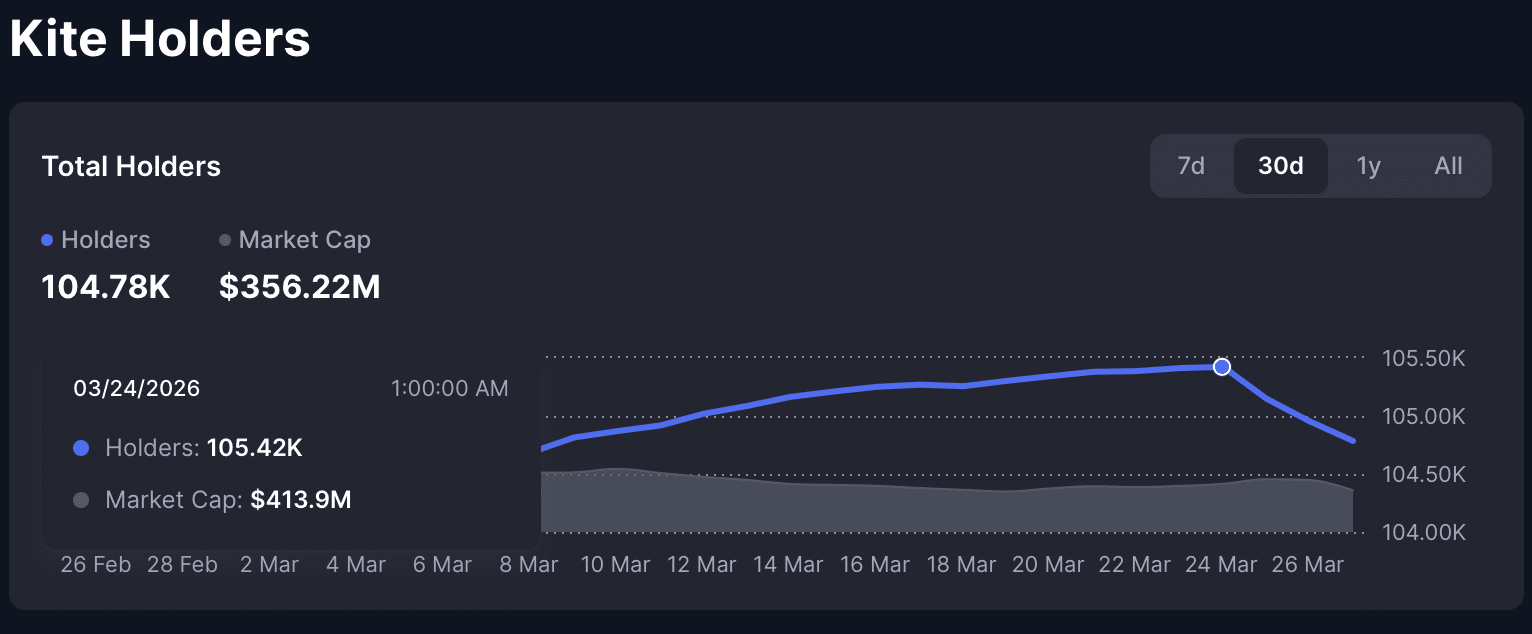
A key driver behind KITE’s recent decline lies in deteriorating fundamentals. The number of holders has dropped sharply after peaking at 105,420 on the 24th of March, when market capitalization reached $413.9 million.

At press time, the holder count has fallen to 104,780, while market capitalization has declined by $57 million, according to CoinMarketCap.
Source: CoinMarketCap

Despite the drop in participation, KITE’s circulating supply remains elevated at 1.8 billion tokens. This imbalance between supply and shrinking holder demand continues to weigh on sentiment.

At the same time, price action has weakened, with KITE posting a double-digit loss of 11% over the past 24 hours as of writing. Trading volume, however, has increased. Historically, rising volume alongside falling prices signals strong bearish momentum, suggesting the downtrend may extend.

Perpetual market signals growing short dominance

The perpetual futures market adds further downside risk.

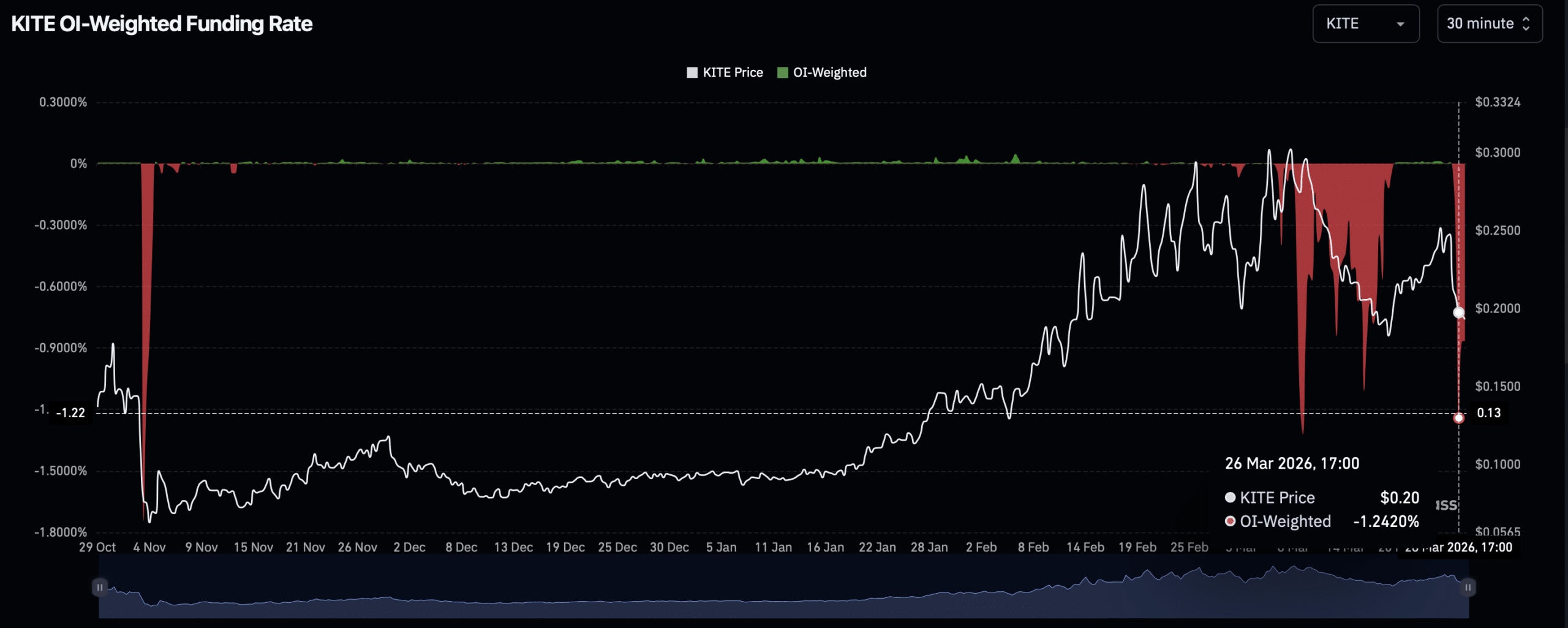
Short traders have increased their dominance across KITE contracts. Over the past 24 hours, the Open Interest Weighted Funding Rate, which measures whether longs or shorts control the market, has turned sharply negative, at press time, reinforcing bearish sentiment.

The Funding Rate dropped to -1.2420%, the steepest drop since the 9th of March. On the 19th of March, a similar decline occurred, resulting in a sharp price drop from $0.29 to $0.18, indicating potential downside pressure.
Source: CoinGlass

Notably, capital inflows into the perpetual market have risen even as short positioning intensifies. Open Interest has increased by nearly 1% to $50.54 million, suggesting that traders are adding liquidity primarily to build short exposure.

Liquidity points to further downside risk

Liquidity data indicates that KITE may still have room to decline.

Current liquidity clusters indicate a potential move toward $0.175, where a concentration of unfilled orders exists. With minimal liquidity below this level, price may gravitate toward this zone in the short term.
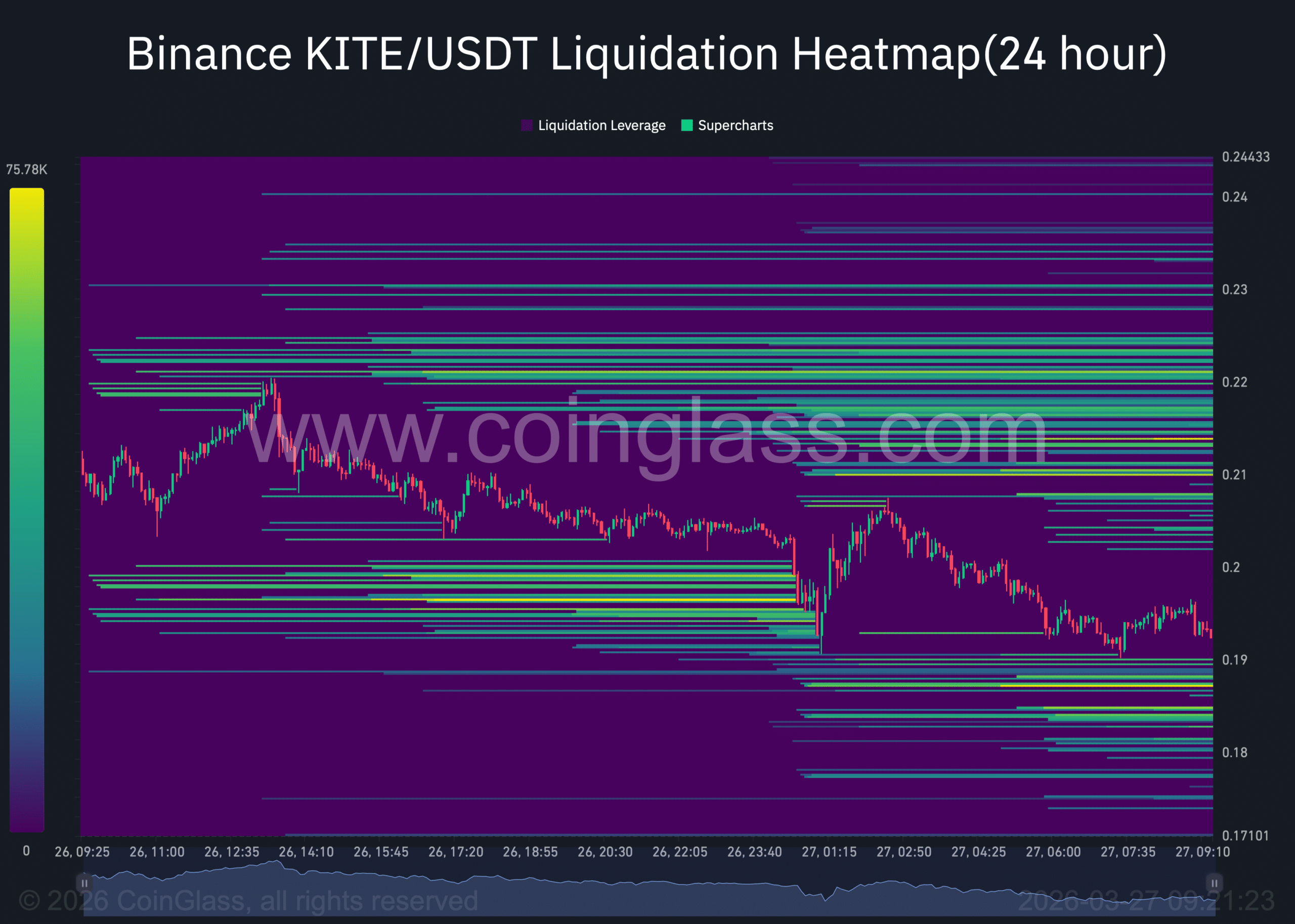
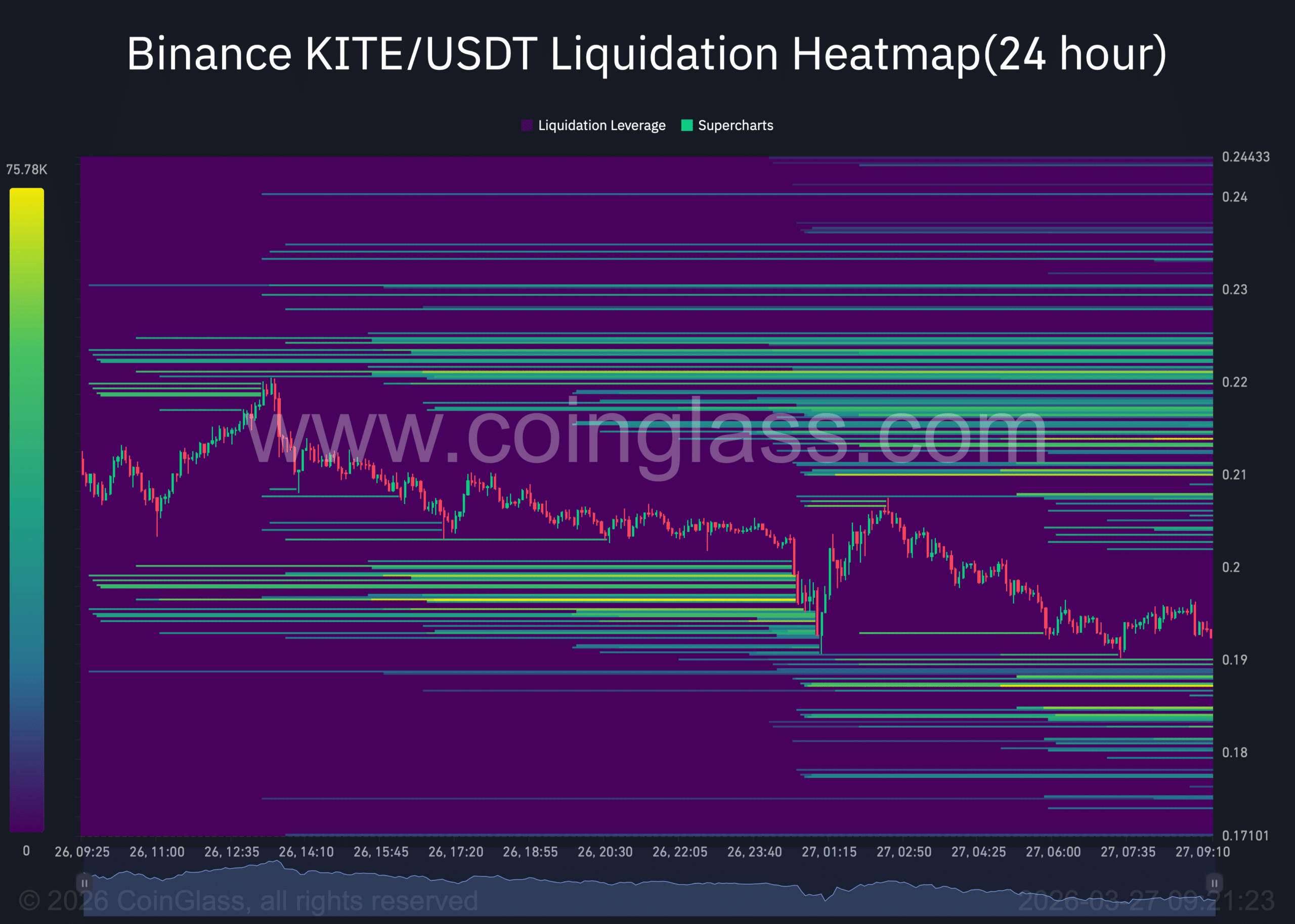
Source: CoinGlass

If KITE stabilizes and rebounds from this region, it could target a recovery toward the $0.23–$0.24 range. However, given the prevailing bearish momentum and increasing short pressure, the probability of further downside remains higher for now.


Final Summary

  • KITE’s holder count continues to decline after reaching an all-time high on March 24, coinciding with a $57 million drop in market capitalization.
  • Perpetual traders are reinforcing the downtrend, with short contracts rising to levels last seen weeks ago.


İlgili Sorular

QWhat is the main reason behind KITE's recent price decline according to the article?

AThe main reason is deteriorating fundamentals, including a sharp drop in holder count and an imbalance between the elevated circulating supply of 1.8 billion tokens and shrinking holder demand.

QHow has the number of KITE holders changed since its peak on March 24th?

AThe holder count has dropped from a peak of 105,420 on March 24th to 104,780 at the time of writing.

QWhat does the negative Open Interest Weighted Funding Rate indicate for the perpetual futures market?

AA sharply negative funding rate of -1.2420% indicates that short traders are dominant and paying long traders, reinforcing bearish sentiment in the market.

QWhat price level does liquidity data suggest KITE gravitate towards in the short term?

ALiquidity data suggests a potential move toward $0.175, where a concentration of unfilled orders exists.

QWhat was the percentage loss in KITE's price over the 24 hours preceding the article?

AKITE posted a double-digit loss of 11% over the past 24 hours as of writing.

İlgili Okumalar

UBS: The Crowdedness of A-Share Tech Stocks Is Far From Reaching Historical Peaks

UBS: A-share tech stocks still far from peak crowding levels A-shares' technology sector has seen a strong rebound, with trading activity hitting record highs, raising concerns about market crowding. However, UBS Securities argues that a key indicator of institutional positioning suggests the current crowding level remains well below historical peaks. While the large-cap tech sector's share of total A-share trading volume and market capitalization have reached historical highs, the overweight ratio of domestic mutual funds in this sector stood at 9.9% in Q1 2026. This is down from 11.6% in Q3 2025 and significantly lower than the historical peak of 14.1% in Q4 2015. It also pales in comparison to the historical peak overweight of 18.7% for the consumer sector. UBS notes that typical cycles from a low to a peak in fund overweighting last about three years, and the current outperformance of the tech/growth style has lasted less than two years since the policy pivot in September 2024. UBS expects A-share earnings recovery to accelerate, providing fundamental support. It forecasts 2026 A-share profit growth to rise to 11% from 3.9% in 2025. Non-financial A-share profits grew 11.8% YoY in Q1 2026, with gross and net profit margins at their highest since 2023. Persistent fund inflows, the expansion of thematic ETFs, and a recovery in private fund issuance are supporting market liquidity. In tactical allocation, UBS favors growth and cyclical styles under its "slow bull" base case, with overweight ratings on six sectors: Electronics (benefiting from semiconductor inventory recovery and AI innovation), Communications (driven by AI computing demand), Machinery (aided by domestic capex recovery), Non-ferrous Metals (due to rising copper/aluminum prices), Chemicals (supported by anti-involution policies), and Electrical Equipment (driven by policy support and AI data center power demand).

marsbit1 saat önce

UBS: The Crowdedness of A-Share Tech Stocks Is Far From Reaching Historical Peaks

marsbit1 saat önce

İşlemler

Spot
Futures
活动图片