"King of Shilling" Hayes Strikes Again, This Time Setting His Sights on Deribit

Foresight News2026-06-29 tarihinde yayınlandı2026-06-29 tarihinde güncellendi

Özet

On June 29, BitMEX co-founder Arthur Hayes acquired approximately 6.16 million SYN tokens via OTC platform Flowdesk, valued at around $2.2 million. Subsequently, Hayes publicly endorsed SYN on X, calling it one of the most asymmetric investments he's seen since HYPE and declaring it time for an on-chain options DEX to challenge industry leader Deribit, naming Hypercall as that challenger. The article details the evolution of the Synapse Protocol, originally launched in 2021 as a cross-chain messaging and liquidity network. While its TVL peaked above $1 billion during the last bull market, it has since declined. The protocol's team has since built Hypercall, an on-chain options trading platform on Hyperliquid's HyperEVM, which supports trading options on "any asset" with features like 24/7 trading and defined risk limited to the premium paid. Deribit, founded in 2016, is highlighted as the dominant centralized crypto options exchange, commanding roughly 85% market share in BTC and ETH options. Its strengths include deep liquidity and professional tools, though it faces critiques over custody risk, KYC requirements, and regulatory uncertainty. The analysis suggests Hypercall's potential lies in decentralization, permissionless access, and transparency, potentially carving a niche in DeFi-native and emerging asset options. However, it faces significant challenges competing with Deribit's established network effect and liquidity depth. The piece concludes by noting Hayes's re...


Author: Ma He, Foresight News


On June 29, an address associated with BitMEX co-founder Arthur Hayes purchased approximately 6.16 million SYN tokens via the OTC platform Flowdesk, with a transaction value of about $2.2 million at an average buy price of around $0.3573 per token.
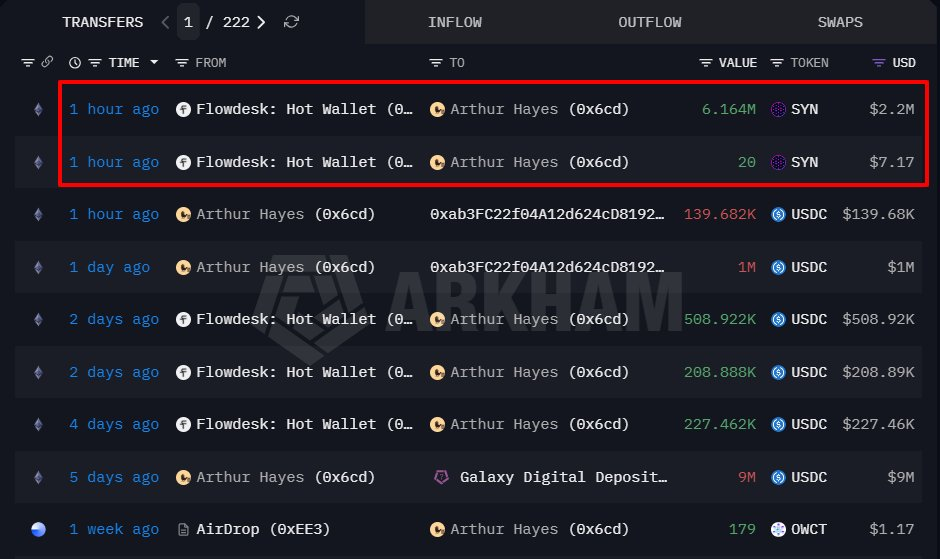


Subsequently, Arthur Hayes posted on the X platform stating that SYN is one of the most asymmetric investments he has seen since HYPE and explicitly declared, "Now is the time for options DEX to officially challenge Deribit, and Hypercall is that challenger."


Currently, SYN is trading at $0.436, up over 40% in 24 hours. Since June 2026, the price of SYN has experienced explosive growth, increasing more than 10x in a single month, with an FDV of approximately $110 million.


Synapse: From Cross-Chain Infrastructure to On-Chain Options


Synapse Protocol was established in 2021, initially positioning itself as a universal cross-chain messaging and liquidity network. It allows developers to transmit arbitrary data between different blockchains, including smart contract calls and NFTs, going beyond simple asset bridging.


Early on, Synapse gained a foothold in the multi-chain ecosystem with its cross-chain AMM liquidity pools and low-slippage stablecoin swaps. During the 2021-2022 bull market, its TVL once exceeded $1 billion, making it a major player in the cross-chain bridge sector alongside projects like Wormhole, LayerZero, and Axelar. However, the competition in cross-chain connectivity is fierce, and compounded by the bear market impact, the protocol's TVL declined significantly.
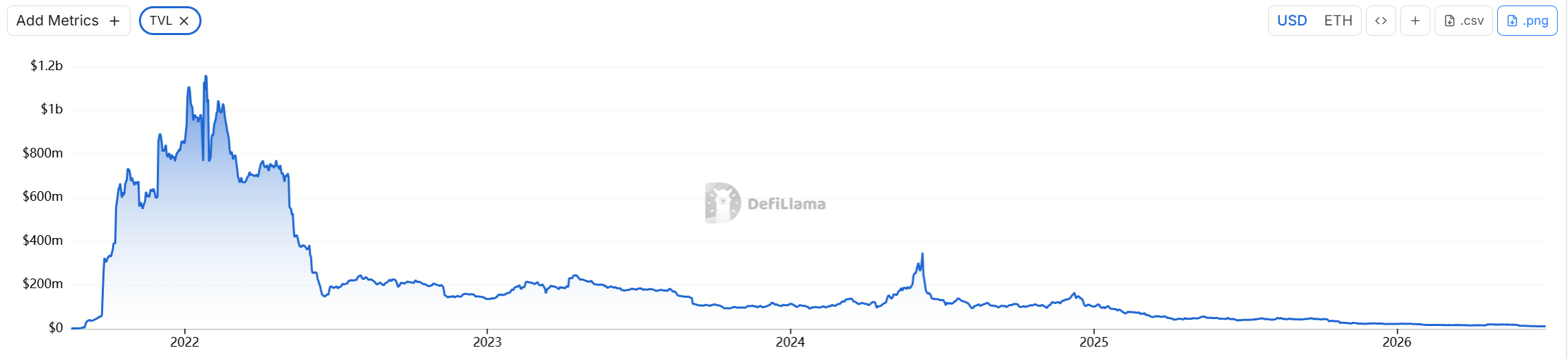


According to the latest data from DefiLlama, as of June 2026, Synapse TVL is approximately $11.1 million, primarily concentrated on chains like Ethereum and Canto.


The SYN token, serving as the governance token, reached a high of around $5 in October 2021 but has remained subdued for a long time since.


Hypercall is an on-chain options trading protocol built by the Synapse team, deployed on HyperEVM within the Hyperliquid ecosystem. Its core proposition is to create "an options exchange that can trade any asset."


Unlike traditional centralized options platforms or early on-chain options protocols, Hypercall's official documentation states it supports trading at any scale, with contracts divisible down to the dollar or up to million-dollar levels. Additionally, the maximum loss on an option is limited to the premium paid, with no liquidation or cascading liquidation risks. It also supports 24/7 trading.


Currently, Hypercall's Mainnet Alpha is live, allowing users to connect their wallets to trade SpaceX (SPCX) options. BTC puts and NVDA spreads have also appeared as available underlyings. The team previously claimed its product has processed over $55 billion in cumulative trading volume.


Deribit: The Centralized Options Dominator


Founded in 2016, Deribit has long held an absolute dominant position in the crypto options market. According to industry data, its market share in BTC and ETH options is around 85%, making it the preferred platform for institutional traders, market makers, and quantitative funds.


Currently, data from DeFiLlama shows its total asset value is $3.588 billion.
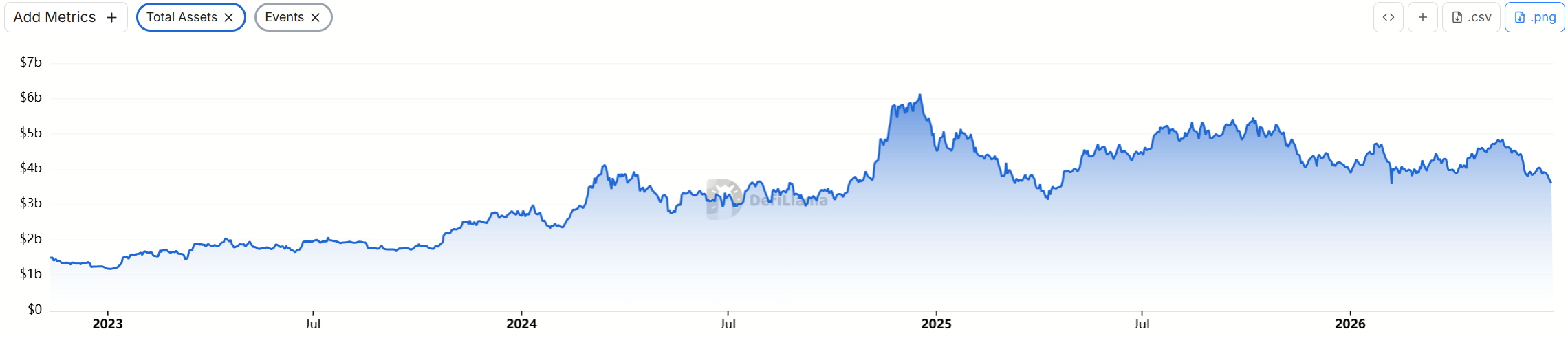


Deribit's advantages lie in its deep liquidity and professional tools: support for portfolio margin, block trading, and low-latency multicast data feeds. Furthermore, it has a long track record of stable operation. However, centralization brings inherent limitations: custodial risks, KYC barriers, regulatory uncertainty, and relative unfriendliness towards small retail users and DeFi natives. The complexity of options trading and the margin mechanism further amplify these pain points.


Arthur Hayes's call taps into the industry's core logic—as on-chain perpetual DEXs like Hyperliquid have demonstrated high performance, composability, and capital efficiency, the demand for on-chain options, as "precise tools for expressing volatility and direction," is accumulating.


Hypercall's potential advantages include: decentralization, permissionlessness, no KYC, and transparency. Moreover, deep integration with the Hyperliquid settlement layer promises a trading experience close to centralized platforms while retaining on-chain transparency. However, the protocol is still in its early Mainnet Alpha stage, with liquidity depth far inferior to Deribit. Initial underlying assets include SpaceX for testing; coverage of mainstream crypto options will take time. Historically, on-chain options protocols (like early versions of Hegic, Opyn) have made many attempts but often struggled to scale due to insufficient liquidity.


Deribit's network effects are difficult to replace in the short term. Hypercall is more likely to act as a "complement and differentiated competitor" rather than a direct replacement—especially in the DeFi-native and emerging asset (e.g., RWA, AI-related) options space.


What Game is the King of Shilling Playing?


Arthur Hayes's recent "shilling" track record shows significant divergence.


Previously, he was highly bullish on HYPE, predicting a price target as high as $150, but chose to liquidate all his HYPE holdings in early June. He also liquidated his holdings in previously shilled NEAR and WLD. On June 16 and 23, on-chain tracking data showed he repurchased a total of 91,000 HYPE tokens via an exchange.


On June 24, the release of a CARDS (Collector Crypt) in-depth research report by Arthur Hayes's family office, Maelstrom, also sparked controversy. The report set a price target of $4 by the end of summer.


Just 4 days later, CARDS's market cap had fallen approximately 22% since Maelstrom set the target price.


Currently, its price is $0.2437, with a market cap of $100 million and an FDV of $487 million.
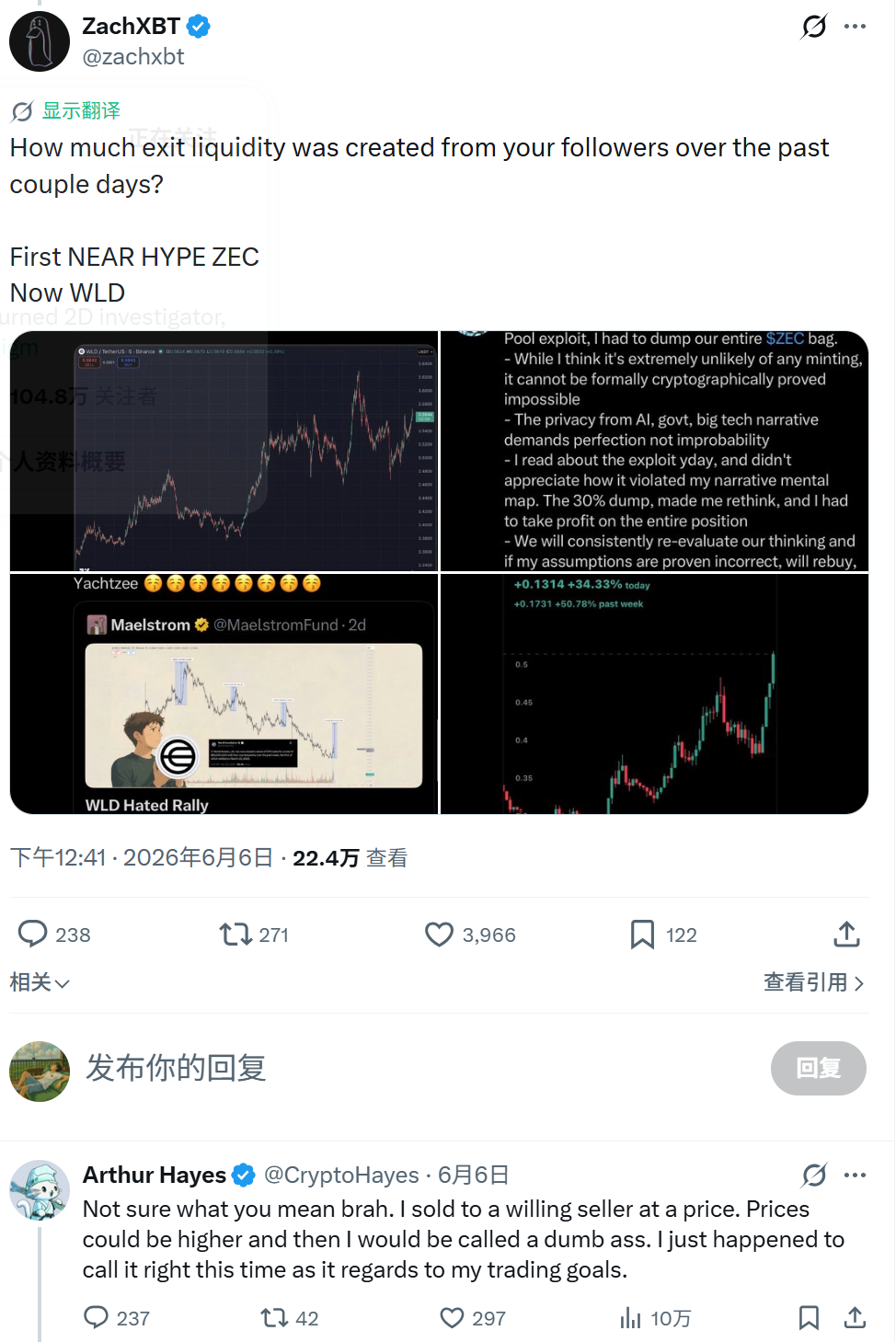


On-chain detective ZachXBT previously criticized Arthur Hayes on X, tweeting, "How much exit liquidity has your fanbase created for you over the last few days?" Arthur Hayes responded that he was just trading normally, prices can go up or down, and stated, "Happened to get this one right."


İlgili Sorular

QAccording to the article, what action did Arthur Hayes's associated address take on June 29th, and what was the reason given for this investment?

AArthur Hayes's associated address purchased approximately 6.16 million SYN tokens worth about $2.2 million via the OTC platform Flowdesk on June 29th. Hayes later stated on X that SYN was one of the most asymmetric investments he had seen since HYPE, explicitly saying it was time for an on-chain options DEX to challenge Deribit and that Hypercall was that challenger.

QWhat is the core historical business of the Synapse Protocol, and what new venture is the team currently focusing on with Hypercall?

ASynapse Protocol was originally founded in 2021 as a universal cross-chain messaging and liquidity network, allowing arbitrary data transfer between blockchains. The team is now focusing on Hypercall, an on-chain options trading protocol built on Hyperliquid's HyperEVM, which aims to be an exchange for trading options on any asset.

QWhat are the main advantages and current limitations of the Hypercall protocol compared to the established leader Deribit?

AHypercall's main advantages are its decentralization, permissionless and KYC-free nature, transparency, integration with the Hyperliquid settlement layer, and features like no forced liquidation. Its primary current limitations are its early Mainnet Alpha stage, significantly lower liquidity depth than Deribit, and initial coverage focused on test assets like SpaceX, with mainstream crypto options still needing time to develop.

QWhat recent criticism did Arthur Hayes face from the on-chain investigator ZachXBT, and how did Hayes respond?

AZachXBT criticized Arthur Hayes on X, asking how much exit liquidity his followers had created for him over the past few days due to his public calls. Hayes responded that he was just trading normally, that prices can go up or down, and that he 'just happened to be right this time.'

QWhat was the performance of the CARDS token after Arthur Hayes's Maelstrom family office published a research report with a price target?

AFour days after Maelstrom published a research report on June 24th setting a price target of $4 for CARDS by the end of summer, the token's market cap had fallen by approximately 22%.

İlgili Okumalar

In Jinjiang, Fujian, a Storage Super Unicorn Lies Quiet

In Fujian's Jinjiang, a city known for sportswear, lies a quiet semiconductor giant: Fujian Jinhua Integrated Circuit Co. (JHICC). Once a promising domestic DRAM manufacturer alongside Yangtze Memory and ChangXin Memory Technologies (CXMT), its journey was derailed in 2018 when the U.S. placed it on an Entity List and filed criminal charges for alleged trade secret theft. This halted production for years. A turning point came in February 2024 when a U.S. federal court found JHICC not guilty. However, it had lost crucial time. While CXMT soared to become a top-valued A-share company in 2024, JHICC, with an estimated valuation of 80 billion RMB, was just restarting. Its current output is primarily customized DDR4 chips, not the advanced DDR5/HBM demanded for AI, but it still benefits from the broader memory chip upcycle. JHICC's story is tied to Chen Zhengkun, a veteran engineer who left Micron to lead the venture. Founded in 2016 with state-backed funding, JHICC partnered with Taiwan's UMC to develop DRAM technology. Rapid progress was cut short by the U.S. actions, which Micron initiated, partly due to its heavy reliance on the Chinese market. Post-sanctions, Chen's team worked to rebuild the production line with reduced reliance on U.S. technology. According to its records, JHICC achieved small-scale production and revenue growth under immense pressure. It now focuses on the stable "niche" DRAM market (e.g., TVs, routers) with a monthly capacity of ~40,000 wafers, aiming for 60,000 by 2026. It holds over 1,000 patents but remains on the Entity List. For Jinjiang, investing in JHICC was a bold industrial leap. The local government provided unwavering financial and logistical support during the crisis, helping the company survive. JHICC has become the anchor for a growing local semiconductor cluster. Though its scale lags behind domestic peers, JHICC's persistence symbolizes a hard-won foothold in a global market long dominated by Samsung, SK Hynix, and Micron. Having missed one boom, it seeks a place in the new AI-driven memory supercycle.

marsbit37 dk önce

In Jinjiang, Fujian, a Storage Super Unicorn Lies Quiet

marsbit37 dk önce

Must-Watch Events Next Week|CLARITY Act Could Face Senate Vote; SpaceX, Circle to Report Earnings (8.3-8.9)

**Summary: Key Events and Developments to Watch (August 3-9)** The upcoming week is marked by significant financial disclosures, key legislative deadlines, and notable product updates. **Major Financial Events:** Several companies are scheduled to release their Q2 2026 earnings. American Bitcoin (ABTC) will report on August 3, followed by SpaceX and Hut 8 Mining Corp. on August 4, and Circle on August 5. Notably, a significant portion of SpaceX shares (up to 12% of total shares) will be unlocked on August 6 following their earnings release. **Key Legislative Deadline:** The U.S. Senate faces an August 7 deadline to secure 60 votes for the CLARITY Act, a bipartisan bill aiming to establish a federal regulatory framework for cryptocurrencies. The Senate may hold a full vote on the bill during the week. **Economic Data:** The U.S. July Non-Farm Payrolls report will be released on August 7, providing crucial labor market data. **Technology & Product Updates:** * **Shutdowns:** DeFi portfolio tracker Zapper and wallet app Ctrl Wallet will cease operations on August 3. * **Upgrades:** LayerZero will deprecate its v1 relayers on August 3. XRP Ledger's new version 3.3.0, featuring five new functions, is expected next week. * **AI:** Elon Musk announced that the advanced Grok 4.6 AI model is set for release around August 7. * **Bitcoin:** The BIP-110 forced signaling for a potential Bitcoin network change is scheduled to begin around August 8. **Other Notable Events:** Chinese robotics firm Unitree Tech has set its preliminary price inquiry for its IPO for August 5. South Korean exchange Upbit will delist AQT and AERGO tokens on August 3.

marsbit2 saat önce

Must-Watch Events Next Week|CLARITY Act Could Face Senate Vote; SpaceX, Circle to Report Earnings (8.3-8.9)

marsbit2 saat önce

İşlemler

Spot
活动图片




