‘Keep Going’: Justin Sun Drives Massive TRX Buy-Up; Will MAXI Follow the Tron-Led Rally?

bitcoinist2026-02-05 tarihinde yayınlandı2026-02-05 tarihinde güncellendi

Özet

Justin Sun's public endorsement of TRX buy-backs has triggered significant market activity, effectively decoupling TRX from Bitcoin’s volatility and signaling strong liquidity support. This defensive strategy often shifts investor appetite toward higher-risk, high-reward assets. One such beneficiary is Maxi Doge ($MAXI), a meme coin targeting leveraged trading culture. With a presale exceeding $4.5M and notable accumulations by large wallets, MAXI aims to engage traders through competitive features and staking rewards. The project positions itself as a speculative vehicle aligned with current market dynamics, appealing to those seeking outsized returns.

The crypto market is often dictated by subtle signals, but Justin Sun has never been one for subtlety.

When the Tron founder tweets ‘keep going’ regarding $TRX buy-backs, the market listens, not because of the sentiment, but because of the raw liquidity backing it. Recent on-chain movements suggest a coordinated effort to defend TRX price levels, effectively decoupling the asset from broader Bitcoin volatility.
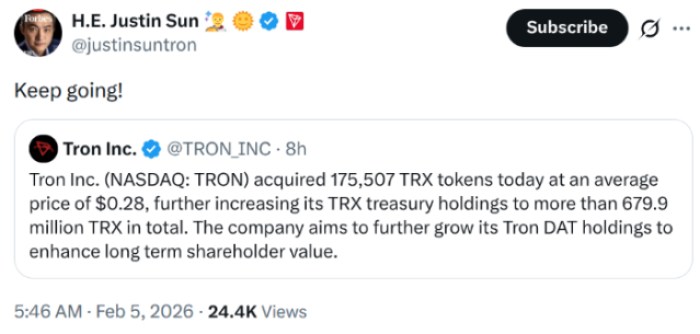
This isn’t just about price support; it’s a display of treasury dominance designed to signal strength in an otherwise choppy altcoin environment.

For traders, the implication is stark: liquidity is being artificially deepened. If history is any guide, when major ecosystem leaders like Tron stabilize, risk appetite doesn’t disappear; it rotates.

The capital preservation seen in large-cap alts often serves as a prelude to capital deployment in higher-beta sectors. Sun’s aggressive defense of the peg creates a safety net. And safety nets? They encourage speculators to look further out on the risk curve.

Usually, the beneficiary of this rotation is the meme coin sector, where ‘smart money’ moves to maximize the leverage effect of their gains. As liquidity cycles out of stabilized Layer-1s, it hunts for fresh narratives with explosive upside potential.

One such contender emerging from the noise is Maxi Doge ($MAXI), a project that explicitly targets the high-leverage trading culture that thrives in these exact market conditions. While Sun plays defense, MAXI is playing offense.

Maxi Doge Builds A ‘Leverage King’ Culture For ROI Hunters

While Tron focuses on infrastructural dominance, Maxi Doge is carving out a niche by addressing the psychological engine of the crypto market: the retail trader’s desire for outsized returns.

Most meme coins rely solely on viral imagery, but MAXI integrates the ‘gym-bro’ culture of ‘never skipping leg day’ with the high-stakes mentality of 1000x leverage trading. The project positions itself as a 240-lb canine juggernaut, a direct metaphor for the conviction required to hold through market volatility.
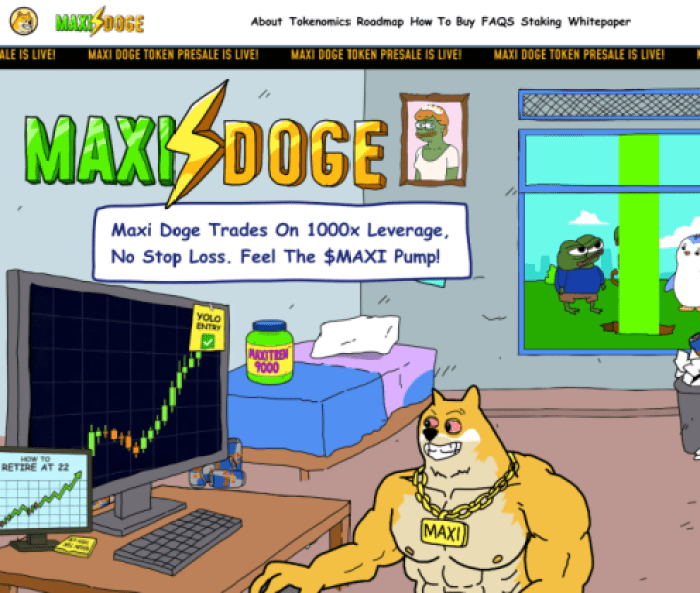

But can it actually deliver? This narrative is backed by functional utility designed to retain capital. The project plans to introduce holder-only trading competitions with leaderboard rewards, gamifying the trading experience in a way that static meme tokens can’t.

By creating a competition, Maxi Doge solves the issue of community engagement that plagues (and kills) many ERC-20 tokens post-launch. The ‘Maxi Fund’ treasury further supports this ecosystem, providing the liquidity needed for partnerships and future platform integrations.

The synergy here is notable. As established chains like Tron provide the rails for transaction volume, tokens like Maxi Doge provide the speculative vehicle that retail traders actually want to drive. The project’s ethos, ‘lift, trade, repeat,’ mirrors the grind of the current bull market, appealing to traders who find traditional spot trading too slow.

LEARN MORE ABOUT THE $MAXI PRESALE

Whales Accumulate $618K As MAXI Presale Breaches $4.5M

Smart money rarely waits for a project to launch on centralized exchanges before taking a position. Etherscan data reveals that two high-net-worth wallets recently accumulated 618K in Maxi Doge, with individual purchases of $314K and $314K.

This institutional-grade buying pressure has pushed the total funds raised to over $4.5M. It shows whales are positioning themselves before the token hits the open market liquidity pools.

The current presale price of $0.0002802 offers a specific entry point that these large holders seemingly view as undervalued relative to the project’s roadmap. Beyond the buy pressure, the tokenomics incentivize long-term alignment through a dynamic staking APY (current rewards sit at 68%.)

By allocating a dedicated pool of supply for daily automatic smart contract distribution, Maxi Doge encourages investors to lock their tokens rather than flip them immediately. This reduces circulating supply at launch, a critical factor for price appreciation in the volatile days following a Token Generation Event (TGE).

GET YOUR GAINZ WITH $MAXI

The content provided in this article is for informational purposes only and does not constitute financial advice. Cryptocurrency markets are highly volatile and carry significant risk. Always conduct your own due diligence before making any investment decisions.


Trend Kriptolar

İlgili Sorular

QWhat action did Justin Sun take regarding TRX, and what was the market's reaction?

AJustin Sun tweeted 'keep going' regarding TRX buy-backs, and the market reacted due to the significant liquidity backing this move, with on-chain data suggesting a coordinated effort to defend TRX's price levels.

QAccording to the article, what is a common beneficiary when liquidity rotates out of stabilized Layer-1s like Tron?

AThe meme coin sector is often the beneficiary, as liquidity hunts for fresh narratives with explosive upside potential, such as projects like Maxi Doge ($MAXI).

QHow does Maxi Doge ($MAXI) aim to differentiate itself from typical meme coins?

AMaxi Doge integrates the 'gym-bro' culture with high-stakes leverage trading, plans holder-only trading competitions with rewards, and has a treasury (Maxi Fund) to support ecosystem growth, aiming for functional utility beyond just viral imagery.

QWhat evidence does the article provide to show institutional interest in Maxi Doge during its presale?

AEtherscan data shows two high-net-worth wallets accumulated $618K in MAXI (with individual purchases of $314K each), helping push the total presale funds raised to over $4.5M.

QWhat mechanism does Maxi Doge use to encourage long-term holding and reduce immediate selling pressure at launch?

AIt offers a dynamic staking APY (currently 68%) with daily automatic smart contract distributions, incentivizing investors to lock their tokens and reduce circulating supply post-launch.

İlgili Okumalar

Agent Race Ends, Super Workbench Takes Over

The era of fragmented AI agents is ending. Over the past month, China's tech giants—Tencent, Alibaba, and ByteDance—have simultaneously shifted strategy: instead of launching new, standalone AI agents, they are consolidating their various agent projects into unified "super workbenches." Tencent integrated its QClaw teams into WorkBuddy, a strategic product hailed as a potential third flagship after QQ and WeChat. Alibaba is merging its QoderWork, Wukong, and MuleRun agents into a new "Qianwen Office" platform under DingTalk's leadership. ByteDance rebranded its TRAE SOLO coding agent to TRAE Work, signaling a broader focus on workflow collaboration. This convergence marks a pivotal industry consensus. The initial exploration phase, where companies rapidly built numerous overlapping agents for different scenarios, proved costly and inefficient. With open-source tools eroding technical barriers, competition has shifted from agent creation to resource consolidation and cost control. Historically, platform wars are won not by creating more products, but by simplifying them—as seen with browsers unifying web access and super-apps consolidating services. Now, the "super workbench" aims to become the unified AI entry point for work. This reflects a deeper market realization: the primary audience for AI is no longer just programmers (a market in the tens of millions) but all knowledge workers (a market of billions). The real opportunity lies in augmenting everyday tasks—managing emails, documents, data, and meetings—across the entire workday. The core battleground is becoming control over the primary AI entry point that employees use daily. Tencent's WorkBuddy leverages WeChat and Tencent Docs; Alibaba's Qianwen Office taps into DingTalk's organizational data; ByteDance's TRAE Work integrates with Feishu's workflows. Whoever owns this "super workbench" gains strategic control over orchestrating enterprise data and APIs. This shift is redefining enterprise software. Traditional SaaS applications, valued for their user interfaces, will recede into the background. Their core functionalities will be exposed as standardized "Skills" or APIs for the super workbench's agents to invoke. Software value will shift from selling user seats to charging based on API calls and outcomes delivered. The evolution of agents is moving through clear stages: first as novel standalone products, then as consolidated primary work entry points, and finally as pervasive, invisible capabilities embedded into the digital fabric. The recent moves by major tech firms signal the transition from the first stage into the second, accelerating toward the third. In the end, the most successful agent technology may become invisible—like electricity or the HTTP protocol—a fundamental, unnamed infrastructure powering work itself.

marsbit8 dk önce

Agent Race Ends, Super Workbench Takes Over

marsbit8 dk önce

Michael Saylor: 110 Reasons to Oppose BIP-110

Michael Saylor presents 110 arguments against Bitcoin Improvement Proposal (BIP) 110, a soft fork aimed at restricting certain non-monetary data storage uses (like inscriptions) on the Bitcoin blockchain. He acknowledges the proponents' valid concerns—such as node costs, fee pressure, and preserving Bitcoin's monetary focus—but fundamentally disagrees with the proposed solution. Saylor argues that BIP 110 represents a dangerous precedent of using consensus rules to enforce value judgments on transaction validity, moving away from Bitcoin's core principles of neutrality and permissionless innovation. His key objections are organized into eleven categories: 1) It violates neutrality and hard consensus by banning currently valid transactions. 2) It fails to meet the high burden of proof required for a consensus change, lacking concrete data on the alleged crisis. 3) Its seven bundled technical restrictions are overly broad, targeting generic script functionalities and blocking future upgrade paths. 4) It sacrifices compatibility and future optionality by closing off designed upgrade hooks. 5) Its temporary rules add significant complexity (grandfathering, expiry states) without sufficient justification. 6) The economic and security impacts, particularly on miner revenue and fee markets, are uncertain and unmodeled. 7) Superior, market-based tools (fee markets, relay/mining policies) already exist to manage blockchain load. 8) It stifles innovation by creating a chilling effect for developers. 9) Its modified activation mechanism (55% threshold, forced signaling) is aggressive and risks network splits. 10) The precedent it sets—using consensus to suppress disliked but legal uses—is more dangerous than the problem it aims to solve. 11) A better path exists: improving measurements, refining resource-based policies, and allowing market forces to work. Saylor concludes that Bitcoin's strength lies in its neutral rules, open markets, and hard consensus. Changing these foundational elements to target specific use cases is an unnecessary and risky "iatrogenic" intervention. He advocates for guarding Bitcoin's neutrality rather than acting as its redeemer.

marsbit23 dk önce

Michael Saylor: 110 Reasons to Oppose BIP-110

marsbit23 dk önce

İşlemler

Spot

Popüler Makaleler

SUN Nasıl Satın Alınır

HTX.com’a hoş geldiniz! SUN (SUN) satın alma işlemlerini basit ve kullanışlı bir hâle getirdik. Adım adım açıkladığımız rehberimizi takip ederek kripto yolculuğunuza başlayın. 1. Adım: HTX Hesabınızı OluşturunHTX'te ücretsiz bir hesap açmak için e-posta adresinizi veya telefon numaranızı kullanın. Sorunsuzca kaydolun ve tüm özelliklerin kilidini açın. Hesabımı Aç2. Adım: Kripto Satın Al Bölümüne Gidin ve Ödeme Yönteminizi SeçinKredi/Banka Kartı: Visa veya Mastercard'ınızı kullanarak anında SUN (SUN) satın alın.Bakiye: Sorunsuz bir şekilde işlem yapmak için HTX hesap bakiyenizdeki fonları kullanın.Üçüncü Taraflar: Kullanımı kolaylaştırmak için Google Pay ve Apple Pay gibi popüler ödeme yöntemlerini ekledik.P2P: HTX'teki diğer kullanıcılarla doğrudan işlem yapın.Borsa Dışı (OTC): Yatırımcılar için kişiye özel hizmetler ve rekabetçi döviz kurları sunuyoruz.3. Adım: SUN (SUN) Varlıklarınızı SaklayınSUN (SUN) satın aldıktan sonra HTX hesabınızda saklayın. Alternatif olarak, blok zinciri transferi yoluyla başka bir yere gönderebilir veya diğer kripto para birimlerini takas etmek için kullanabilirsiniz.4. Adım: SUN (SUN) Varlıklarınızla İşlem YapınHTX'in spot piyasasında SUN (SUN) ile kolayca işlemler yapın.Hesabınıza erişin, işlem çiftinizi seçin, işlemlerinizi gerçekleştirin ve gerçek zamanlı olarak izleyin. Hem yeni başlayanlar hem de deneyimli yatırımcılar için kullanıcı dostu bir deneyim sunuyoruz.

673 Toplam GörüntülenmeYayınlanma 2024.12.12Güncellenme 2025.03.21

SUN Nasıl Satın Alınır

Tartışmalar

HTX Topluluğuna hoş geldiniz. Burada, en son platform gelişmeleri hakkında bilgi sahibi olabilir ve profesyonel piyasa görüşlerine erişebilirsiniz. Kullanıcıların SUN (SUN) fiyatı hakkındaki görüşleri aşağıda sunulmaktadır.

活动图片









