Kalshi Trading Volume Continues to Break Records, What Is the Reasonable Pre-Market Stock Price?

marsbit2026-02-11 tarihinde yayınlandı2026-02-11 tarihinde güncellendi

Özet

Amidst a declining crypto market, prediction markets have emerged as a standout sector. Kalshi, the largest regulated prediction market platform in the U.S., reached a record monthly trading volume exceeding $9.5 billion in January, sparking renewed interest in its pre-IPO stock pricing. Current pre-IPO share prices for Kalshi show significant discrepancies across platforms. On PreStocks, prices are around $369 (implied market cap) and $364 (capitalization-based). In contrast, Jarsy lists a price of approximately $504 per share. Meanwhile, traditional financial markets like Nasdaq Private Market and Hiive show prices around $320 and $358, respectively. Kalshi completed a Series E funding round last year at an $11 billion valuation. Based on this, a reasonable pre-IPO share price range is estimated to be $320–$358. However, considering its surging trading volume and a projected market capitalization of at least $15 billion, a more optimistic price range of $358–$423 is plausible. This suggests Jarsy's current pricing may be high, while PreStocks might present an arbitrage opportunity. With major sporting events in 6 expected to boost activity, Kalshi's annual revenue potential is significant, potentially exceeding earlier estimates for competitor Polymarket, which could further drive up its pre-IPO valuation.

Original|Odaily Planet Daily(@OdailyChina)

Author|Wenser(@wenser 2010)

During the market downturn, prediction markets have become the most eye-catching sector in the crypto market. In early February, when the market plummeted, BTC and ETH once fell by more than 10%, but prediction market trading remained active, with weekly transactions reaching 26.39 million, a record high. At the same time, as the largest compliant prediction market platform in the United States, Kalshi also surged to the top of the sector with over $9.5 billion in trading volume in January, setting a new historical high for monthly trading volume. This has led to a new round of market pricing for Kalshi's pre-market stock.

Today, the question we are discussing is—what should be the reasonable price range for the pre-market stock of Kalshi, which is expected to become the "first stock in the prediction market"?

Overview of Current Pricing on Tokenized Stock Trading Platforms: PreStocks, Jarsy

As of the time of writing, there is a significant price difference for Kalshi's pre-market stock on two major tokenized stock trading platforms:

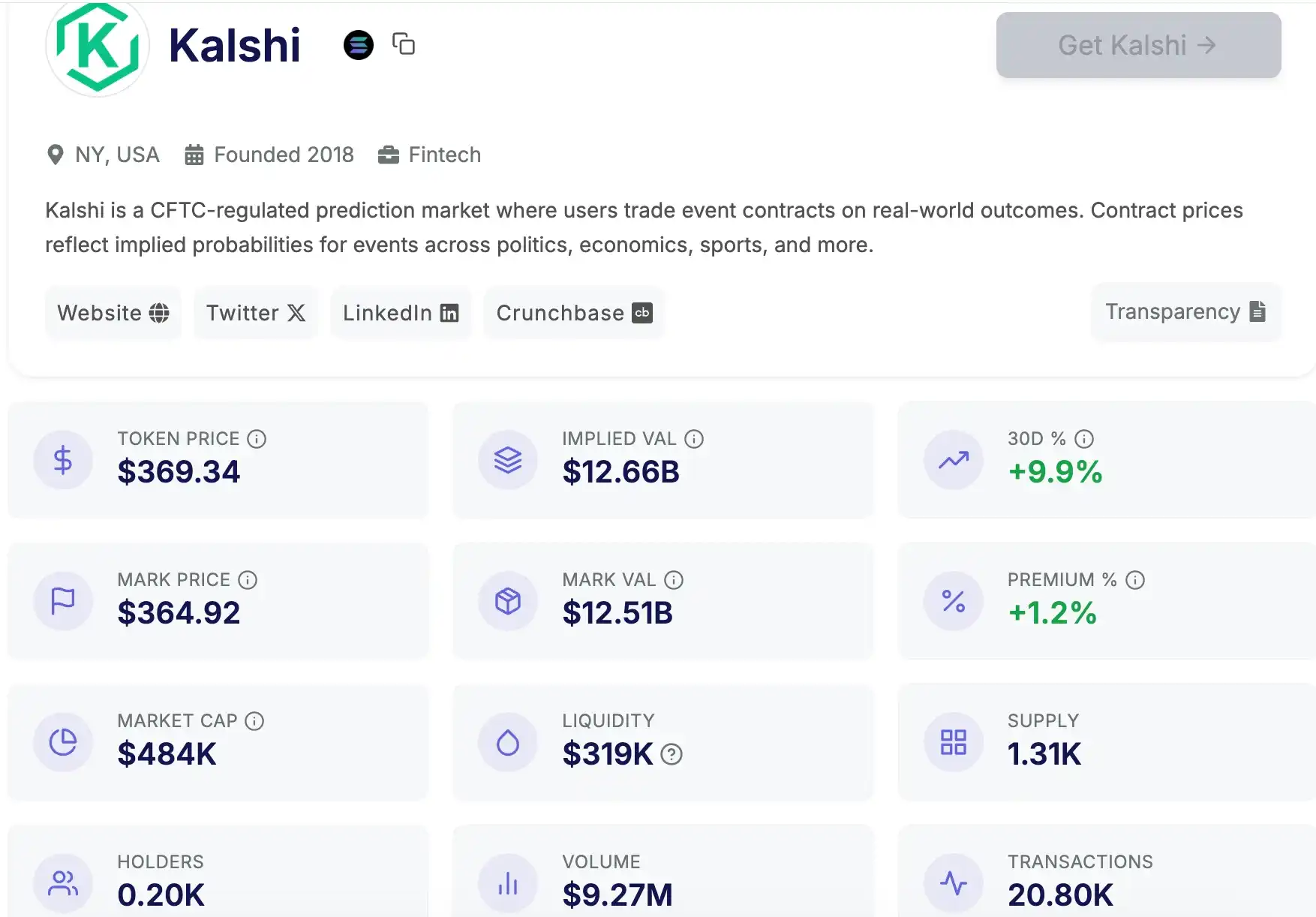
On the PreStocks platform, the pre-market pricing for Kalshi stock includes two prices—

One price is the token price under the implied market capitalization (market liquidity pricing level), with a per-share price of around $369;

The other price is the marked price under the capital market capitalization (existing financing pricing level), with a per-share price of around $364.
On the Jarsy platform, the pre-market per-share price for Kalshi has already risen to around $504.

It is worth mentioning that compared to the time when we previously wrote the article "Kalshi's Pre-Market Stock Price Soars, Is It Still Worth Buying Now?", the pre-market prices for Kalshi stock on both platforms have experienced varying degrees of increases and decreases. The price situation at that time was as follows:

  • On PreStocks, Kalshi's implied market capitalization was approximately $14 billion, with a per-share price of around $407;
  • On Jarsy, Kalshi's market valuation was $11 billion, with a per-share price of $450.

In other words, the price on the PreStocks platform dropped from $407 to around $369; while the price on the Jarsy platform rose from $450 to around $504.

For comparison, the pre-market pricing for Kalshi stock in traditional financial markets has also changed—

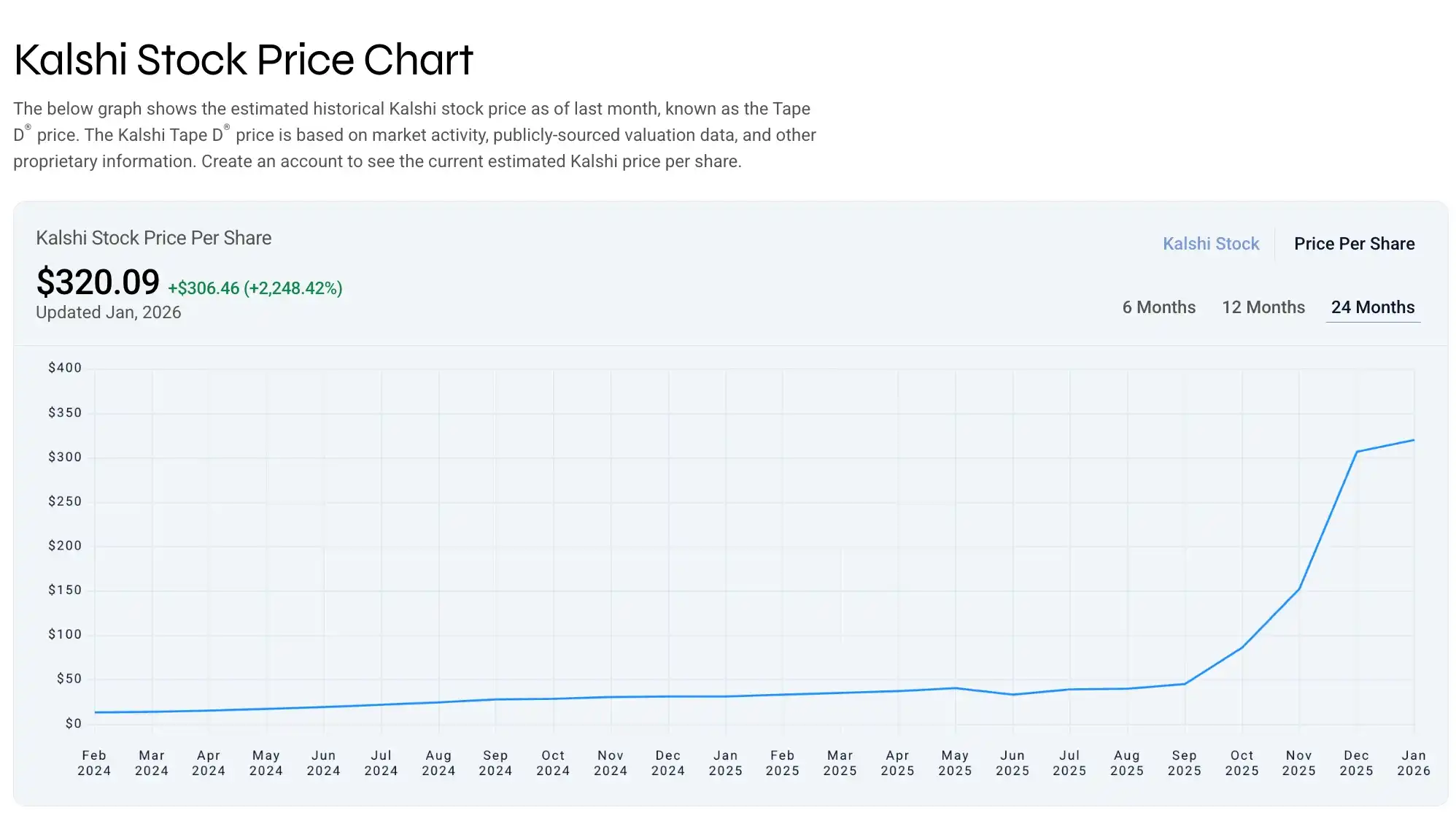
  • On Nasdaq Private Market, Kalshi's per-share price rose from around $307 to around $320;
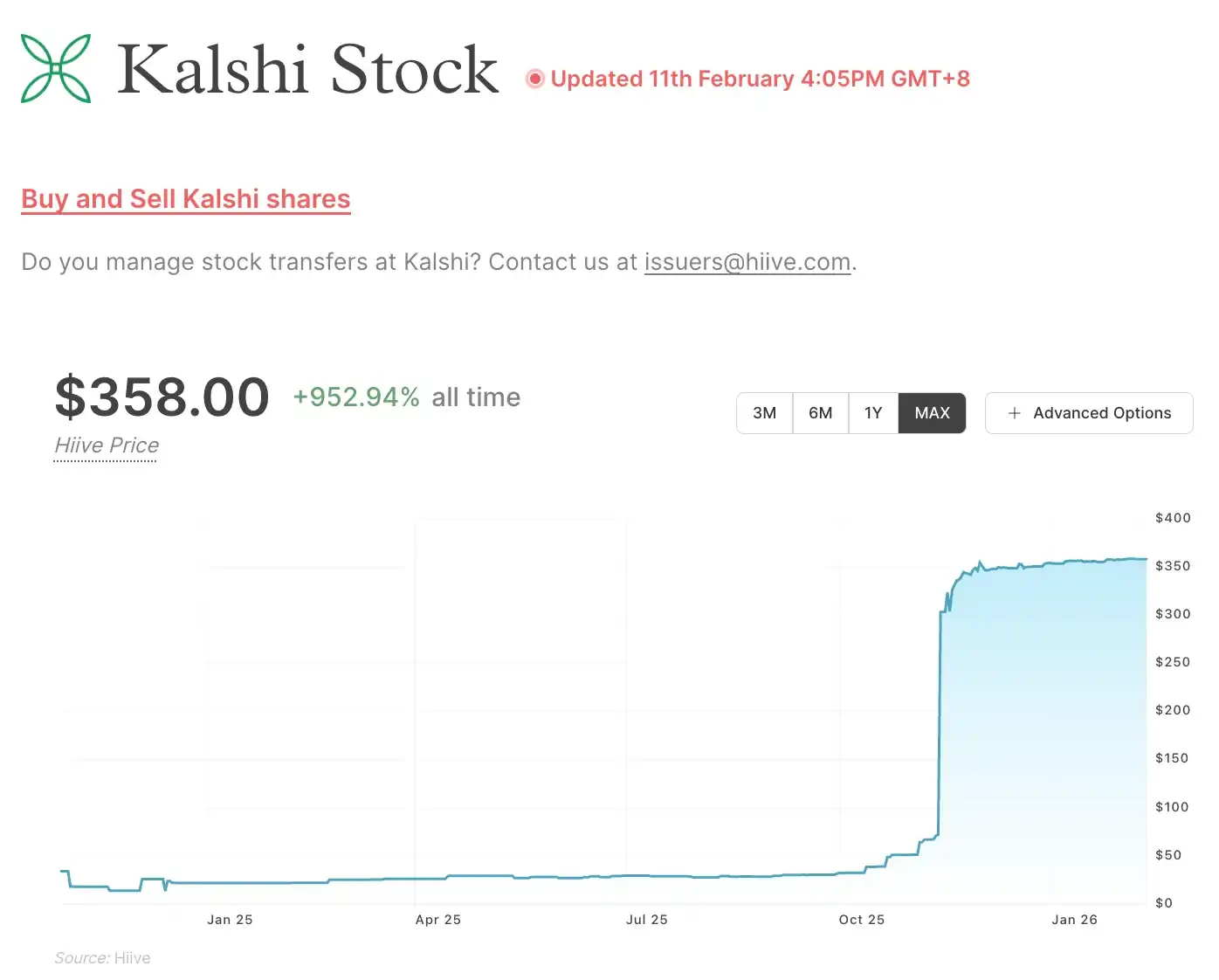
  • On Hiive, Kalshi's per-share price increased by $1 from around $357 to around $358.
Reasonable Pre-Market Pricing Range for Kalshi Stock: Around $320~$423

Last year, Kalshi completed a $1 billion Series E financing round with a valuation of $11 billion.

Based on the market capitalization and corresponding stock prices mentioned above, the number of Kalshi shares is approximately between 30.72 million and 34.30 million.

Specifically, the number of shares is calculated as follows—
Based on a $11 billion market capitalization corresponding to the traditional financial market pre-market prices of $320 and $358, the number of Kalshi shares is approximately 30.72 million to 34.37 million;
Based on the implied market capitalization/token price and capital market capitalization/marked price on the PreStocks platform, the number of Kalshi shares is approximately 34.27 million to 34.30 million;
Based on the pre-market purchase price per share on the Jarsy platform, Kalshi's market capitalization is capped at $18.665 billion, with a per-share price of $604.84, and the number of shares is approximately 30.86 million.

Based on the above information, we can make the following deductions:

First, based on the $11 billion valuation, the reasonable pre-market pricing range for Kalshi stock is approximately $320-$358. In other words, the current pricing on crypto market tokenized stock trading platforms such as PreStocks and Jarsy is relatively high;

Second, Kalshi's trading volume in January reached $9.5 billion, close to the overall prediction market size of about $10 billion in October last year; in October last year, its market share was about 50% of the prediction market. From this perspective, Kalshi's current capital market valuation is at least above $15 billion.

Third, based on a $15 billion valuation and combined with data such as the range of Kalshi's share count, the pre-market pricing range for Kalshi stock is approximately $436~$488.

Thus, if the number of Kalshi shares meets expectations, and under the premise of a $15 billion implied market capitalization, conservatively estimated, the reasonable pre-market pricing range for Kalshi stock may be $320~$378 (calculated based on the average of the lowest prices in the pricing range); optimistically estimated, the reasonable pre-market pricing range for Kalshi stock may be $358~$423 (calculated based on the average of the highest prices in the pricing range).

Based on the above data conclusions, the pre-market pricing for Kalshi stock on the Jarsy platform is relatively high, while the PreStocks platform offers some arbitrage opportunities.

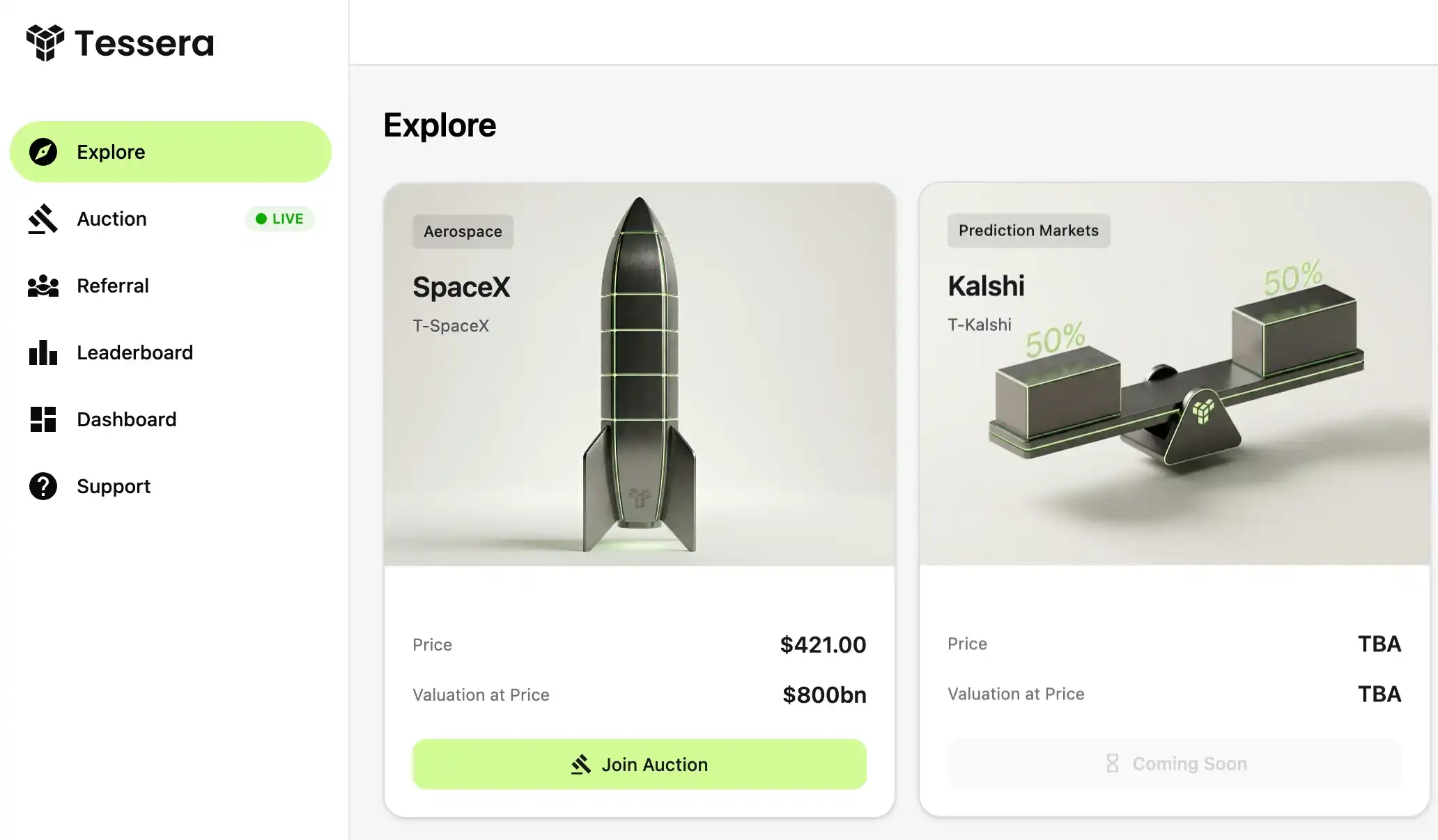
In addition, the latest tokenized stock trading platform, Tessera, plans to open equity public offerings in the future, which readers can also consider as an alternative reference (invitation code can be found here).
Combined with the relevant information mentioned in the previously published article by Odaily Planet Daily, "Data Calculation Shows Polymarket's Annual Revenue Exceeding $100 Million Is Not Difficult, Provided That...":

Based on a static calculation of the trading volume and fee ratio in the "15-minute cryptocurrency rise and fall" market on Polymarket, under the current trading volume level and structure, if Polymarket introduces a similar fee model in all markets, it is expected to generate $418 million in annual revenue for the platform.

As a prediction market platform with larger trading volume and higher fees, and taking advantage of the timing of the major sports year in 2026, Kalshi's annual revenue is expected to exceed this estimated revenue of Polymarket. From this perspective, the capital market may further raise the pre-market pricing of Kalshi stock in the future.


İlgili Sorular

QWhat is the current pre-market stock price range for Kalshi on PreStocks and Jarsy platforms?

AOn PreStocks, the pre-market stock price for Kalshi is around $369 (implied market cap) and $364 (capital market cap). On Jarsy, the pre-market price is around $504.

QWhat was the valuation of Kalshi after its Series E funding round last year?

AKalshi completed a $1 billion Series E funding round last year, valuing the company at $11 billion.

QWhat is the estimated reasonable pre-market stock price range for Kalshi based on a $11 billion valuation?

ABased on a $11 billion valuation, the estimated reasonable pre-market stock price range for Kalshi is approximately $320 to $358.

QWhat is the optimistic estimated pre-market stock price range for Kalshi if its implied market cap reaches $15 billion?

AIf Kalshi's implied market cap reaches $15 billion, the optimistic estimated pre-market stock price range is approximately $358 to $423.

QHow does the article suggest Kalshi's future annual revenue might compare to Polymarket's estimated revenue?

AThe article suggests that Kalshi's annual revenue is expected to surpass Polymarket's estimated $418 million annual revenue, especially with the advantage of the 2026 major sports year.

İlgili Okumalar

How to Automate Any Workflow with Claude Skills (Complete Tutorial)

This is a comprehensive guide to mastering Claude Skills, a feature for creating permanent, reusable instruction sets that automate specific workflows. Unlike simple saved prompts, Skills function like trained employees, delivering consistent, high-quality outputs by defining the entire task process, standards, error handling, and output format. The guide is structured in four phases: **Phase 1: Installation (5 minutes).** Skills are folders containing a `SKILL.md` file. The user is instructed to find a relevant Skill online, install it, test it on a real task, and compare its performance to one-off prompts. **Phase 2: Building Your First Custom Skill.** Start by rigorously defining the Skill's purpose, trigger phrases, and providing a concrete example of perfect output. The `SKILL.md` file has two parts: a YAML frontmatter with a specific name/description/triggers, and a detailed, step-by-step workflow written in natural language with examples and quality standards. **Phase 3: Testing & Optimization for Production.** Test the Skill in three scenarios: 1) a standard, common task; 2) edge cases with missing or conflicting data; and 3) a pressure test with maximum complexity. Any failure indicates a needed instruction. Implement a weekly optimization cycle to continuously refine the Skill based on real usage. **Phase 4: Building a Complete Skill Library.** The goal is to create a team of Skills for all repetitive tasks. Examples are given for industries like real estate, marketing, finance, consulting, and e-commerce. The user should list their tasks, prioritize them, and build one new Skill per week, maintaining a master document to track their library. The conclusion emphasizes the compounding time savings: ten Skills saving 30 minutes each per week reclaims over 260 hours (6.5 work weeks) per year, fundamentally transforming one's work system.

marsbit19 dk önce

How to Automate Any Workflow with Claude Skills (Complete Tutorial)

marsbit19 dk önce

Dialogue with Vitalik, Xiao Feng, Aya Miyaguchi, and Joseph Chalom: From the 'Subtraction Principle' to the Agent Economy

Conversation with Vitalik Buterin, Xiao Feng, Aya Miyaguchi, and Joseph Chalom: Highlights from the Ethereum Application Summit on key future directions. Vitalik Buterin discussed the concept of "Full Stack Open Source Security," extending security from the protocol to hardware layers like wallets and chips. He predicted AI will simplify blockchain interaction, enabling natural language commands for complex operations. He emphasized that Ethereum's future focus should be on security, decentralization, and trustless infrastructure—the areas where it holds its core competitive edge. The fusion of AI, Fully Homomorphic Encryption (FHE), and blockchain is seen as crucial for real-world applications requiring privacy, such as healthcare. Xiao Feng underscored the importance of simplifying technology for mass adoption. He drew parallels to the evolution from command lines to GUIs and apps, suggesting that AI-driven natural language interfaces will be key to bringing more users into Web3. He stressed that while performance is important, Ethereum must continue to uphold its foundational principles of decentralization and user sovereignty. Aya Miyaguchi, Chair of the Ethereum Foundation, explained the evolving role of the Foundation through the "Principle of Subtraction." As the ecosystem matures, the EF is stepping back from areas where the community can take the lead, acting as one of many "gardeners" rather than a central driver. She highlighted that real applications are built on Ethereum's core values: censorship resistance, open source, security, and privacy. The concept of "Local-first" initiatives, like the Ethereum Applications Guild (EAG), was also emphasized for leveraging regional strengths to create global impact. Joseph Chalom, CEO of SharpLink, positioned Ethereum as the future infrastructure for global capital markets, differentiating it from Bitcoin through its "productivity" via staking yields. He envisioned the rise of an "Agent Economy" by 2027, where AI agents, powered by Web3 wallets, will autonomously manage financial tasks like yield optimization and RWA investments. The summit concluded that with core infrastructure maturing, the application layer is now the key driver for Ethereum's next phase of growth and real-world adoption.

marsbit21 dk önce

Dialogue with Vitalik, Xiao Feng, Aya Miyaguchi, and Joseph Chalom: From the 'Subtraction Principle' to the Agent Economy

marsbit21 dk önce

Cerebras IPO: A $48.8 Billion Valuation—Is the 'Nvidia Challenger' a Bubble or a New King?

Cerebras Systems, positioning itself as an NVIDIA challenger, is going public with a $48.8 billion valuation despite several underlying paradoxes revealed in its S-1 filing. While 2025 revenue grew 76% to $510M and GAAP net income was $237.8M, this profitability relies heavily on a one-time, non-cash accounting gain. Adjusting for this, the company's non-GAAP net loss actually widened to $75.7M. Furthermore, customer concentration remains extreme: 86% of 2025 revenue came from two Abu Dhabi-based entities, MBZUAI (62%) and G42 (24%). Its landmark deal with OpenAI, valued at over $20 billion, creates a complex, nested relationship where OpenAI is simultaneously a major customer, lender, warrant holder, and strategic partner with exclusivity clauses. Cerebras's technical edge in latency-sensitive AI inference is real, with its wafer-scale chip outperforming competitors in benchmarks. However, this advantage is confined to a specific niche, not the broader AI training market dominated by NVIDIA's CUDA ecosystem. With a 95x price-to-sales ratio, the valuation demands flawless execution of the OpenAI contract and massive future revenue growth. Key long-term risks include intense competition from giants like NVIDIA and AMD, a dual-class share structure granting insiders near-total voting control, and ongoing geopolitical uncertainties regarding export controls. The IPO is a pivotal capital markets event for AI infrastructure. As an investment, it represents a high-risk, high-reward bet on the "inference-first" narrative and Cerebras's ability to dominate its specialized segment, underpinned by a valuation that highlights the current fervor in the sector.

marsbit1 saat önce

Cerebras IPO: A $48.8 Billion Valuation—Is the 'Nvidia Challenger' a Bubble or a New King?

marsbit1 saat önce

İşlemler

Spot
Futures
活动图片