Original | Odaily Planet Daily (@OdailyChina)
Author | Asher (@Asher_ 0210)

Your X feed might once again be flooded with 'Talk-to-Earn' projects.
On August 18, Kaito AI announced the launch of its browser plugin Kaito Pulse, further binding users' discussion behavior on X, on-chain activities, and social influence. Simultaneously, Kaito revealed its first post-relaunch partnership with Axis Robotics, reigniting the incentive model centered around content creators and community contributors.
Unlike the simple content incentives previously centered around Yaps, Kaito's aim this time is not merely 'rewarding posts' but establishing a new scoring system based on 'attention + behavior verification.'
What is Kaito Pulse?
Kaito Pulse is a browser plugin launched by Kaito, designed to overlay more 'on-chain identity' information onto the X timeline. This allows users to not only see the opinions expressed by an X account but also understand the real market actions behind it.
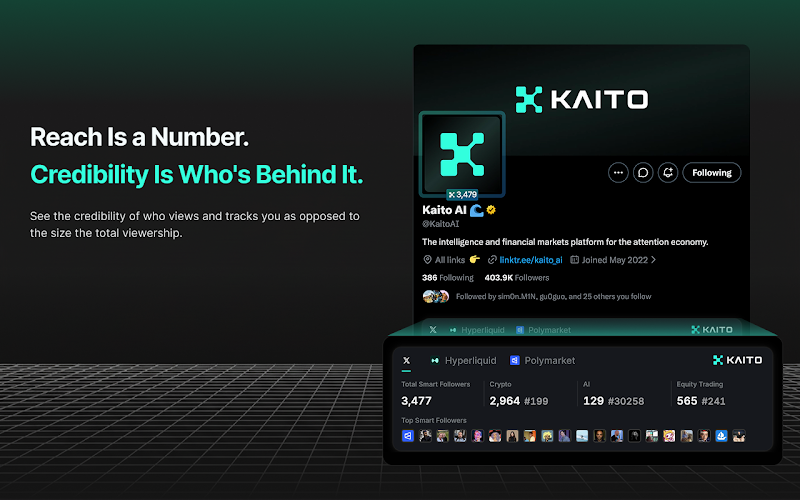
After installing the plugin, users can directly view other users' on-chain activity information within the X timeline, including public trading positions from platforms like Polymarket and Hyperliquid, to better assess whether an account's views align with its actual actions.
By combining social influence with on-chain behavior, Kaito hopes to transform X from a simple information dissemination platform into a social layer that integrates 'opinions, identity, and trading behavior.'
This also represents an upgrade from Yaps to Pulse for Kaito.
Previously, Kaito primarily tracked discussion heat around crypto on X, building content influence leaderboards and incentivizing user participation with KAITO tokens. However, as numerous accounts began mass-producing content, the limitations of measuring influence solely based on discussion volume became increasingly apparent. Therefore, Pulse further incorporates dimensions like content influence, community interaction, and on-chain behavior verification, while introducing a new scoring system called Aura to measure user influence and verified on-chain actions.
Previously, Kaito focused on who generated the most discussion; now, Kaito is more concerned with whose discussion is worth trusting.
Plugin's Excessive Permissions Spark 'Data Collection' Controversy Upon Launch
The launch of Kaito Pulse sparked heated community discussions, with many believing that as market conditions warm up, a new wave of 'Talk-to-Earn economy' is imminent. However, Kaito Pulse also quickly ignited debates within the community regarding privacy and permission overreach.
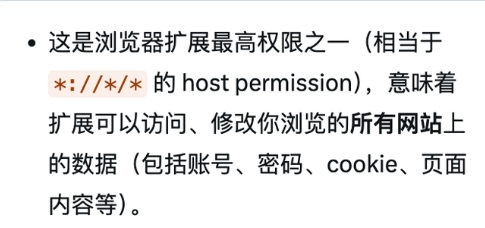
Kaito Pulse Plugin Accused of Multiple Deep Data Collection Behaviors
Ultra posted on X, stating that an analysis of the Pulse plugin code revealed potential involvement in multiple data collection activities, including device fingerprinting, X platform behavior tracking, and third-party account verification.
Among these, device identification is the most concerning issue. Ultra claimed that Kaito Pulse might generate a device fingerprint using information like GPU rendering results, hardware model, and hardware test audio, and link this information to X accounts, affecting anonymity in scenarios involving multi-account users and community matrix accounts.
Besides device information, Ultra also questioned the scope of Kaito Pulse's collection of user X behavior data. The plugin might record certain user behaviors on the X platform, including browsing paths, content dwell time, click behavior, and follow status, and use periodic requests to determine user activity status.
Additionally, third-party account verification is another point of contention. Ultra pointed out that Pulse involves verification processes for ChatGPT, Claude, and multiple trading platform accounts, suggesting these processes might access sensitive user data like subscription status, usage quotas, and trading account information.
Community Divide: Verifying Authenticity or Sacrificing Privacy?
During the Yaps era, Kaito primarily measured influence based on discussion heat on X. However, as mass content production by numerous accounts became more common, the community gradually raised a question: Does high heat equal real influence?
By adding more dimensions like on-chain behavior and external account verification, Kaito Pulse aims to reduce the room for users to gain rankings solely through posting and interaction, making the influence score closer to users' real contributions.
But more verification mechanisms also mean users need to grant more data permissions. Consequently, the community has formed two different views on Kaito Pulse:
- Supporters argue that a major issue in InfoFi is artificial inflation and false influence, and only by adding identity and behavior verification can a more credible incentive system be built;
- Skeptics believe platforms should not infinitely expand data collection scope just to improve scoring accuracy, and a new balance must be found between user privacy and incentive rewards.
Official Response to Privacy Controversy: Kaito Pulse Does Not Collect User Raw Data
In response to community skepticism, Kaito founder Yu Hu subsequently addressed the concerns.
Yu Hu stated that Kaito Pulse is designed with the principle of data minimization. The product's goal is not to collect user data but to prove certain identities or behaviors through verification mechanisms under active user authorization.
Regarding concerns about account information, Kaito Pulse does not obtain complete account contents from users nor does it save user raw data. The related processes are mainly used to generate verification results; the platform receives proof information, not the underlying user data.
Addressing the controversy over external account verification, Kaito Pulse uses verification technologies including zkTLS, aiming to allow users to prove they possess certain off-chain identities or behavioral records without exposing raw data.
Simultaneously, Yu Hu acknowledged that the presentation scope of certain permissions might be prone to misunderstanding, and future versions will further optimize permission descriptions and user prompts.
The Next Step for 'Talk-to-Earn Economy': Verifying Influence or Surrendering Privacy?
The debate sparked by Kaito Pulse essentially touches on the unavoidable data dilemma within the InfoFi sector.
In the past, platforms judged an account's value mainly based on follower count, interaction data, and content popularity. However, with the increasing prevalence of AI-generated content, batch accounts, and matrix operations, simple 'discussion volume' has become an increasingly unreliable proxy for genuine influence.
Therefore, Kaito attempts to introduce more verification dimensions, and controversy has followed suit—as platforms seek to further prove 'who you are' and 'whether your views are credible,' the information users need to provide also increases.
For users, installing the plugin to participate in the next wave of the 'Talk-to-Earn economy' also means they need to reconsider: for rankings, points, and potential rewards, how much data are they truly willing to open? Platforms need more data to distinguish real influence from artificial hype; but users also need assurance that this data is genuinely used only for verification and does not become a new digital profile.
Kaito Pulse aims to verify user influence, but as it gains access to more device, behavioral, and account data, Kaito itself has become the subject of scrutiny.