Just Now, The World's First Human vs. Robot Tennis Match Begins, Robot's Desperate Save Leaves Zheng Jie Astonished

marsbit2026-08-23 tarihinde yayınlandı2026-08-23 tarihinde güncellendi

Özet

Just now, the world's first human vs. robot tennis match began, featuring stunning robotic saves that left tennis star Zheng Jie in awe. This historic event, part of the second World Humanoid Robot Games and broadcast live globally by China Media Group, marked a pivotal moment in Chinese technological innovation and embodied artificial intelligence. The match featured both mixed human-robot doubles and a groundbreaking singles match between Zheng Jie and the "Galaxy Xingzai" humanoid robot developed by Galaxy General. The robot demonstrated impressive skills including serving, forehands, backhands, and strategic court movement, with serves exceeding 100 km/h. It exhibited remarkable adaptability, recovering from a fall to continue play and handling slices and spins. The doubles match highlighted its ability to coordinate dynamically with a human partner. The event's significance extends far beyond a novelty match. Tennis represents an ultimate pressure test for embodied AI, demanding real-time integration of perception, decision-making, full-body motion control, and live博弈 within fractions of a second—a stark contrast to the discrete, contemplative environment of board games like Go mastered by AlphaGo. It directly confronts Moravec's paradox, showcasing AI's move from digital cognition to physical execution. This capability is powered by Galaxy General's proprietary "Galaxy Star Brain" (AstraBrain) model. Its key innovation is a unified architecture that integrates high-l...

AstraTennis moment for China's robots has arrived.

On August 22nd, the second World Humanoid Robot Games opened, broadcast live globally by China Media Group.

As the camera panned across the court, the entire venue seemed to hold its breath.

On either side of the net stood a human tennis star on one side, and a humanoid robot on the other.

This moment marks a historic singularity in embodied AI for Chinese technological innovation.

The world's first true human vs. robot tennis match officially began!

World's First Human vs. Robot Tennis Match

It started right away with an exciting human-robot mixed doubles match.

Surprisingly, Galaxy Xingzai's performance was brilliant: Its footwork was nimble, moving quickly back and forth as needed, playing very smoothly.

Moreover, Xingzai and its human partner formed a perfect one-in-front, one-behind formation with great默契, fighting hard against the opposing team.
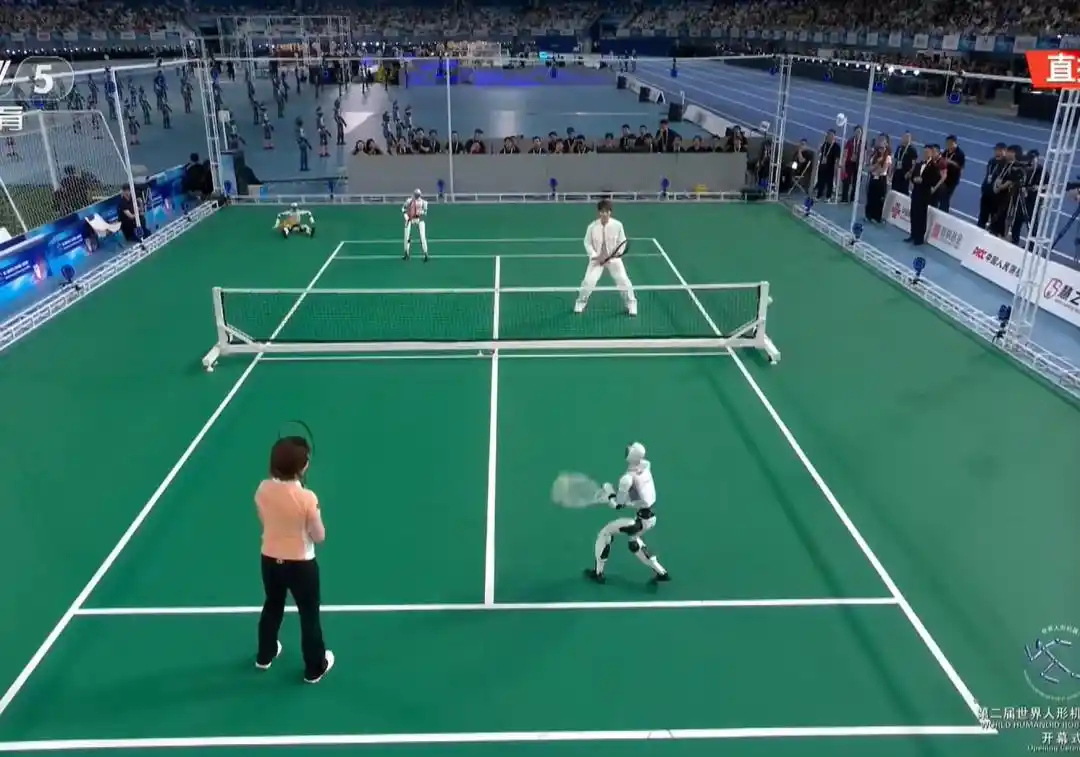
Next, tennis star Zheng Jie and Galaxy General-purpose Robot engaged in the world's first human vs. robot singles match.
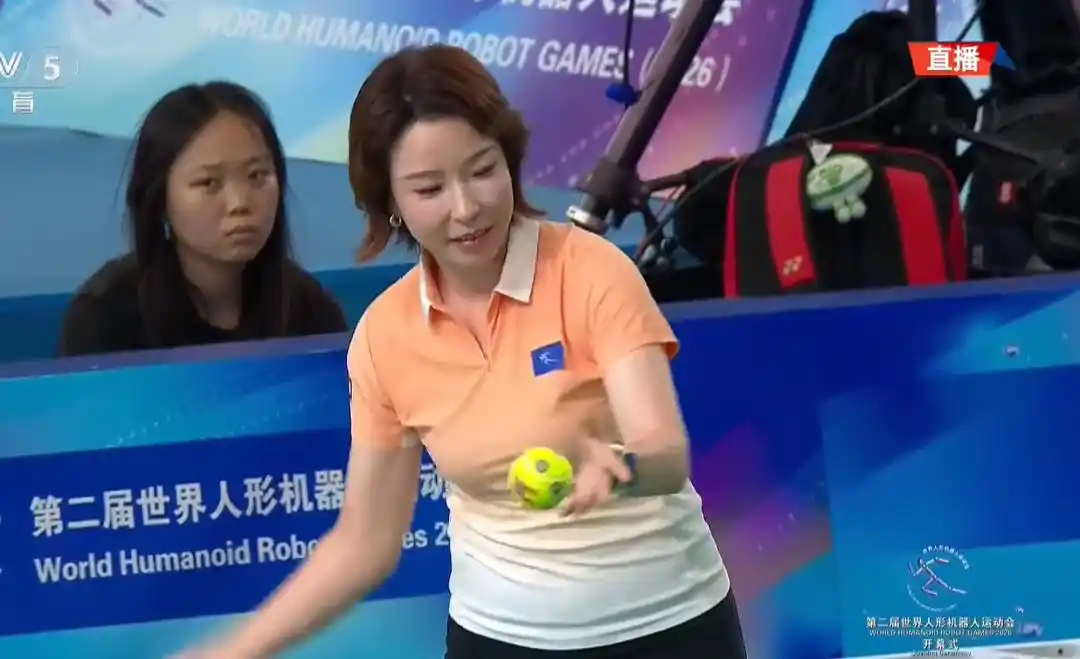
Whether forehand or backhand, the robot traded shots with the human on equal terms.

Then, Zheng Jie decided to up the difficulty, hitting a lob.
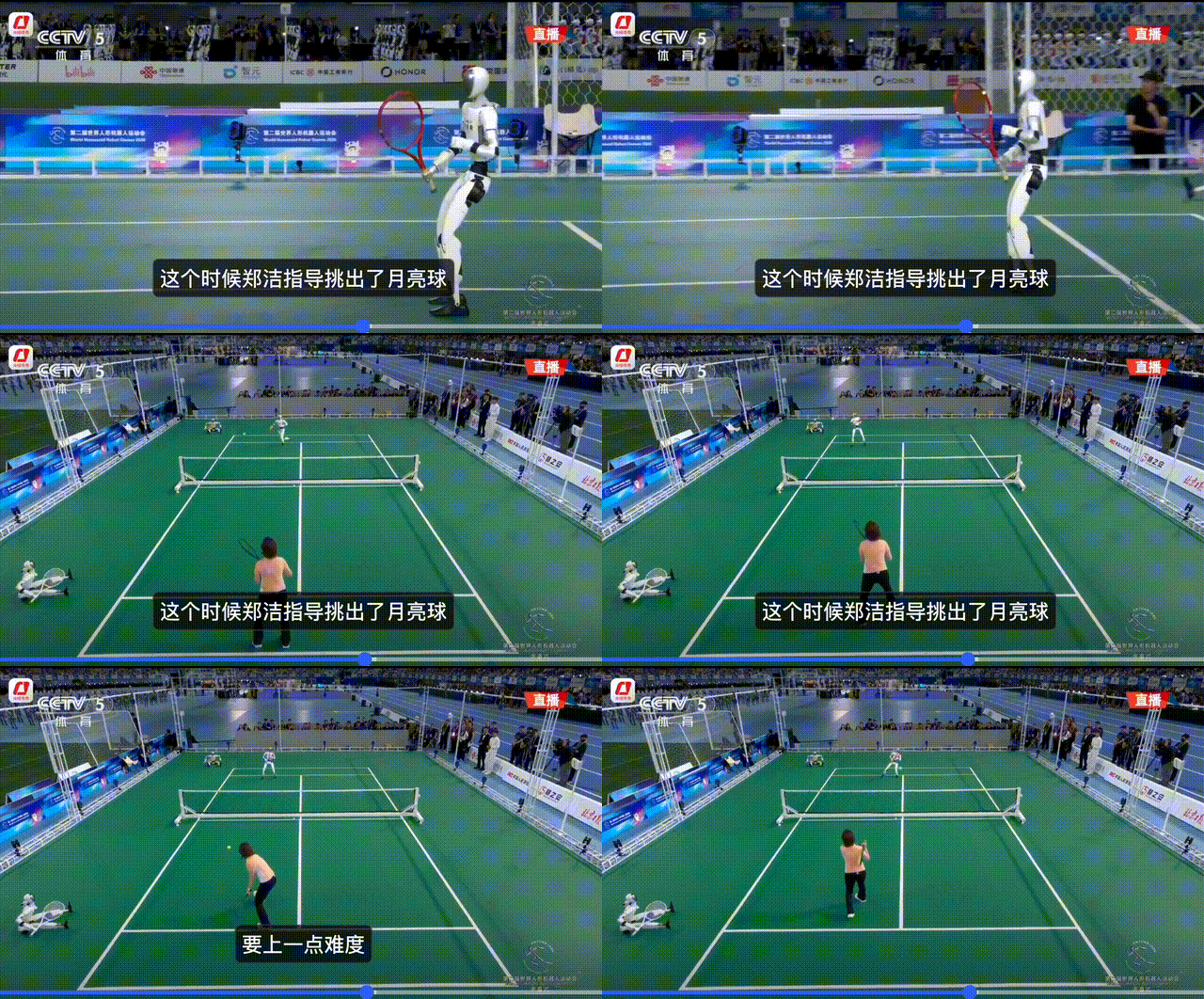
However, while being pulled left and right by its opponent, the robot accidentally took a tumble and landed flat on its back.

Unexpectedly, the next second, it immediately adjusted its posture and stood back up.

Facing Zheng Jie's slices and spins, the robot's judgment was also surprisingly good.

Finally, Zheng Jie knew she couldn't hold back anymore and began moving the robot around with shots left, right, forward, and back. The robot unexpectedly executed a brilliant split-step, earning cheers from the live audience.
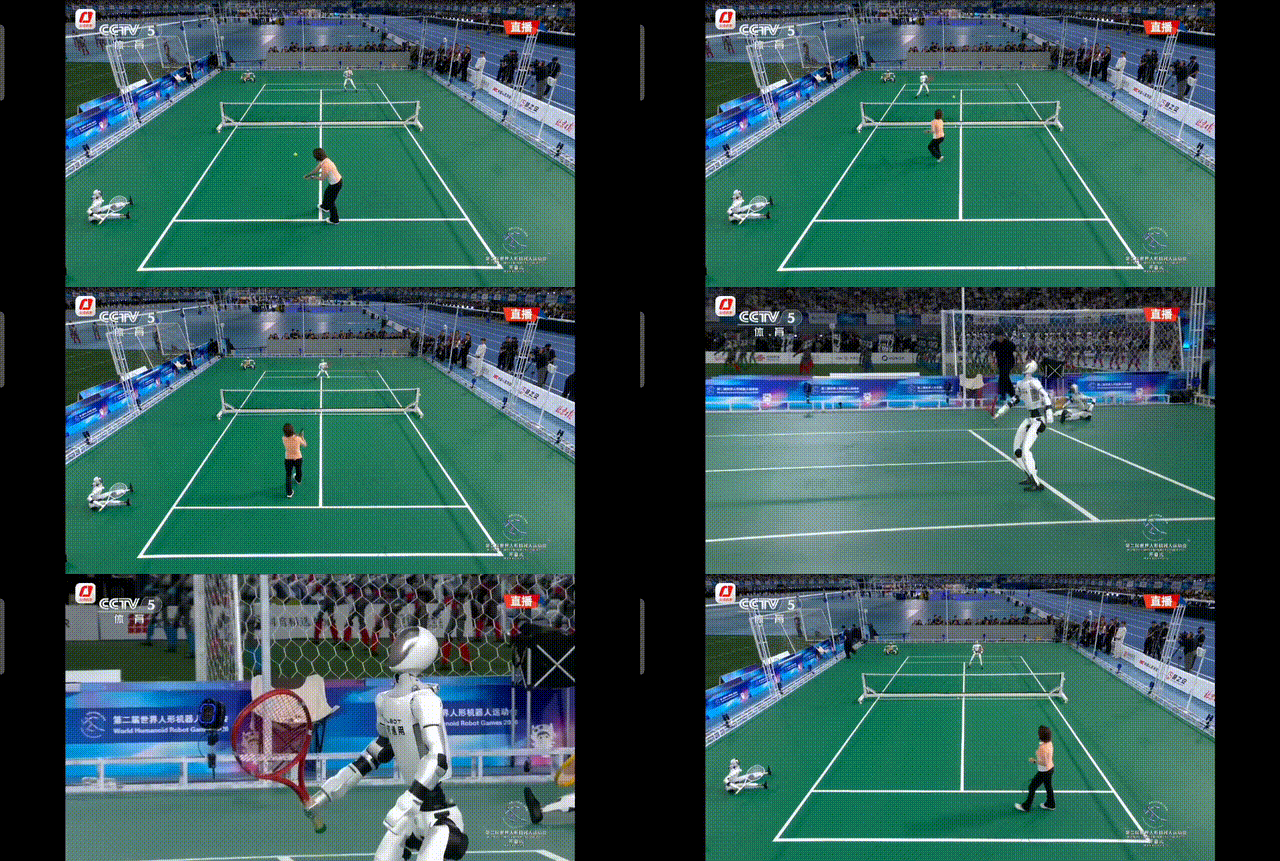
The match ended, and the robot's performance had everyone cheering.

Throughout the match, actions like bending the knees, tossing the ball, and body rotation were all performed autonomously by the humanoid robot.

Moreover, with serve speeds exceeding 100 kilometers per hour, leaving it only a few tenths of a second to react, it rarely faltered.

This robot is from Galaxy General.

Ten years ago, AlphaGo defeated Lee Sedol. Ten years later, a Chinese robot competes on the same court as a top tennis athlete.

If AlphaGo proved AI could conquer the digital world, then today, Galaxy General's Chinese robot proves: AI can withstand the extreme pressure tests of the physical world.

For the first time, it stood up from within the code, running, swinging, strategizing in real competition, even getting up on its own after a fall and continuing the fight.

Such a spectacular embodied AI AstraTennis moment was witnessed globally, simultaneously!
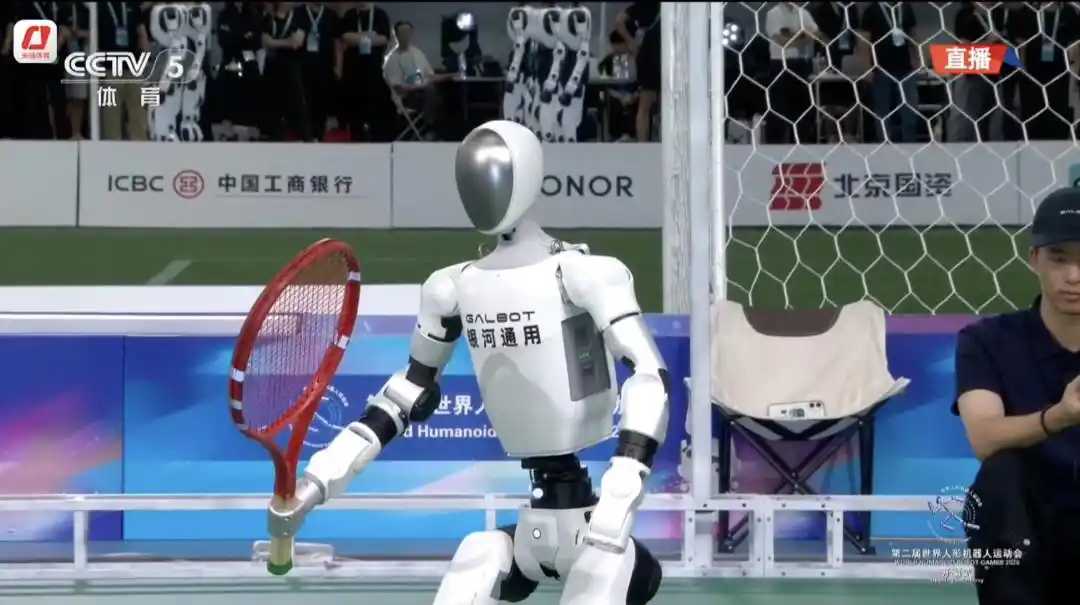
The AstraTennis Moment for China's Robots

Why could this tennis match trigger a massive earthquake in the global tech community?

Because tennis is the ultimate pressure test for embodied intelligence.

With reaction times of only a few tenths of a second, this sport simultaneously pushes a robot's perception, decision-making, whole-body motion control, and real-time strategic gameplay to their physical limits.

Furthermore, playing tennis is much harder for AI than playing Go.

After all, AlphaGo faced 361 definite intersections on a 19x19 grid, and after the opponent's move, it had tens of seconds or even minutes to calculate the next step.

That was gameplay in the digital world—vast solution space, but clear boundaries and constant rules. The entire world was static, discrete, and completely visible to the AI.

Although the solution space for this puzzle was larger than the number of atoms in the universe, for AI it was just a more difficult "math problem."
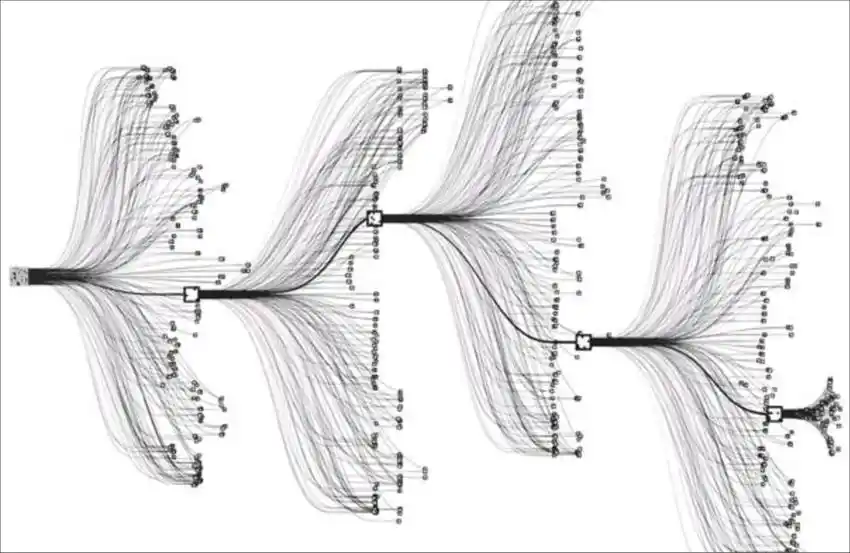
But a tennis court is different.

The ball comes at speeds over 100 km/h, its landing point affected by spin, wind, and court friction, with varying physical parameters for every single shot.

The robot must complete perception, prediction, decision-making, and whole-body coordination within a few hundred milliseconds, while keeping itself from falling. The opponent is a living person who can deceive the robot and change pace.

This is the Moravec's Paradox in action.

In 1988, Hans Moravec, then the head of Carnegie Mellon's Mobile Robot Laboratory, pointed out: "It is comparatively easy to make computers exhibit adult-level performance on intelligence tests or playing checkers, and difficult or impossible to give them the skills of a one-year-old when it comes to perception and mobility."
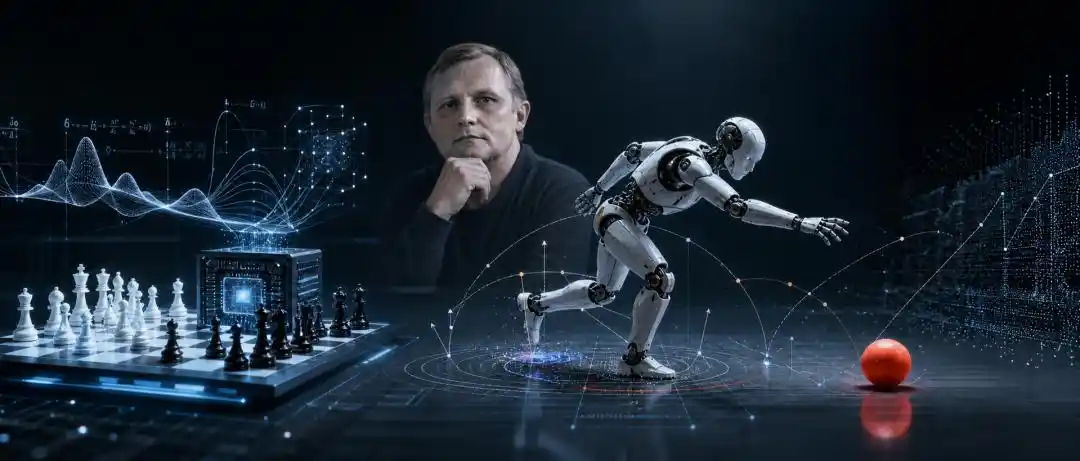
Over thirty years later, the first half has long been fulfilled, but the latter half remains very difficult to achieve.

Therefore, the true significance of this tennis match far exceeds "whether a robot can play tennis."

The question it poses is: This time, can AI truly step out of the digital world and close the loop—perceiving, deciding, controlling motion, and engaging in real-time gameplay—within a real physical environment?

AI cannot stop at thinking; it must complete the full loop from cognitive decision-making to whole-body execution.

This time, a Chinese company has submitted the answer first!

On the court, Galaxy General's robot performance was truly stunning.

Serving, forehand, backhand, baseline rallies, net volleys—all these individual skills appeared during the match, and all were performed exceptionally well.

Doubles presented even greater challenges.

With the robot and its human teammate on the same side, it had to judge in real-time who should go for the ball, who should cover, and dynamically adjust its tactics.

So, it needed to understand not just the ball, but also what its teammate intended to do next.

During the high-speed exchanges, there were moments of desperate saves. After falling down, the robot got back up on its own and continued playing.

Many people's first reaction was: Haven't robots done these individual movements before?

Shooting hoops, kicking a ball, running 100 meters—videos of humanoid robots over the past two years seem to show everything.

But the biggest difference here is that tennis is a contest between two players.

The environment for running is predictable; every shot in tennis is a new problem presented by the opponent in real-time. Running allows practicing one movement ten thousand times; no two tennis shots are exactly the same.

To stand firm in a contest—that is true intelligence.

Brain and Cerebellum, Housed in the Same Model for the First Time

Supporting all this is Galaxy General's self-developed embodied intelligence large model, "Galaxy Star Brain" AstraBrain.

One of its biggest highlights lies in its architectural choice.

The mainstream approach in the industry has been hierarchical: a "brain" model responsible for task understanding and high-level decision-making, a "cerebellum" module responsible for real-time motion control, with instructions passed between them via interfaces.

The drawbacks of this architecture are direct: Even if the brain thinks clearly, by the time the instruction reaches the cerebellum, it's already half a step late; even if the cerebellum's movements are precise, it doesn't know why the brain wants it to move that way.

A more subtle problem is the information gap.

When the brain issues a command, it doesn't know where its center of gravity is leaning or how much force the right arm has left; when the cerebellum executes an action, it doesn't know whether this shot is meant to move the opponent around or to win the point directly.

Both sides might be optimal individually, but together they form a system that "thinks but can't act" or "acts but doesn't think."

In a task like tennis, being slightly late means losing the point.

Galaxy Star Brain's approach is to integrate the brain layer (task understanding and tactical decision-making), the cerebellum layer (high-dynamic whole-body motion control), and neural control within the same model.

According to Galaxy General, this is the world's first model capable of simultaneously handling "thinking clearly" and "acting out," with no information loss in between.

Reasoning backward from the tennis task, this might be the only solution. Tactical decisions cannot be separated from real-time perception of one's own physical limits, and motion control cannot be separated from understanding tactical intent—the two should never have been separated in the first place.
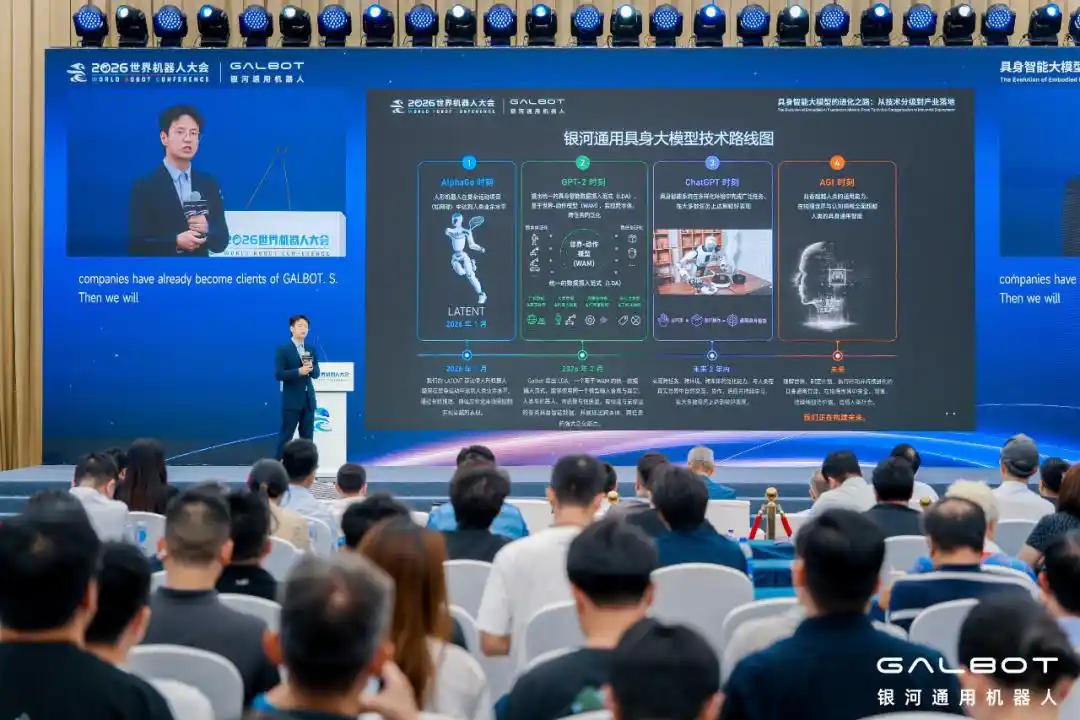
Learning from Imperfect Human Data

Playing Ten Million Matches in Virtual Courts

Beyond architecture, another question is: How was this model trained?

A traditional challenge in robotics is the lack of data.

A language model can consume all the text on the internet; robots don't have such an internet.

Collecting one hour of real robot movement data takes one hour, requires human supervision, and risks hardware damage.
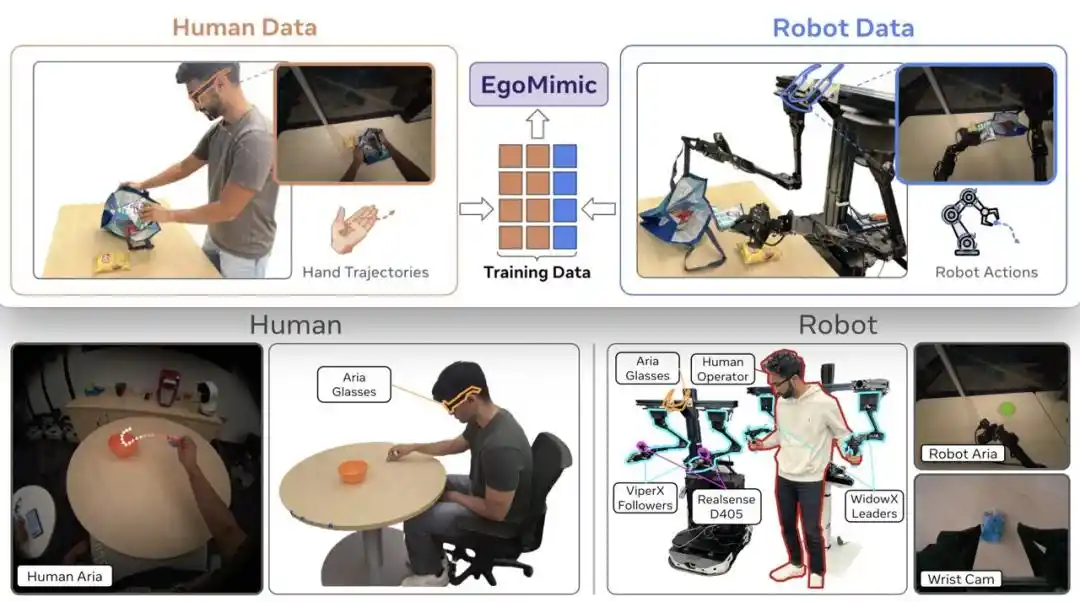
This is also why progress in embodied AI has often been slower than expected in recent years.

Supporting this effort is Galaxy General's core technology platform, "Galaxy Star Workshop."

The process is divided into two main steps.

Step One: Learning from "Imperfect Human Data."

Human tennis movement data can be collected via motion capture, video, or wearable sensors.

However, human movements themselves are not standardized. Amateur players are indeed amateurs, with extraneous movements. Professional players' movements maximize their individual athleticism, making them difficult for others to replicate, and everyone's height, wingspan, and joint angles differ from the robot's.

Traditional imitation learning requires demonstration data to be clean, aligned, and high-quality—requirements almost impossible to meet with human data.

The task of the Galaxy Star Workshop data platform is to extract useful priors from this noisy, misaligned, mixed-quality demonstration data:

When to start moving, the general rhythm of a swing, how to transfer body weight—truly learning the underlying motion principles.

The value of this step lies in cold-start capability.

The robot doesn't have to start exploring from random movements; it begins with a rough idea of "what playing tennis looks like."

Step Two: Entering the Virtual Tennis World.

In the simulated environment, multiple intelligent agents play against each other. It's not one robot practicing against a ball machine, but multiple strategies evolving and competing against each other.

When one side learns to hit the sidelines, the other is forced to learn large lateral movements; when one side learns the drop shot, the other is forced to learn to rush the net.

Within this vast virtual competition, a miracle occurs—"skill emergence."

Engineers never taught it how to slide for a desperate save, but after countless failures to reach the ball, the model itself "figured out" the posture for a maximum extension.

Engineers never wrote hard-coded instructions for getting up after a fall, but after falling millions of times in the virtual world, the model itself "learned" how to coordinate all its motors to stand back up.

Skills do not need to be manually designed; under the pressure of competition, the AI learns them on its own.

Finally, when these "souls" honed to mastery in the virtual world are seamlessly transferred into the physical bodies of real robots in the physical world, a tennis master is born!

Placed within the spectrum of machine learning, this path lies between two extremes.

The ceiling of pure imitation learning is the level of the demonstrator; a human coach cannot teach a student who surpasses them, and human demonstrations simply don't contain data on "how to get up after falling and continue playing."

Pure reinforcement learning explores from scratch. In tasks like tennis with huge action spaces and sparse rewards, the search cost becomes unrealistically high, and it tends to learn bizarre, humanly incomprehensible actions that might win points but don't resemble tennis.

Start with human priors as a foundation, then elevate through autonomous evolution.

This approach isn't entirely new; AlphaGo also started by learning human Go games before self-play. What's new is that ten years ago, this method succeeded on a board, and ten years later, it has succeeded for the first time on a task requiring a body.

In a sense, this is the most fascinating technical echo between AstraTennis and AlphaGo.

In the AlphaGo era, intelligence thought on a board; this time, intelligence begins to enter the physical world.

This is far more than just a tennis match. This AstraTennis moment proves: In the new era of carbon-silicon symbiosis, the power of China is beginning to create more wonders.

Edited by: Aeneas, David

This article is from the WeChat public account "New Zhiyuan", author: ASI Apocalypse

Trend Kriptolar

İlgili Sorular

QWhat major event in the history of AI and robotics is described in the article as taking place on August 22nd?

AThe second World Humanoid Robot Games, which featured the world's first genuine man vs. machine tennis match between Chinese tennis star Zheng Jie and a humanoid robot from Galaxy General Robots.

QWhat is the name of the AI model developed by Galaxy General Robots that powers the tennis-playing robot, and what is its key architectural innovation?

AThe AI model is called AstraBrain (Galaxy Star Brain). Its key innovation is integrating the 'brain' (task understanding and tactical decision-making) and the 'cerebellum' (high-dynamic full-body motion control) into a single model, eliminating information loss and delay between decision and action.

QAccording to the article, why is playing tennis a much harder challenge for AI than playing Go (like AlphaGo)?

ATennis is harder because it exists in the dynamic, continuous physical world. The robot must perceive, predict, decide, and coordinate its entire body within fractions of a second against a live, unpredictable opponent, dealing with variables like spin, wind, and friction. Go, in contrast, is a static, discrete digital board game with clear rules and longer decision times.

QHow did the Galaxy General Robots team train their AI model to play tennis, overcoming the lack of real-world robot data?

AThey used a two-step process. First, the model learned general movement priors from 'imperfect human data' (motion capture, videos). Second, multiple AI agents were placed in a high-fidelity virtual tennis simulator where they played millions of matches against each other. Through this self-play and evolutionary pressure, the model autonomously developed advanced skills like sliding saves and recovering from falls, which were then transferred to the physical robot.

QWhat broader technological significance does the article attribute to this 'AstraTennis moment' beyond just a robot playing a sport?

AThe event marks a historic 'embodied intelligence singularity' for Chinese innovation. It demonstrates that AI can successfully transition from pure cognitive tasks in the digital realm (like AlphaGo) to performing integrated perception, decision-making, and full-body motion control under the extreme pressure of real-time physical competition. It proves AI can form a complete closed loop from thought to action in the unpredictable physical world.

İlgili Okumalar

Mysterious "Ox Alpha" Large Model Goes Viral with Limited-Time Free Access

A mysterious anonymous AI model named "Ox Alpha," nicknamed "Cow is Coming" by Chinese netizens, has appeared on OpenRouter, sparking widespread speculation. The model offers a 1 million token context, supports text, image, and video inputs, can call tools, and is currently free. Its standout feature is strong coding ability. Initial tests on the DeepSWE benchmark, which evaluates real-world software engineering tasks, showed an 80% pass rate on a subset of tasks, reportedly nearing top-tier code models. However, follow-up tests yielded a 63% score, with variations attributed to different task sets and configurations. The model's true developer is a major topic of debate. The prevailing theory points to Zhipu AI's unreleased GLM-5.3 Flash or its multimodal variant. Evidence cited includes identical visual token consumption patterns with GLM-5V-Turbo for videos, a consistent offset in text token counts compared to GLM-5.3, and similar behavioral traits like refusing audio processing. Zhipu has a precedent of anonymous testing. Simultaneously, another anonymous model, "korrine," appeared on Code Arena, with guesses ranging from Moonshot's Kimi K3.1 to models from Qwen or MiMo, adding to the industry's guessing game. This trend of anonymous "undercover" testing allows for unbiased performance evaluation in platforms like Arena and provides real-world, high-pressure testing through tools like OpenRouter before official release. It also serves as an effective marketing tactic, prolonging discussion through suspense. If Ox Alpha is indeed a "Flash" model, its performance raises expectations for the full-scale version's potential.

marsbit5 dk önce

Mysterious "Ox Alpha" Large Model Goes Viral with Limited-Time Free Access

marsbit5 dk önce

Breaking News: DeepSeek Announces All-Day Off-Peak Pricing on Weekends, Making Weekend Work More Cost-Effective?

DeepSeek has announced a significant change to its API pricing model, effective August 23. The new policy removes peak/off-peak distinctions on weekends (Saturdays and Sundays), charging the lower off-peak rate for the entire two-day period. This adjustment has sparked mixed reactions within the developer and professional communities. For developers and businesses heavily reliant on DeepSeek's V4-Flash and V4-Pro APIs, this is welcome news. It allows them to schedule bulk processing tasks on weekends without the higher peak-hour costs, potentially halving their API bills for such workloads. Some users have celebrated the move for making weekend work more cost-effective. However, the announcement has also raised concerns among employees. There is apprehension that companies, particularly in cost-sensitive sectors like AI-powered short drama production, might reorganize work schedules to align with these new cost incentives. Instances are already emerging where teams schedule high-token tasks during cheaper nighttime hours or adjust staff shifts. This has led to worries about a potential shift towards weekend workdays and weekday time-off, prioritizing cost savings over traditional work-life balance. Debate has ensued regarding the practicality of such schedule changes, with questions about increased communication overhead and overall efficiency. Speculation about DeepSeek's motives for the change includes theories that peak pricing correlates with internal model training schedules, though others counter that training is largely automated. The new pricing structure is now in effect, prompting users to reconsider their task scheduling strategies.

marsbit49 dk önce

Breaking News: DeepSeek Announces All-Day Off-Peak Pricing on Weekends, Making Weekend Work More Cost-Effective?

marsbit49 dk önce

The Biggest Dark Horse in AI Payments Might Be Coinbase Giving Agents a Wallet

In the AI payments race, while most focus on traditional giants like Visa or AI platforms like OpenAI, Coinbase has quietly emerged as a key player. Data from 2026 shows over 90% of on-chain Agent transactions occur on Coinbase's Base network, with 99% settled in USDC and over 97% using the x402 protocol. Coinbase's pivotal move was launching "Agentic Wallets" in February 2026—a dedicated wallet infrastructure giving AI Agents their own financial identity. Unlike Visa or Stripe, which connect Agents to existing payment rails, Coinbase provides Agents with autonomous wallets to hold assets (like stablecoins), initiate transfers, and execute transactions under predefined rules. This solves core issues for machine-to-machine payments: high credit card fees for micropayments, the need for constant human authorization, and unclear transaction attribution. Coinbase's strength lies in its closed-loop ecosystem: the Base blockchain (low-cost, high-throughput), the x402 payment protocol, Agentic Wallets, and native assets like USDC. This integrated stack, built through years of infrastructure investment, positioned Coinbase to capture early Agent payment demand as the AI economy surged. The key insight is that AI payment adoption may depend less on whose standard wins and more on whose usable infrastructure is ready first. While debates over protocols and payment rails continue, real Agent transactions are already flowing—primarily through Coinbase's ecosystem. It may not be the ultimate winner, but for now, it's the frontrunner by being prepared.

marsbit1 saat önce

The Biggest Dark Horse in AI Payments Might Be Coinbase Giving Agents a Wallet

marsbit1 saat önce

Dialogue with Bitwise CIO: Bitcoin May Be Near Bottom, Who Will Drive the Next Rally?

In a recent podcast, Bitwise CIO Matt Hougan analyzed Bitcoin's current market cycle, suggesting it is near a bottom characterized by low volatility and investor indifference. He believes the next major price surge will be driven primarily by wealth management platforms, financial advisors, and family offices, who control trillions in assets and are now gaining access to Bitcoin ETFs. Hougan views Bitcoin as a long-dated, out-of-the-money call option on it becoming a global reserve asset. Its value increases with global monetary system volatility, making it a natural hedge against currency disorder. He outlined Bitcoin's adoption path: first as a global digital store of value (competing with gold), and potentially later as a check against fiat currency abuse by sovereign states. Addressing the muted price action despite institutional ETF inflows, Hougan explained that significant selling by long-term retail holders has offset buying pressure. However, he is optimistic as data shows retail selling has subsided, which, combined with continued institutional inflows, could propel prices higher. Hougan downplayed the future impact of Federal Reserve interest rates and MicroStrategy's actions on Bitcoin's price, arguing they are becoming less relevant. Instead, he pointed to runaway U.S. fiscal deficits and debt as the core long-term drivers. Finally, he discussed the transformative potential of asset tokenization, predicting all traditional assets will eventually trade 24/7 on blockchains. This will merge traditional and crypto markets, increasing efficiency but also introducing crypto-like features such as overnight volatility and easier access to leverage into traditional finance.

marsbit2 saat önce

Dialogue with Bitwise CIO: Bitcoin May Be Near Bottom, Who Will Drive the Next Rally?

marsbit2 saat önce

İşlemler

Spot

Popüler Makaleler

$S$ Nedir

SPERO'yu Anlamak: Kapsamlı Bir Genel Bakış SPERO'ya Giriş İnovasyonun manzarası gelişmeye devam ederken, web3 teknolojilerinin ve kripto para projelerinin ortaya çıkışı dijital geleceği şekillendirmede önemli bir rol oynamaktadır. Bu dinamik alanda dikkat çeken projelerden biri SPERO, $$s$$ olarak adlandırılmaktadır. Bu makale, SPERO hakkında ayrıntılı bilgi toplamak ve sunmak amacıyla, meraklılar ve yatırımcıların web3 ve kripto alanlarındaki temellerini, hedeflerini ve yeniliklerini anlamalarına yardımcı olmayı amaçlamaktadır. SPERO,$$s$$ Nedir? SPERO,$$s$$, kripto alanında merkeziyetsizlik ve blok zinciri teknolojisi ilkelerini kullanarak etkileşimi, faydayı ve finansal kapsayıcılığı teşvik eden bir ekosistem yaratmayı amaçlayan benzersiz bir projedir. Proje, kullanıcıların yenilikçi finansal çözümler ve hizmetler sunarak eşler arası etkileşimleri yeni yollarla kolaylaştırmayı hedeflemektedir. SPERO,$$s$$'nin temel amacı, bireyleri güçlendirmek ve kripto para alanındaki kullanıcı deneyimini artıran araçlar ve platformlar sağlamaktır. Bu, daha esnek işlem yöntemlerini mümkün kılmayı, topluluk odaklı girişimleri teşvik etmeyi ve merkeziyetsiz uygulamalar (dApp'ler) aracılığıyla finansal fırsatlar yaratmayı içermektedir. SPERO,$$s$$'nin temel vizyonu kapsayıcılık etrafında dönmekte olup, geleneksel finansal sistemlerdeki boşlukları kapatmayı ve blok zinciri teknolojisinin faydalarından yararlanmayı hedeflemektedir. SPERO,$$s$$'nin Yaratıcısı Kimdir? SPERO,$$s$$'nin yaratıcısının kimliği bir miktar belirsizdir, çünkü kurucusu(ları) hakkında ayrıntılı arka plan bilgisi sağlayan sınırlı kamuya açık kaynaklar bulunmaktadır. Bu şeffaflık eksikliği, projenin merkeziyetsizlik taahhüdünden kaynaklanabilir—birçok web3 projesinin paylaştığı bir etik anlayışı, bireysel tanınmanın yerine kolektif katkıları önceliklendirmektedir. Topluluk ve onun kolektif hedefleri etrafında tartışmaları merkezileştirerek, SPERO,$$s$$, belirli bireyleri öne çıkarmadan güçlendirme özünü taşımaktadır. Bu nedenle, SPERO'nun etik anlayışını ve misyonunu anlamak, tek bir yaratıcının kimliğini belirlemekten daha önemlidir. SPERO,$$s$$'nin Yatırımcıları Kimlerdir? SPERO,$$s$$, kripto sektöründe yeniliği teşvik etmeye adanmış girişim sermayedarlarından melek yatırımcılara kadar çeşitli yatırımcılar tarafından desteklenmektedir. Bu yatırımcıların odak noktası genellikle SPERO'nun misyonuyla uyumlu olup, toplumsal teknolojik ilerlemeyi, finansal kapsayıcılığı ve merkeziyetsiz yönetimi vaat eden projeleri önceliklendirmektedir. Bu yatırımcı temelleri, yalnızca yenilikçi ürünler sunan projelere değil, aynı zamanda blok zinciri topluluğuna ve ekosistemlerine olumlu katkılarda bulunan projelere de ilgi duymaktadır. Bu yatırımcıların desteği, SPERO,$$s$$'yi hızla gelişen kripto projeleri alanında dikkate değer bir rakip haline getirmektedir. SPERO,$$s$$ Nasıl Çalışır? SPERO,$$s$$, onu geleneksel kripto para projelerinden ayıran çok yönlü bir çerçeve kullanmaktadır. İşte benzersizliğini ve yeniliğini vurgulayan bazı temel özellikler: Merkeziyetsiz Yönetim: SPERO,$$s$$, kullanıcıların projenin geleceğiyle ilgili karar alma süreçlerine aktif olarak katılmalarını sağlayan merkeziyetsiz yönetim modellerini entegre etmektedir. Bu yaklaşım, topluluk üyeleri arasında sahiplik ve hesap verebilirlik duygusunu teşvik etmektedir. Token Kullanımı: SPERO,$$s$$, ekosistem içinde çeşitli işlevler sunmak üzere tasarlanmış kendi kripto para token'ını kullanmaktadır. Bu token'lar, işlemleri, ödülleri ve platformda sunulan hizmetlerin kolaylaştırılmasını sağlayarak genel etkileşimi ve faydayı artırmaktadır. Katmanlı Mimari: SPERO,$$s$$'nin teknik mimarisi, modülerlik ve ölçeklenebilirliği destekleyerek projenin evrimi sırasında ek özelliklerin ve uygulamaların sorunsuz bir şekilde entegrasyonuna olanak tanımaktadır. Bu uyum sağlama yeteneği, sürekli değişen kripto manzarasında geçerliliği sürdürmek için hayati öneme sahiptir. Topluluk Katılımı: Proje, işbirliği ve geri bildirim teşvik eden mekanizmalar kullanarak topluluk odaklı girişimlere vurgu yapmaktadır. Güçlü bir topluluk oluşturarak, SPERO,$$s$$, kullanıcı ihtiyaçlarını daha iyi karşılayabilir ve piyasa trendlerine uyum sağlayabilir. Kapsayıcılığa Odaklanma: Düşük işlem ücretleri ve kullanıcı dostu arayüzler sunarak, SPERO,$$s$$, daha önce kripto alanında yer almamış bireyler de dahil olmak üzere çeşitli bir kullanıcı tabanını çekmeyi hedeflemektedir. Bu kapsayıcılık taahhüdü, erişilebilirlik yoluyla güçlendirme misyonuyla uyumludur. SPERO,$$s$$ Zaman Çizelgesi Bir projenin tarihini anlamak, gelişim yolculuğu ve kilometre taşları hakkında kritik bilgiler sağlar. Aşağıda, SPERO,$$s$$'nin evriminde önemli olayları haritalayan önerilen bir zaman çizelgesi bulunmaktadır: Kavram Geliştirme ve Fikir Aşaması: SPERO,$$s$$'nin temelini oluşturan ilk fikirler, blok zinciri endüstrisindeki merkeziyetsizlik ve topluluk odaklılık ilkeleriyle yakından uyumlu olarak geliştirildi. Proje Beyaz Kağıdının Yayınlanması: Kavramsal aşamayı takiben, SPERO,$$s$$'nin vizyonunu, hedeflerini ve teknolojik altyapısını ayrıntılı bir şekilde açıklayan kapsamlı bir beyaz kağıt yayımlandı ve topluluk ilgisini ve geri bildirimini toplamak amacıyla sunuldu. Topluluk Oluşturma ve Erken Katılımlar: Projenin hedefleri etrafında tartışmalar yürüterek destek toplamak ve erken benimseyenler ile potansiyel yatırımcılar için bir topluluk oluşturmak amacıyla aktif iletişim çabaları gerçekleştirildi. Token Üretim Etkinliği: SPERO,$$s$$, yerel token'larını erken destekçilere dağıtmak ve ekosistem içinde başlangıç likiditesini sağlamak amacıyla bir token üretim etkinliği (TGE) gerçekleştirdi. İlk dApp'in Yayınlanması: SPERO,$$s$$ ile ilişkili ilk merkeziyetsiz uygulama (dApp) faaliyete geçti ve kullanıcıların platformun temel işlevleriyle etkileşimde bulunmalarını sağladı. Sürekli Gelişim ve Ortaklıklar: Projenin tekliflerine sürekli güncellemeler ve iyileştirmeler yapılmakta olup, blok zinciri alanındaki diğer oyuncularla stratejik ortaklıklar, SPERO,$$s$$'yi rekabetçi ve gelişen bir oyuncu haline getirmiştir. Sonuç SPERO,$$s$$, web3 ve kripto paranın finansal sistemleri devrim niteliğinde dönüştürme ve bireyleri güçlendirme potansiyelinin bir kanıtıdır. Merkeziyetsiz yönetime, topluluk katılımına ve yenilikçi tasarlanmış işlevselliğe olan bağlılığıyla, daha kapsayıcı bir finansal manzaraya doğru bir yol açmaktadır. Hızla gelişen kripto alanındaki herhangi bir yatırımda olduğu gibi, potansiyel yatırımcılar ve kullanıcılar, SPERO,$$s$$ içindeki devam eden gelişmelerle ilgili olarak kapsamlı bir araştırma yapmaları ve düşünceli bir şekilde katılmaları teşvik edilmektedir. Proje, kripto endüstrisinin yenilikçi ruhunu sergileyerek, sayısız olasılığını keşfetmeye davet etmektedir. SPERO,$$s$$'nin yolculuğu hala devam ederken, temel ilkeleri, teknoloji, finans ve birbirimizle etkileşim biçimimizi etkileyebilir.

417 Toplam GörüntülenmeYayınlanma 2024.12.17Güncellenme 2024.12.17

$S$ Nedir

AGENT S Nedir

Agent S: Web3'te Otonom Etkileşimin Geleceği Giriş Web3 ve kripto para dünyasında sürekli gelişen manzarada, yenilikler bireylerin dijital platformlarla etkileşim biçimlerini sürekli olarak yeniden tanımlıyor. Bu tür öncü projelerden biri olan Agent S, açık ajans çerçevesi aracılığıyla insan-bilgisayar etkileşimini devrim niteliğinde değiştirmeyi vaat ediyor. Otonom etkileşimlerin yolunu açarak, Agent S karmaşık görevleri basitleştirmeyi ve yapay zeka (AI) alanında dönüştürücü uygulamalar sunmayı hedefliyor. Bu detaylı inceleme, projenin karmaşıklıklarına, benzersiz özelliklerine ve kripto para alanındaki etkilerine dalacaktır. Agent S Nedir? Agent S, bilgisayar görevlerinin otomasyonunda üç temel zorluğu ele almak üzere özel olarak tasarlanmış çığır açıcı bir açık ajans çerçevesidir: Alan Spesifik Bilgi Edinimi: Çerçeve, çeşitli dış bilgi kaynaklarından ve iç deneyimlerden akıllıca öğrenir. Bu çift yönlü yaklaşım, alan spesifik bilgi açısından zengin bir veri havuzu oluşturmasını sağlar ve görev yürütmedeki performansını artırır. Uzun Görev Ufukları Üzerinde Planlama: Agent S, karmaşık görevlerin verimli bir şekilde parçalanmasını ve yürütülmesini kolaylaştıran deneyim artırımlı hiyerarşik planlama kullanır. Bu özellik, çoklu alt görevleri etkili ve verimli bir şekilde yönetme yeteneğini önemli ölçüde artırır. Dinamik, Homojen Olmayan Arayüzlerle Başlama: Proje, ajanlar ve kullanıcılar arasındaki etkileşimi geliştiren yenilikçi bir çözüm olan Ajan-Bilgisayar Arayüzü'ni (ACI) tanıtmaktadır. Çok Modlu Büyük Dil Modellerini (MLLM'ler) kullanarak, Agent S çeşitli grafik kullanıcı arayüzlerini sorunsuz bir şekilde gezinebilir ve manipüle edebilir. Bu öncü özellikler aracılığıyla, Agent S, makinelerle insan etkileşimini otomatikleştirmede karşılaşılan karmaşıklıkları ele alan sağlam bir çerçeve sunarak, AI ve ötesinde birçok uygulama için zemin hazırlıyor. Agent S'nin Yaratıcısı Kimdir? Agent S'nin kavramı temelde yenilikçi olsa da, yaratıcısı hakkında spesifik bilgiler belirsizliğini koruyor. Yaratıcı şu anda bilinmiyor, bu da projenin yeni aşamasını veya kurucu üyeleri gizli tutma stratejik tercihini vurguluyor. Anonimlikten bağımsız olarak, odak çerçevenin yetenekleri ve potansiyeli üzerinde kalıyor. Agent S'nin Yatırımcıları Kimlerdir? Agent S, kriptografik ekosistemde oldukça yeni olduğundan, yatırımcıları ve finansal destekçileri hakkında ayrıntılı bilgiler açıkça belgelenmemiştir. Projeyi destekleyen yatırım temelleri veya organizasyonları hakkında kamuya açık bilgilerdeki eksiklik, finansman yapısı ve gelişim yol haritası hakkında sorular doğuruyor. Destekleyicilerin anlaşılması, projenin sürdürülebilirliğini ve potansiyel pazar etkisini değerlendirmek için kritik öneme sahiptir. Agent S Nasıl Çalışır? Agent S'nin temelinde, çeşitli ortamlarda etkili bir şekilde çalışmasını sağlayan son teknoloji bir sistem yatmaktadır. İşleyiş modeli birkaç ana özellik etrafında inşa edilmiştir: İnsan Benzeri Bilgisayar Etkileşimi: Çerçeve, bilgisayarlarla etkileşimleri daha sezgisel hale getirmeyi amaçlayan gelişmiş AI planlaması sunar. Görev yürütmedeki insan davranışını taklit ederek, kullanıcı deneyimlerini yükseltmeyi vaat eder. Anlatı Belleği: Yüksek düzeyde deneyimlerden yararlanmak için kullanılan Agent S, görev geçmişlerini takip etmek amacıyla anlatı belleğini kullanarak karar verme süreçlerini geliştirir. Episodik Bellek: Bu özellik, kullanıcılara adım adım rehberlik sağlayarak, çerçevenin görevler gelişirken bağlamsal destek sunmasına olanak tanır. OpenACI Desteği: Yerel olarak çalışabilme yeteneği ile Agent S, kullanıcıların etkileşimleri ve iş akışları üzerinde kontrol sağlamasına olanak tanır ve Web3'ün merkeziyetsiz felsefesiyle uyumlu hale gelir. Dış API'lerle Kolay Entegrasyon: Çeşitli AI platformlarıyla uyumluluğu ve çok yönlülüğü, Agent S'nin mevcut teknolojik ekosistemlere sorunsuz bir şekilde entegre olmasını sağlar ve geliştiriciler ile organizasyonlar için cazip bir seçenek haline getirir. Bu işlevsellikler, Agent S'nin kripto alanındaki benzersiz konumuna katkıda bulunarak, karmaşık, çok aşamalı görevleri minimum insan müdahalesi ile otomatikleştirir. Proje geliştikçe, Web3'teki potansiyel uygulamaları dijital etkileşimlerin nasıl gelişeceğini yeniden tanımlayabilir. Agent S'nin Zaman Çizelgesi Agent S'nin gelişimi ve kilometre taşları, önemli olaylarını vurgulayan bir zaman çizelgesinde özetlenebilir: 27 Eylül 2024: Agent S'nin kavramı, “Bilgisayarları İnsan Gibi Kullanan Açık Bir Ajans Çerçevesi” başlıklı kapsamlı bir araştırma makalesi ile tanıtıldı ve projenin temelini sergiledi. 10 Ekim 2024: Araştırma makalesi arXiv'de kamuya açık olarak yayınlandı ve çerçevenin derinlemesine bir incelemesini ve OSWorld benchmark'ına dayalı performans değerlendirmesini sundu. 12 Ekim 2024: Agent S'nin yetenekleri ve özellikleri hakkında görsel bir içgörü sağlayan bir video sunumu yayımlandı ve potansiyel kullanıcılar ve yatırımcılarla daha fazla etkileşim sağlandı. Bu zaman çizelgesindeki işaretler, sadece Agent S'nin ilerlemesini değil, aynı zamanda şeffaflık ve topluluk katılımına olan bağlılığını da göstermektedir. Agent S Hakkında Ana Noktalar Agent S çerçevesi gelişmeye devam ederken, birkaç ana özellik öne çıkmakta ve yenilikçi doğasını ve potansiyelini vurgulamaktadır: Yenilikçi Çerçeve: İnsan etkileşimine benzer bir bilgisayar kullanımı sağlamak üzere tasarlanan Agent S, görev otomasyonuna yeni bir yaklaşım getiriyor. Otonom Etkileşim: GUI aracılığıyla bilgisayarlarla otonom olarak etkileşim kurabilme yeteneği, daha akıllı ve verimli hesaplama çözümlerine doğru bir sıçrama anlamına geliyor. Karmaşık Görev Otomasyonu: Sağlam metodolojisi ile karmaşık, çok aşamalı görevleri otomatikleştirerek süreçleri daha hızlı ve daha az hata payı ile gerçekleştirebilir. Sürekli İyileştirme: Öğrenme mekanizmaları, Agent S'nin geçmiş deneyimlerden öğrenmesini sağlar ve sürekli olarak performansını ve etkinliğini artırır. Çok Yönlülük: OSWorld ve WindowsAgentArena gibi farklı işletim ortamlarında uyumlu olması, geniş bir uygulama yelpazesine hizmet edebilmesini sağlar. Agent S, Web3 ve kripto alanında kendini konumlandırırken, etkileşim yeteneklerini artırma ve süreçleri otomatikleştirme potansiyeli, AI teknolojilerinde önemli bir ilerlemeyi temsil etmektedir. Yenilikçi çerçevesi aracılığıyla, Agent S dijital etkileşimlerin geleceğini örneklemekte ve çeşitli sektörlerde kullanıcılar için daha sorunsuz ve verimli bir deneyim vaat etmektedir. Sonuç Agent S, AI ve Web3'ün birleşiminde cesur bir sıçramayı temsil ediyor ve teknoloji ile etkileşim biçimimizi yeniden tanımlama kapasitesine sahip. Henüz erken aşamalarında olmasına rağmen, uygulama olanakları geniş ve çekici. Kritik zorlukları ele alan kapsamlı çerçevesi ile Agent S, otonom etkileşimleri dijital deneyimin ön plana çıkmasına taşımayı hedefliyor. Kripto para ve merkeziyetsizlik alanlarına daha derinlemesine girdikçe, Agent S gibi projelerin teknoloji ve insan-bilgisayar işbirliğinin geleceğini şekillendirmede önemli bir rol oynayacağı kesin.

877 Toplam GörüntülenmeYayınlanma 2025.01.14Güncellenme 2025.01.14

AGENT S Nedir

S Nasıl Satın Alınır

HTX.com’a hoş geldiniz! Sonic (S) satın alma işlemlerini basit ve kullanışlı bir hâle getirdik. Adım adım açıkladığımız rehberimizi takip ederek kripto yolculuğunuza başlayın. 1. Adım: HTX Hesabınızı OluşturunHTX'te ücretsiz bir hesap açmak için e-posta adresinizi veya telefon numaranızı kullanın. Sorunsuzca kaydolun ve tüm özelliklerin kilidini açın. Hesabımı Aç2. Adım: Kripto Satın Al Bölümüne Gidin ve Ödeme Yönteminizi SeçinKredi/Banka Kartı: Visa veya Mastercard'ınızı kullanarak anında Sonic (S) satın alın.Bakiye: Sorunsuz bir şekilde işlem yapmak için HTX hesap bakiyenizdeki fonları kullanın.Üçüncü Taraflar: Kullanımı kolaylaştırmak için Google Pay ve Apple Pay gibi popüler ödeme yöntemlerini ekledik.P2P: HTX'teki diğer kullanıcılarla doğrudan işlem yapın.Borsa Dışı (OTC): Yatırımcılar için kişiye özel hizmetler ve rekabetçi döviz kurları sunuyoruz.3. Adım: Sonic (S) Varlıklarınızı SaklayınSonic (S) satın aldıktan sonra HTX hesabınızda saklayın. Alternatif olarak, blok zinciri transferi yoluyla başka bir yere gönderebilir veya diğer kripto para birimlerini takas etmek için kullanabilirsiniz.4. Adım: Sonic (S) Varlıklarınızla İşlem YapınHTX'in spot piyasasında Sonic (S) ile kolayca işlemler yapın.Hesabınıza erişin, işlem çiftinizi seçin, işlemlerinizi gerçekleştirin ve gerçek zamanlı olarak izleyin. Hem yeni başlayanlar hem de deneyimli yatırımcılar için kullanıcı dostu bir deneyim sunuyoruz.

2.2k Toplam GörüntülenmeYayınlanma 2025.01.15Güncellenme 2026.06.02

S Nasıl Satın Alınır

Tartışmalar

HTX Topluluğuna hoş geldiniz. Burada, en son platform gelişmeleri hakkında bilgi sahibi olabilir ve profesyonel piyasa görüşlerine erişebilirsiniz. Kullanıcıların S (S) fiyatı hakkındaki görüşleri aşağıda sunulmaktadır.

活动图片