Just Now, Chinese AI Enters Top 2 in Global Programming, Only Claude Remains Ahead

marsbit2026-05-27 tarihinde yayınlandı2026-05-27 tarihinde güncellendi

Özet

**China's AI Ranks Second Globally in Programming, Trailing Only Claude** Today, Alibaba's Qwen3.7-Max achieved a score of 1541 on the Code Arena benchmark, securing fourth place globally and surpassing top models like GPT-5.5 and Gemini 3.5 Flash. Among the top positions, it is now the only non-Claude model, placing second overall after Anthropic's Opus models. Before this official ranking, Qwen3.7-Max had already gained recognition overseas. In practical tests, it outperformed rivals on tasks like creating a self-training Tetris AI and generating complex 3D models, often at a significantly lower cost. Developers praised its ability, especially when integrated with tools like Hermes Agent and OpenCode, to effectively replace models such as GPT-5.5. In a hands-on challenge to create a 3D racing game from a detailed prompt, Qwen3.7-Max delivered a fully playable HTML file in the first attempt, requiring only minor bug fixes. It uniquely included a start menu and sound effects—details missed by other models. While competitors like Gemini 3.5 Flash and Claude Opus 4.6 produced less polished or functional versions, and GPT-5.5 had its own quirks, Qwen3.7-Max stood out for its initial completeness and playability. This performance stems from its design as an "Agent Base Model," built for long-duration, autonomous task execution. Internal tests show it can run continuously for 35 hours, making over 1158 tool calls without context degradation or instruction drift. Key technical ...

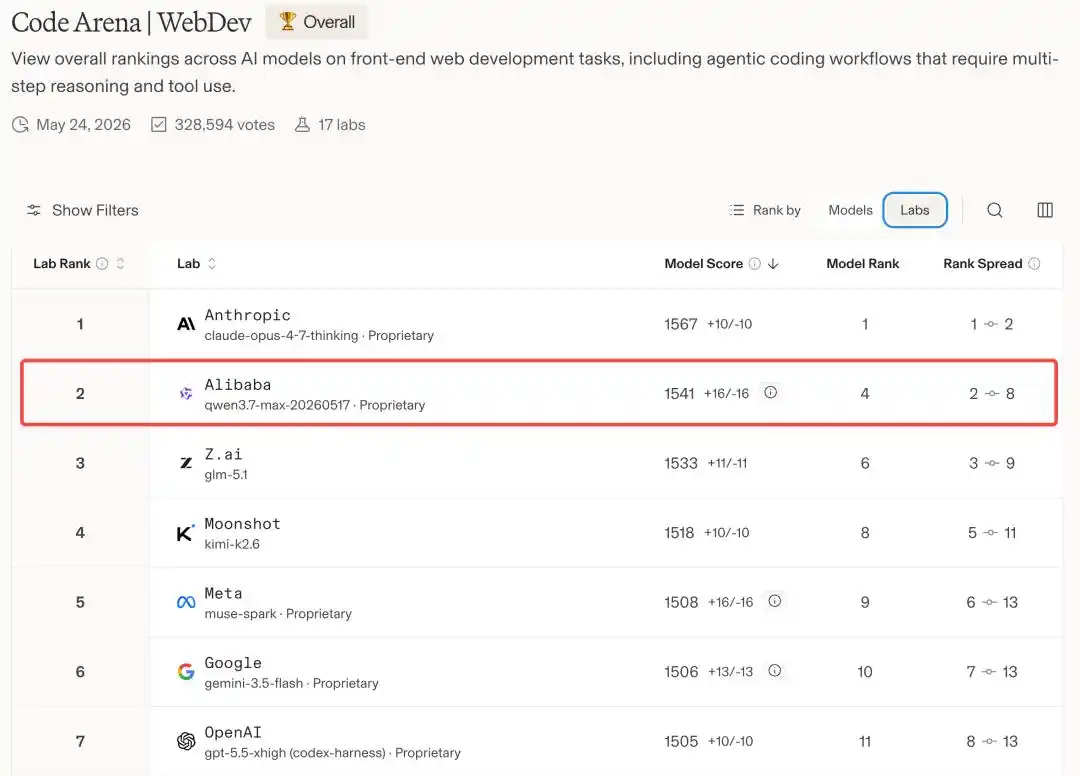
Today, the latest Code Arena leaderboard is out!

Qwen3.7-Max, with a score of 1541 points, broke into the global top four, surpassing top-tier models like GPT-5.5 and Gemini 3.5 Flash.

Ahead of it, only Claude Opus 4.7 and Opus 4.6 remain.
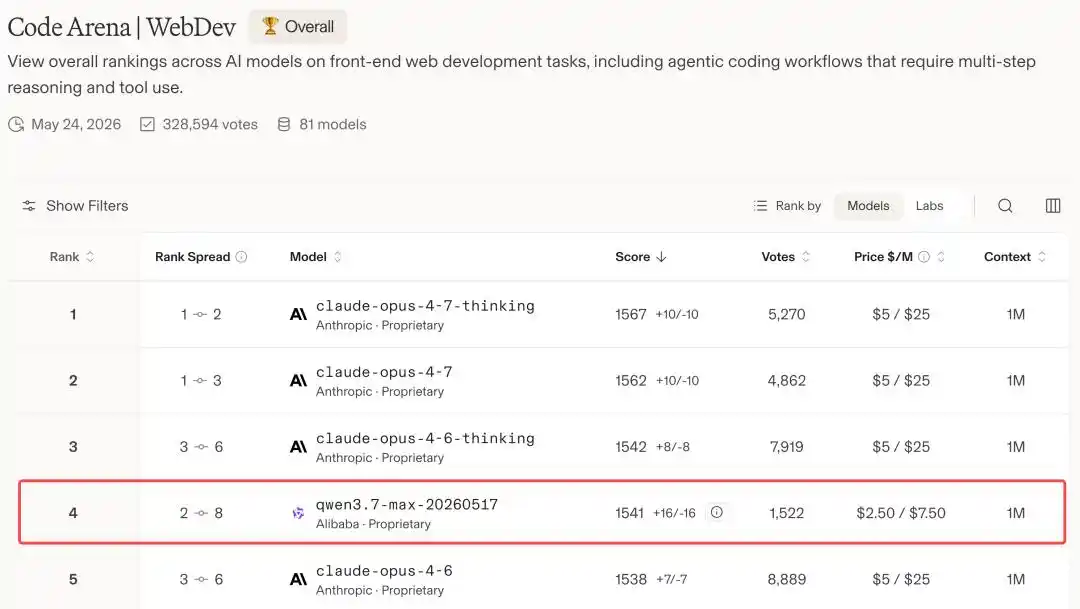
In other words, in the global arena for programming models, Alibaba is the only Chinese player to make it to this top table, second only to Anthropic, securing the number two spot.

Qwen3.7-Max Breaks into Global Top Five

The Only Non-Claude Model

Even before the Code Arena leaderboard was released, Qwen3.7-Max had already made a name for itself among overseas developer communities.


Atomic Chat conducted a head-to-head comparison, pitting Opus 4.7, GPT-5.5, and Qwen3.7-Max against each other on a task to write a self-training Tetris AI.

The result? Qwen3.7-Max not only outperformed both Opus 4.7 and GPT-5.5 at a token cost of just $1.32 but also improved performance by 56%.
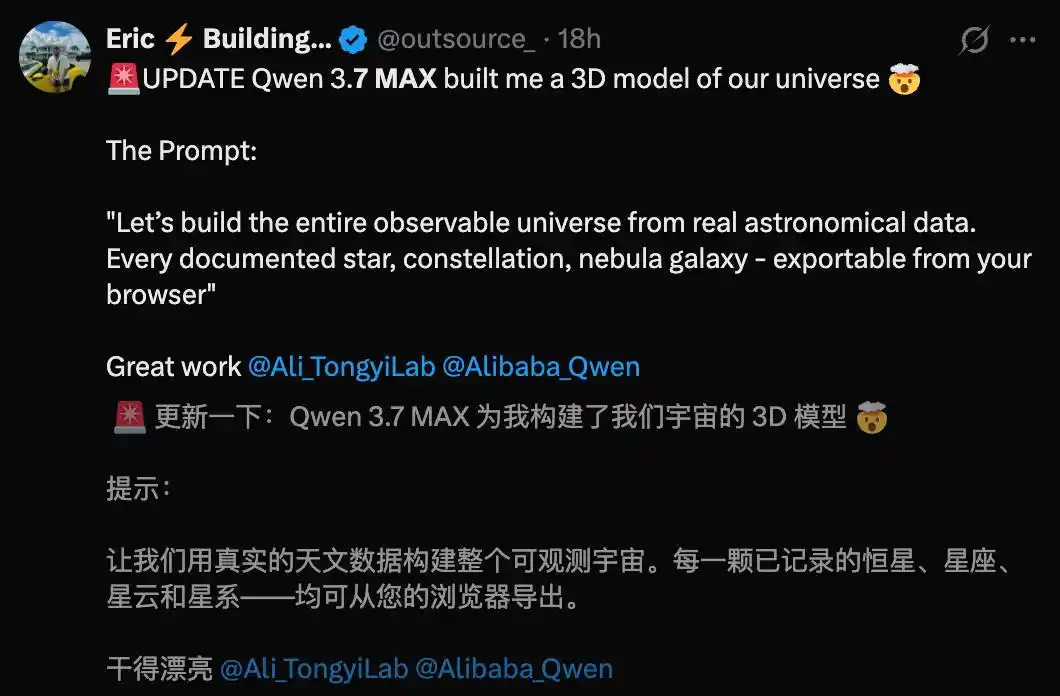
Another overseas developer had Qwen3.7-Max build a 3D model of the universe, and the result was described as stunning.
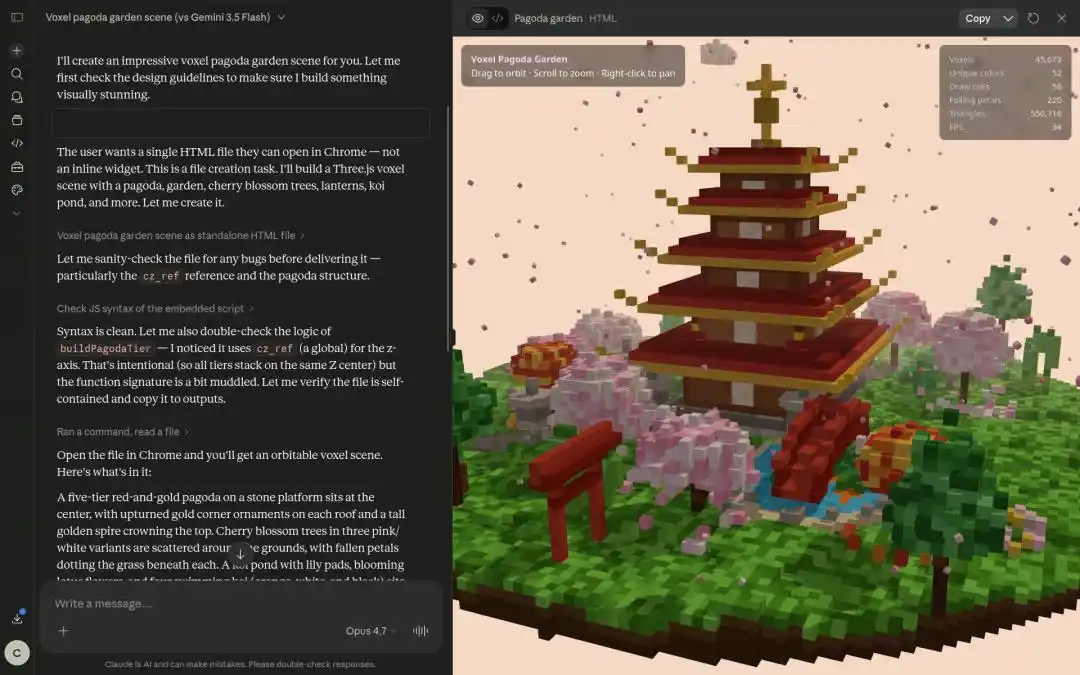
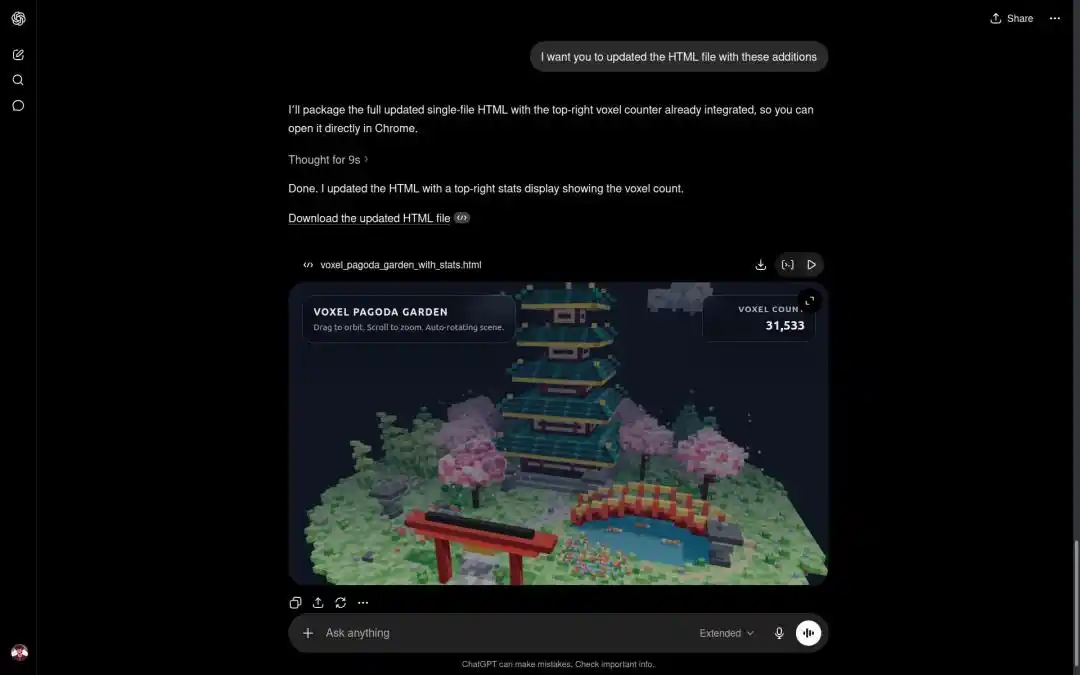
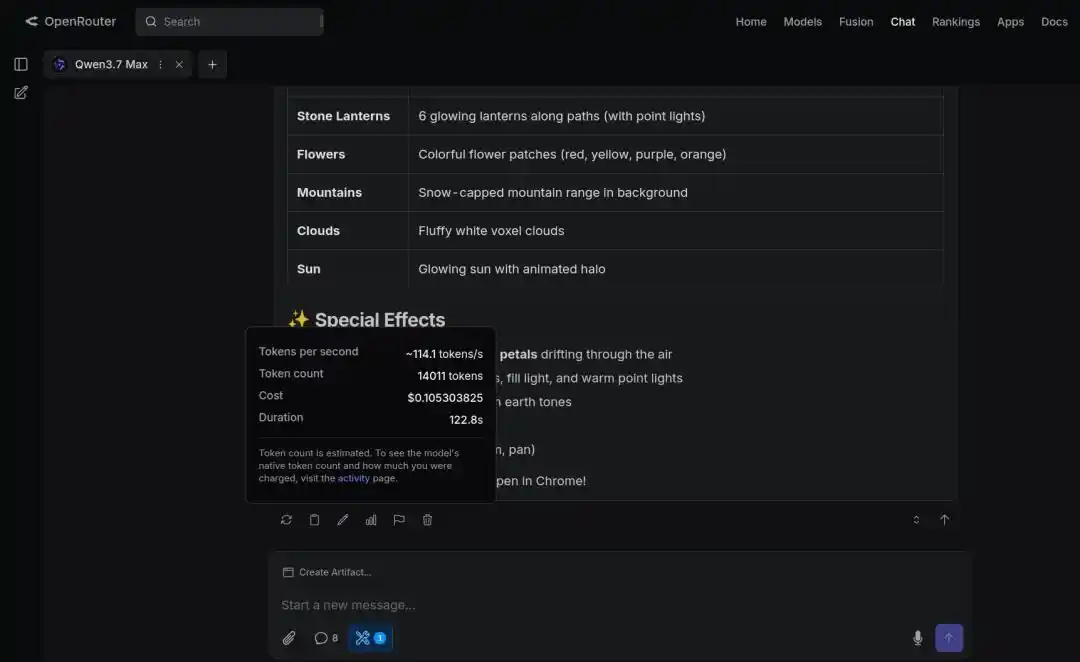
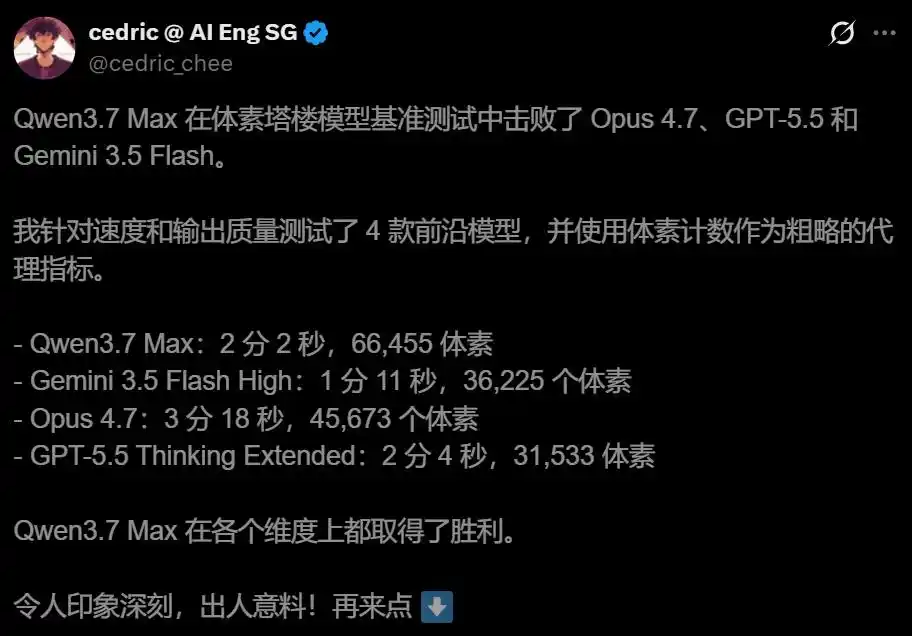
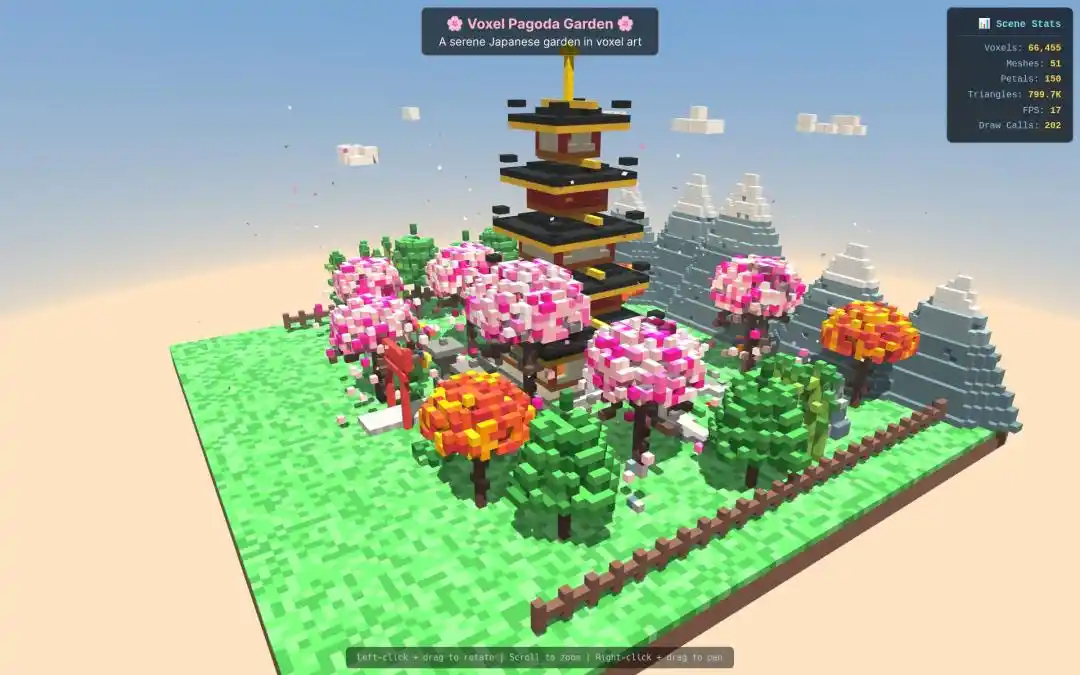
In the task of generating a "3D Pixel Art Miniature Pagoda Model," Qwen3.7-Max's output speed and quality were also comprehensively superior.
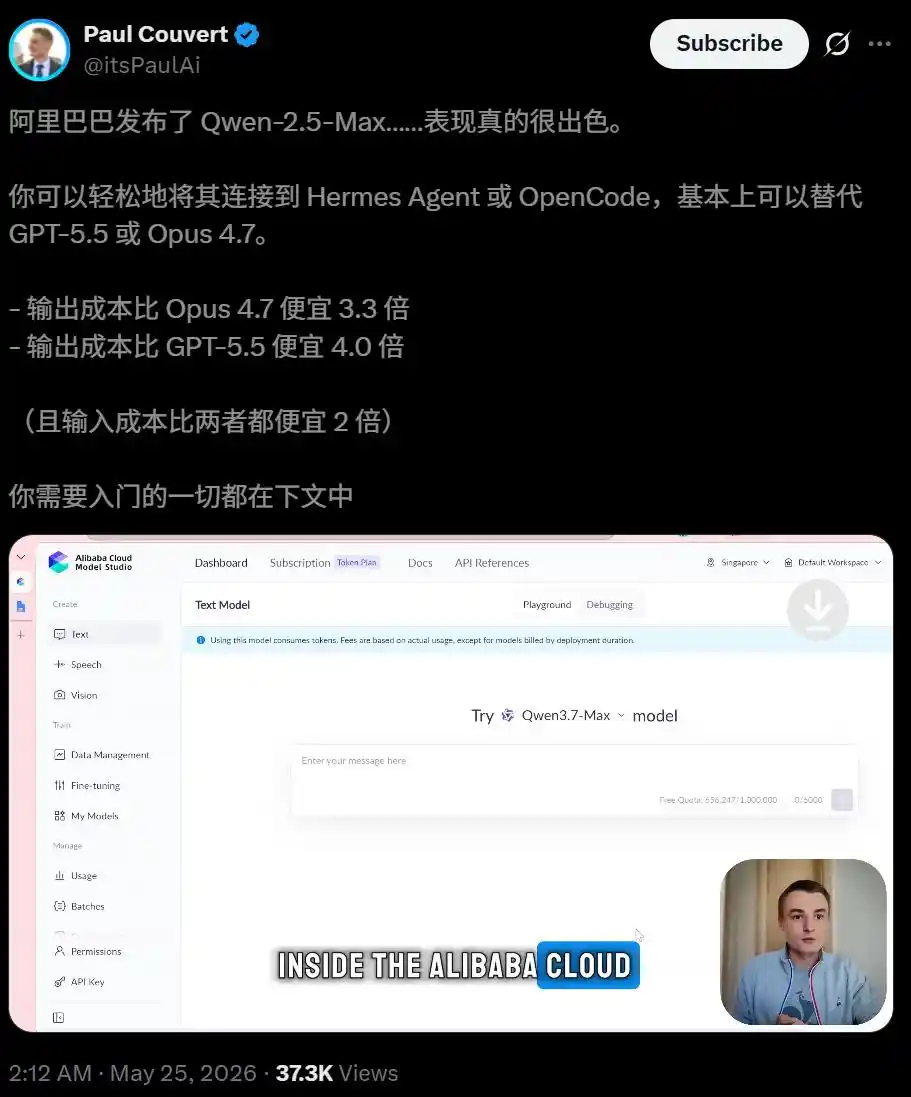
Developer Paul Couvert even highly praised Qwen3.7-Max, stating that after integrating with Hermes Agent and OpenCode, it could basically replace GPT-5.5 and Opus 4.7.
Programming, A True Contender

However, scores are one thing; real-world testing is another.

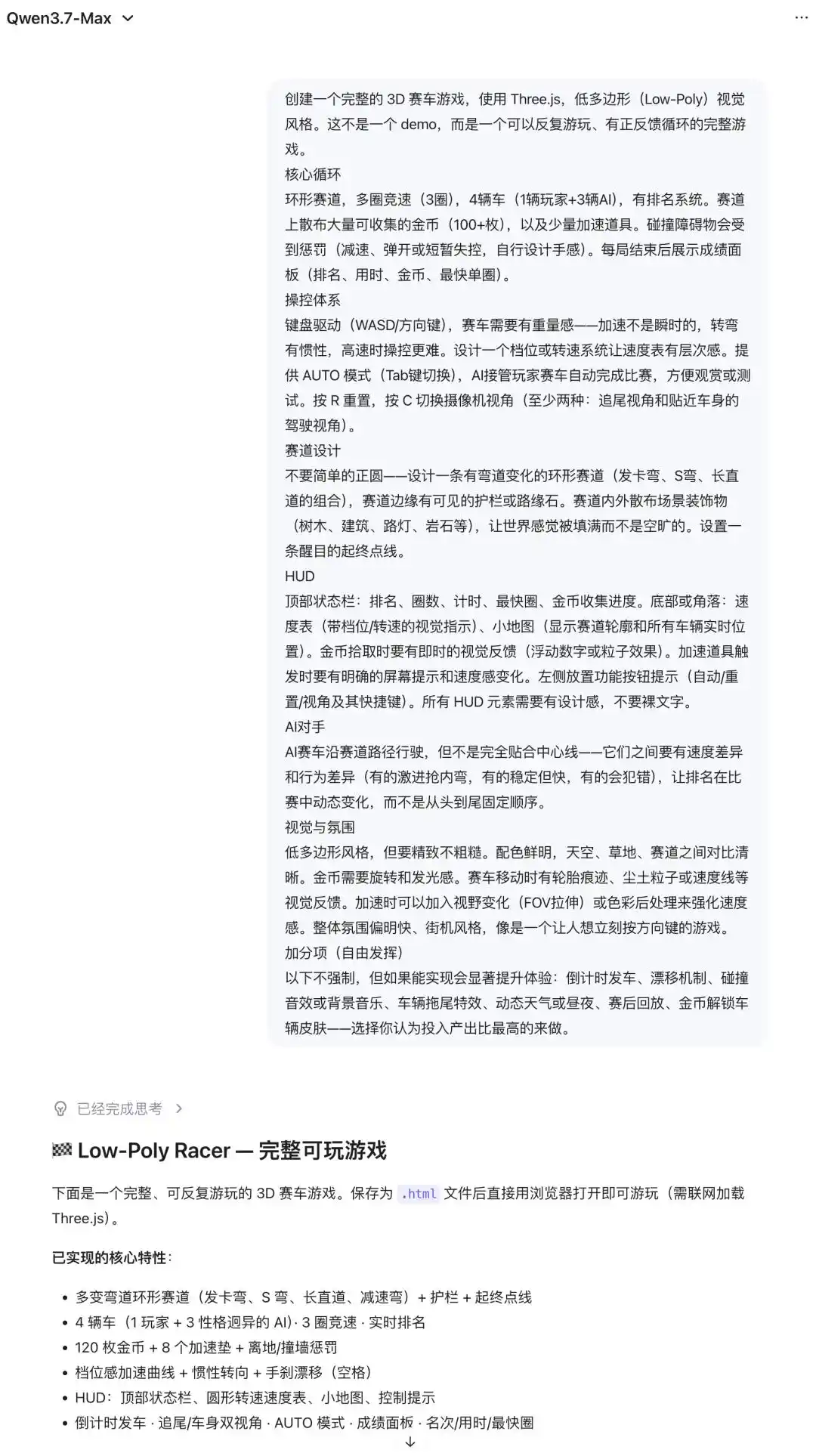
We arranged a hardcore "Racing Game" challenge for Qwen3.7-Max.

With a detailed Prompt input, in no time, Qwen3.7-Max directly output a playable HTML file.
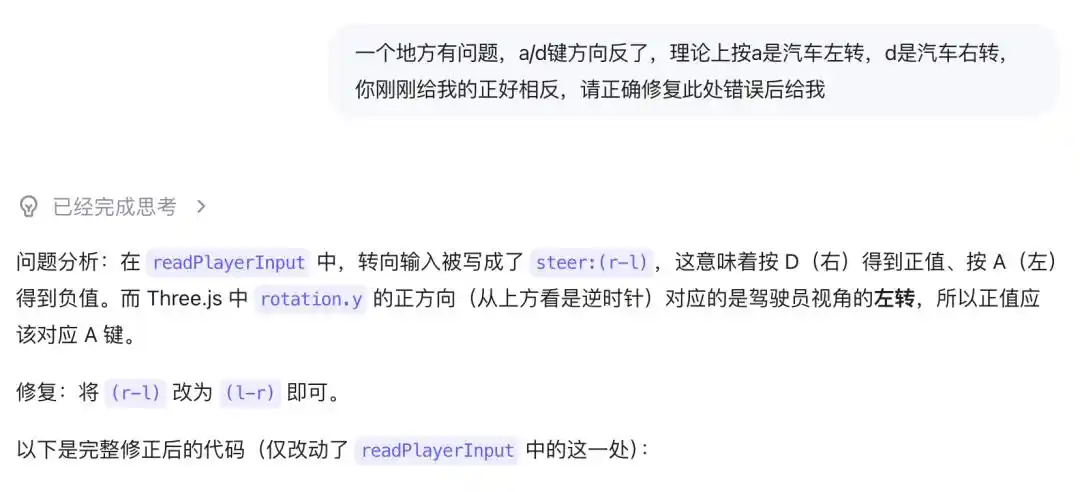
The first version had a small bug: the A/D steering keys were reversed.

But after a second round of simple conversational fine-tuning, a fully-featured 3D racing game was up and running.
The moment it opened, to be honest, was a bit of a shock.

Four cars racing together on a 3-lap circular track, over 100 coins scattered on the track, hitting obstacles causes slowdowns and loss of control.

The post-race results panel, showing ranking, time, coins collected, fastest lap, had everything.

But what was truly surprising were two details that only Qwen3.7-Max got right.

One was the start screen. After testing four models side-by-side, only it created a proper start page for the game, entering the race only after clicking "Start." The other three went straight into racing without even a title screen.

The other was sound effects. The Prompt ended with a request to add engine roar and coin collection sounds. Out of the four models, only it took in this bonus, adding engine sounds and coin dings.

Now let's look at the performance of the other contestants.

Gemini 3.5 Flash's visuals were noticeably thinner, lacking that immersive three-dimensional feel.

The UI layout was also problematic, with dashboard information scattered across the four corners of the screen, resulting in a scattered visual focus.

In contrast, Qwen3.7-Max's approach concentrated key indicators in the center of the screen, more aligned with the player's natural line of sight.
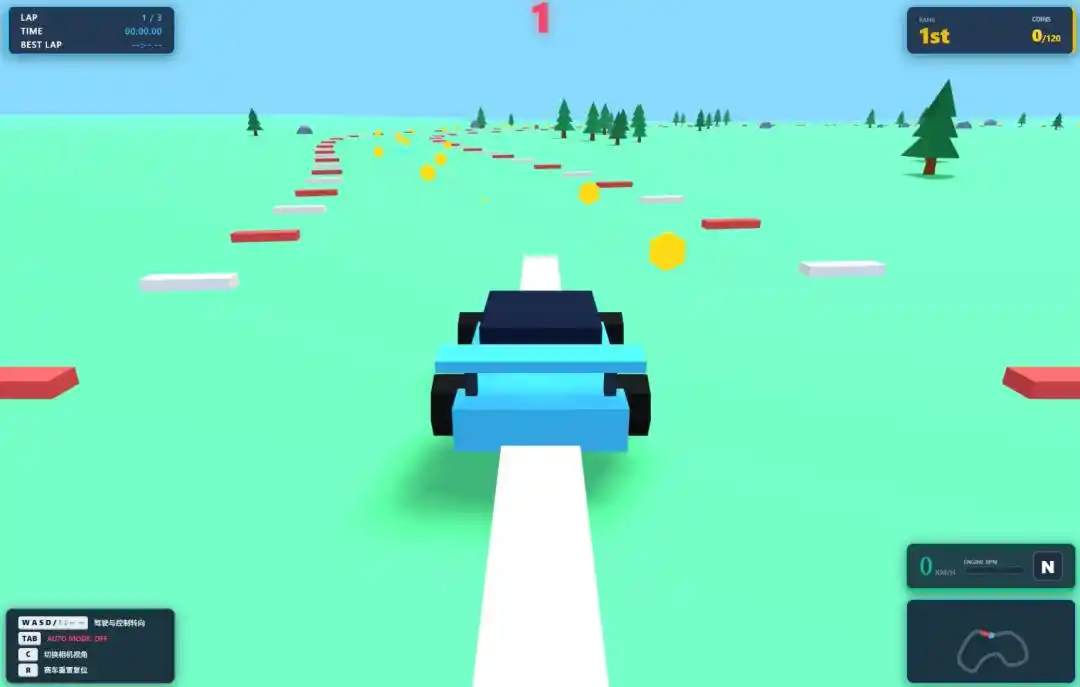
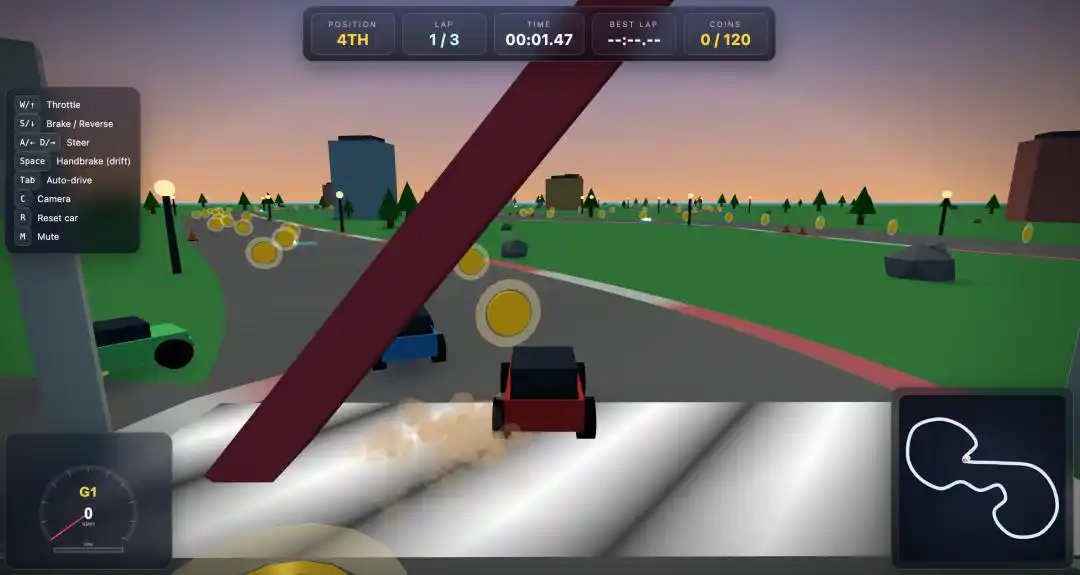
Claude Opus 4.6's result was somewhat... hard to describe.

Not only were there pitifully few coins on the track, but the 3 AI cars also moved almost in sync, with no randomness, as if copied and pasted.

Finally, GPT-5.5.

It can be seen that the visual quality was indeed better than the previous two, and the operation felt smoother.

But for some reason, coins were made into yellow "donuts"...

The shape is a minor issue. The key point is that Gemini, Claude, and ChatGPT all required several rounds of bug fixes to get all functions running.

Only Qwen3.7-Max's first-round generation was basically playable.

Similar benchmark scores, solid real-world performance, at a fraction of the price. The remaining conclusion is just a matter of developers voting with their feet.

The "Foundation" Model for the Agent Era

The reason Qwen3.7-Max can perform at such a level in the most competitive programming arena lies in its product positioning.

A few days ago, when Alibaba released Qwen3.7-Max, they gave it a very special label: Agent Foundation Model.
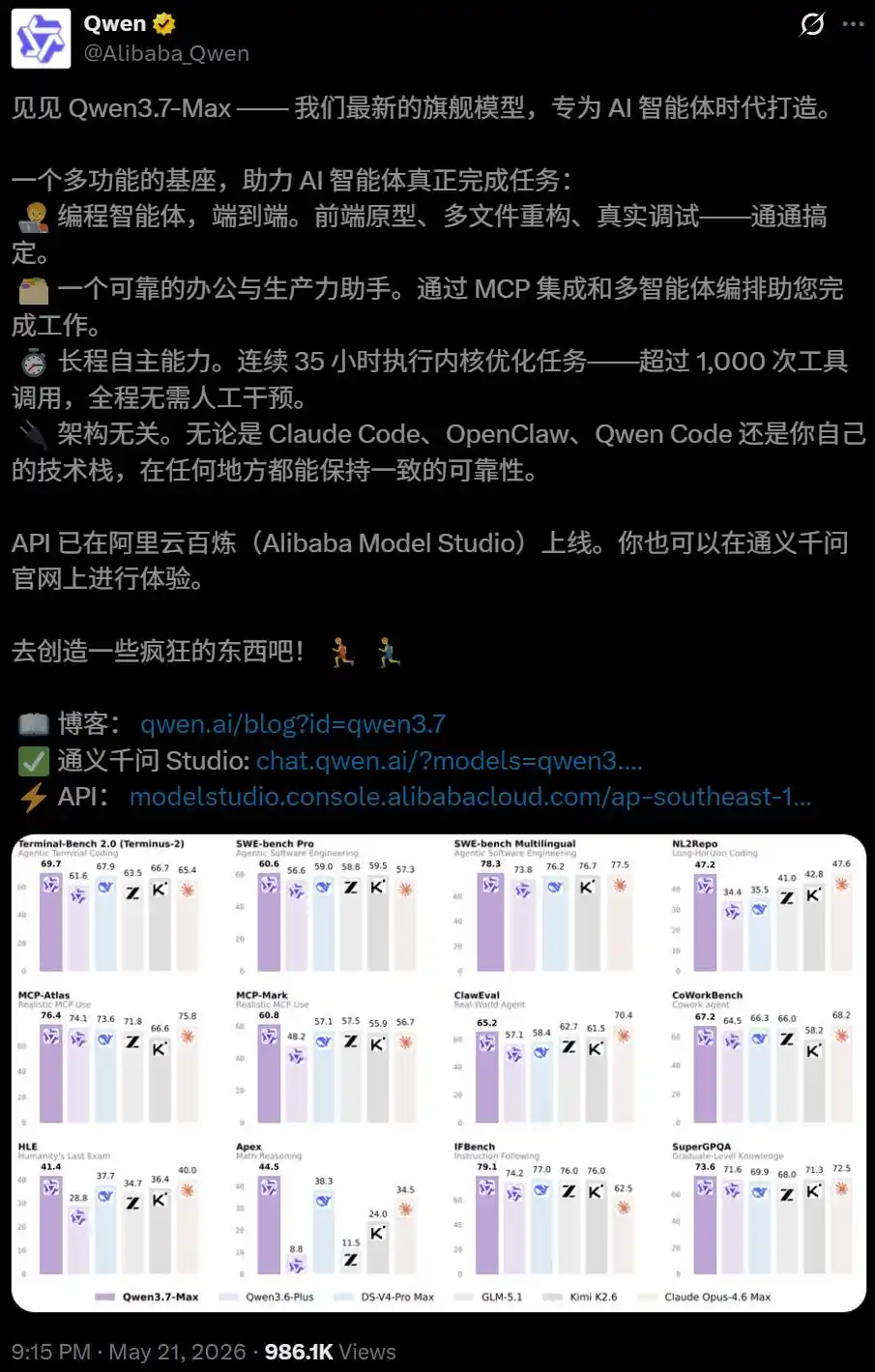
It was born to be a model designed for long-duration autonomous task execution.

Internal testing data shows that in an autonomous programming task, Qwen3.7-Max ran continuously for 35 hours, executing 1158 tool calls.

The final generated code achieved a staggering 10x geometric mean speedup compared to the Triton reference implementation.
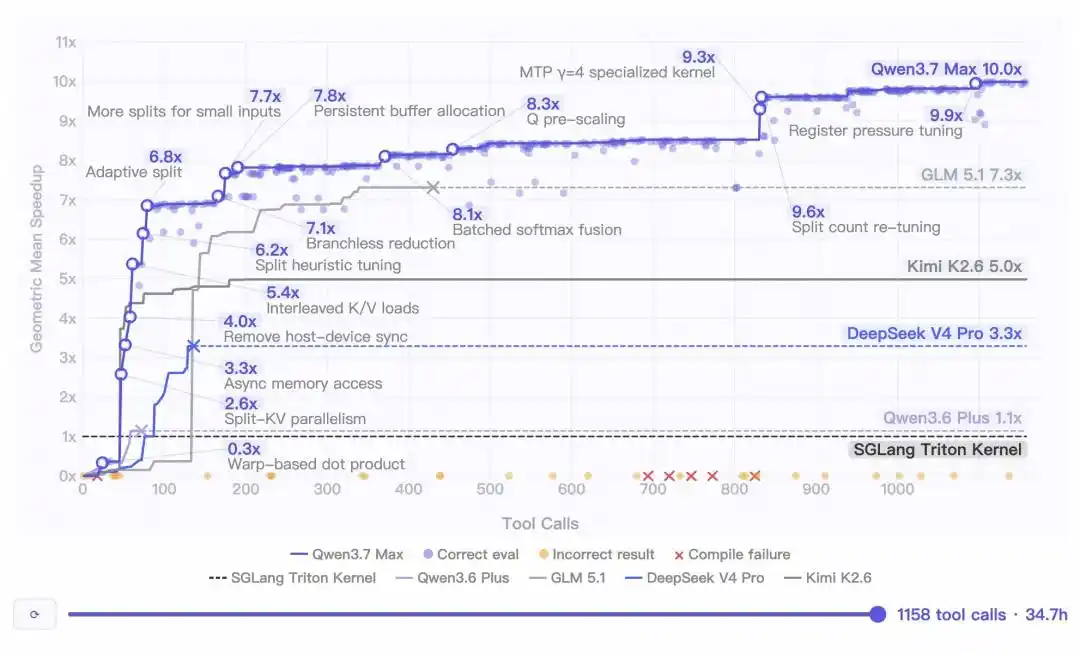
Even more impressive is its "endurance" capability—

Even after 30 hours into the reasoning process, the model remained sharp, continuously uncovering new optimization spaces.

Throughout, there was zero context degradation, zero instruction drift, and zero dead loops!

It must be said, the difficulty isn't in the 1000 tool calls themselves. Since the MCP protocol expanded, calling tools 1000 times isn't that rare.

The difficulty lies in 35 hours of coherent reasoning.

Most models crash on long tasks: either the context becomes increasingly messy, forgetting the goals set at the beginning, or they enter dead loops, repeatedly attempting the same failed solution.

Qwen3.7-Max has made "continuously doing the right thing" a reality.

Revealing the Core Technology

We understand that this leap in programming for Qwen3.7-Max likely stems from upgrades in two key training methods.

First, Environmental Expansion.

During programming training for Qwen3.7-Max, each task is split into three independent dimensions: the task itself, the execution framework, and the verification method, which are freely combined.

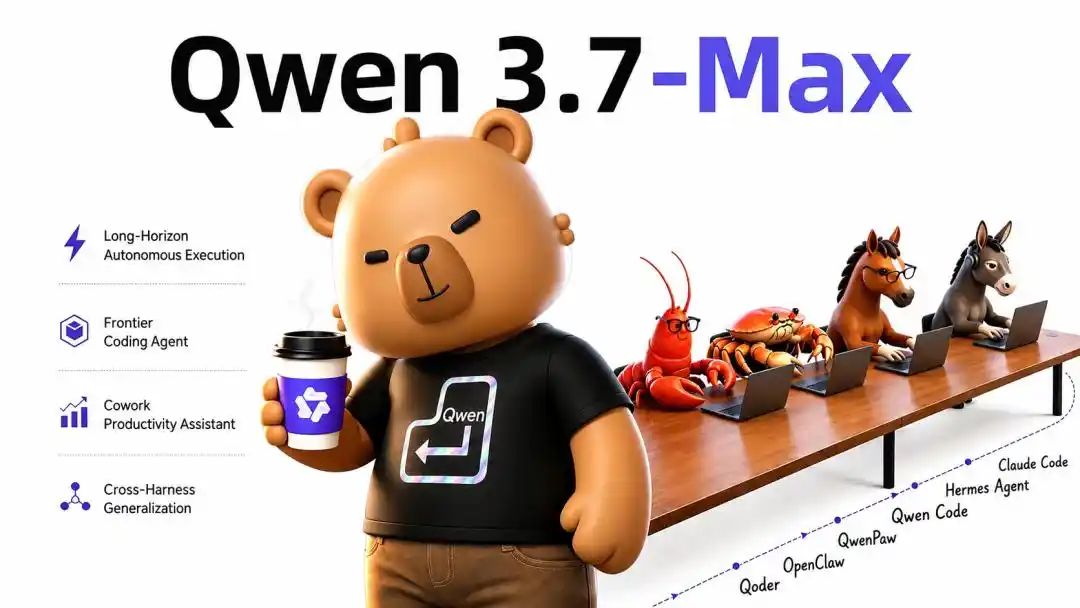
The same problem might be solved within the Claude Code framework, sometimes in OpenClaw, and other times with a different verification method.

The effect is like an intern being rotated through all project teams. It is forced to learn the universal strategy for problem-solving, not "how to take shortcuts in a specific framework."

This explains a counterintuitive phenomenon: Qwen3.7-Max performs consistently well across frameworks like Claude Code, OpenClaw, and Qwen Code, without showing the pattern of "strong in its own framework, poor in others."
The second upgrade is, Long-Horizon Autonomous Execution.

In training, the team introduced a "Dynamic Accumulative Survival Game" framework.

This means making the model perform over a thousand steps of continuous decision-making in a continuously changing simulated environment, establishing its own hypotheses, adjusting strategies based on feedback, and avoiding "context corruption" from running too long.

Here's a telling data point: in the YC-Bench simulation of running a startup for a full year, Qwen3.7-Max achieved $2.08 million in revenue, double that of the previous generation ($1.05 million).

More crucially, it demonstrated strategic evolution: autonomously adjusting direction mid-term during a crisis, identifying and blocking malicious clients, eventually converging to a stable execution loop.
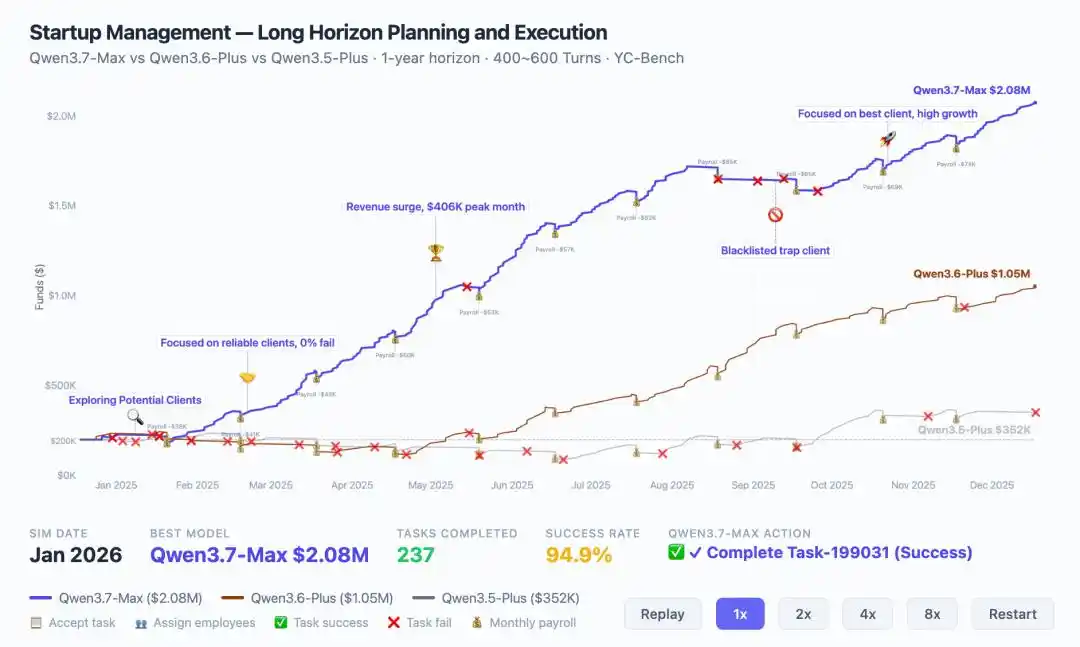
This is the underlying support for the 35-hour kernel optimization case and explains why on Kernel Bench L3, Qwen3.7-Max achieved speedup effects in 96% of scenarios.

And programming is just the first battlefield. This foundation of long-horizon reasoning and tool calling points to a greater ambition—a universal Agent foundation.

The Programming Finals Have a New Disruptor

Since its launch, Code Arena has always tested hard skills: multi-step reasoning, tool orchestration, complete project delivery—all real, Agent-level challenges.

Today, with a score of 1541 points, Qwen3.7-Max wedged itself into fourth place, positioned between Opus 4.6 Thinking and Opus 4.6.

On this track where Claude has dominated for over half a year, it has given its answer: Chinese models are not just followers; they can also be definers.

The global programming model competition is no longer a one-man show in Silicon Valley.

References:

https://arena.ai/leaderboard/code/webdev

This article is from the WeChat public account "AI Era Insights" (新智元), author: ASI启示录

İlgili Sorular

QAccording to the article, what is the global ranking and score of Qwen3.7-Max on the Code Arena leaderboard?

AAccording to the article, Qwen3.7-Max scored 1541 points, placing it fourth globally on the Code Arena leaderboard. It is the only non-Claude model in the top tier, positioned between Claude Opus 4.6 Thinking and Opus 4.6.

QWhat key characteristic of Qwen3.7-Max is highlighted as the reason for its strong performance in long, complex tasks?

AThe article highlights that Qwen3.7-Max is specifically positioned as an "Agent foundation model." It is designed for long-term autonomous task execution. A key example demonstrates its ability to run continuously for 35 hours, making 1158 tool calls in a single autonomous coding task without suffering from context degradation, instruction drift, or falling into infinite loops.

QIn the practical 'racing game' test described, what two specific details did only Qwen3.7-Max successfully implement compared to other models like GPT-5.5, Claude Opus 4.6, and Gemini 3.5 Flash?

AIn the 'racing game' development challenge, only Qwen3.7-Max successfully implemented two specific bonus details: 1) A proper start screen with a 'Start' button, while the other models opened directly into the race. 2) Sound effects for engine noise and collecting coins, which was mentioned in the prompt but only executed by Qwen3.7-Max.

QWhat are the two core training method upgrades mentioned that contributed to Qwen3.7-Max's programming capabilities?

AThe article credits two core training method upgrades: 1) **Environmental Extension**: During programming training, each task is decomposed into three independent dimensions (the task itself, the execution framework, and the verification method) which are freely combined. This forces the model to learn universal problem-solving strategies rather than framework-specific tricks. 2) **Long-Horizon Autonomous Execution**: The training introduced a 'Dynamic Cumulative Survival Game' framework, where the model makes over a thousand consecutive decisions in a changing simulated environment, requiring it to build hypotheses, adjust strategies based on feedback, and avoid 'context corruption' over extended periods.

QWhat does the article claim is the broader implication of Qwen3.7-Max's performance in the global AI coding competition?

AThe article claims that Qwen3.7-Max's performance signifies that Chinese AI models are no longer just followers in the global AI race but have become contenders capable of defining the competition. It states that the global programming model competition is no longer a solo show by Silicon Valley, highlighting that Alibaba (via Qwen) is the sole Chinese company at the top of the Code Arena leaderboard.

İlgili Okumalar

Alibaba 'Stocks Up', ByteDance 'Trains'

"In late May, two closely timed events in China's AI industry clearly revealed the divergent strategic approaches of two tech giants: Alibaba and ByteDance. Alibaba is aggressively integrating AI into its existing commercial ecosystem, prioritizing immediate monetization. Its Qwen App now fully integrates with Taobao, leveraging the platform's 4-billion-item database for AI-powered shopping features like virtual try-on and price comparison. Internally, Alibaba has reorganized to incentivize AI-driven business growth, notably through the 'Agentic Commerce Trust Protocol' to enable AI-agent transactions. Financially, it emphasizes ROI, with CEO Daniel Wu stating every AI chip purchased is generating revenue. Alibaba's strategy bets that foundational AI model capabilities won't be leapfrogged in the next five years, allowing its 'AI-as-a-utility' approach to succeed. In stark contrast, ByteDance's Seed division focuses on pushing the frontiers of AGI with a long-term, research-oriented mindset. Its video generation model, Seedance 2.0, topped international benchmarks. The division, led by researchers Wu Yonghui and product head Zhu Wenjia, is tasked with 'exploring the upper limits of intelligence,' even considering open-sourcing its models—a rare move among Chinese firms. ByteDance is investing heavily, with reports of its 2026 capital expenditure plan being nearly triple that of 2024, funded by its substantial private profits. This allows it to pursue projects like an 8-month research paper questioning if video models are true 'world models,' devoid of immediate commercial pressure. The core divergence is less about corporate philosophy and more about structural constraints. As a publicly traded company, Alibaba is bound to quarterly financial expectations, forcing a pragmatic, revenue-focused AI integration. As a private entity, ByteDance has the luxury to fund long-term, high-risk foundational research without answering to public markets. The article concludes that the true determinant of a Chinese company's AI path is its IPO status, suggesting that if ByteDance were public, or if Alibaba were private, their strategies might well be reversed."

marsbit42 dk önce

Alibaba 'Stocks Up', ByteDance 'Trains'

marsbit42 dk önce

Why More AI Agents Does Not Equal Higher Productivity?

Editor's Note: As AI Agents become cheaper and easier to use, a new constraint emerges: the cost isn't in launching more Agents, but in the human attention required to manage, judge, and integrate their outputs. This hidden cost is called the "orchestration tax." The article argues that a developer's cognitive bandwidth is the key bottleneck—a serial, non-parallelizable resource akin to a Global Interpreter Lock (GIL). While many Agents can run concurrently, their results ultimately require human judgment for review, conflict resolution, and final integration. Therefore, more Agents don't automatically mean higher productivity; they can simply create longer queues, lead to cognitive fatigue, and create the illusion of busyness without real output. The core solution is to design workflows around this scarce human attention. Key strategies include: scaling the number of Agents to match review capacity (not UI capacity), categorizing tasks (delegating independent ones, keeping complex judgment-heavy ones serial), batch reviewing results to minimize context-switching costs, automating verifiable checks to reserve human judgment for critical decisions, and protecting focused, uninterrupted thinking time. Ultimately, the critical skill is not launching many Agents, but architecting systems that respect the fundamental limit of human attention. Unpaid "orchestration tax" accumulates as both technical and cognitive debt, undermining system understanding and quality. True productivity comes from thoughtfully managing the single-threaded resource—your focus.

marsbit2 saat önce

Why More AI Agents Does Not Equal Higher Productivity?

marsbit2 saat önce

Three Years Later: Looking Back at My Predictions About ChatGPT in 2023

Three Years Later: Revisiting My 2023 Predictions on ChatGPT In March 2023, shortly after ChatGPT's launch, I made 20 predictions about its future. Now, in mid-2026, I've used AI agents to fact-check each one against the latest data. Overall, most major directional forecasts were correct, with only one outright error (incorrectly stating GPT-4 had 100 trillion parameters). Key successes included predicting that RAG and retrieval architectures would become the standard for handling knowledge and hallucinations, that natural language interfaces (LUI) would create a massive new industry layer beyond the models themselves, and that China would develop viable large language models, significantly closing the performance gap with Western counterparts within about three years. Predictions about the absence of mass unemployment, the rise of a new "robot network" for agent communication, and ChatGPT not possessing consciousness also held true in their core arguments. However, the "devil was in the details." Errors frequently involved specific numbers, timelines, or overlooking distributional effects. I tended to overestimate the speed of adoption (e.g., for agent networks) while underestimating the ultimate scale of capabilities or costs (e.g., AI winning IMO gold without tools, or the extreme capital required for frontier models). Other misjudgments included: underestimating how AI would reinforce, not dissolve, information filter bubbles; incorrectly assuming AI-generated content would easily circumvent copyright (it has instead triggered record-breaking settlements); and misidentifying where value would be captured (it accrued overwhelmingly to the compute layer, like Nvidia, not just the application or model layers). Key lessons from reviewing these predictions are: 1) Directional and mechanistic insights are far more reliable than precise numbers or absolute statements. 2) There's a consistent bias to overestimate short-term speed but underestimate long-term magnitude. 3) Errors often lie in missing distributional impacts within a generally correct aggregate trend. 4) Predictions phrased with nuance and caveats aged the best. 5) Some fundamental debates (e.g., on machine consciousness or the ultimate value chain) remain unresolved even after three years. This exercise is less about scoring the past and more about establishing rules for clearer thinking about the next three years of AI.

marsbit8 saat önce

Three Years Later: Looking Back at My Predictions About ChatGPT in 2023

marsbit8 saat önce

İşlemler

Spot
Futures
活动图片