Jito Foundation to return to US amid 'clearer rules' for digital assets

cointelegraph2025-12-17 tarihinde yayınlandı2025-12-17 tarihinde güncellendi

Özet

The Jito Foundation, a nonprofit supporting the Solana-based MEV infrastructure platform Jito, has decided to return to the United States, citing clearer regulatory rules for digital assets. The organization had previously moved operations overseas due to debanking and regulatory hostility during what industry figures call "Operation Chokepoint 2.0." Jito Labs CEO Lucas Bruder stated that banks and vendors refused to work with them, creating significant legal risks. Recent developments, including the passage of the GENIUS stablecoin bill and progress on a crypto market structure bill, influenced the decision to return. Despite a more favorable regulatory environment under the new SEC leadership, some crypto industry executives report that debanking practices continue.

The Jito Foundation, the nonprofit organization facilitating the development of the Jito platform, said it will return to the United States, citing “clearer rules” for digital assets in the country.

Jito is a maximal extractable value (MEV) infrastructure builder for the Solana network. MEV refers to the profit that traders or validators can make by controlling the order, inclusion or exclusion of transactions in a blockchain block. By rearranging transactions before they are confirmed, MEV participants can capitalize on opportunities such as arbitrage or front-running to earn extra fees on transaction rewards.

The Jito Foundation was forced to operate overseas due to the debanking of the crypto industry during the so-called Operation Chokepoint 2.0, according to Lucas Bruder, co-founder and CEO of Jito Labs. Bruder, pseudonymously known as “buffalu,” said:

“Banks wouldn’t service us. Vendors wouldn’t contract with us. Every product decision carried real but unquantifiable legal risk from a hostile and capricious regulatory agency gone rogue.”
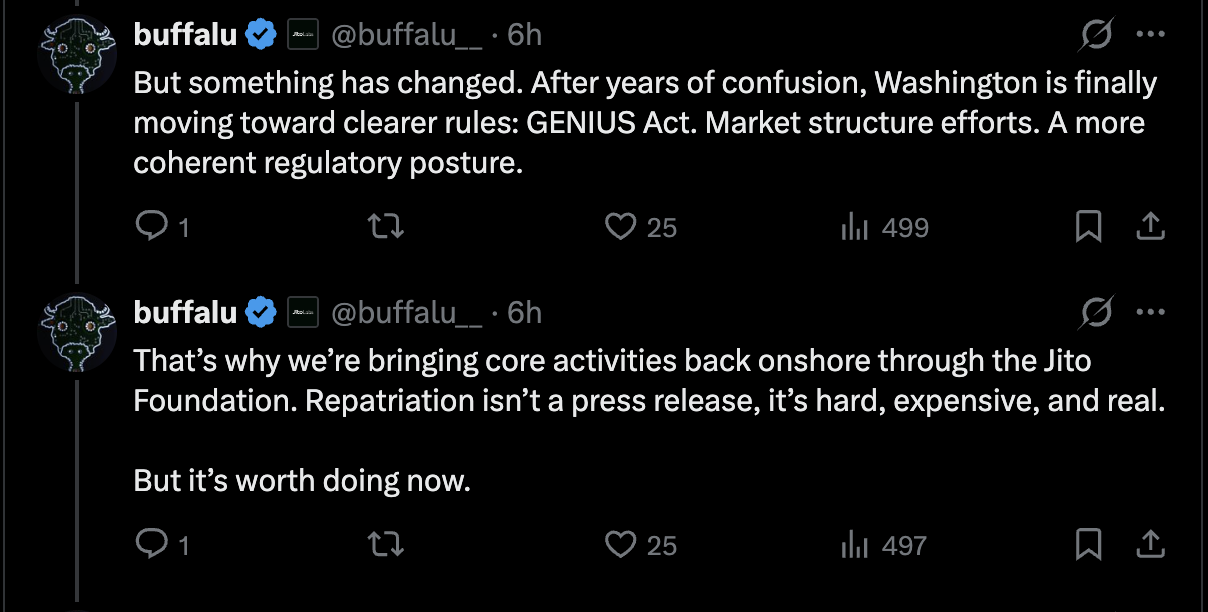
Source: buffalu

Bruder cited recent regulatory changes, including the passage of the GENIUS stablecoin bill and lawmakers working on a crypto market structure bill, as reasons for the Jito Foundation returning to the US.

The announcement reflects the regulatory sea change in the US, particularly at the Securities and Exchange Commission (SEC), following the 2024 presidential election and the appointment of Paul Atkins as SEC chair.

Related: ‘Grow up... We debank Democrats, we debank Republicans:’ JPMorgan CEO

Crypto industry executives say Operation Chokepoint 2.0 is ongoing in 2025

Even with a pro-crypto administration in the White House and at the SEC, crypto industry executives continue to report being victims of debanking.

In November, Jack Mallers, the CEO of Bitcoin Lightning Network payments company Strike, said JPMorgan Chase closed his personal bank account.

The financial services giant did not specify the reason for closing the account, Mallers said, adding that his father had been a private client for over 30 years.
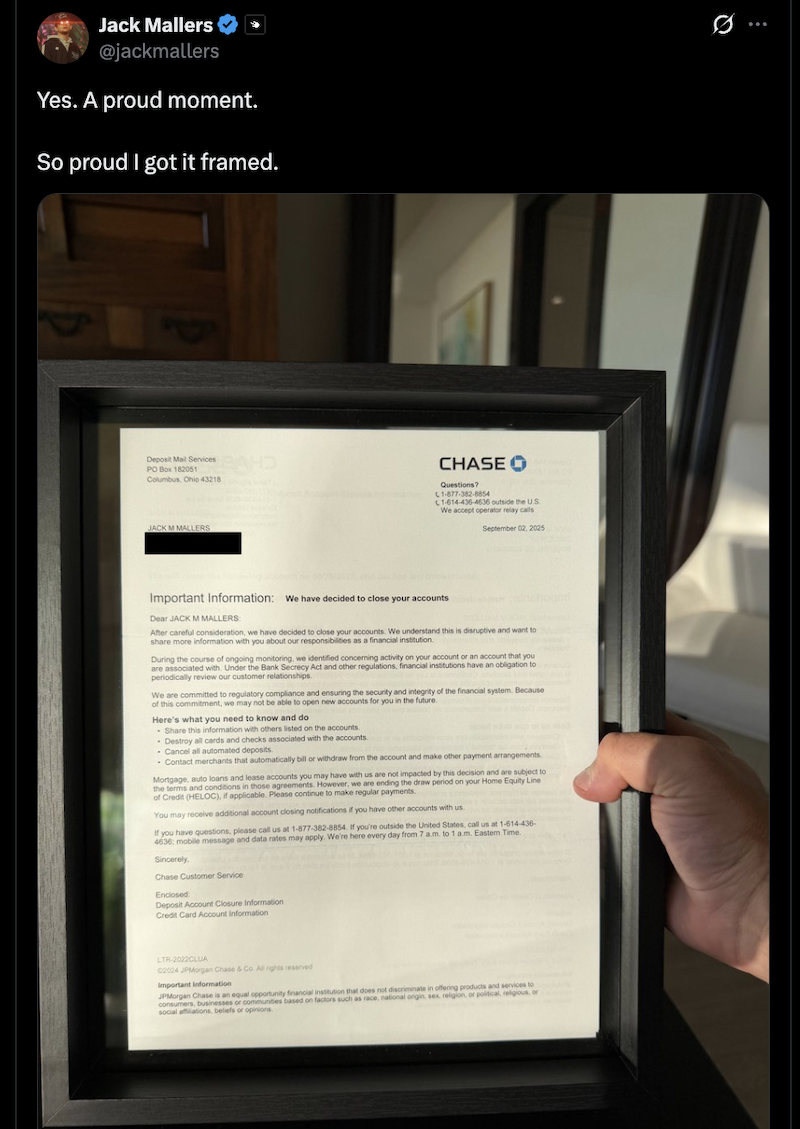
Jack Mallers shares a framed copy of the debanking letter he received from JPMorgan Chase. Source: Jack Mallers

In August, Alex Rampell, a general partner at venture capital firm Adreessen Horowitz, warned of the continuation of Operation Chokepoint by the banking industry through other tactics.

These tactics include banks charging excessive fees for clients moving crypto to wallets, centralized exchanges, Web3 applications and other digital asset service providers or outright blocking transfers to specific crypto platforms, Rampell said.

Magazine: Proton Mail exposing activists’ info showed the limits of encryption

İlgili Okumalar

Huang Renxun Dramatically 'Saves' South Korean Stock Market

In early June, South Korea's stock market experienced a sharp decline, with the KOSPI index dropping over 5% and triggering a trading halt. Amid this volatility, NVIDIA CEO Jensen Huang's visit to Seoul provided a dramatic boost to market sentiment. During his trip, Huang held a dinner meeting with SK Group Chairman Chey Tae-won and SK Hynix CEO Kwak Noh-Jung. He announced that NVIDIA's new Vera CPU would utilize SK Hynix DRAM and confirmed a multi-year technical collaboration between the two companies. This partnership aims to co-develop next-generation memory for NVIDIA's AI infrastructure roadmap, covering products from data center supercomputers to personal AI devices. Huang also publicly commented that AI company stocks were attractively priced. A key announcement was that NVIDIA's upcoming Vera Rubin AI supercomputer systems will use HBM4 memory, with supply qualifications granted to all three major suppliers: SK Hynix, Samsung Electronics, and Micron Technology. Despite this multi-sourcing strategy, Huang warned that the industry-wide chip shortage, affecting everything from wafers to packaging, is expected to persist for several years due to relentless demand from global AI factory construction. The collaboration extends beyond memory supply. SK Hynix will employ NVIDIA's AI platforms and Omniverse digital twin technology to enhance its own semiconductor design, simulation, and manufacturing processes, aiming for more autonomous factory operations. This visit builds upon a prior October 2025 agreement for SK Group to build a large-scale AI data center using over 50,000 NVIDIA GPUs. Huang's itinerary also included meetings with other Korean giants like Hyundai, LG, and Samsung, indicating NVIDIA's broader strategy to deepen ties with South Korea's tech industry.

链捕手5 saat önce

Huang Renxun Dramatically 'Saves' South Korean Stock Market

链捕手5 saat önce

When Inference Becomes a Scarce Resource, Who Captures the Value?

When Inference Becomes the Scarce Resource, Who Captures the Value? The core AI bottleneck has shifted from model training to inference (runtime execution). While concerns persisted about an "AI compute gap"—initially a $200B, now a $600B problem—the market is now recognizing that the solution and value lie in the inference layer. Nvidia's financial restructuring around "serving tokens" and Cerebras's successful IPO highlight this shift. Inference is a recurring, usage-based cost, estimated to be 10-50x larger than the one-time training market, especially with the rise of agentic AI. The inference stack spans six layers: silicon (e.g., Nvidia), bare metal (e.g., CoreWeave), GPU rental/aggregation, deployment/optimization, model APIs, and end applications. Most companies operate in one layer. However, Hyperbolic uniquely spans three layers (GPU rental, deployment, and model APIs) without owning any hardware. It aggregates fragmented GPU supply from multiple cloud providers into a standardized pool, offering developers the cheapest available compute through intelligent routing. Its multi-cloud aggregation creates a data moat and a flywheel: more supply leads to better pricing data and liquidity, attracting more developers and providers. In contrast, applications like Venice operate at the top of the stack, reselling privacy-wrapped inference but remaining dependent on and constrained by the underlying compute costs they purchase. As inference demand explodes, value accrues not just to consumer applications but increasingly to the aggregation and routing layer that captures their cost of revenue. The coming potential GPU oversupply reinforces this dynamic. While hardware owners may suffer from depreciation, asset-light aggregators like Hyperbolic benefit from price arbitrage, routing workloads to the cheapest available capacity. The ultimate winner in the inference economy may not be the entity with the most GPUs, but the one that can most efficiently discover, aggregate, and route the world's fragmented compute.

链捕手5 saat önce

When Inference Becomes a Scarce Resource, Who Captures the Value?

链捕手5 saat önce

İşlemler

Spot
Futures

Popüler Makaleler

US Nasıl Satın Alınır

HTX.com’a hoş geldiniz! Talus Network (US) satın alma işlemlerini basit ve kullanışlı bir hâle getirdik. Adım adım açıkladığımız rehberimizi takip ederek kripto yolculuğunuza başlayın. 1. Adım: HTX Hesabınızı OluşturunHTX'te ücretsiz bir hesap açmak için e-posta adresinizi veya telefon numaranızı kullanın. Sorunsuzca kaydolun ve tüm özelliklerin kilidini açın. Hesabımı Aç2. Adım: Kripto Satın Al Bölümüne Gidin ve Ödeme Yönteminizi SeçinKredi/Banka Kartı: Visa veya Mastercard'ınızı kullanarak anında Talus Network (US) satın alın.Bakiye: Sorunsuz bir şekilde işlem yapmak için HTX hesap bakiyenizdeki fonları kullanın.Üçüncü Taraflar: Kullanımı kolaylaştırmak için Google Pay ve Apple Pay gibi popüler ödeme yöntemlerini ekledik.P2P: HTX'teki diğer kullanıcılarla doğrudan işlem yapın.Borsa Dışı (OTC): Yatırımcılar için kişiye özel hizmetler ve rekabetçi döviz kurları sunuyoruz.3. Adım: Talus Network (US) Varlıklarınızı SaklayınTalus Network (US) satın aldıktan sonra HTX hesabınızda saklayın. Alternatif olarak, blok zinciri transferi yoluyla başka bir yere gönderebilir veya diğer kripto para birimlerini takas etmek için kullanabilirsiniz.4. Adım: Talus Network (US) Varlıklarınızla İşlem YapınHTX'in spot piyasasında Talus Network (US) ile kolayca işlemler yapın.Hesabınıza erişin, işlem çiftinizi seçin, işlemlerinizi gerçekleştirin ve gerçek zamanlı olarak izleyin. Hem yeni başlayanlar hem de deneyimli yatırımcılar için kullanıcı dostu bir deneyim sunuyoruz.

295 Toplam GörüntülenmeYayınlanma 2025.12.11Güncellenme 2026.06.02

US Nasıl Satın Alınır

Tartışmalar

HTX Topluluğuna hoş geldiniz. Burada, en son platform gelişmeleri hakkında bilgi sahibi olabilir ve profesyonel piyasa görüşlerine erişebilirsiniz. Kullanıcıların US (US) fiyatı hakkındaki görüşleri aşağıda sunulmaktadır.

活动图片