Jensen Huang Announces 8 New Products in 1.5 Hours, NVIDIA Fully Bets on AI Inference and Physical AI

marsbit2026-01-06 tarihinde yayınlandı2026-01-06 tarihinde güncellendi

Özet

NVIDIA CEO Jensen Huang unveiled eight major announcements during his CES 2026 keynote, focusing on advancing AI inference and physical AI technologies. The centerpiece was the NVIDIA Vera Rubin POD AI supercomputer, which integrates six custom chips—Vera CPU, Rubin GPU, NVLink 6 Switch, ConnectX-9 SuperNIC, BlueField-4 DPU, and Spectrum-X CPO—designed for协同 performance. The Rubin GPU offers 5x higher inference and 3.5x higher training performance than Blackwell, with support for HBM4 memory. The Vera Rubin NVL72 system delivers 3.6 EFLOPS in NVFP4 inference performance in a single rack, with enhanced memory bandwidth. NVIDIA also introduced the Spectrum-X Ethernet CPO for improved power efficiency, a推理上下文内存存储平台 to optimize KV cache storage and reduce recomputation, and the DGX SuperPOD based on Rubin architecture, cutting token costs for large MoE models to 1/10. On the software side, NVIDIA expanded its open-source offerings, including new models and datasets, and emphasized the rise of physical AI. The company open-sourced the Alpha-Mayo model for autonomous driving, enabling reasoning-based decision-making, and announced production-ready NVIDIA DRIVE platforms for Mercedes-Benz. Partnerships with Siemens and robotics firms like Boston Dynamics were highlighted, underscoring NVIDIA’s full-stack approach to AI infrastructure and real-world AI applications.

Author | ZeR0 JunDa, Zhidongxi

Editor | Moying

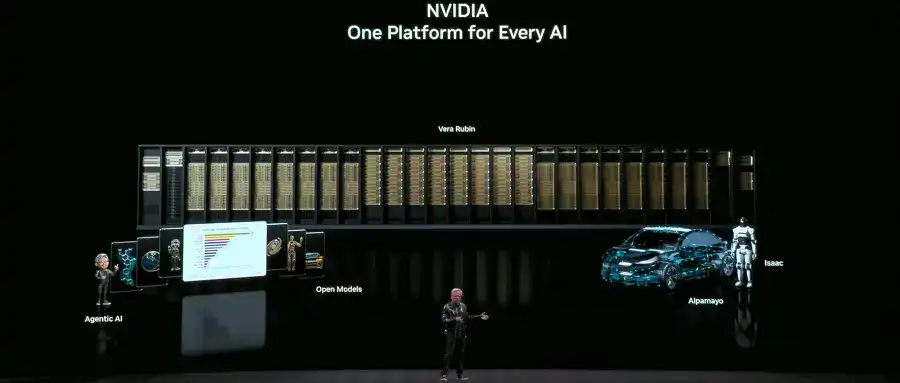
LAS VEGAS, January 5, 2026 (Zhidongxi) — Just now, NVIDIA founder and CEO Jensen Huang delivered his first keynote of 2026 at CES 2026. As usual wearing a leather jacket, Huang announced 8 major releases within 1.5 hours, providing an in-depth introduction to the entire new generation platform, from chips and racks to network design.

In the fields of accelerated computing and AI infrastructure, NVIDIA released the NVIDIA Vera Rubin POD AI supercomputer, NVIDIA Spectrum-X co-packaged optics for Ethernet, NVIDIA Inference Context Memory Storage Platform, and the NVIDIA DGX SuperPOD based on DGX Vera Rubin NVL72.
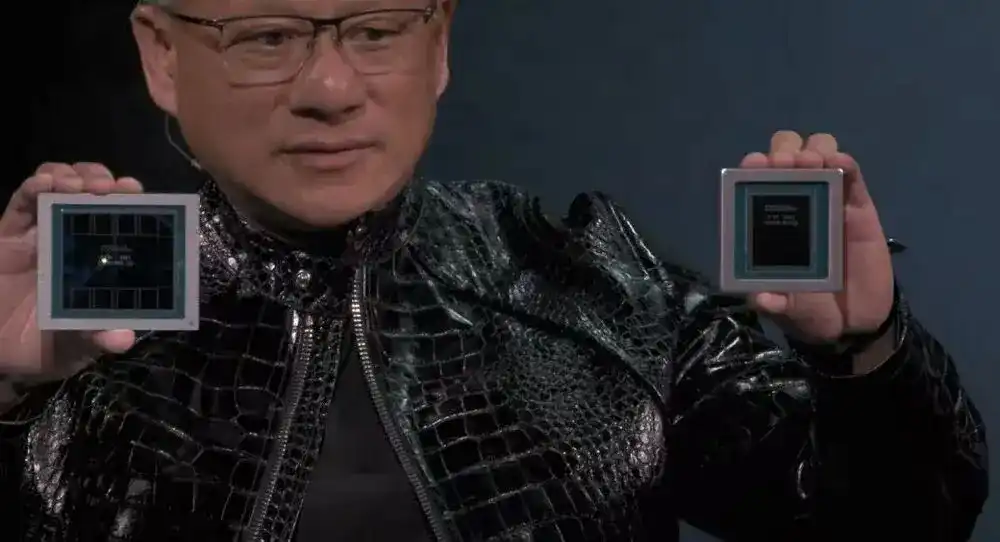
The NVIDIA Vera Rubin POD utilizes six major NVIDIA self-developed chips, covering CPU, GPU, Scale-up, Scale-out, storage, and processing capabilities. All parts are co-designed to meet the demands of advanced models and reduce computing costs.

Among them, the Vera CPU adopts a custom Olympus core architecture. The Rubin GPU introduces a Transformer engine, achieving up to 50 PFLOPS of NBFP4 inference performance. NVLink bandwidth per GPU is as fast as 3.6 TB/s. It supports third-generation Universal Confidential Computing (the first rack-level TEE), achieving a complete trusted execution environment across CPU and GPU domains.
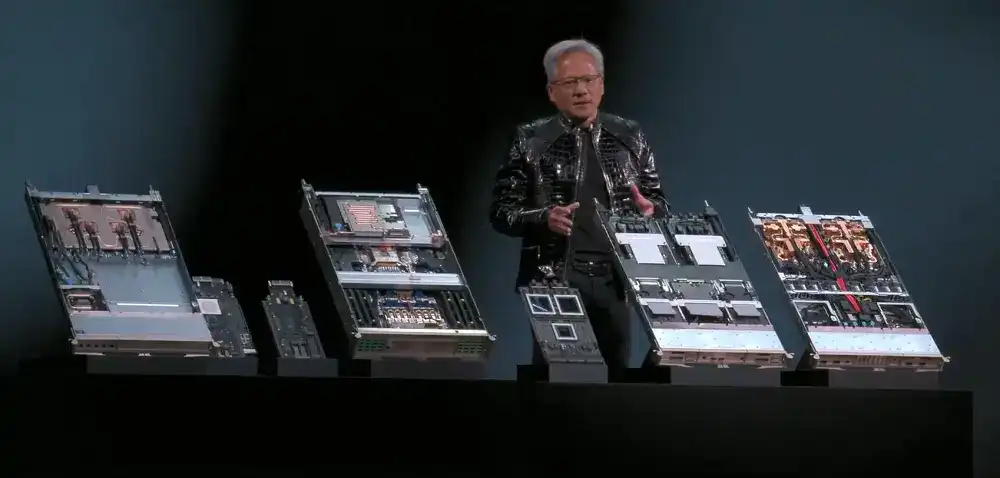
These chips have already taped out. NVIDIA has validated the entire NVIDIA Vera Rubin NVL72 system, and partners have begun running their internally integrated AI models and algorithms. The entire ecosystem is preparing for the deployment of Vera Rubin.

Among other releases, the NVIDIA Spectrum-X co-packaged optics for Ethernet significantly optimize power efficiency and application uptime. The NVIDIA Inference Context Memory Storage Platform redefines the storage stack to reduce redundant computation and improve inference efficiency. The NVIDIA DGX SuperPOD based on DGX Vera Rubin NVL72 reduces the token cost of large MoE models to 1/10th.
Regarding open models, NVIDIA announced an expansion of its open-source model family bucket, releasing new models, datasets, and libraries. This includes new additions to the NVIDIA Nemotron open-source model series: an Agentic RAG model, security models, and voice models. It also released new open models for all types of robots. However, Jensen Huang did not provide detailed introductions during the speech.

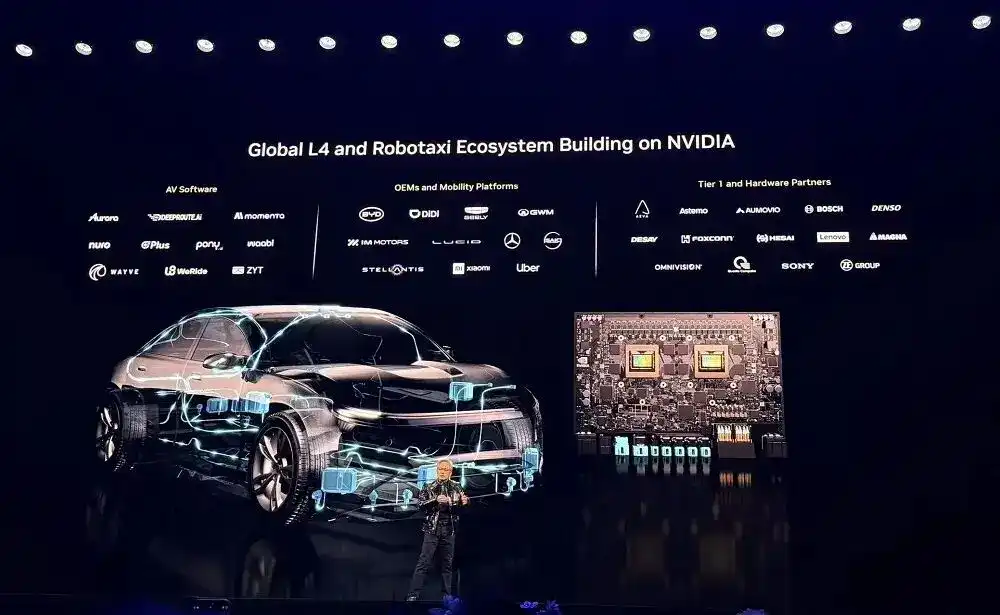
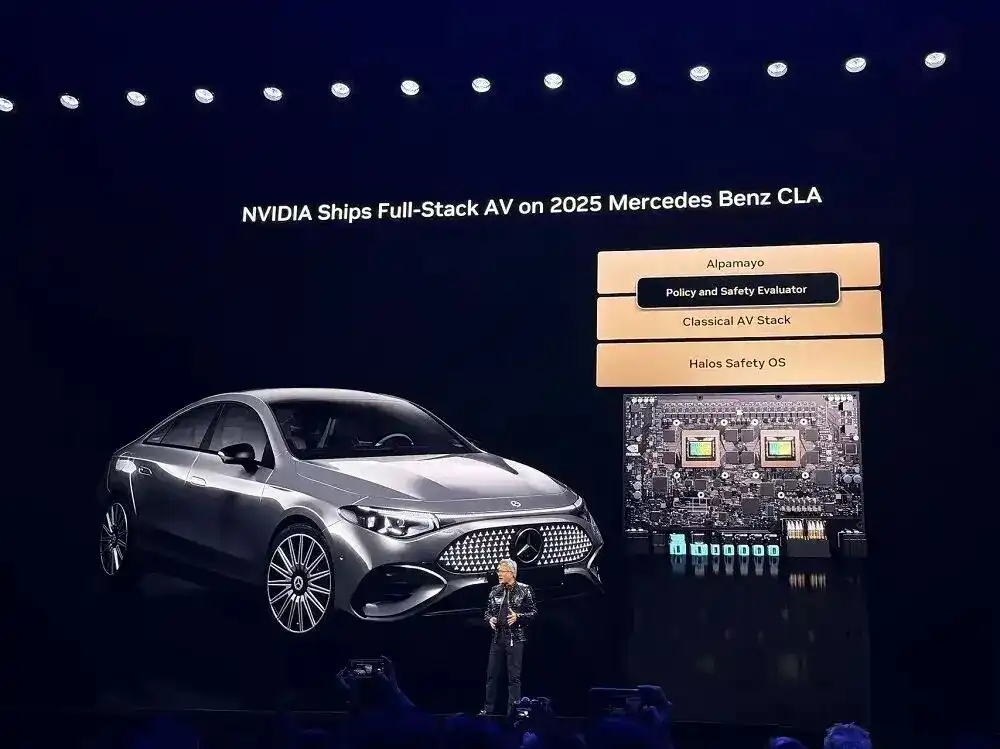
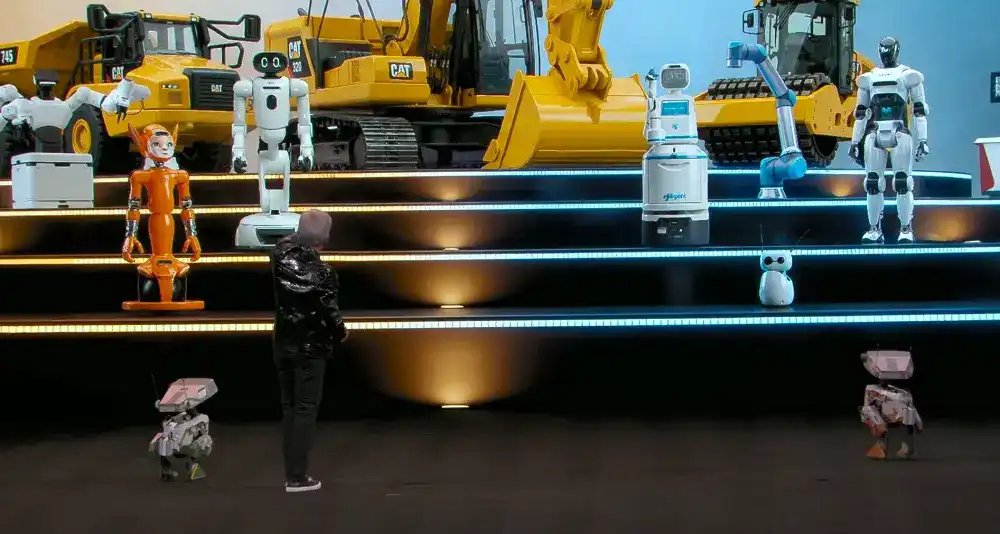
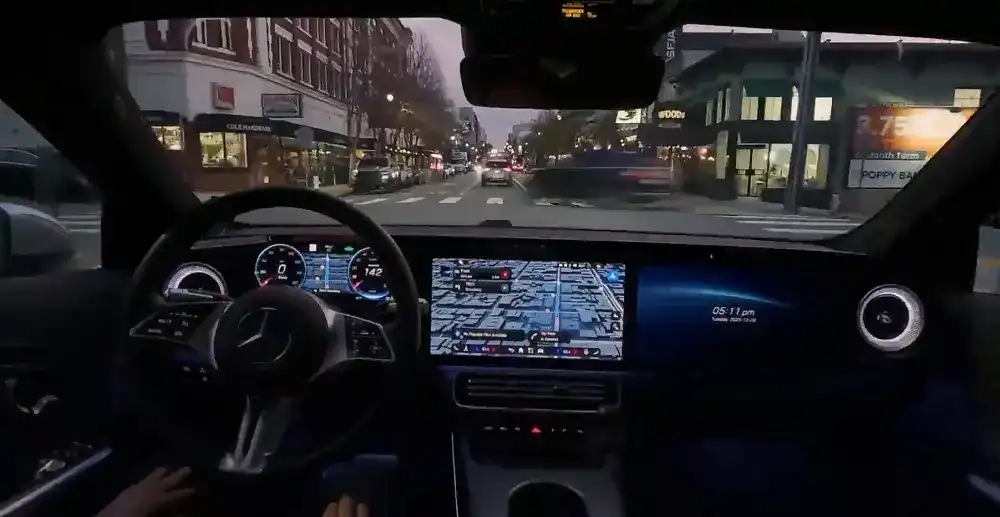
In terms of Physical AI: The ChatGPT moment for Physical AI has arrived. NVIDIA's full-stack technology enables the global ecosystem to transform industries through AI-driven robotics. NVIDIA's extensive AI tool library, including the new Alpamayo open-source model portfolio, enables the global transportation industry to quickly achieve safe L4 driving. The NVIDIA DRIVE autonomous driving platform is now in production, equipped in all new Mercedes-Benz CLA vehicles for L2++ AI-defined driving.
01. New AI Supercomputer: 6 Self-Developed Chips, Single Rack Computing Power Reaches 3.6 EFLOPS

Jensen Huang believes that every 10 to 15 years, the computer industry undergoes a comprehensive reshaping. But this time, two platform transformations are happening simultaneously: from CPU to GPU, and from "programming software" to "training software." Accelerated computing and AI are reconstructing the entire computing stack. The computing industry, worth $10 trillion over the past decade, is undergoing a modernization transformation.

At the same time, the demand for computing power is soaring dramatically. Model size grows 10x annually, the number of tokens used for model thinking grows 5x annually, and the cost per token decreases 10x annually.
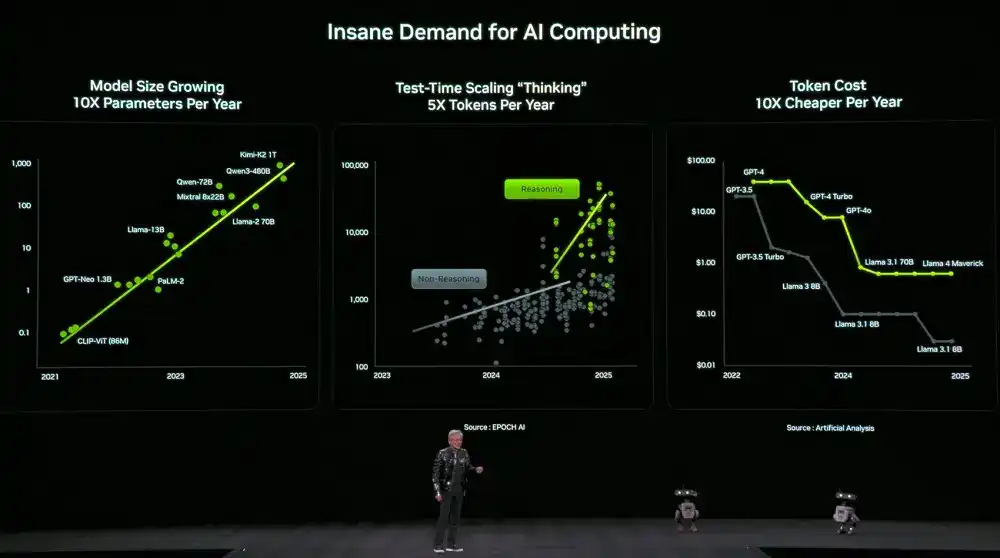
To meet this demand, NVIDIA has decided to release new computing hardware every year. Huang revealed that Vera Rubin has now fully entered production.

The new NVIDIA Vera Rubin POD AI supercomputer utilizes six self-developed chips: Vera CPU, Rubin GPU, NVLink 6 Switch, ConnectX-9 (CX9) SmartNIC, BlueField-4 DPU, and Spectrum-X 102.4T CPO.

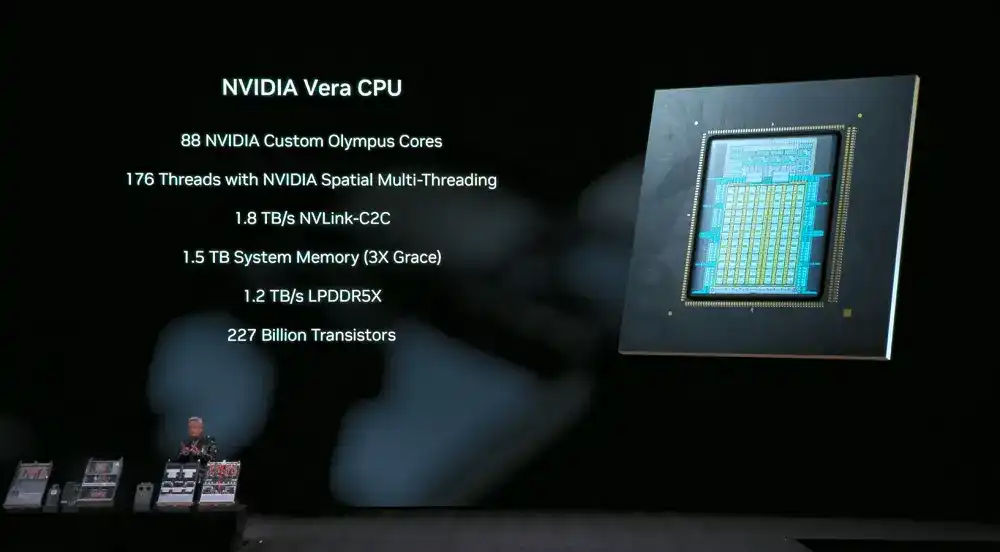
Vera CPU: Designed for data movement and agent processing, it features 88 NVIDIA custom Olympus cores, 176-thread NVIDIA spatial multithreading, 1.8 TB/s NVLink-C2C supporting CPU:GPU unified memory, system memory up to 1.5 TB (3x that of Grace CPU), SOCAMM LPDDR5X memory bandwidth of 1.2 TB/s, and supports rack-level confidential computing, doubling data processing performance.
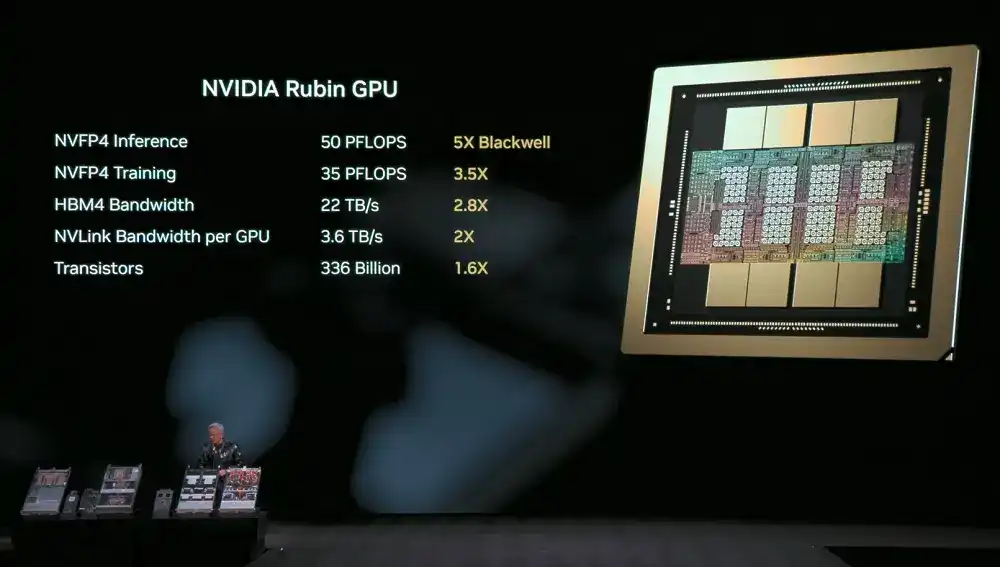
Rubin GPU: Introduces a Transformer engine, achieving NVFP4 inference performance up to 50 PFLOPS, 5x that of Blackwell GPU, with backward compatibility, maintaining inference precision while improving BF16/FP4 level performance; NVFP4 training performance reaches 35 PFLOPS, 3.5x that of Blackwell.

Rubin is also the first platform to support HBM4, with HBM4 bandwidth reaching 22 TB/s, 2.8x that of the previous generation, providing the required performance for demanding MoE models and AI workloads.
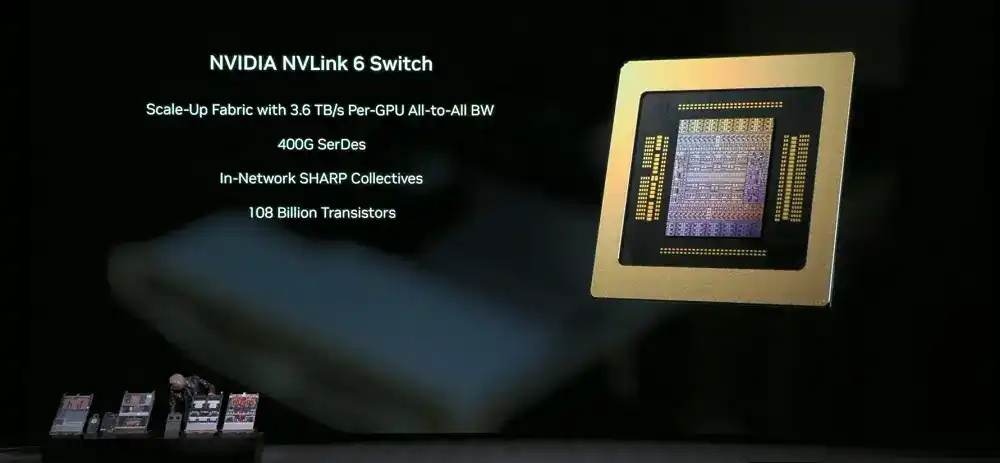
NVLink 6 Switch: Single lane rate increased to 400 Gbps, using SerDes technology for high-speed signal transmission; each GPU achieves 3.6 TB/s of full interconnect communication bandwidth, 2x the previous generation, total bandwidth is 28.8 TB/s, in-network computing performance reaches 14.4 TFLOPS at FP8 precision, and supports 100% liquid cooling.
NVIDIA ConnectX-9 SuperNIC: Provides 1.6 Tb/s bandwidth per GPU, optimized for large-scale AI, with fully software-defined, programmable, accelerated data paths.

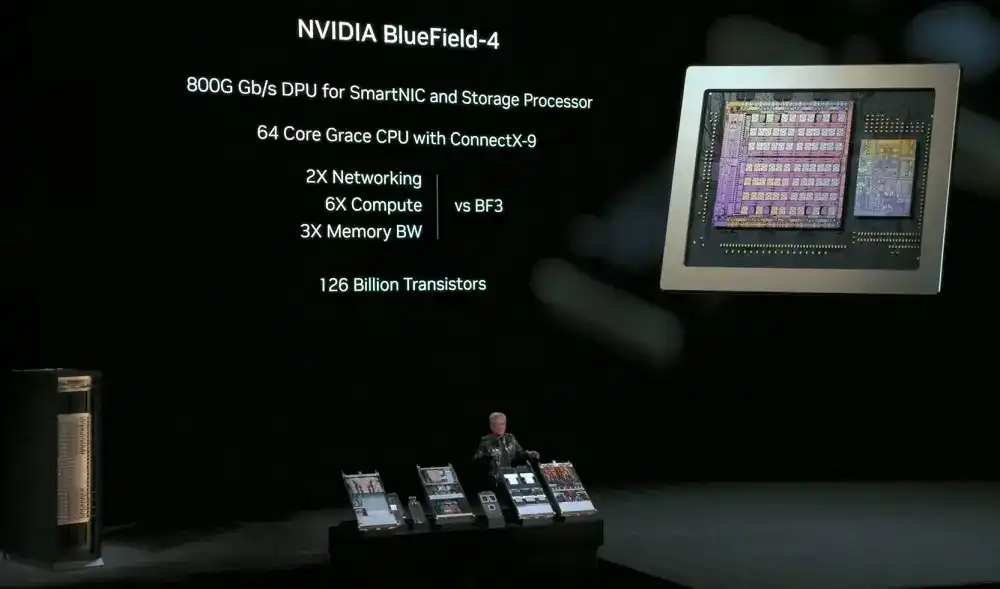
NVIDIA BlueField-4: 800 Gbps DPU, used for SmartNICs and storage processors, equipped with 64-core Grace CPU, combined with ConnectX-9 SuperNIC, for offloading network and storage-related computing tasks, while enhancing network security capabilities. Computing performance is 6x the previous generation, memory bandwidth is 3x, and GPU access to data storage speed is increased to 2x.
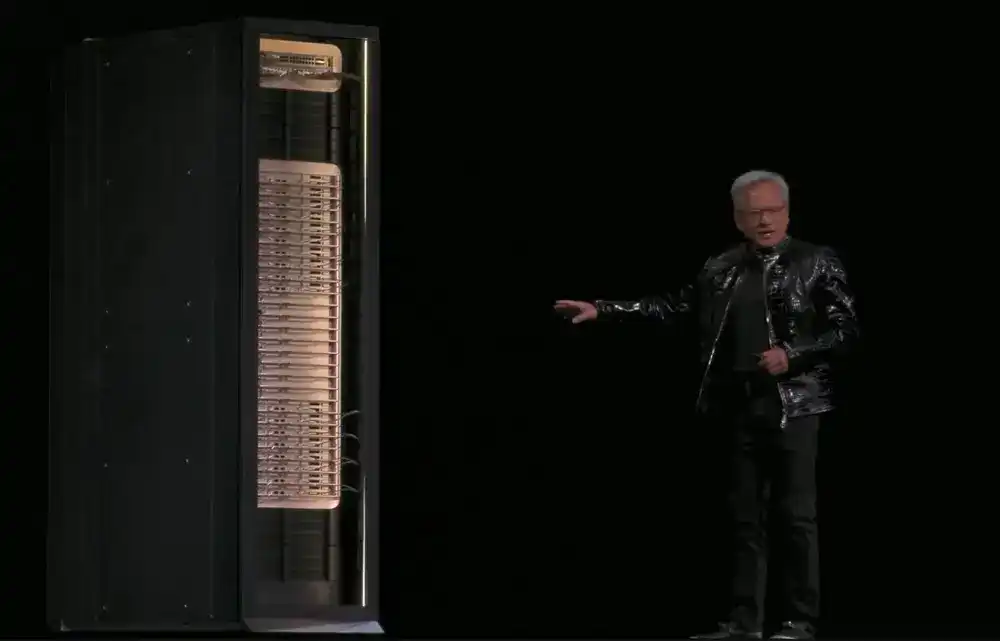
NVIDIA Vera Rubin NVL72: Integrates all the above components into a single-rack processing system at the system level, featuring 2 trillion transistors, NVFP4 inference performance of 3.6 EFLOPS, and NVFP4 training performance of 2.5 EFLOPS.

The system's LPDDR5X memory capacity reaches 54 TB, 2.5x the previous generation; total HBM4 memory is 20.7 TB, 1.5x the previous generation; HBM4 bandwidth is 1.6 PB/s, 2.8x the previous generation; total scale-up bandwidth reaches 260 TB/s, exceeding the total bandwidth scale of the global internet.

The system is based on the third-generation MGX rack design. The compute tray features a modular, hostless, cableless, fanless design, making assembly and maintenance 18x faster than GB200. Assembly work that originally took 2 hours now takes about 5 minutes. While the original system used about 80% liquid cooling, it now uses 100% liquid cooling. The single system itself weighs 2 tons, and with coolant, it can reach 2.5 tons.
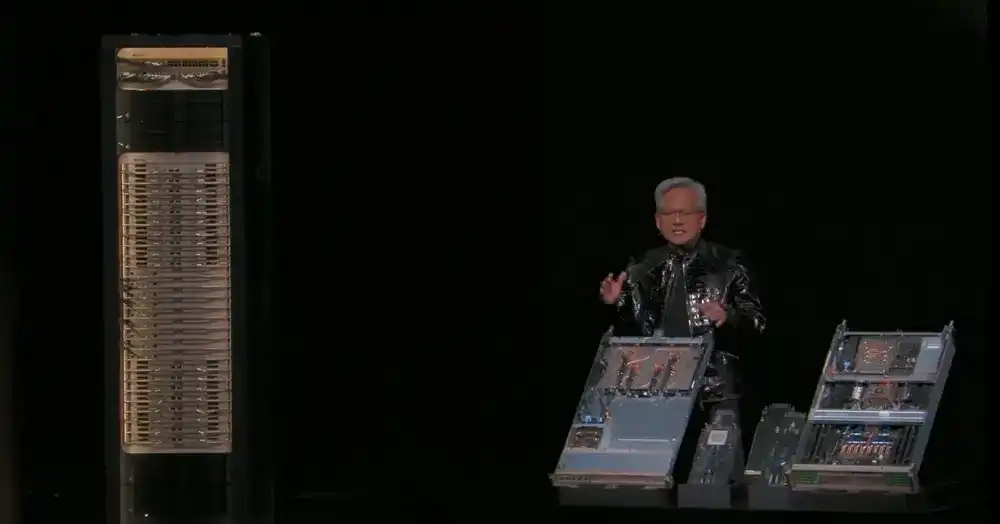
The NVLink Switch tray enables zero downtime maintenance and fault tolerance; the rack can still operate when a tray is removed or partially deployed. The second-generation RAS engine enables zero downtime health checks.

These features improve system uptime and throughput, further reducing training and inference costs, meeting data center requirements for high reliability and high maintainability.

Over 80 MGX partners are ready to support the deployment of Rubin NVL72 in hyperscale networks.

02. Three Major New Releases Drastically Improve AI Inference Efficiency: New CPO Device, New Context Storage Layer, New DGX SuperPOD

Simultaneously, NVIDIA released three important new products: NVIDIA Spectrum-X co-packaged optics for Ethernet, NVIDIA Inference Context Memory Storage Platform, and the NVIDIA DGX SuperPOD based on DGX Vera Rubin NVL72.

1. NVIDIA Spectrum-X Co-Packaged Optics for Ethernet

The NVIDIA Spectrum-X co-packaged optics for Ethernet is based on the Spectrum-X architecture, uses a 2-chip design, employs 200 Gbps SerDes, and each ASIC can provide 102.4 Tb/s bandwidth.

This switching platform includes a 512-port high-density system and a 128-port compact system, each port rate is 800 Gb/s.
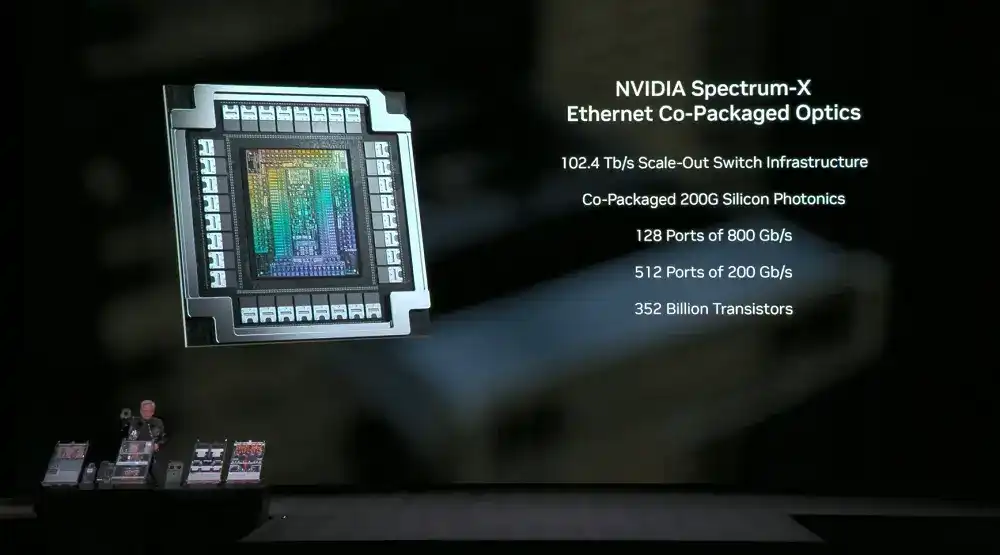
The CPO (Co-Packaged Optics) switching system achieves 5x improvement in energy efficiency, 10x improvement in reliability, and 5x improvement in application uptime.

This means more tokens can be processed per day, further reducing the total cost of ownership (TCO) of data centers.

2. NVIDIA Inference Context Memory Storage Platform

The NVIDIA Inference Context Memory Storage Platform is a POD-level AI-native storage infrastructure for storing KV Cache. Based on BlueField-4 and Spectrum-X Ethernet acceleration, tightly coupled with NVIDIA Dynamo and NVLink, it achieves协同 context scheduling between memory, storage, and network.

This platform treats context as a first-class data type, achieving 5x inference performance and 5x better energy efficiency.
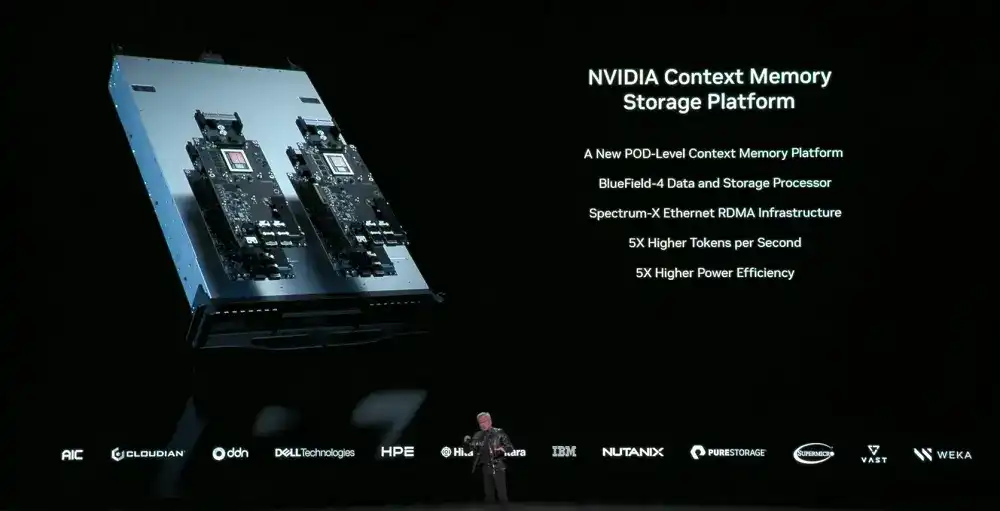
This is crucial for improving long-context applications like multi-turn conversations, RAG, and Agentic multi-step reasoning. These workloads highly depend on the ability to efficiently store, reuse, and share context throughout the system.

AI is evolving from chatbots to Agentic AI, which reasons, calls tools, and maintains long-term state. Context windows have expanded to millions of tokens. This context is stored in the KV Cache. Recomputing it every step wastes GPU time and creates huge latency, hence the need for storage.

But GPU memory, while fast, is scarce. Traditional network storage is too inefficient for short-term context. The AI inference bottleneck is shifting from computation to context storage. Therefore, a new memory layer between GPU and storage, optimized for inference, is needed.
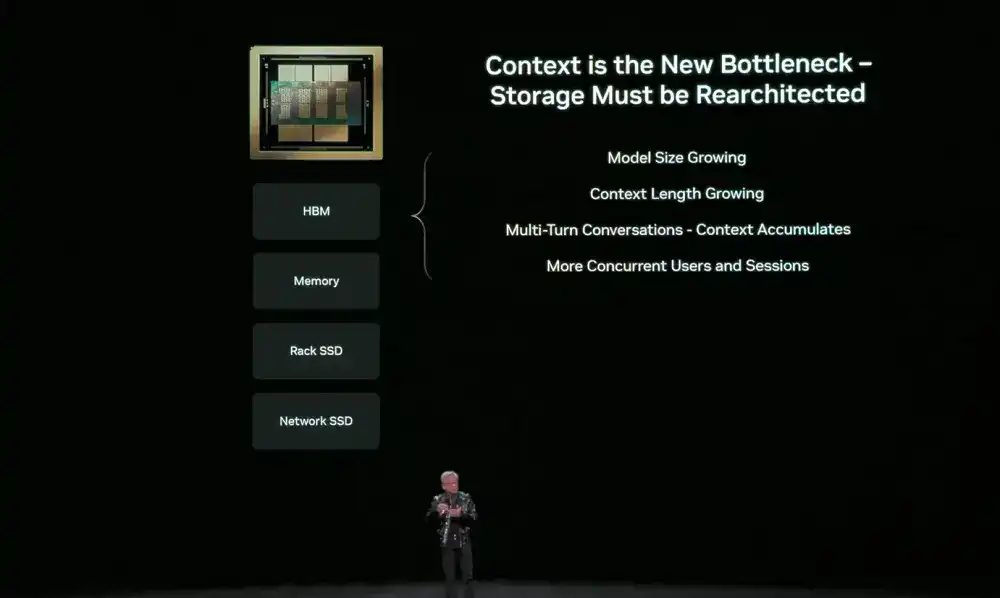
This layer is no longer an afterthought patch but must be co-designed with network storage to move context data with minimal overhead.

As a new storage tier, the NVIDIA Inference Context Memory Storage Platform does not reside directly in the host system but is connected externally to the computing devices via BlueField-4. Its key advantage is the ability to scale the storage pool size more efficiently, thereby avoiding redundant computation of KV Cache.

NVIDIA is working closely with storage partners to bring the NVIDIA Inference Context Memory Storage Platform to the Rubin platform, enabling customers to deploy it as part of a fully integrated AI infrastructure.

3. NVIDIA DGX SuperPOD Built on Vera Rubin

At the system level, the NVIDIA DGX SuperPOD serves as a blueprint for large-scale AI factory deployment. It uses 8 sets of DGX Vera Rubin NVL72 systems, with NVLink 6 for scale-up networking and Spectrum-X Ethernet for scale-out networking, incorporates the NVIDIA Inference Context Memory Storage Platform, and is engineering-validated.

The entire system is managed by NVIDIA Mission Control software for ultimate efficiency. Customers can deploy it as a turnkey platform, completing training and inference tasks with fewer GPUs.

Due to极致 co-design at the 6-chip, tray, rack, Pod, data center, and software levels, the Rubin platform achieves a significant drop in training and inference costs. Compared to the previous generation Blackwell, training MoE models of the same scale requires only 1/4 the number of GPUs; at the same latency, the token cost for large MoE models is reduced to 1/10th.
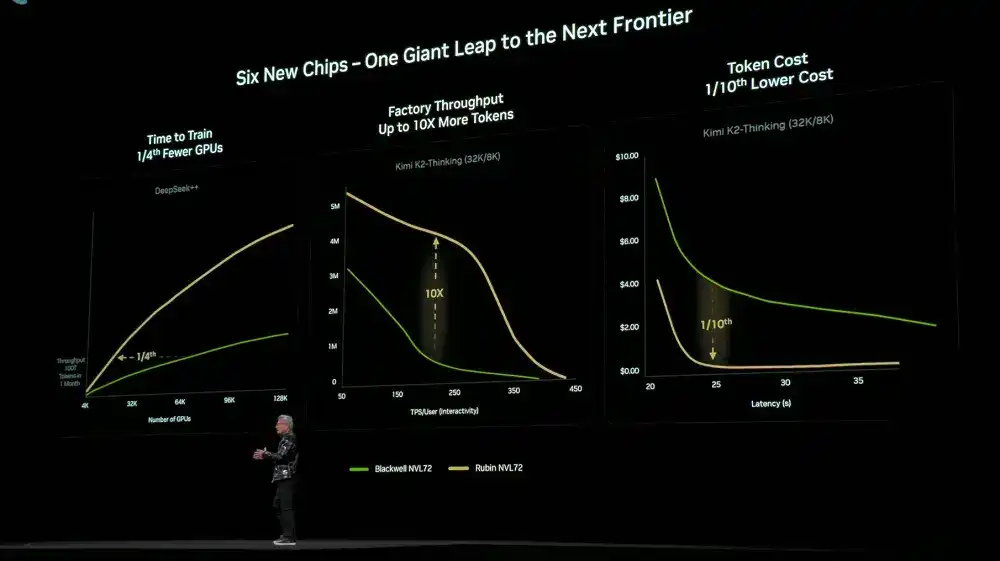
The NVIDIA DGX SuperPOD using the DGX Rubin NVL8 system was also announced.

Leveraging the Vera Rubin architecture, NVIDIA is working with partners and customers to build the world's largest, most advanced, and lowest-cost AI systems, accelerating the mainstream adoption of AI.

<极速>
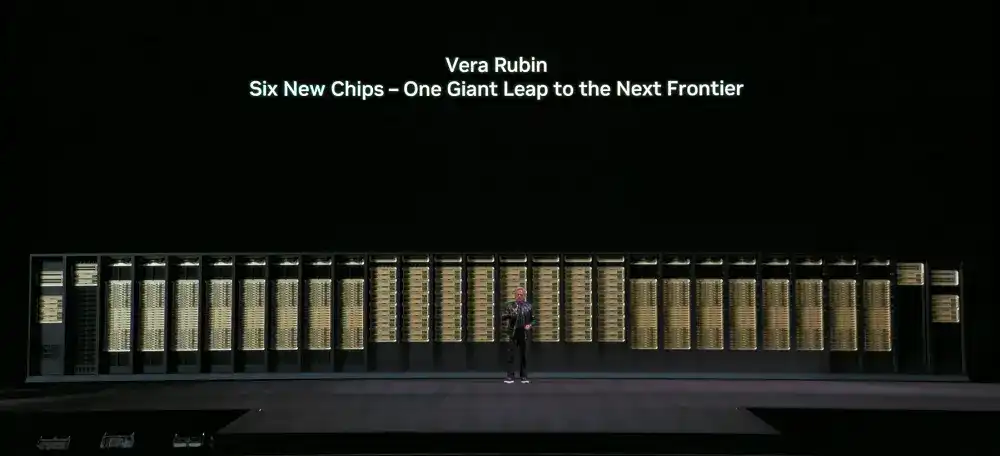
Rubin infrastructure will be available in the second half of this year through CSPs and system integrators, with Microsoft among the first to deploy.

03. Expanding the Open Model Universe: New Models, Data, Major Contributor to Open Source Ecosystem

On the software and model front, NVIDIA continues to increase its open-source investment.

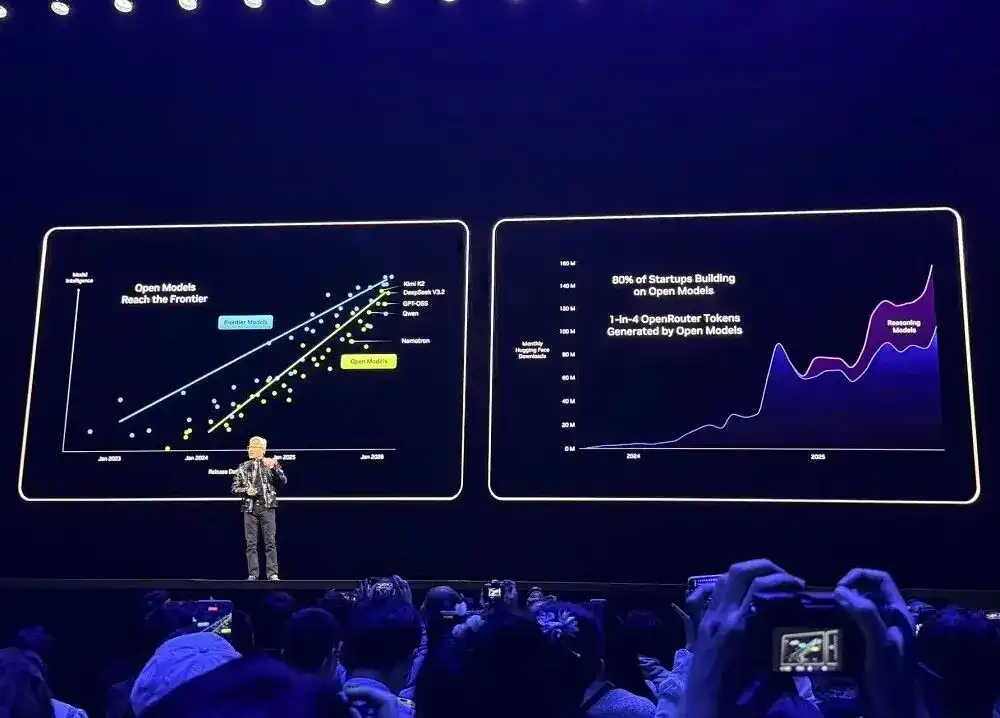
Mainstream development platforms like OpenRouter show that AI model usage grew 20x over the past year, with about 1/4 of the tokens coming from open-source models.

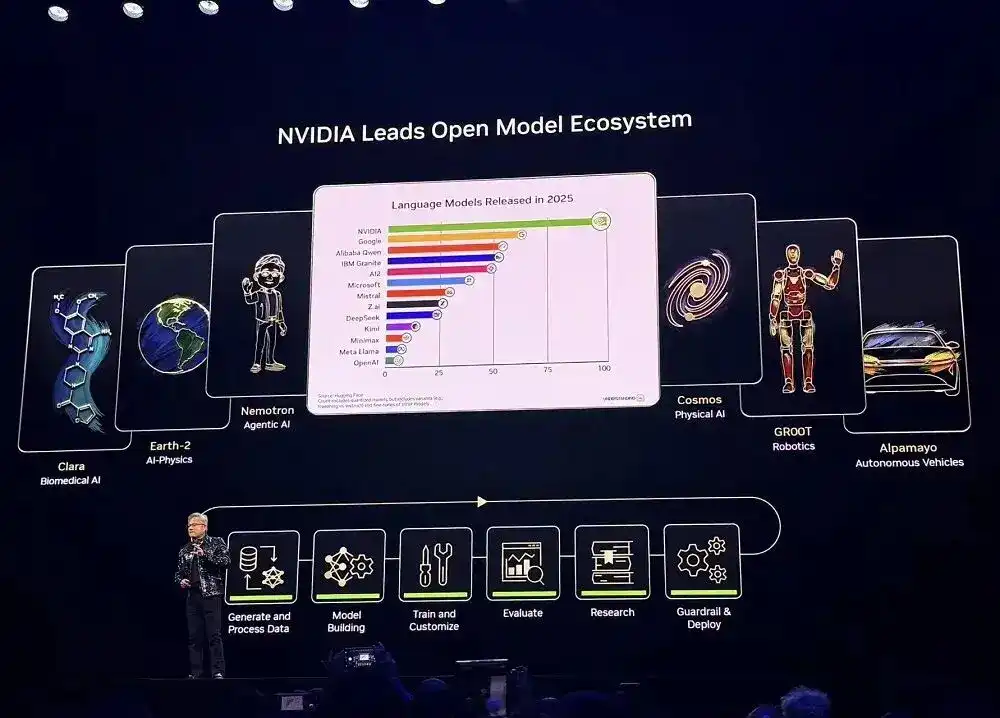
In 2025, NVIDIA was the largest contributor of open-source models, data, and recipes on Hugging Face, releasing 650 open-source models and 250 open-source datasets.

NVIDIA's open-source models rank at the top in various leaderboards. Developers can not only use these open-source models but also learn from them, continuously train, expand datasets, and use open-source tools and documented techniques to build AI systems.

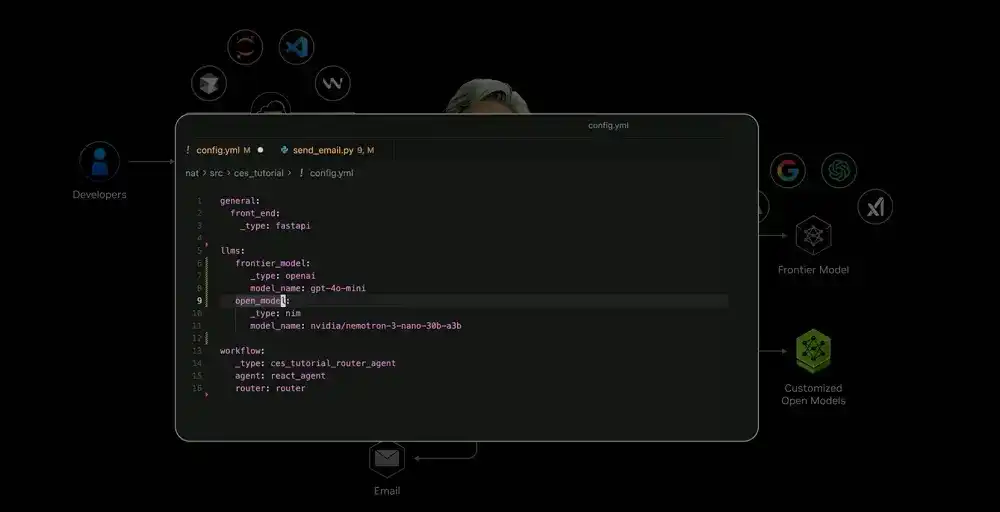
Inspired by Perplexity, Jensen Huang observed that Agents should be multi-model, multi-cloud, and hybrid-cloud, which is also the basic architecture of Agentic AI systems, adopted by almost all startups.

With the open-source models and tools provided by NVIDIA, developers can now customize AI systems and use the most cutting-edge model capabilities. NVIDIA has integrated the above framework into "blueprints" and integrated them into SaaS platforms. Users can achieve rapid deployment with blueprints.

In a live demo case, this system can automatically judge whether a task should be handled by a local private model or a cloud frontier model based on user intent. It can also call external tools (like email API, robot control interface, calendar service, etc.) and achieve multimodal fusion, uniformly processing information like text, voice, images, and robot sensor signals.

These complex capabilities were absolutely unimaginable in the past but have now become trivial. Similar capabilities are available on enterprise platforms like ServiceNow and Snowflake.

04. Open-Sourcing Alpha-Mayo Model, Enabling Autonomous Vehicles to "Think"

NVIDIA believes that Physical AI and robotics will ultimately become the world's largest consumer electronics segment. Everything that can move will eventually become fully autonomous, powered by Physical AI.

AI has gone through the stages of perceptual AI, generative AI, and Agentic AI, and is now entering the era of Physical AI, where intelligence enters the real world. These models can understand physical laws and generate actions directly from perception of the physical world.

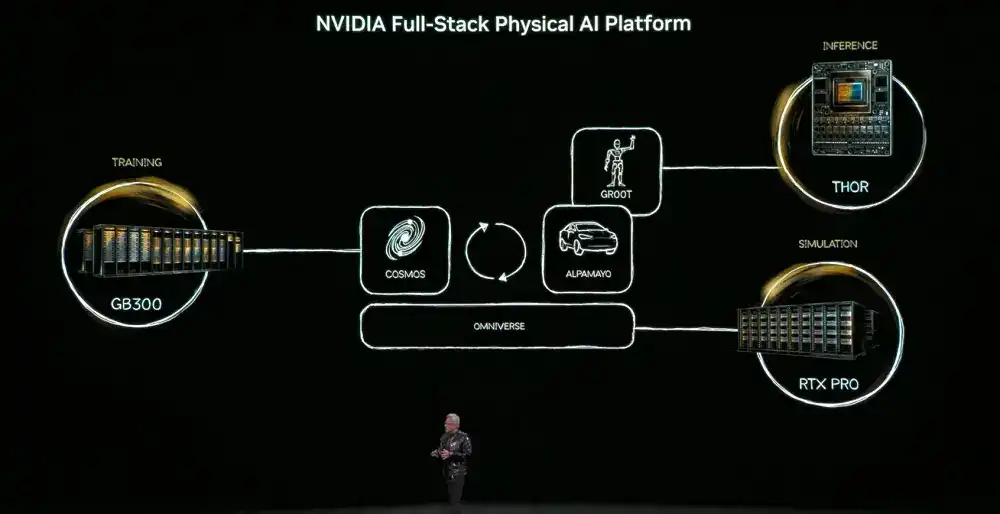
But to achieve this goal, Physical AI must learn the common sense of the world — object permanence, gravity, friction. The acquisition of these capabilities will rely on three computers: the training computer (DGX) for building AI models, the inference computer (robot/vehicle chip) for real-time execution, and the simulation computer (Omniverse) for generating synthetic data and verifying physical logic.

The core model among these is the Cosmos world foundation model, which aligns language, images, 3D, and physical laws, supporting the full pipeline from simulation to training data generation.

Physical AI will appear in three types of entities: structures (like factories, warehouses), robots, and autonomous vehicles.

Jensen Huang believes that autonomous driving will be the first large-scale application scenario for Physical AI. Such systems need to understand the real world, make decisions, and execute actions, requiring extremely high safety, simulation, and data requirements.

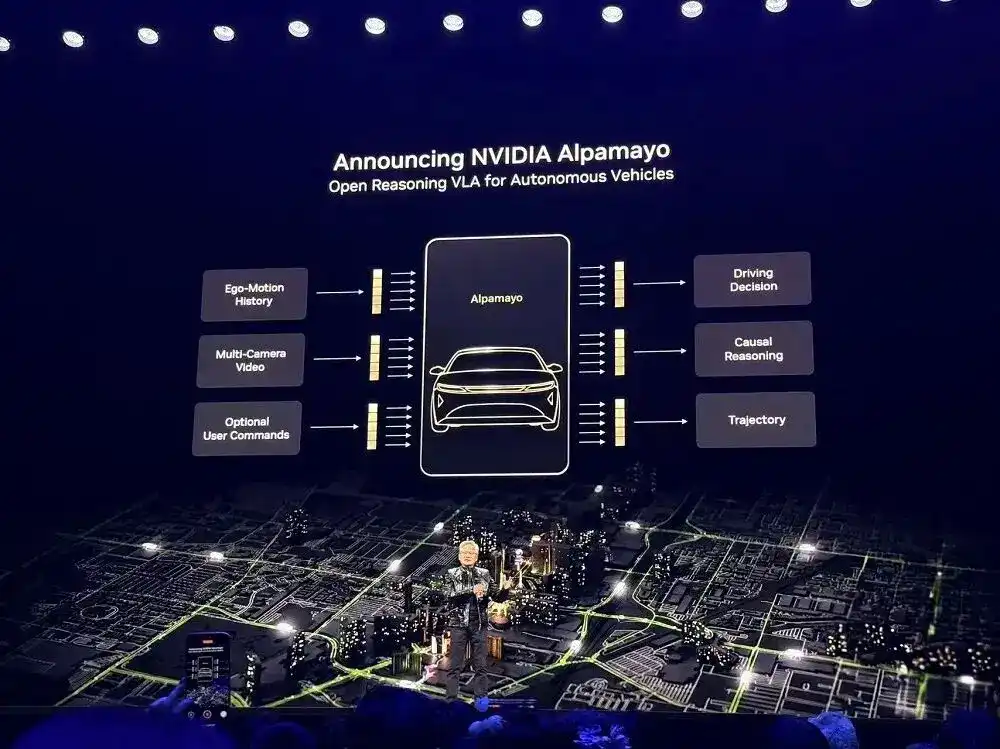
To this end, NVIDIA released Alpha-Mayo, a complete system comprising open-source models, simulation tools, and Physical AI datasets, to accelerate the development of safe, reasoning-based Physical AI.

Its product portfolio provides basic building blocks for global automakers, suppliers, startups, and researchers to construct L4 autonomous driving systems.

Alpha-Mayo is the industry's first model that truly enables autonomous vehicles to "think," and this model is now open-sourced. It works by breaking down problems into steps, reasoning about all possibilities, and choosing the safest path.

This reasoning-based task-action model enables the autonomous driving system to solve complex edge scenarios it has never encountered before, such as a busy intersection with failed traffic lights.

Alpha-Mayo has 10 billion parameters, large enough to handle autonomous driving tasks, yet lightweight enough to run on workstations built for autonomous driving researchers.

It can receive text, surround-view camera feeds, vehicle historical state, and navigation input, and output driving trajectories and reasoning processes, allowing passengers to understand why the vehicle took a certain action.

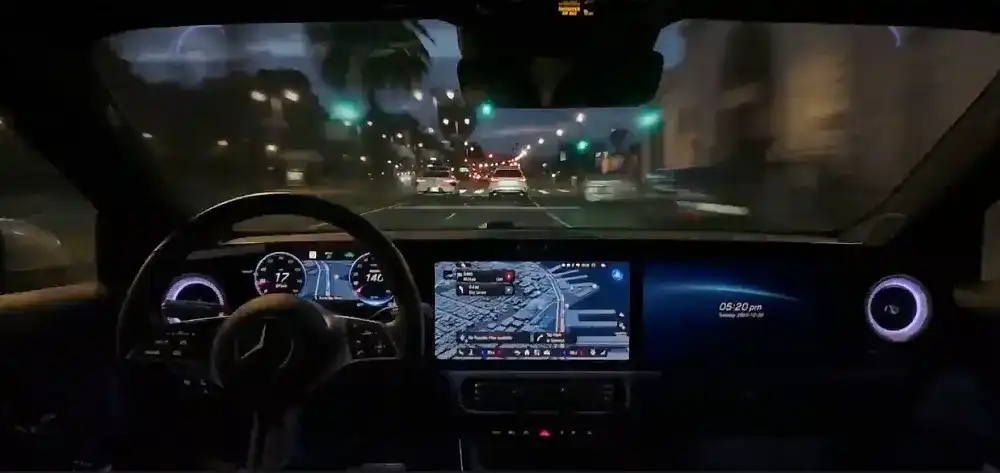
In the promotional video played live, driven by Alpha-Mayo, the autonomous vehicle can autonomously complete pedestrian avoidance, predict oncoming left-turn vehicles and change lanes to avoid them, all with 0 intervention.

Huang announced that the Mercedes-Benz CLA equipped with Alpha-Mayo is already in production and was just rated the world's safest car by NCAP. Every line of code, chip, and system is safety-certified. The system will launch in the US market and will introduce stronger driving capabilities later this year, including highway hands-off driving and end-to-end autonomous driving in urban environments.

极速

NVIDIA also released part of the dataset used to train Alpha-Mayo and the open-source reasoning model evaluation simulation framework Alpha-Sim. Developers can fine-tune Alpha-Mayo with their own data or use Cosmos to generate synthetic data, training and testing autonomous driving applications on a combination of real and synthetic data. Additionally, NVIDIA announced the NVIDIA DRIVE platform is now in production.

NVIDIA announced that global robotics leaders like Boston Dynamics, Franka Robotics, Surgical手术机器人, LG Electronics, NEURA, XRLabs, and Zhiyuan Robotics are all building on NVIDIA Isaac and GR00T.

Huang also announced the latest collaboration with Siemens. Siemens is integrating NVIDIA CUDA-X, AI models, and Omniverse into its portfolio of EDA, CAE, and digital twin tools and platforms. Physical AI will be widely used throughout the entire process from design and simulation to production manufacturing and operations.

05. Conclusion: Embracing Open Source with the Left Hand, Making Hardware Systems Irreplaceable with the Right Hand

As the focus of AI infrastructure shifts from training to large-scale inference, platform competition has evolved from single-point computing power to systems engineering covering chips, racks, networks, and software. The goal is转向 delivering maximum inference throughput at the lowest TCO. AI is entering a new stage of "factory-like operation."

NVIDIA places great emphasis on system-level design. Rubin achieves improvements in both training and inference performance and economics and can serve as a plug-and-play replacement for Blackwell, enabling a seamless transition from Blackwell.

In terms of platform positioning, NVIDIA still believes training is crucial because only by quickly training the most advanced models can the inference platform truly benefit. Therefore, NVFP4 training was introduced in the Rubin GPU to further improve performance and reduce TCO.

Simultaneously, this AI computing giant continues to significantly strengthen network communication capabilities in both scale-up and scale-out architectures and treats context as a key bottleneck, achieving co-design of storage, network, and computation.

NVIDIA is vigorously pursuing open source on one hand, while on the other hand making its hardware, interconnects, and system design increasingly "irreplaceable." This strategic closed loop of continuously expanding demand, incentivizing token consumption, promoting inference scaling, and providing cost-effective infrastructure is building an even more impregnable moat for NVIDIA.

İlgili Sorular

QWhat are the six self-developed chips used in the NVIDIA Vera Rubin POD AI supercomputer?

AThe six self-developed chips are: Vera CPU, Rubin GPU, NVLink 6 Switch, ConnectX-9 (CX9) SmartNIC, BlueField-4 DPU, and Spectrum-X 102.4T CPO.

QWhat is the key feature of the NVIDIA Rubin GPU that significantly boosts its inference performance?

AThe key feature is the introduction of the Transformer engine, which delivers NVFP4 inference performance of up to 50 PFLOPS, a 5x increase over the Blackwell GPU.

QWhat is the primary purpose of the NVIDIA Inference Context Memory Storage Platform?

AIts primary purpose is to store KV Cache, acting as a POD-level AI-native storage infrastructure to avoid repeated computations, thereby improving inference efficiency and performance for long-context applications like multi-turn conversations and Agentic AI.

QWhat major achievement did Jensen Huang announce regarding the application of Physical AI in the automotive industry?

AHe announced that the NVIDIA DRIVE autonomous driving platform is now in production, powering all new Mercedes-Benz CLA vehicles for L2++ AI-defined driving, and that a car equipped with the open-source Alpha-Mayo model was rated the world's safest car by NCAP.

QAccording to the article, how does the cost of tokens for large Mixture-of-Experts (MoE) models change with the new DGX Vera Rubin NVL72-based SuperPOD?

AThe token cost for large MoE models is reduced to 1/10th of the previous cost under the same latency conditions.

İlgili Okumalar

İşlemler

Spot
Futures

Popüler Makaleler

GROK AI Nedir

Grok AI: Web3 Döneminde Konuşma Teknolojisini Devrim Niteliğinde Yenilik Giriş Hızla gelişen yapay zeka alanında, Grok AI, ileri teknoloji ve kullanıcı etkileşimi alanlarını birleştiren dikkate değer bir proje olarak öne çıkıyor. Ünlü girişimci Elon Musk'ın liderliğindeki xAI tarafından geliştirilen Grok AI, yapay zeka ile etkileşim şeklimizi yeniden tanımlamayı hedefliyor. Web3 hareketi devam ederken, Grok AI, karmaşık sorgulara yanıt vermek için konuşma yapay zekasının gücünden yararlanmayı amaçlıyor ve kullanıcılara sadece bilgilendirici değil, aynı zamanda eğlenceli bir deneyim sunuyor. Grok AI Nedir? Grok AI, kullanıcılarla dinamik bir şekilde etkileşimde bulunmak üzere tasarlanmış sofistike bir konuşma yapay zeka sohbet botudur. Birçok geleneksel yapay zeka sisteminin aksine, Grok AI, genellikle uygunsuz veya standart yanıtların dışında kabul edilen daha geniş bir sorgu yelpazesini benimsemektedir. Projenin temel hedefleri şunlardır: Güvenilir Akıl Yürütme: Grok AI, bağlamsal anlayışa dayalı mantıklı yanıtlar sağlamak için sağduyu akıl yürütmeyi vurgular. Ölçeklenebilir Denetim: Araç yardımı entegrasyonu, kullanıcı etkileşimlerinin hem izlenmesini hem de kalite için optimize edilmesini sağlar. Resmi Doğrulama: Güvenlik en önemli önceliktir; Grok AI, çıktılarının güvenilirliğini artırmak için resmi doğrulama yöntemlerini entegre eder. Uzun Bağlam Anlayışı: AI modeli, kapsamlı konuşma geçmişini saklama ve hatırlama konusunda mükemmel bir performans sergileyerek anlamlı ve bağlamsal olarak farkında tartışmaların yapılmasını kolaylaştırır. Saldırgan Dayanıklılık: Manipüle edilmiş veya kötü niyetli girdilere karşı savunmalarını geliştirmeye odaklanarak, Grok AI kullanıcı etkileşimlerinin bütünlüğünü korumayı hedefler. Özünde, Grok AI sadece bir bilgi alma cihazı değil; dinamik diyalogu teşvik eden, etkileyici bir konuşma partneridir. Grok AI'nın Yaratıcısı Grok AI'nın arkasındaki beyin, otomotiv, uzay yolculuğu ve teknoloji gibi çeşitli alanlarda yenilikle özdeşleşen Elon Musk'tır. Yapay zeka teknolojisini faydalı yollarla geliştirmeye odaklanan xAI çatısı altında, Musk'ın vizyonu, yapay zeka etkileşimlerinin anlaşılmasını yeniden şekillendirmeyi amaçlıyor. Liderlik ve temel etik, Musk'ın teknolojik sınırları zorlamaya olan bağlılığı tarafından derinden etkilenmektedir. Grok AI'nın Yatırımcıları Grok AI'yi destekleyen yatırımcılarla ilgili spesifik detaylar sınırlı kalmakla birlikte, projenin kuluçka merkezi olan xAI'nin, esasen Elon Musk tarafından kurulduğu ve desteklendiği kamuya açık bir şekilde kabul edilmektedir. Musk'ın önceki girişimleri ve mülkleri, Grok AI'nın güvenilirliğini ve büyüme potansiyelini daha da artıran sağlam bir destek sağlar. Ancak, şu anda Grok AI'yı destekleyen ek yatırım fonları veya kuruluşlarıyla ilgili bilgiye kolayca erişim sağlanamamaktadır; bu da potansiyel gelecekteki keşif alanını işaret etmektedir. Grok AI Nasıl Çalışır? Grok AI'nın operasyonel mekanikleri, kavramsal çerçevesi kadar yenilikçidir. Proje, benzersiz işlevselliklerini kolaylaştıran birkaç son teknoloji ürünü teknolojiyi entegre eder: Sağlam Altyapı: Grok AI, konteyner orkestrasyonu için Kubernetes, performans ve güvenlik için Rust ve yüksek performanslı sayısal hesaplama için JAX kullanılarak inşa edilmiştir. Bu üçlü, sohbet botunun verimli çalışmasını, etkili bir şekilde ölçeklenmesini ve kullanıcılara zamanında hizmet vermesini sağlar. Gerçek Zamanlı Bilgi Erişimi: Grok AI'nın ayırt edici özelliklerinden biri, X platformu (önceden Twitter olarak biliniyordu) aracılığıyla gerçek zamanlı verilere erişim yeteneğidir. Bu yetenek, yapay zekaya en son bilgilere erişim sağlar ve diğer yapay zeka modellerinin gözden kaçırabileceği zamanında yanıtlar ve öneriler sunmasına olanak tanır. İki Etkileşim Modu: Grok AI, kullanıcılara “Eğlenceli Mod” ve “Normal Mod” arasında seçim yapma imkanı sunar. Eğlenceli Mod, daha eğlenceli ve mizahi bir etkileşim tarzı sağlarken, Normal Mod, kesin ve doğru yanıtlar vermeye odaklanır. Bu çok yönlülük, çeşitli kullanıcı tercihlerine hitap eden özelleştirilmiş bir deneyim sağlar. Özünde, Grok AI performansı etkileşimle birleştirerek, hem zenginleştirici hem de eğlenceli bir deneyim yaratmaktadır. Grok AI'nın Zaman Çizelgesi Grok AI'nın yolculuğu, gelişim ve dağıtım aşamalarını yansıtan önemli dönüm noktalarıyla işaretlenmiştir: İlk Geliştirme: Grok AI'nın temel aşaması, modelin ilk eğitim ve ince ayarının yapıldığı yaklaşık iki ay boyunca gerçekleşmiştir. Grok-2 Beta Yayını: Önemli bir ilerleme olarak, Grok-2 beta duyurulmuştur. Bu sürüm, sohbet etme, kodlama ve akıl yürütme yetenekleriyle donatılmış iki versiyon—Grok-2 ve Grok-2 mini—sunmuştur. Halka Açık Erişim: Beta geliştirmesinin ardından, Grok AI X platformu kullanıcılarına sunulmuştur. Telefon numarasıyla doğrulanan ve en az yedi gün aktif olan hesap sahipleri, sınırlı bir versiyona erişim sağlayarak teknolojiyi daha geniş bir kitleye ulaştırmaktadır. Bu zaman çizelgesi, Grok AI'nın kuruluşundan kamu etkileşimine kadar sistematik büyümesini kapsar ve sürekli iyileştirme ve kullanıcı etkileşimine olan bağlılığını vurgular. Grok AI'nın Ana Özellikleri Grok AI, yenilikçi kimliğine katkıda bulunan birkaç ana özelliği kapsamaktadır: Gerçek Zamanlı Bilgi Entegrasyonu: Güncel ve ilgili bilgilere erişim, Grok AI'yı birçok statik modelden ayırarak, etkileyici ve doğru bir kullanıcı deneyimi sağlar. Çeşitli Etkileşim Tarzları: Farklı etkileşim modları sunarak, Grok AI çeşitli kullanıcı tercihlerine hitap eder ve yapay zeka ile konuşurken yaratıcılığı ve kişiselleştirmeyi teşvik eder. Gelişmiş Teknolojik Altyapı: Kubernetes, Rust ve JAX kullanımı, projeye güvenilirlik ve optimal performans sağlamak için sağlam bir çerçeve sunar. Etik Tartışma Dikkati: Görüntü üreten bir işlevin dahil edilmesi, projenin yenilikçi ruhunu sergiler. Ancak, aynı zamanda tanınabilir figürlerin saygılı bir şekilde tasvir edilmesi ve telif hakkı ile ilgili etik konuları da gündeme getirir—bu, yapay zeka topluluğunda süregelen bir tartışmadır. Sonuç Konuşma yapay zekası alanında öncü bir varlık olarak Grok AI, dijital çağda dönüştürücü kullanıcı deneyimlerinin potansiyelini kapsar. xAI tarafından geliştirilen ve Elon Musk'ın vizyoner yaklaşımıyla yönlendirilen Grok AI, gerçek zamanlı bilgiyi gelişmiş etkileşim yetenekleriyle birleştirir. Yapay zekanın neler başarabileceği konusunda sınırları zorlamayı hedeflerken, etik konulara ve kullanıcı güvenliğine odaklanmayı sürdürmektedir. Grok AI, sadece teknolojik ilerlemeyi değil, aynı zamanda Web3 manzarasında yeni bir konuşma paradigmasını da temsil eder ve kullanıcılara hem yetkin bilgi hem de eğlenceli etkileşim sunma vaadinde bulunur. Proje gelişmeye devam ederken, teknolojinin, yaratıcılığın ve insan benzeri etkileşimin kesişim noktasında nelerin başarılabileceğinin bir kanıtı olarak durmaktadır.

268 Toplam GörüntülenmeYayınlanma 2024.12.26Güncellenme 2024.12.26

GROK AI Nedir

ERC AI Nedir

Euruka Tech: $erc ai ve Web3'teki Hedefleri Üzerine Bir Genel Bakış Giriş Blockchain teknolojisi ve merkeziyetsiz uygulamaların hızla gelişen manzarasında, her biri benzersiz hedefler ve metodolojilerle yeni projeler sıkça ortaya çıkmaktadır. Bu projelerden biri, kripto para ve Web3 alanında faaliyet gösteren Euruka Tech'tir. Euruka Tech'in, özellikle $erc ai token'ının ana odak noktası, merkeziyetsiz teknolojinin büyüyen yeteneklerinden yararlanmak için tasarlanmış yenilikçi çözümler sunmaktır. Bu makale, Euruka Tech'in kapsamlı bir genel görünümünü, hedeflerini, işlevselliğini, yaratıcısının kimliğini, potansiyel yatırımcılarını ve Web3'teki daha geniş bağlam içindeki önemini keşfetmeyi amaçlamaktadır. Euruka Tech, $erc ai Nedir? Euruka Tech, Web3 ortamının sunduğu araçlar ve işlevsellikleri kullanan bir proje olarak tanımlanmaktadır ve operasyonlarında yapay zekayı entegre etmeye odaklanmaktadır. Projenin çerçevesine dair spesifik detaylar biraz belirsiz olsa da, kullanıcı etkileşimini artırmayı ve kripto alanındaki süreçleri otomatikleştirmeyi amaçlamaktadır. Proje, yalnızca işlemleri kolaylaştırmakla kalmayıp, aynı zamanda yapay zeka aracılığıyla öngörücü işlevsellikleri de entegre eden merkeziyetsiz bir ekosistem yaratmayı hedeflemektedir; bu nedenle token'ının adı $erc ai'dir. Amaç, büyüyen Web3 alanında daha akıllı etkileşimleri ve verimli işlem işleme süreçlerini kolaylaştıran sezgisel bir platform sunmaktır. Euruka Tech'in Yaratıcısı Kimdir, $erc ai? Şu anda, Euruka Tech'in arkasındaki yaratıcı veya kurucu ekip hakkında bilgi verilmemiştir ve bu durum biraz belirsizdir. Bu veri eksikliği, ekibin geçmişi hakkında bilgi sahibi olmanın genellikle blockchain sektöründe güvenilirlik oluşturmak için gerekli olduğu endişelerini doğurmaktadır. Bu nedenle, somut detaylar kamuya sunulana kadar bu bilgiyi bilinmeyen olarak sınıflandırdık. Euruka Tech'in Yatırımcıları Kimlerdir, $erc ai? Benzer şekilde, Euruka Tech projesinin yatırımcıları veya destekleyen organizasyonları hakkında mevcut araştırmalarla kolayca sağlanan bir bilgi yoktur. Euruka Tech ile etkileşimde bulunmayı düşünen potansiyel paydaşlar veya kullanıcılar için kritik bir unsur, kurumsal finansal ortaklıklar veya saygın yatırım firmalarından gelen destekle sağlanan güvencedir. Yatırım ilişkileri hakkında açıklamalar olmadan, projenin finansal güvenliği veya sürdürülebilirliği hakkında kapsamlı sonuçlar çıkarmak zordur. Bulunan bilgilere paralel olarak, bu bölüm de bilinmeyen durumundadır. Euruka Tech, $erc ai Nasıl Çalışır? Euruka Tech için detaylı teknik spesifikasyonların eksik olmasına rağmen, yenilikçi hedeflerini göz önünde bulundurmak önemlidir. Proje, yapay zekanın hesaplama gücünden yararlanarak kripto para ortamında kullanıcı deneyimini otomatikleştirmeyi ve geliştirmeyi hedeflemektedir. AI'yi blockchain teknolojisiyle entegre ederek, Euruka Tech otomatik ticaret, risk değerlendirmeleri ve kişiselleştirilmiş kullanıcı arayüzleri gibi özellikler sunmayı amaçlamaktadır. Euruka Tech'in yenilikçi özü, kullanıcılar ile merkeziyetsiz ağların sunduğu geniş olanaklar arasında kesintisiz bir bağlantı yaratma hedefinde yatmaktadır. Makine öğrenimi algoritmaları ve AI kullanarak, ilk kez kullanıcı zorluklarını en aza indirmeyi ve Web3 çerçevesindeki işlem deneyimlerini düzene sokmayı amaçlamaktadır. AI ve blockchain arasındaki bu simbiyoz, $erc ai token'ının önemini vurgulamakta ve geleneksel kullanıcı arayüzleri ile merkeziyetsiz teknolojilerin gelişmiş yetenekleri arasında bir köprü işlevi görmektedir. Euruka Tech, $erc ai Zaman Çizelgesi Maalesef, Euruka Tech hakkında mevcut olan sınırlı bilgiler nedeniyle, projenin yolculuğundaki önemli gelişmeler veya kilometre taşları hakkında detaylı bir zaman çizelgesi sunamıyoruz. Genellikle bir projenin evrimini haritalamak ve büyüme eğrisini anlamak için değerli olan bu zaman çizelgesi şu anda mevcut değildir. Önemli olaylar, ortaklıklar veya işlevsel eklemeler hakkında bilgiler belirgin hale geldikçe, güncellemeler kesinlikle Euruka Tech'in kripto alanındaki görünürlüğünü artıracaktır. Diğer “Eureka” Projeleri Üzerine Açıklama Birden fazla projenin ve şirketin “Eureka” benzeri bir isimlendirmeye sahip olduğunu belirtmek önemlidir. Araştırmalar, robotlara karmaşık görevler öğretmeye odaklanan NVIDIA Research'ten bir AI ajanı gibi girişimleri, ayrıca eğitim ve müşteri hizmetleri analitiğinde kullanıcı deneyimini geliştiren Eureka Labs ve Eureka AI'yi tanımlamıştır. Ancak, bu projeler Euruka Tech'ten farklıdır ve hedefleri veya işlevleri ile karıştırılmamalıdır. Sonuç Euruka Tech, $erc ai token'ı ile birlikte, Web3 manzarasında umut verici ancak şu anda belirsiz bir oyuncuyu temsil etmektedir. Yaratıcısı ve yatırımcıları hakkında detaylar açıklanmamış olsa da, yapay zekayı blockchain teknolojisiyle birleştirme konusundaki temel hedefi ilgi odağı olmaktadır. Projenin, gelişmiş otomasyon aracılığıyla kullanıcı etkileşimini teşvik etme konusundaki benzersiz yaklaşımları, Web3 ekosistemi ilerledikçe onu farklı kılabilir. Kripto piyasası gelişmeye devam ederken, paydaşların Euruka Tech etrafındaki gelişmelere dikkat etmeleri önemlidir; belgelenmiş yeniliklerin, ortaklıkların veya tanımlanmış bir yol haritasının gelişimi, önümüzdeki dönemde önemli fırsatlar sunabilir. Şu an itibarıyla, Euruka Tech'in potansiyelini ve rekabetçi kripto manzarasındaki konumunu açığa çıkarabilecek daha somut içgörüler beklemekteyiz.

249 Toplam GörüntülenmeYayınlanma 2025.01.02Güncellenme 2025.01.02

ERC AI Nedir

DUOLINGO AI Nedir

DUOLINGO AI: Dil Öğrenimini Web3 ve AI İnovasyonu ile Entegre Etmek Teknolojinin eğitimi yeniden şekillendirdiği bir çağda, yapay zeka (AI) ve blok zinciri ağlarının entegrasyonu dil öğrenimi için yeni bir ufuk açmaktadır. DUOLINGO AI ve ona bağlı kripto para birimi $DUOLINGO AI ile tanışın. Bu proje, önde gelen dil öğrenme platformlarının eğitimsel yeteneklerini merkeziyetsiz Web3 teknolojisinin faydalarıyla birleştirmeyi hedefliyor. Bu makale, DUOLINGO AI'nın temel yönlerini, hedeflerini, teknolojik çerçevesini, tarihsel gelişimini ve gelecekteki potansiyelini incelerken, orijinal eğitim kaynağı ile bu bağımsız kripto para girişimi arasındaki netliği korumaktadır. DUOLINGO AI Genel Görünümü DUOLINGO AI'nın temelinde, öğrenicilerin dil yeterliliğinde eğitimsel kilometre taşlarına ulaşmaları için kriptografik ödüller kazanabilecekleri merkeziyetsiz bir ortam oluşturma hedefi yatmaktadır. Akıllı sözleşmeler uygulayarak, proje beceri doğrulama süreçlerini ve token tahsislerini otomatikleştirmeyi amaçlamakta, şeffaflık ve kullanıcı sahipliğini vurgulayan Web3 ilkelerine uymaktadır. Model, dil edinimindeki geleneksel yaklaşımlardan ayrılarak, token sahiplerinin kurs içeriği ve ödül dağıtımları üzerinde iyileştirmeler önermesine olanak tanıyan topluluk odaklı bir yönetişim yapısına dayanmaktadır. DUOLINGO AI'nın bazı dikkat çekici hedefleri şunlardır: Oyunlaştırılmış Öğrenme: Proje, dil yeterlilik seviyelerini temsil etmek için blok zinciri başarıları ve değiştirilemez tokenleri (NFT'ler) entegre ederek, katılımcıları motive eden dijital ödüller sunmaktadır. Merkeziyetsiz İçerik Üretimi: Eğitmenler ve dil meraklılarının kendi kurslarını katkıda bulunmalarına olanak tanıyarak, tüm katkıda bulunanların fayda sağladığı bir gelir paylaşım modeli oluşturmaktadır. AI Destekli Kişiselleştirme: Gelişmiş makine öğrenimi modellerini kullanarak, DUOLINGO AI dersleri bireysel öğrenme ilerlemesine uyacak şekilde kişiselleştirmekte, köklü platformlarda bulunan uyarlamalı özelliklere benzer bir deneyim sunmaktadır. Proje Yaratıcıları ve Yönetişim Nisan 2025 itibarıyla, $DUOLINGO AI'nın arkasındaki ekip takma isimler kullanmaktadır; bu, merkeziyetsiz kripto para alanında sıkça görülen bir uygulamadır. Bu anonimlik, bireysel geliştiricilere odaklanmak yerine kolektif büyümeyi ve paydaş katılımını teşvik etmek amacıyla tasarlanmıştır. Solana blok zincirinde dağıtılan akıllı sözleşme, geliştiricinin cüzdan adresini not etmekte, bu da yaratıcıların kimliğinin bilinmemesine rağmen işlemlerle ilgili şeffaflık taahhüdünü simgelemektedir. Yol haritasına göre, DUOLINGO AI, Merkeziyetsiz Otonom Organizasyon (DAO) haline gelmeyi hedeflemektedir. Bu yönetişim yapısı, token sahiplerinin özellik uygulamaları ve hazine tahsisleri gibi kritik konularda oy kullanmalarına olanak tanımaktadır. Bu model, çeşitli merkeziyetsiz uygulamalarda bulunan topluluk güçlendirme ethosu ile uyumlu olup, kolektif karar verme sürecinin önemini vurgulamaktadır. Yatırımcılar ve Stratejik Ortaklıklar Şu anda, $DUOLINGO AI ile bağlantılı olarak kamuya açık tanımlanabilir kurumsal yatırımcılar veya risk sermayedarları bulunmamaktadır. Bunun yerine, projenin likiditesi esas olarak merkeziyetsiz borsa (DEX) kaynaklıdır ve bu, geleneksel eğitim teknolojisi şirketlerinin finansman stratejileriyle keskin bir zıtlık oluşturmaktadır. Bu tabandan gelen model, merkeziyetsizliğe olan bağlılığını yansıtan topluluk odaklı bir yaklaşımı işaret etmektedir. DUOLINGO AI, beyaz kitabında, kurs tekliflerini zenginleştirmeyi amaçlayan belirsiz “blok zinciri eğitim platformları” ile işbirlikleri kurmayı planladığını belirtmektedir. Belirli ortaklıklar henüz açıklanmamış olsa da, bu işbirlikçi çabalar, blok zinciri yeniliğini eğitim girişimleri ile birleştirmeyi amaçlayan bir stratejiyi ima etmektedir ve çeşitli öğrenme yollarında erişimi ve kullanıcı katılımını genişletmektedir. Teknolojik Mimari AI Entegrasyonu DUOLINGO AI, eğitimsel tekliflerini geliştirmek için iki ana AI destekli bileşen içermektedir: Uyarlanabilir Öğrenme Motoru: Bu sofistike motor, kullanıcı etkileşimlerinden öğrenmekte olup, büyük eğitim platformlarından gelen özel modellere benzer. Belirli öğrenici zorluklarını ele almak için ders zorluğunu dinamik olarak ayarlamakta ve zayıf alanları hedeflenmiş alıştırmalarla pekiştirmektedir. Konuşma Ajanları: GPT-4 destekli sohbet botlarını kullanarak, DUOLINGO AI kullanıcıların simüle edilmiş konuşmalara katılmalarına olanak tanıyarak, daha etkileşimli ve pratik bir dil öğrenme deneyimi sunmaktadır. Blok Zinciri Altyapısı $DUOLINGO AI, Solana blok zincirinde inşa edilmiş kapsamlı bir teknolojik çerçeve kullanmaktadır: Beceri Doğrulama Akıllı Sözleşmeleri: Bu özellik, yeterlilik testlerini başarıyla geçen kullanıcılara otomatik olarak token ödülleri vermekte, gerçek öğrenim sonuçları için teşvik yapısını güçlendirmektedir. NFT Rozetleri: Bu dijital tokenler, öğrenicilerin kurslarının bir bölümünü tamamlamak veya belirli becerileri ustalaşmak gibi ulaştıkları çeşitli kilometre taşlarını simgelemekte ve bunları dijital olarak takas etmelerine veya sergilemelerine olanak tanımaktadır. DAO Yönetişimi: Token sahibi topluluk üyeleri, anahtar öneriler üzerinde oy kullanarak yönetişime katılabilir, bu da kurs teklifleri ve platform özelliklerinde yeniliği teşvik eden katılımcı bir kültürü kolaylaştırmaktadır. Tarihsel Zaman Çizelgesi 2022–2023: Kavramsallaştırma DUOLINGO AI için temel, dil öğrenimindeki AI ilerlemeleri ile blok zinciri teknolojisinin merkeziyetsiz potansiyeli arasındaki sinerjiyi vurgulayan bir beyaz kağıdın oluşturulmasıyla başlar. 2024: Beta Lansmanı Sınırlı bir beta sürümü, popüler dillerdeki teklifleri tanıtarak, erken kullanıcıları token teşvikleri ile ödüllendirir ve projenin topluluk katılım stratejisinin bir parçası olarak sunulmaktadır. 2025: DAO Geçişi Nisan ayında, tokenlerin dolaşıma girmesiyle tam bir ana ağ lansmanı gerçekleşir ve topluluk, Asya dillerine ve diğer kurs gelişmelerine olası genişlemeler hakkında tartışmalara başlar. Zorluklar ve Gelecek Yönelimleri Teknik Engeller Hırslı hedeflerine rağmen, DUOLINGO AI önemli zorluklarla karşı karşıyadır. Ölçeklenebilirlik, AI işleme ile merkeziyetsiz bir ağı sürdürme maliyetleri arasında denge kurma konusunda sürekli bir endişe kaynağıdır. Ayrıca, merkeziyetsiz bir teklif arasında kaliteli içerik üretimi ve moderasyonu sağlamak, eğitim standartlarını koruma konusunda karmaşıklıklar yaratmaktadır. Stratejik Fırsatlar İleriye dönük olarak, DUOLINGO AI, akademik kurumlarla mikro yeterlilik ortaklıkları kurma potansiyeline sahiptir ve dil becerilerinin blok zinciri ile doğrulanmış onaylarını sağlamaktadır. Ayrıca, çapraz zincir genişlemesi, projenin daha geniş kullanıcı tabanlarına ve ek blok zinciri ekosistemlerine erişim sağlamasına olanak tanıyabilir, böylece birlikte çalışabilirliğini ve erişimini artırabilir. Sonuç DUOLINGO AI, yapay zeka ve blok zinciri teknolojisinin yenilikçi bir birleşimini temsil etmekte olup, geleneksel dil öğrenim sistemlerine topluluk odaklı bir alternatif sunmaktadır. Takma isimli geliştirme süreci ve ortaya çıkan ekonomik modeli bazı riskler taşısa da, projenin oyunlaştırılmış öğrenme, kişiselleştirilmiş eğitim ve merkeziyetsiz yönetişim konusundaki taahhüdü, Web3 alanında eğitim teknolojisi için bir yol haritası aydınlatmaktadır. AI gelişmeye devam ederken ve blok zinciri ekosistemi evrim geçirirken, DUOLINGO AI gibi girişimler, kullanıcıların dil eğitimi ile etkileşim biçimlerini yeniden tanımlayabilir, toplulukları güçlendirebilir ve yenilikçi öğrenme mekanizmaları aracılığıyla katılımı ödüllendirebilir.

252 Toplam GörüntülenmeYayınlanma 2025.04.11Güncellenme 2025.04.11

DUOLINGO AI Nedir

Tartışmalar

HTX Topluluğuna hoş geldiniz. Burada, en son platform gelişmeleri hakkında bilgi sahibi olabilir ve profesyonel piyasa görüşlerine erişebilirsiniz. Kullanıcıların AI (AI) fiyatı hakkındaki görüşleri aşağıda sunulmaktadır.

活动图片