Japan's Central Bank on the Verge of Raising Rates, Can the AI Bull Market Still Hold?

marsbit2026-06-15 tarihinde yayınlandı2026-06-15 tarihinde güncellendi

Özet

TL;DR: The impending Bank of Japan (BOJ) interest rate hike is shifting global market focus this week, raising questions about its potential impact on the AI-driven bull market and cryptocurrencies like Bitcoin. For years, the yen has served as a cheap global "funding currency," enabling carry trades where investors borrowed yen at low rates to buy higher-yielding assets. This dynamic amplified liquidity and risk appetite in global markets, benefiting high-beta assets like AI tech stocks and crypto. The BOJ's expected move to raise rates from 0.75% to 1.0% signals a shift away from this era of ultra-low-cost funding. The core concern isn't the 1% rate itself, but the direction of change and its potential to reduce global leverage and risk tolerance. An unwinding of yen carry trades could force investors to sell global assets to buy back yen for repayment, potentially triggering synchronized volatility in overvalued sectors. While AI fundamentals and crypto-specific drivers remain intact, the market impact will depend on whether the BOJ signals a faster-than-expected pace of normalization. Post-decision, watch for correlations between a strengthening yen, rising Japanese bond yields, and simultaneous pressure on tech stocks and cryptocurrencies to gauge if the market is pricing in a broader tightening of cheap global liquidity.

TL;DR

If you regularly follow the price fluctuations of NVIDIA, Microsoft, Bitcoin, or Ethereum, you typically focus on tracking core variables such as U.S. inflation data, the Federal Reserve's interest rate policy path, AI-related revenue realization, and on-chain capital flows. But this week, the market's attention has been captured by what seems like a more distant variable: the direction of the Bank of Japan's interest rates.

The reason is not complicated. For many years, the yen has been one of the cheapest funding currencies in the world. Investors could borrow low-interest yen, convert it into dollars or other currencies, and then buy higher-yielding, faster-appreciating assets. This is the yen carry trade, simply put, borrowing low-interest yen to buy high-yield assets.

It may not directly appear on a particular AI stock or a specific Bitcoin address, but it can affect global risk appetite and leverage costs. Now, the Bank of Japan is exiting its long-term ultra-low interest rate environment, and the market is beginning to recalculate how much longer this 'low-interest credit card' can be swiped.

According to a Reuters report on June 10, 66 out of 70 economists expect the Bank of Japan to raise its policy rate from 0.75% to 1.0% at its June meeting. In another survey, 53 out of 67 economists expect the rate to rise to 1.25% by year-end. This meeting will conclude on June 16th. As of June 15th, 1.0% remains the economists' survey expectation, not an already announced result.
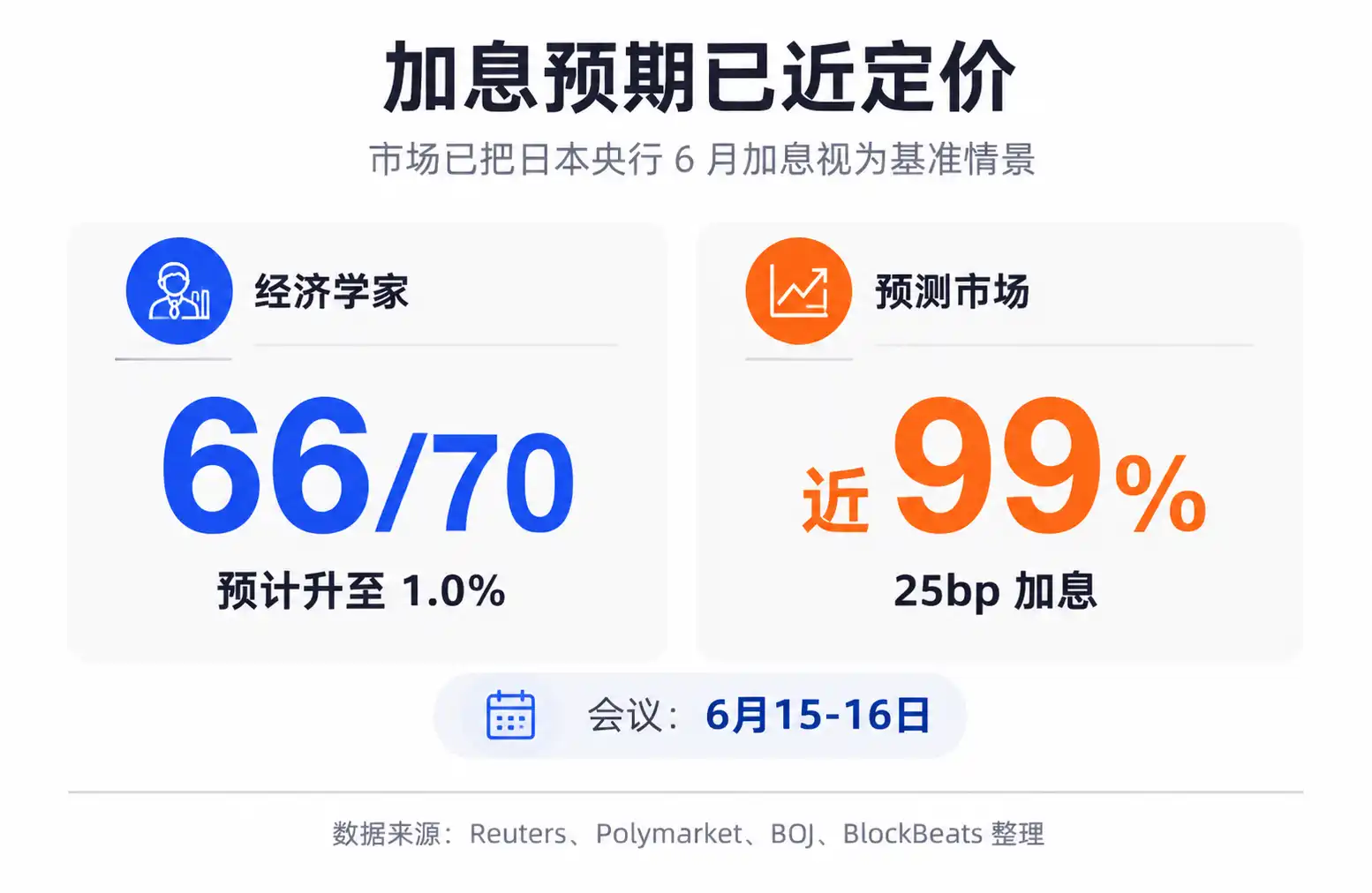
25 basis points may seem small. What the market fears is not the number 'Japanese interest rates reaching 1%', but whether assets that have relied on cheap funding, crowded positions, and high-risk appetites will be repriced after long-term cheap money starts to become more expensive. AI mega-tech and crypto are precisely the most sensitive terminals on this chain.

The Bank of Japan Affects the Global Funding Foundation

Think of the yen carry trade as a low-interest credit card. As long as the borrowing cost is low enough, the exchange rate stable enough, and the target assets rise fast enough, investors are willing to swipe this card to add leverage. The yen has long played the role of this global credit card.

This card is important because it doesn't just serve the Japanese market. Low-interest yen can be converted into dollars, flowing into U.S. stocks, bonds, emerging markets, commodities, and also indirectly affecting the risk appetite in crypto markets. When global asset prices rise, carry trades amplify liquidity. When the yen appreciates or Japanese interest rates rise, this chain works in reverse, forcing some funds to reduce positions, repay loans, and cut leverage.

Therefore, investors cannot judge its market impact solely based on 'the size of the Japanese economy.' The Bank of Japan is changing not the profit outlook of one local industry, but a long-term, low-cost foundation within the global funding map.

The April meeting already signaled this. At that time, the BOJ maintained the uncollateralized overnight call rate at around 0.75%, but the vote was 6 to 3, with 3 members already advocating an immediate hike to around 1.0%. In its Outlook Report that same month, the BOJ lowered its real GDP forecast for fiscal 2026 to 0.5% and raised its core CPI forecast to 2.8%. The policy discussion has shifted from whether to normalize to how fast normalization should be.
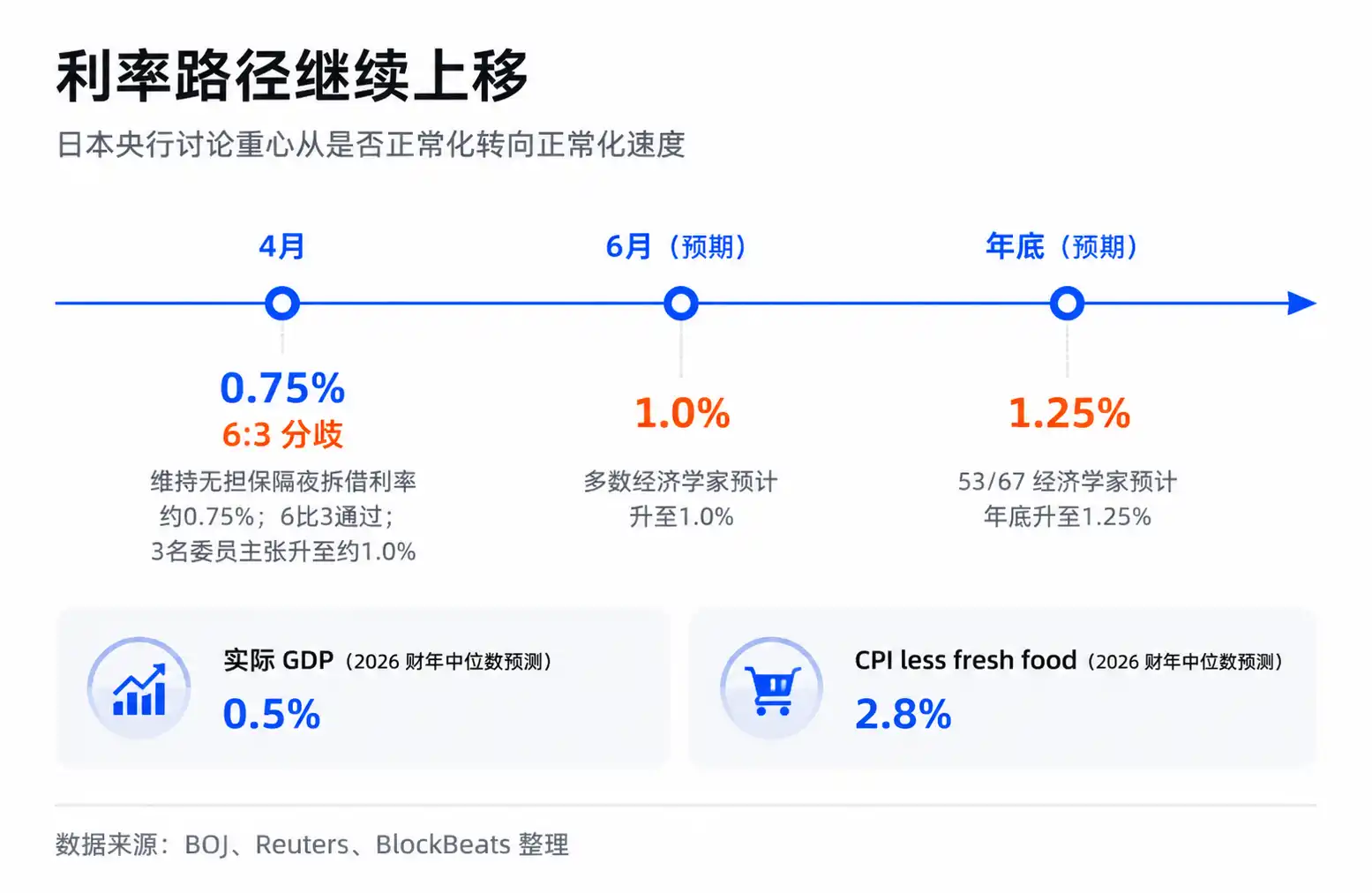
The market consensus remains relatively mild: the BOJ will raise rates gradually, with ample policy communication, and part of the yen carry trade has already been unwound during past bouts of volatility. But the risk framework looks at something else. As long as residual leverage remains, what triggers volatility is often not the absolute level of interest rates, but the speed of change in interest rate differentials and exchange rate expectations.

For AI stocks and crypto, this speed matters. They are both high-beta assets, meaning assets with greater price elasticity. They rise more sharply when liquidity is loose and fall faster when risk appetite declines. AI leaders have real revenue and industry trend support, and Bitcoin also has ETFs, the halving cycle, and on-chain structures, but their marginal pricing still highly depends on global risk appetite.

When cheap money diminishes, the market may not immediately reject the AI or crypto narratives, but it may lower the valuation multiples it is willing to pay for future growth.

25bp Amplified by Leverage and Exchange Rates

Looking solely at 25 basis points, a Japanese rate hike shouldn't seem likely to shock global assets. The problem is that carry trades are not simple comparisons of deposits and loans; they are a system layered with leverage, exchange rates, and crowded positions.

A typical yen carry trade has three sources of return: low borrowing cost in yen, high returns on purchased assets, and a stable or depreciating yen. As long as these three hold, the trade is comfortable. Once Japanese rates rise, the first source of return is compressed. If the market begins to expect yen appreciation, the third source becomes a risk. Investors not only earn less but may also lose money on the exchange rate.

That's why 1% itself isn't necessarily scary, but moving from 0.75% towards 1.0%, with the market expecting 1.25% by year-end, changes the calculus for capital. What carry trades fear most is not a slow rise in cost, but everyone simultaneously realizing the same trade is no longer profitable and then rushing to unwind.

Unwinding transmits local Japanese policy to global risk assets. Investors need to buy back yen to repay debt, potentially selling dollar-denominated assets, tech stocks, crypto, commodities, or emerging market positions. If many funds act similarly at the same time, price declines can trigger more risk controls, margin calls, and volatility model adjustments, creating secondary amplification.

The IMF noted in its April 2026 Global Financial Stability Report that carry trade unwinding could amplify market volatility through channels like capital flows, bond yield volatility, leveraged ETFs, and non-bank financial institution deleveraging. The key point here is not that a particular downturn is solely caused by the BOJ, but that this mechanism exists and can exacerbate shocks when liquidity is tight.
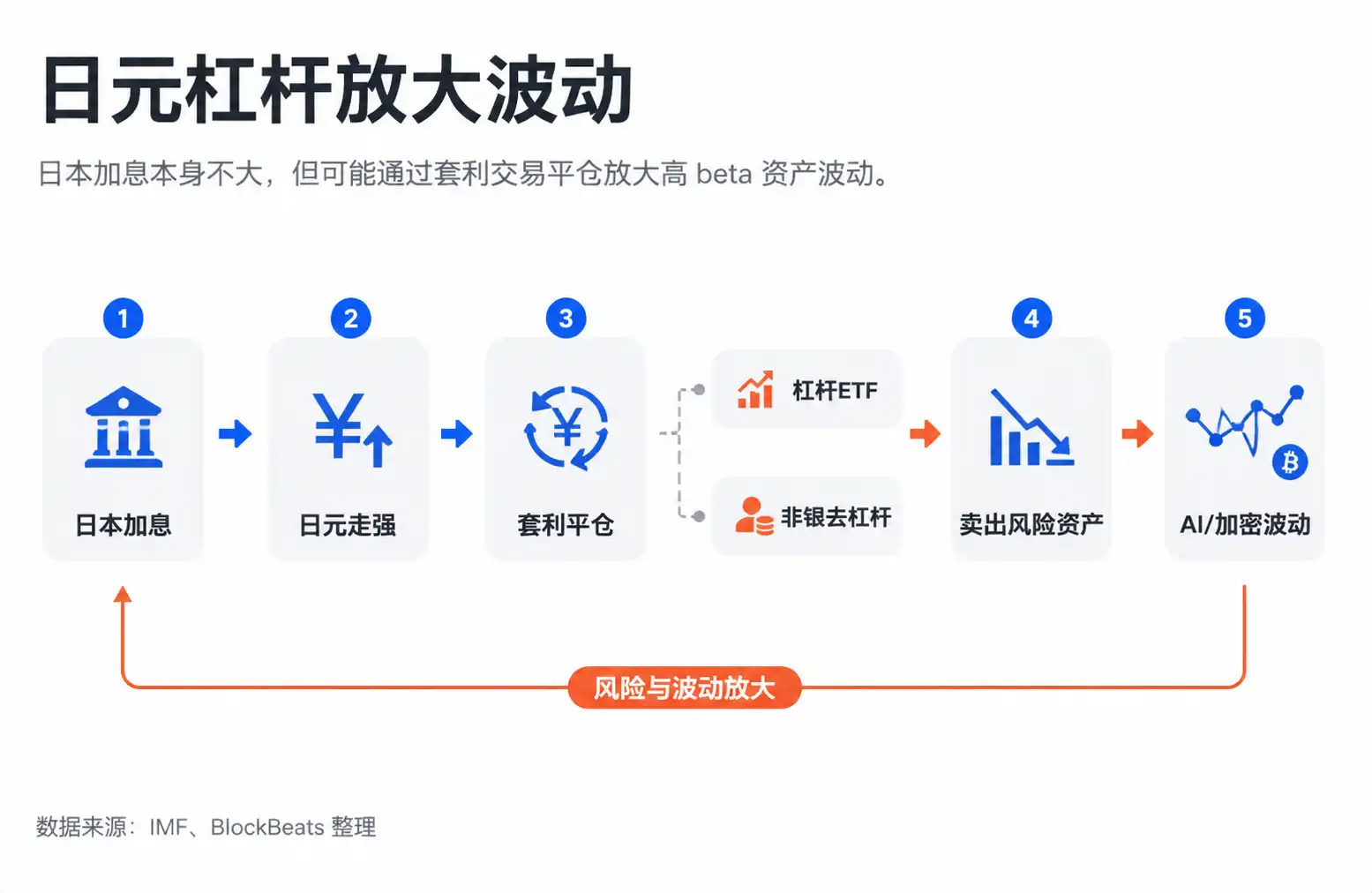
Over the past two years, the market has repeatedly seen similar phenomena: momentum stocks, AI tech stocks, and Bitcoin experiencing synchronized volatility without clear new Fed signals or a sudden deterioration in single-company fundamentals. Institutional analysis often cites yen carry trade unwinding as one explanation. Strictly speaking, this can only prove a high temporal coincidence and a plausible mechanism, not sole causation. But for trading, correlation and transmission mechanisms are sufficient to constitute a risk variable.

The Market Is Trading on Higher Funding Hurdles

More precisely, the market is not trading on 'Japan's rate hike destroying AI,' but on 'higher funding hurdles for global risk assets.' These are two different things.

The AI rally still has its own main drivers. Cloud provider capital expenditures, GPU demand, model application deployment, enterprise software revenue—these are the long-term fundamentals for companies like NVIDIA and Microsoft. Bitcoin also has its own main drivers, including ETF inflows, regulatory frameworks, macro hedging narratives, and on-chain supply structure. The BOJ will not replace these variables.

But at high valuation stages, fundamentals answer whether there is long-term value, while liquidity answers what multiple the market is willing to pay for that future. When global low-cost funding is more abundant, investors are more willing to pay a high price for future growth. When funding costs rise and risk appetite falls, the same growth story may be discounted more heavily.

This is the meaning of implicit funding cost. It may not manifest as a rise in a specific company's loan rate, nor does it necessarily mean a specific fund directly borrowed yen. It's more like the overall leverage temperature of the market: when money is cheap, investors chase high-volatility assets. When money becomes expensive, the market's tolerance for losses, distant profits, and valuation bubbles declines.

Therefore, the market significance of this BOJ meeting does not lie in whether 1% is a high interest rate. In the U.S. or many emerging markets, 1% is certainly not high. But in the history of the yen as a global funding currency, it represents a change in direction. A pipeline of capital that has long provided cheap leverage is moving from extremely low cost towards normal cost.

'Most carry trades have already been unwound' also does not mean the risk disappears. Some trades have indeed been reduced in past volatility, and the market has also digested the June hike expectation in advance. But as long as residual exposure remains within the banking system, offshore yen lending, and non-bank leverage, prices will remain sensitive to the speed of normalization.

More importantly, the yen is just one visible anchor point. Global risk assets in recent years have not relied solely on the Fed but also on various low-cost funding currencies, offshore liquidity, and cross-market leverage. When these funding sources simultaneously become less cheap, a dovish Fed pivot may not fully offset the marginal tightening from other currency systems.

Post-Decision, Watch Linkage Between Yen, JGBs, and High-Beta Assets

The verification point for this narrative is clear: after the Bank of Japan's decision on June 16th, does the market just 'buy the rumor, sell the fact,' or does it begin repricing a faster normalization path?

If the BOJ raises to 1.0% as per the economists' survey expectation, but its tone is dovish, USD/JPY reacts calmly, and U.S. tech stocks and crypto do not come under synchronized pressure, then this looks more like a digested policy event. The market will continue to refocus on AI revenue, the Fed's path, and the U.S. earnings cycle, with Japan being a short-term disturbance.

If the decision or subsequent remarks lead the market to price in a year-end 1.25% or even higher path earlier, with the yen appreciating rapidly and Japanese bond yields rising, while NVIDIA, other momentum tech stocks, BTC, and ETH experience synchronized volatility, it would indicate investors are starting to trade not the 25 basis points, but a renewed contraction in the yen leverage chain.

Next, watch the linkage between prices: does yen strength accompany weakness in high-beta assets, does volatility rise without new U.S. negatives, do leveraged ETFs and crowded momentum stocks bear the brunt first. As long as these signals appear together, the Bank of Japan is no longer just the Bank of Japan—it is reminding the market that the map of global cheap money is becoming more expensive.


Trend Kriptolar

İlgili Sorular

QWhat is the core market concern behind the Bank of Japan's potential rate hike, beyond the immediate interest rate change?

AThe market is not primarily concerned about Japan's interest rate reaching 1% itself. Instead, the worry is that as a long-term source of cheap money (the 'global credit card') begins to get more expensive, assets that have relied on low-cost financing, crowded positions, and high risk appetite may face repricing. The article highlights that AI stocks and cryptocurrencies are particularly sensitive 'terminal points' on this chain.

QAccording to the article, why is the potential impact of the Bank of Japan's policy greater than Japan's economic size might suggest?

AThe Bank of Japan's policy change is significant because it alters a key piece of low-cost 'foundation' in the global financing map. The Japanese yen has long served as a cheap funding currency for global carry trades. Investors borrow low-interest yen, convert it to dollars, and invest in higher-yielding assets worldwide. A policy shift in Japan thus does not just change a local industry's profit outlook but impacts the global cost of leverage and risk appetite.

QWhat are the three layers of profit in a typical yen carry trade, and how does a Bank of Japan rate hike threaten them?

AA typical yen carry trade has three profit layers: 1) The low cost of borrowing yen. 2) The higher return from the purchased asset. 3) The yen not appreciating (or even depreciating). A Bank of Japan rate hike directly compresses the first layer (higher borrowing cost). Furthermore, if the rate hike leads to market expectations of yen appreciation, the third layer turns into a risk, as investors could lose money on the currency exchange when repaying the loan.

QThe article distinguishes between 'fundamentals' and 'liquidity' for high-beta assets like AI stocks. What is the key difference in their roles?

AFor high-beta assets like AI stocks and Bitcoin, fundamentals answer the question of long-term value (e.g., cloud capital expenditure, GPU demand, ETF inflows, supply structure). Liquidity, on the other hand, answers the question of the valuation multiple the market is willing to pay for that future growth. When global low-cost financing is abundant, investors pay higher prices for future growth stories. When financing costs rise and risk appetite falls, the same growth story may be discounted at a lower multiple.

QWhat key market signals should investors watch after the Bank of Japan's June meeting to assess the impact on global risk assets?

AInvestors should watch for specific inter-market linkages: whether a stronger yen is accompanied by weakness in high-beta assets (like momentum tech stocks, BTC, ETH), whether market volatility rises without new U.S. catalysts, and whether leveraged ETFs and crowded momentum stocks lead the decline. The simultaneous appearance of these signals would indicate the market is trading on the theme of a broader contraction in global cheap funding, beyond just the immediate rate decision.

İlgili Okumalar

After Three Consecutive Quarters of Decline, Can the Crypto Market Find a Window for Stabilization in Q3?

The cryptocurrency market has just concluded its worst-performing quarter since 2022, with total capitalization dropping 12.6% to $2.1 trillion. All core metrics indicate capital is leaving the sector, not just rotating within it. Bitcoin fell 14.2% and Ethereum dropped 25.4% in Q2, breaking their previous correlation with US tech stocks. A key driver is the reversal in US spot Bitcoin ETF flows, which saw a net outflow of approximately $4.67 billion in Q2, including a record monthly outflow near $4.5 billion in June. While recent data suggests long-term holders are accumulating again, sustained ETF outflows mean continued selling pressure. Market focus is now singularly on the Federal Reserve. The upcoming July FOMC meeting is seen as the most critical event for Q3. A dovish signal could support Bitcoin reclaiming a $68,000-$84,000 range, while a hawkish stance might establish a new trading band around $50,000-$56,000. Additionally, regulatory uncertainty persists, with the progress of the crucial *CLARITY Act* stalling in the Senate, reducing its perceived 2026 passage probability to 40-45%. Despite the broad downturn, a few sectors showed growth. Prediction markets saw nominal volume surge 48.7% year-over-year to $113.8 billion, and tokenized collectibles transaction volume rose 143% quarterly to $1.4 billion. The Real-World Asset (RWA) tokenization sector also continued steady growth, now representing ~$28.1 billion in on-chain value. The market's foundation for an extreme crash appears limited, with Bitcoin price hovering near its 200-week moving average. However, the trading paradigm has shifted from narrative-driven speculation to decisions based on price action, policy developments, and interest rate expectations, making a broad sentiment-driven rally unlikely in the near term.

marsbit48 dk önce

After Three Consecutive Quarters of Decline, Can the Crypto Market Find a Window for Stabilization in Q3?

marsbit48 dk önce

BIT Trading Moment: BTC Still Suppressed by Weekly 200 EMA, Rejection May Restart Decline; Storage and Semiconductors that Surged Last Night Begin Falling in Evening Trading

**Crypto & Stock Market Wrap: Bitcoin Tests Resistance, Stocks Retreat After AI Surge** Bitcoin consolidates around $66,000, facing key resistance near $68,000—an area seen as a major psychological and technical hurdle where previous rallies have failed. Analysts note the cryptocurrency is caught between its 200-week moving average (~$63,333) and 200-week EMA (~$68,328). A clear break above $68k is needed to signal a stronger bullish trend, while a rejection could lead to a retest of $63k support. Market sentiment remains cautious, with low futures open interest pointing to a low-liquidity rebound rather than a full bull market. Bitcoin spot ETFs saw another $203 million inflow. US stock futures pointed lower after a strong Tuesday session led by a massive rebound in semiconductors and memory stocks. The rally was fueled by renewed optimism about AI-driven hardware demand, with Micron, SanDisk, and SK Hynix surging. However, those gains reversed in pre-market trading. Super Micro Computer (SMCI) soared over 20% after hours on strong guidance and a record backlog. Other standouts included Rocket Lab and nuclear energy plays Oklo and X-Energy. Rising oil prices (Brent above $91) and climbing Treasury yields (10-year near 4.64%), however, are reigniting inflation concerns and acting as a headwind for equities. In Asia, markets were mixed. South Korea's KOSPI pared early gains to close slightly higher as semiconductor stocks like SK Hynix gave back initial surges. Japan's Nikkei edged lower as the yen hit a fresh 38-year low against the dollar, raising fears of potential market intervention. Key events to watch include the Samsung Galaxy launch, AMD's AI event, and a slew of major tech earnings from Alphabet, Tesla, and IBM after the close on Wednesday, followed by the ECB meeting and Intel's earnings on Thursday.

marsbit56 dk önce

BIT Trading Moment: BTC Still Suppressed by Weekly 200 EMA, Rejection May Restart Decline; Storage and Semiconductors that Surged Last Night Begin Falling in Evening Trading

marsbit56 dk önce

Former CFTC Chairman, Circle President Tarbert: Preaching Long-Termism While Cashing Out $30 Million Himself

Former CFTC Chairman and Circle President Heath Tarbert has consistently advocated for a long-term vision in public, urging patience from investors as Circle’s stock price has fallen significantly from its peak. However, it has been revealed that since Circle’s IPO, Tarbert has continuously sold his CRCL shares through pre-arranged trading plans, cashing out approximately $30 million, without making any public market purchases. This contrast between his public messaging and personal actions has drawn criticism. Tarbert joined Circle in July 2023 as Chief Legal Officer, leveraging his regulatory experience to help guide the company through its IPO and expansion. Despite promoting stablecoins as long-term infrastructure, he established a 10b5-1 trading plan just before Circle went public, leading to substantial stock sales over the following year. In March 2026, he initiated another plan to sell more shares. His career trajectory highlights a pattern of moving between high-level regulatory roles and influential positions in the financial sector. After resigning as CFTC Chairman in early 2021, he joined Citadel Securities as Chief Legal Officer just 27 days later, during a period of intense regulatory scrutiny for the firm. He later joined Circle, aiding its efforts to navigate regulatory challenges for its public listing. While Tarbert's expertise in policy and compliance is valuable to companies like Circle, his actions—advocating long-term confidence while personally divesting—raise questions about the alignment between his public statements and his private financial decisions, leaving investors who followed his advice to bear the market risks.

marsbit1 saat önce

Former CFTC Chairman, Circle President Tarbert: Preaching Long-Termism While Cashing Out $30 Million Himself

marsbit1 saat önce

Gate Research Institute: The 'Wall Street-ization' Wave of Crypto Financial Products – Competition or Integration?

The article titled "Gate Research Institute: Are Crypto Financial Products Sparking a 'Wall Street' Wave—Competition or Convergence?" explores the evolving relationship between the crypto ecosystem and traditional finance (TradFi). The piece begins by reflecting on Bitcoin's original 2009 vision of decentralization, disintermediation, and moving away from banks. It then contrasts this with the 2024 landscape, where key crypto assets like Bitcoin are increasingly held through Wall Street products like ETFs issued by giants like BlackRock. The article questions whether this signifies that TradFi is systematically taking over the rights to issue, price, custody, and distribute crypto financial assets. The core argument is that this is not a zero-sum takeover but rather a bidirectional convergence where each side addresses the other's weaknesses. Crypto offers 24/7 global markets, programmable settlement, and open access but lacks compliant channels, institutional-grade custody, deep fiat liquidity, and mainstream distribution. TradFi possesses these but is constrained by legacy systems, limited operating hours, and slow settlement. Two primary convergence paths are highlighted: * **Path A (CEX to TradFi):** Exemplified by Gate, which has progressed from offering tokenized stocks and CFDs to providing direct, real stock trading (US, Hong Kong, South Korea) within its platform, using USDT. * **Path B (TradFi to Crypto):** Exemplified by Robinhood, which has integrated crypto trading, acquired exchanges like Bitstamp, and is moving traditional assets like stocks onto the blockchain via tokenization and its own Layer 2. Both paths are ultimately competing to become the next-generation, unified financial account—a "super account" where users can seamlessly trade cryptocurrencies, stocks, ETFs, RWA (Real World Assets), and tokenized treasury products in one interface. The growth of RWA and tokenized treasuries (e.g., BlackRock's BUIDL) is presented as the asset-layer fusion, providing stable, yield-bearing assets on-chain and acting as a bridge between the two worlds. In conclusion, the "Wall Street-ization" of crypto is framed as a mutual transformation. Decentralized ideals persist in the protocol layer, while at the application layer, a more efficient, global, and accessible unified capital market is emerging from this convergence. The future competition lies not between crypto exchanges and stockbrokers, but between platforms vying to offer the most comprehensive asset coverage, liquidity, and user experience within a single account.

marsbit1 saat önce

Gate Research Institute: The 'Wall Street-ization' Wave of Crypto Financial Products – Competition or Integration?

marsbit1 saat önce

İşlemler

Spot

Popüler Makaleler

$BANK Nedir

Bank AI: Bankacılıkta Devrimsel Bir Adım Giriş Teknolojideki hızlı ilerlemelerin damgasını vurduğu bir çağda, Bank AI, yapay zeka (AI) ve bankacılık hizmetleri kesişiminde yer almaktadır. Bu yenilikçi proje, finansal manzarayı yeniden tanımlamayı, operasyonel verimliliği, güvenlik önlemlerini ve müşteri deneyimlerini AI'nin gücüyle geliştirmeyi hedefliyor. Bank AI yolculuğuna çıkarken, projenin içeriğine, operasyonel dinamiklerine, tarihsel bağlamına ve önemli kilometre taşlarına dalacağız. Bank AI Nedir? Bank AI, yapay zekanın çeşitli bankacılık operasyonlarına entegrasyonunu hedefleyen dönüştürücü bir girişimi temsil etmektedir. Bu proje, süreçleri otomatikleştirmek, risk yönetimi protokollerini geliştirmek ve kişiselleştirilmiş hizmetler aracılığıyla müşteri etkileşimini artırmak için AI'nin yeteneklerinden yararlanmaktadır. Bank AI'nin temel hedefleri şunlardır: Bankacılık Fonksiyonlarının Otomasyonu: AI teknolojilerini kullanarak, Bank AI rutin görevleri otomatikleştirmeyi, insan kaynakları üzerindeki yükü azaltmayı ve verimliliği artırmayı amaçlamaktadır. Geliştirilmiş Risk Yönetimi: Proje, dolandırıcılık ve diğer tehditlere karşı güvenlik önlemlerini güçlendirerek riski tahmin edip tanımlamak için AI algoritmalarını kullanmaktadır. Bankacılık Hizmetlerinin Kişiselleştirilmesi: Bank AI, müşteri verilerini ve davranışlarını analiz ederek, özel finansal ürünler ve hizmetler sunmaya odaklanmaktadır. Müşteri Deneyimini İyileştirme: Chatbotlar ve sanal asistanlar gibi AI destekli çözümlerin uygulanması, kullanıcıların daha insana yakın etkileşimler yaşamasını sağlamayı hedeflemekte, bankalarla etkileşim biçimlerini devrim niteliğinde değiştirmektedir. Bu hedeflerle, Bank AI, bankacılığı daha verimli, güvenli ve kullanıcı odaklı hale getiren önemli bir oyuncu olarak kendini konumlandırmaktadır. Bank AI'nin Yaratıcısı Kimdir? Bank AI'nin yaratıcısı hakkında detaylar bilinmemektedir. Bu nedenle, mevcut bilgilerde belirli bir kişi veya organizasyon tanımlanmamıştır. Projenin başlangıcı etrafındaki anonimlik soruları gündeme getirse de, bunun iddialı vizyonu ve hedefleri üzerinde bir olumsuz etkisi yoktur. Bank AI'nin Yatırımcıları Kimlerdir? Proje yaratıcılarında olduğu gibi, Bank AI'nin yatırımcıları veya destekleyen organizasyonları hakkında da özel bilgiler açıklanmamıştır. Bu bilgiler olmadan, projenin ilerlemesini destekleyen finansal destek ve kurumsal destek hakkında bir çerçeve çizmek zordur. Yine de, böyle yenilikçi bir alanda gelişimi sürdürmek için sağlam bir yatırım temelinin önemi büyüktür. Bank AI Nasıl Çalışır? Bank AI, geleneksel bankacılık çerçevelerinden ayıran benzersiz faktörlere odaklanarak birden fazla yenilikçi alanda faaliyet göstermektedir. İşte temel operasyonel özellikler: Otomasyon: Makine öğrenimi algoritmalarını uygulayarak, Bank AI bankalar içindeki çeşitli manuel süreçleri otomatikleştirir. Bu, operasyonel maliyetleri azaltır ve insan çalışanların daha stratejik faaliyetlere yönelmelerini sağlar. Gelişmiş Risk Yönetimi: Risk yönetimi uygulamalarına AI entegrasyonu, bankaların dolandırıcılık gibi potansiyel tehditleri doğru bir şekilde tahmin etme araçlarıyla donatılmasını sağlar, böylece müşteri bilgileri ve varlıkları güvence altına alınır. Özelleştirilmiş Finansal Tavsiyeler: Müşteri etkileşimlerinden sürekli olarak öğrenerek, AI sistemleri kullanıcı ihtiyaçlarının daha iyi anlaşılmasını sağlar ve finansal kararlar hakkında özelleştirilmiş tavsiyeler sunar. Geliştirilmiş Müşteri Etkileşimleri: AI destekli chatbotlar ve sanal asistanlar kullanarak, Bank AI daha etkileşimli bir müşteri deneyimi sunar, kullanıcıların sorularını hızlı bir şekilde çözmelerine imkan tanır, bekleme sürelerini azaltır ve memnuniyet seviyelerini artırır. Bu operasyonel özellikler, Bank AI'yi bankacılık sektöründe bir öncü olarak konumlandırmakta ve hizmet sunumu ile operasyonel mükemmeliyet için yeni standartlar belirlemektedir. Bank AI Zaman Çizelgesi Bank AI'nin gidişatını anlamak için tarihsel bağlamına bir göz atmak gerekmektedir. Aşağıda önemli kilometre taşlarını ve gelişmeleri vurgulayan bir zaman çizelgesi bulunmaktadır: 2010'ların Başları: AI entegrasyonunun bankacılık hizmetlerine olan ilgisi arttı, bankacılık kurumları potansiyel faydalarını tanımaya başladılar. 2018: Bankaların temel müşteri hizmetleri ve geliştirilmiş güvenlik yönetimi için risk yönetim sistemlerinde chatbotlar gibi AI araçları kullanmaya başlamasıyla AI teknolojilerinin uygulanmasında belirgin bir artış yaşandı. 2023: AI'nin karmaşıklığı artmaya devam etti ve belge işleme ile gerçek zamanlı yatırım analizi gibi daha karmaşık görevler için üretken AI devreye alındı. Bu yıl, AI teknolojisi sayesinde bankaların sahip olduğu yeteneklerde önemli bir sıçrama yaşandı. 2024-Güncel Durum: Bu yıl itibarıyla, Bank AI yükselişte, devam eden araştırmalar ve geliştirmeler bankacılık operasyonlarındaki yetenekleri daha da artırmaya hazırlanıyor. AI uygulamalarının sürekli araştırılması, heyecan verici gelişmelere işaret etmektedir. Bank AI Hakkında Anahtar Noktalar Bankacılıkta AI Entegrasyonu: Bank AI, bankacılık süreçlerini kolaylaştırmak ve kullanıcı deneyimlerini geliştirmek için yapay zekanın benimsenmesine odaklanmaktadır. Otomasyon ve Risk Yönetimi Vurgusu: Proje, rutin görevlerin yükünü azaltmayı amaçlarken, tahmine dayalı analizlerle güvenlik çerçevelerini geliştirmeye büyük önem vermektedir. Kişiselleştirilmiş Bankacılık Çözümleri: Müşteri verilerinden yararlanarak, Bank AI bireysel kullanıcı ihtiyaçlarına yönelik özelleştirilmiş bankacılık hizmetleri sunar. Gelişime Bağlılık: Bank AI, teknolojinin sürekli evrimi ile uyumlu olmasını sağlamak ve güncel kalmak için sürekli araştırma ve geliştirme çabalarına bağlı kalmaktadır. Sonuç Özetle, Bank AI bankacılık endüstrisinde önemli bir adımı temsil etmekte, yapay zekayı kullanarak operasyonel paradigmaları yeniden şekillendirmekte, güvenliği artırmakta ve müşteri memnuniyetini teşvik etmektedir. Yaratıcı ve yatırımcılar hakkındaki bilgi eksikliklerine rağmen, Bank AI'nin net hedefleri ve işlevsel mekanizmaları, devam eden evrimi için güçlü bir temel sunmaktadır. AI teknolojisi gelişmeye ve bankacılık sektörüyle birleşmeye devam ettikçe, Bank AI finansal hizmetlerin geleceğini önemli ölçüde etkilemeye hazır durumda, bankacılıkla olan anlayışımızı ve etkileşim biçimlerimizi geliştirmektedir.

188 Toplam GörüntülenmeYayınlanma 2024.04.06Güncellenme 2024.12.03

$BANK Nedir

BANK Nasıl Satın Alınır

HTX.com’a hoş geldiniz! Lorenzo Protocol (BANK) satın alma işlemlerini basit ve kullanışlı bir hâle getirdik. Adım adım açıkladığımız rehberimizi takip ederek kripto yolculuğunuza başlayın. 1. Adım: HTX Hesabınızı OluşturunHTX'te ücretsiz bir hesap açmak için e-posta adresinizi veya telefon numaranızı kullanın. Sorunsuzca kaydolun ve tüm özelliklerin kilidini açın. Hesabımı Aç2. Adım: Kripto Satın Al Bölümüne Gidin ve Ödeme Yönteminizi SeçinKredi/Banka Kartı: Visa veya Mastercard'ınızı kullanarak anında Lorenzo Protocol (BANK) satın alın.Bakiye: Sorunsuz bir şekilde işlem yapmak için HTX hesap bakiyenizdeki fonları kullanın.Üçüncü Taraflar: Kullanımı kolaylaştırmak için Google Pay ve Apple Pay gibi popüler ödeme yöntemlerini ekledik.P2P: HTX'teki diğer kullanıcılarla doğrudan işlem yapın.Borsa Dışı (OTC): Yatırımcılar için kişiye özel hizmetler ve rekabetçi döviz kurları sunuyoruz.3. Adım: Lorenzo Protocol (BANK) Varlıklarınızı SaklayınLorenzo Protocol (BANK) satın aldıktan sonra HTX hesabınızda saklayın. Alternatif olarak, blok zinciri transferi yoluyla başka bir yere gönderebilir veya diğer kripto para birimlerini takas etmek için kullanabilirsiniz.4. Adım: Lorenzo Protocol (BANK) Varlıklarınızla İşlem YapınHTX'in spot piyasasında Lorenzo Protocol (BANK) ile kolayca işlemler yapın.Hesabınıza erişin, işlem çiftinizi seçin, işlemlerinizi gerçekleştirin ve gerçek zamanlı olarak izleyin. Hem yeni başlayanlar hem de deneyimli yatırımcılar için kullanıcı dostu bir deneyim sunuyoruz.

775 Toplam GörüntülenmeYayınlanma 2025.05.09Güncellenme 2026.06.02

BANK Nasıl Satın Alınır

Tartışmalar

HTX Topluluğuna hoş geldiniz. Burada, en son platform gelişmeleri hakkında bilgi sahibi olabilir ve profesyonel piyasa görüşlerine erişebilirsiniz. Kullanıcıların BANK (BANK) fiyatı hakkındaki görüşleri aşağıda sunulmaktadır.

活动图片













