Japan's Bond Market to Go Fully 'On-Chain'

marsbit2026-05-11 tarihinde yayınlandı2026-05-11 tarihinde güncellendi

Özet

The article details Japan's urgent move to tokenize its Government Bonds (JGBs) on the blockchain, specifically via the Canton Network, in a landmark 2026 proof-of-concept. With over $9 trillion in circulation, JGBs are a cornerstone of Asian institutional collateral, but their legacy settlement system is slow and limited to Tokyo business hours. This inefficiency risks JGBs losing their premier status to faster, 24/7 tokenized U.S. Treasuries, already being settled on Canton by giants like DTCC and JPMorgan. Canton Network was chosen for its unique architecture, enabling atomic, real-time settlements while ensuring strict data privacy and legal compliance—critical for sovereign debt. The shift to "always-on" collateral promises transformative benefits: reducing forced asset sales during market stress by allowing direct collateral posting, eliminating settlement risk in repo transactions, and integrating tokenized commercial bank deposits for institutional-grade cash settlement. This convergence of major sovereign bonds (U.S., Japanese, European) on Canton positions it as a potential new global financial rail, akin to SWIFT for collateral movement. The article frames this as a profound efficiency upgrade within the existing financial system, empowering traditional institutions with superior infrastructure rather than displacing them.

Original Author: Vaidik Mandloi

Compiled and Organized by: BitpushNews

On a Saturday in August 2025, something happened that should have set every cryptocurrency chat group on the internet ablaze. Bank of America, Citadel Securities, the Depository Trust & Clearing Corporation (DTCC), and Société Générale settled a US Treasury repo transaction over a blockchain in real-time over the weekend.

For context, repo is one of the most fundamental trades in institutional finance: one party sells government bonds to another with an agreement to buy them back the next day, typically to raise short-term overnight cash.

This is the 'plumbing' of the financial system. Banks, hedge funds, and central banks use repo daily to manage liquidity, with trillions of dollars flowing through this market. And this was the first time ever such a transaction was settled atomically, nearly instantaneously on a blockchain, outside of market hours, with participants being some of the world's largest financial institutions.

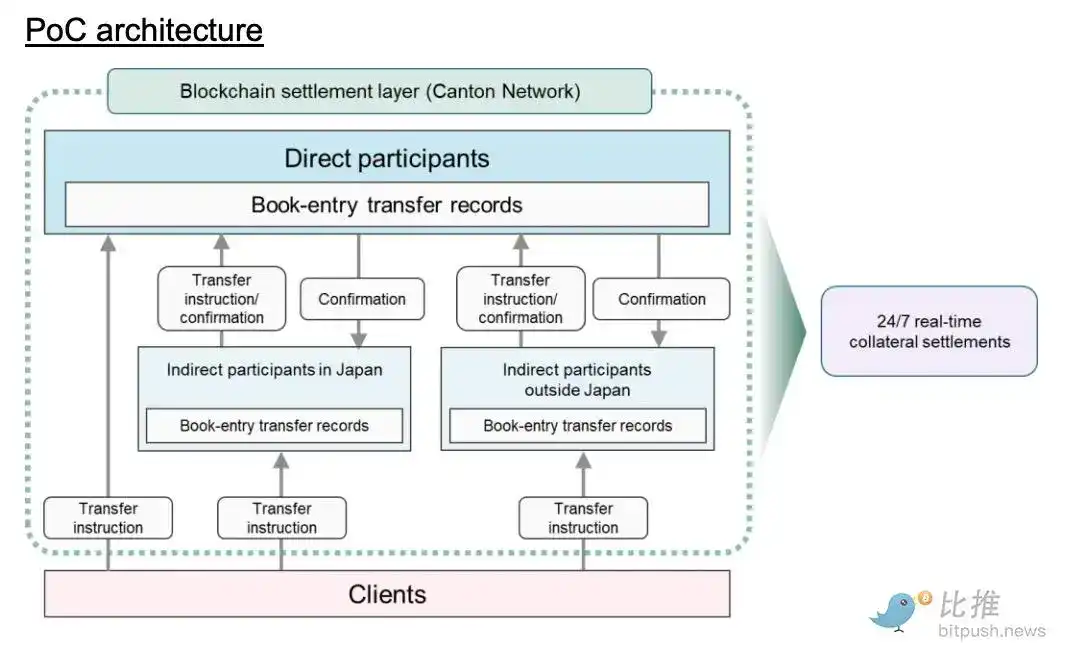
Eight months later, on April 20, 2026, the Japan Securities Clearing Corporation (JSCC), Mizuho Financial Group, Nomura Holdings, and Digital Asset launched a Proof-of-Concept (PoC) aimed at moving Japanese Government Bond (JGB) collateral onto the Canton Network.

JGBs are one of Asia's most critical financial instruments, with over $9 trillion in circulation, making them the single most widely used collateral asset in the region's institutional markets. When banks and hedge funds across Asia need to collateralize their leveraged positions, JGBs are often the go-to choice. And now, that entire collateral system is moving on-chain.

This is arguably the biggest blockchain news of 2026.

This article will analyze why JGBs are the perfect asset to tokenize first, why Canton Network keeps winning institutional orders while public chains battle for retail traffic, and how exactly 'round-the-clock' collateral settlement changes global trading desks.

Why JGBs? Why Now?

For decades, Japan has tried to make the yen a global reserve currency, a wish that never truly materialized. Even today, the yen accounts for only about 4-6% of global reserves, trailing the US dollar, the euro, and even the pound sterling.

But something unintended happened in the process: Japanese government bonds became one of the fastest-growing collateral assets on the Euroclear Collateral Highway—the infrastructure for moving collateral among the world's large financial institutions. Foreign ownership of JGBs has climbed to about 11.9%, meaning roughly ¥144 trillion is held by institutions outside Japan.
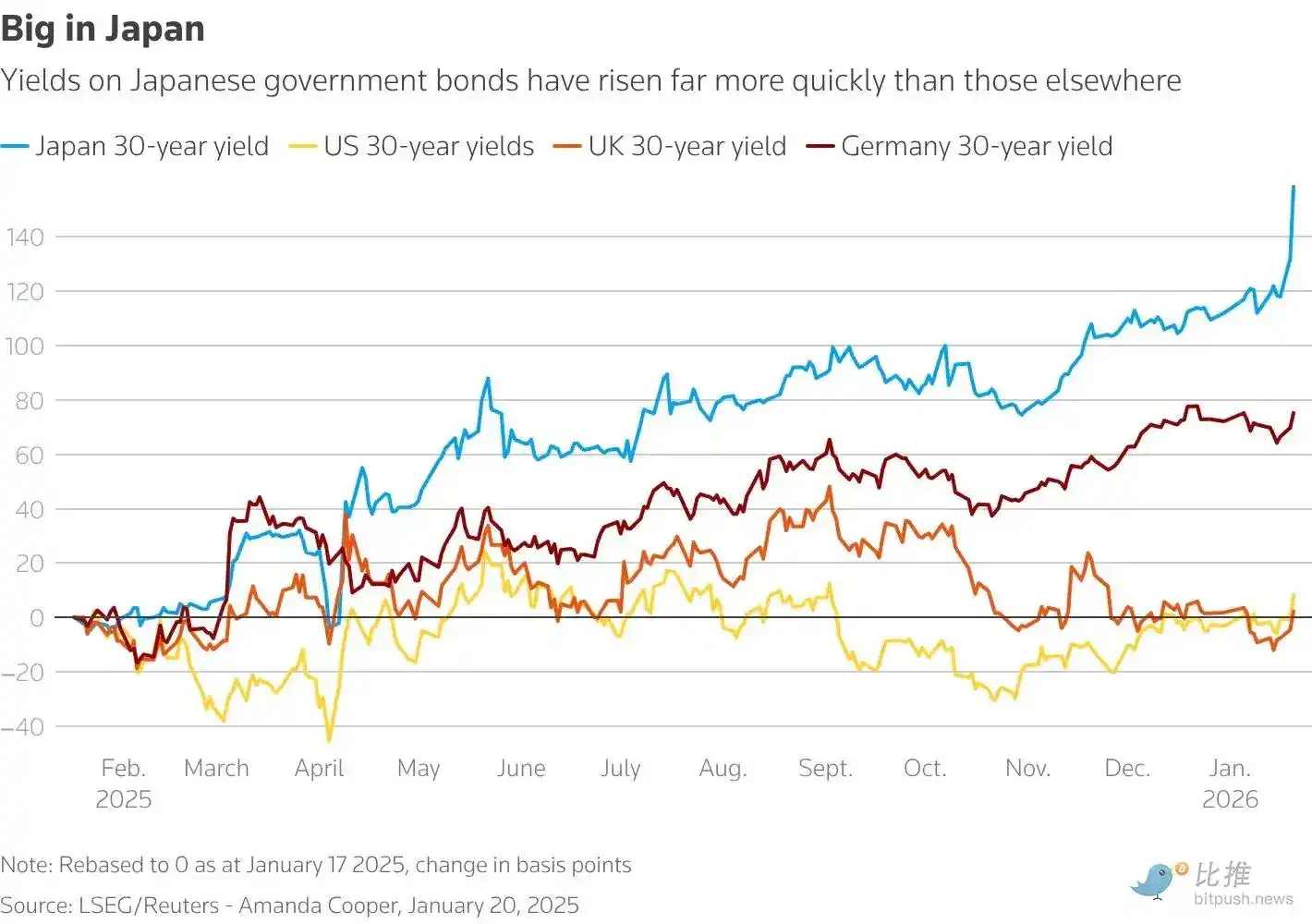
In institutional finance, collateral is everything. Every leveraged position, every derivatives trade, every repo requires high-quality assets as security. Backed by the world's third-largest economy and with virtually no default risk, JGBs are one of the few global assets that qualify. When a hedge fund in Singapore builds a leveraged position, or a bank in London covers a derivatives exposure, JGBs are frequently used as collateral.

Cryptocurrency's most important infrastructure victory is happening inside traditional finance. Without Japan winning the 'currency war,' JGBs have become the operational infrastructure for Asian institutional finance.

The problem is, the entire collateral system operates like it's 1995. Moving JGB collateral between two institutions passes through a layered holding structure: the Bank of Japan (BOJ) at the top, then Hofuri (Japan's securities depository), then a custodian bank, then a sub-custodian. Each layer requires separate reconciliation and operates only during Tokyo business hours (roughly 9 AM to 3 PM JST).

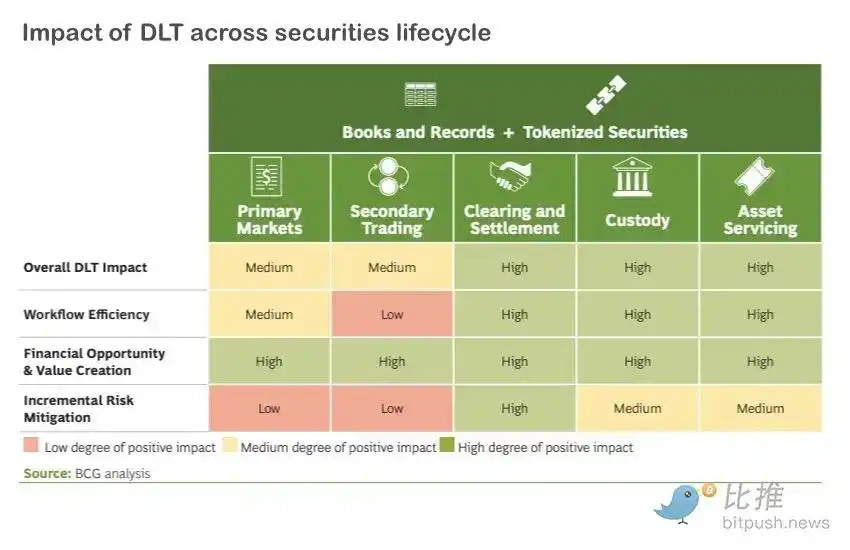
A collateral transfer that should take seconds ends up taking days. During those days, that collateral is 'stuck.' A trading desk in New York needing it at 10 PM has to wait for Tokyo to wake up. A GFMA (Global Financial Markets Association) and BCG study estimates blockchain could unlock $100 billion in trapped collateral globally; for a bank doing $100 billion in daily repo volume, tokenized settlement alone could save $150-300 million annually in operational costs.
Here's something unsettling for Japan: the US is already moving.

DTCC, which custodies $99 trillion in US securities and processes $3.7 quadrillion in annual transactions, partnered with Digital Asset in December 2025 to tokenize US Treasuries on the Canton Network. This means the core of US securities infrastructure is moving towards 24/7 tokenized settlement.

Broadridge is already processing $354 billion in daily tokenized Treasury repo trades on the same network; JPMorgan's Kinexys has processed over $1.5 trillion in cumulative volume through its on-chain payment rail. US Treasuries are rapidly becoming 'always-on, always-movable' collateral assets, while JGBs remain locked in Tokyo's business hours.

If you're a global fund manager needing to post collateral for a margin call at 2 AM, and you can choose between tokenized US Treasuries that settle instantly or JGBs that you have to wait 6 hours for Tokyo to open to move, you choose US Treasuries every time.

Scale that choice across thousands of trading desks, and JGBs risk losing their 'top-tier collateral' status. For a country whose sovereign debt is deeply interwoven into Asia's financial collateral system, this is even an existential issue. The four companies in the JGB on-chain trial used the word 'urgent' in their press release. Given the pace of US infrastructure evolution, it's hard to disagree.

Why Canton Keeps Winning

When Japan's JSCC had to choose a network for JGB collateral, they chose Canton—the same chain DTCC, Broadridge, and JPMorgan are already using. The reason lies in the extremely stringent demands sovereign bond collateral places on a network.

Sovereign bond collateral has a specific set of requirements most blockchains can't meet. When Mizuho Bank transfers JGB collateral to a counterparty in London, the transaction must comply with Japan's Book-Entry Transfer Act. The blockchain record needs to be synchronized at a legal level with Hofuri's official register.

Every party in the transaction (from clearinghouse to custodian to counterparty) can only see data they are authorized to view under Japanese and international securities law. And the entire process requires atomic settlement—the collateral and payment must move at the same instant, or neither moves.

This is an incredibly complex set of constraints. Canton was chosen because its architecture is designed to solve precisely these issues. Each institution runs its own ledger, and cross-institution transactions sync only the data each party is authorized to see. Smart contracts written in Digital Asset's Daml language dictate who can see what and who must authorize each step.

Thus, when JSCC, Mizuho, and Nomura move JGB collateral on Canton, the clearinghouse sees the full picture, Mizuho sees its side, Nomura sees its side, and no one sees anything they shouldn't. Canton is now the only global network enabling three major sovereign bond collateral pools (US Treasuries, Japanese bonds, European bonds) to move across borders, in real-time, 24/7. No other network (public or private) comes close.
What Does 'Round-the-Clock' Collateral Actually Change?

Most coverage of tokenized on-chain settlement stops at 'it's faster.' But speed is just the beginning; the real transformation is in how the system behaves under stress.

Consider what happened in March 2020 during the COVID pandemic. Markets crashed, volatility spiked, and initial margin requirements for equity futures jumped 100% in weeks. Funds unable to meet margin calls were forced to sell assets to raise cash.

But selling assets into a falling market pushes prices lower, triggering more margin calls, forcing more selling. This feedback loop is one of the most dangerous dynamics in finance and nearly broke the system again during the UK LDI pension crisis in September 2022.

How 24/7 tokenized settlement changes this:

  • Direct Collateralization: Currently, when facing a margin call, most funds must first sell assets for cash. With on-chain collateral, funds can directly pledge JGBs or US Treasuries to meet requirements without first converting to cash. The 'forced selling spiral' weakens because fewer institutions dump assets into a falling market just for liquidity.
  • Solving 'Give-to-Get': In traditional repo, the cash lender sends money first and receives collateral later. During this window, one party is exposed. Banks bake this 'intraday exposure' into their haircuts and funding costs.
  • Atomic Execution: With on-chain atomic settlement, both legs of a trade (collateral and cash) move at the same instant. Santander tested this in December 2024, executing $50 million and €50 million in intraday repos on JPMorgan's Kinexys, automatically unwinding them three hours later. Intraday repos, once requiring complex third-party setups or committed credit lines, become routine.

More significantly, in a Canton demo in January 2026, the London Stock Exchange Group (LSEG) brought its Digital Settlement Hub (DiSH) into the trade. DiSH uses tokenized commercial bank deposits as the cash leg, not stablecoins.

This is because banks don't settle billion-dollar trades with USDC—USDC is a private IOU, not 'money good.' DiSH tokens represent actual deposits at regulated banks and can be transferred on-chain 24/7. This solves the cash leg problem, the final piece for institutional adoption. Now, Japan plans to plug JGBs into this same infrastructure.

What This Means

If the JGB trial succeeds, and US Treasuries are already live, with European sovereign bonds also in demos, Canton, in my view, is starting to look like the next SWIFT.

It's a single network becoming the default layer for moving the world's most important collateral across borders. Like SWIFT, once enough institutions join, leaving becomes almost impossible. Network effects compound. Each new sovereign bond class joining benefits existing participants and makes it harder for newcomers to compete.

I think this merits reflection. We in crypto spent years debating decentralization, worrying about single points of failure, building a system no single entity could control the trajectory of. And now, historically the most significant blockchain deployment is converging on a single permissioned network managed by the same institutions that run global finance.

Is this good or bad? It depends on what you believe this is all about. If the goal is to improve capital market efficiency, lower settlement risk, and unlock trillions in trapped collateral, it's working. If the goal was to diminish the power of existing financial institutions, it's doing the opposite—the same gatekeepers are just getting more sophisticated infrastructure.

I don't think that makes it unimportant. Settling government bonds on a blockchain, 24/7, cross-border, atomically, is a genuine upgrade to how global finance operates. But I do think it's worth being honest about what 'kind' of upgrade this is—it's an efficiency revolution: the plumbing is being rebuilt, but the plumbers are the same.


İlgili Sorular

QWhat are JGBs, and why are they considered a critical asset in the Asian institutional finance system according to the article?

AJGBs are Japanese Government Bonds. They are considered a critical asset because, with a circulating value exceeding $9 trillion, they are the most widely used single collateral asset in the region's institutional markets. Supported by the world's third-largest economy and virtually default-free, they are a preferred, high-quality asset for securing leverage positions and derivatives transactions across Asia.

QWhat key problem does the current, traditional JGB collateral settlement system face, and what potential does blockchain technology offer to solve it?

AThe current system operates within limited Tokyo business hours, requiring transfers to pass through multiple holding layers, which takes days and leaves collateral 'frozen' and unavailable. Blockchain technology enables real-time, atomic settlement 24/7. This can unlock an estimated $100 billion in trapped collateral globally and save banks billions annually in operational costs by streamlining the process.

QWhy did Japan's JSCC and associated institutions choose the Canton Network for their JGB tokenization proof-of-concept?

AThey chose the Canton Network because its architecture is specifically designed to meet the stringent requirements of sovereign bond collateral. It allows each institution to run its own ledger while synchronizing only authorized data across parties, ensuring compliance with Japanese securities law. Canton is also the network already being used by major US financial infrastructure players like DTCC for US Treasury tokenization, creating a unified system for cross-border collateral movement.

QHow does the article suggest that 24/7 tokenized collateral settlement could fundamentally change financial market behavior during periods of stress, like the March 2020 crash?

AIt could mitigate the dangerous 'forced selling spiral.' During a crash, funds facing margin calls could directly pledge tokenized JGBs or US Treasuries as collateral without first selling assets for cash. This reduces the need to dump assets into a falling market just to raise liquidity, thereby weakening the feedback loop that exacerbates price declines and further margin calls.

QWhat significant comparison does the article make regarding the Canton Network's potential role in the future of global finance, and what underlying irony or contradiction does it highlight about the blockchain deployment?

AThe article suggests Canton is beginning to look like the next SWIFT—a single default network for moving the world's most important collateral across borders. The highlighted irony is that this historically significant blockchain deployment is converging on a single, permissioned network managed by the very incumbent financial institutions it was once thought might be disrupted. It represents an efficiency revolution in the 'plumbing' of finance, but the 'plumbers' (the established gatekeepers) remain the same.

İlgili Okumalar

Unitree Passes the Hearing, Hangzhou Reaps the Rewards

Unitree Technology, a leading company in Hangzhou's tech scene known as one of the "Hangzhou Six Dragons," has officially passed the review for listing on the Shanghai Stock Exchange's STAR Market (科创板). It plans to raise 4.202 billion yuan for the research and development of intelligent robot models and robot hardware. This milestone will make Unitree the "first humanoid robotics stock." Founded in 2016 by Wang Xingxing, the company started humbly in a small office in Hangzhou's Binjiang district. Initially, the robotics sector was not viewed favorably by the market, with Unitree's products often labeled as "toys" and struggling to secure funding. At its most critical point, with only around 100,000 yuan left, Wang stopped his own salary to keep the company afloat. A crucial turning point came in 2018 when Hangzhou's state-owned capital system provided timely support. A financial platform under the city's state-owned assets completed due diligence in three days and granted a 20-million-yuan loan within a week. This "patient capital" infusion stabilized Unitree, enabling its transition from prototype development to mass production and commercial viability. Subsequently, Hangzhou Capital, through its two major 100-billion-yuan mother funds—the Hangzhou Science and Technology Innovation Fund and the Hangzhou Innovation Fund—participated in four of Unitree's financing rounds (B2, B3, C, and C+). This continuous backing helped the company grow, attract top-tier industrial investors like China Mobile, Tencent, Alibaba, and Geely, and solidify its position as a global leader in legged robotics. By 2025, Unitree achieved significant scale, with revenue reaching 16.99 billion yuan, net profit of 5.91 billion yuan, global leadership in humanoid robot shipments, and over 33,000 quadruped robots sold worldwide. Unitree's journey exemplifies Hangzhou's strategy of nurturing hard-tech startups from "seedlings" to industry leaders. Beyond Unitree, Hangzhou's capital ecosystem has supported other "Six Dragons" like Cloudwalk, BrainCo, and DeepSeek. The city has established a 500-billion-yuan "3+N" industrial fund cluster and specialized early-stage funds like the "Runmiao Fund" with a 20-year term to fill funding gaps for very early-stage projects. This robust "capital + talent" model, coupled with an influx of over 430,000 young professionals in 2025 alone, has fostered a vibrant innovation ecosystem. Hangzhou is now home to 48 unicorns and 413 potential unicorns, building comprehensive industrial chains in AI, robotics, brain-computer interfaces, and more. As Hangzhou experiences a wave of IPOs, it is solidifying its reputation as an ideal city for entrepreneurs.

marsbit1 dk önce

Unitree Passes the Hearing, Hangzhou Reaps the Rewards

marsbit1 dk önce

Are Rising U.S. Stocks Getting More Dangerous? Goldman Sachs: Downside Protection Mechanisms Have Almost Failed

The US stock market rally is showing signs of becoming increasingly precarious as key downside protection mechanisms fail, according to Goldman Sachs. Derivatives strategist Brian Garrett notes that the S&P 500 options volatility skew has plunged to an 18-month low, indicating the market now prices an 8% probability for both a 10% drop and a 10% rise—a sign of "skew failure." Concurrently, Goldman's Panic Index hit a two-year low, reflecting minimal demand for tail-risk hedging. This complacency emerges amid a relentless market surge, with the S&P 500 setting new records frequently in 2024. Garrett highlights three major concerns: extreme concentration in the top ten stocks (40% of index weight), heavy reliance on AI-themed performance, and a price pattern eerily similar to the 1998-1999 period. Despite pervasive media pessimism, this fear is absent in options pricing. Downside hedge costs are historically low. Goldman suggests tactical trades: buying RSP outperformance options versus the SPX for a broadening rally, purchasing VIX calls for protection, and going long on Bitcoin ETF volatility. Hedge funds have been net buyers for two weeks, with sector rotation into financials and out of industrials. Notably, the global single-stock leveraged/ inverse ETF AUM has doubled to over $60 billion in two months, underscoring growing speculative activity.

marsbit27 dk önce

Are Rising U.S. Stocks Getting More Dangerous? Goldman Sachs: Downside Protection Mechanisms Have Almost Failed

marsbit27 dk önce

DAT Failure? Listed Companies Betting on HYPE Floating Profit of $12.5 Billion

Several public companies that adopted a "HYPE Treasury" strategy—holding significant reserves of the HYPE token from the Hyperliquid ecosystem—have achieved substantial paper gains, collectively exceeding $1.25 billion. This contrasts with the reported struggles of MicroStrategy's flagship BTC treasury strategy. The article profiles three such HYPE-focused treasury companies: 1. **Hyperliquid Strategies Inc. (PURR):** The largest holder, with approximately 22.3 million HYPE tokens valued at ~$1.636 billion, resulting in an unrealized gain of ~$1.22 billion. It has fully transitioned from a biotech firm to a dedicated crypto treasury, adding staking and validator operations to enhance returns. 2. **Hyperion DeFi (HYPD):** Holds around 2 million HYPE tokens (~$147 million value) with a gain of ~$49.4 million. It is deeply integrated into the Hyperliquid ecosystem, running a major validator node and building DeFi products for additional yield. 3. **Lion Group Holding (LGHL):** A smaller holder with ~194,000 HYPE tokens (~$14.14 million value), maintaining a long-term commitment to the token. The success of these HYPE treasuries is attributed not only to the token's significant price appreciation but also to active on-chain participation through staking, validation, and ecosystem integrations, creating a compounding "flywheel" effect. The article posits that while MicroStrategy's BTC strategy faces challenges, HYPE treasuries may offer a more sustainable model through deeper protocol engagement, with potential for further growth if HYPE's price rises as predicted by some analysts.

marsbit47 dk önce

DAT Failure? Listed Companies Betting on HYPE Floating Profit of $12.5 Billion

marsbit47 dk önce

DAT Failing? Listed Companies Betting on HYPE Have Floating Profits of $12.5 Billion

Facing a potential need to sell Bitcoin to pay dividends amid a $12.5B quarterly net loss, the crypto treasury strategy pioneered by Strategy appears strained. In contrast, public companies that adopted a similar strategy by betting on the HYPE token are seeing massive gains, with collective unrealized profits exceeding $1.25 billion. Three key HYPE treasury companies are highlighted: 1. **Hyperliquid Strategies Inc. (PURR):** The largest holder, with approximately 22.3 million HYPE tokens valued at ~$1.636 billion, resulting in ~$1.22 billion in unrealized gains. It has fully transitioned from a biotech firm to a native crypto treasury, focusing on staking and ecosystem participation via validator operations. 2. **Hyperion DeFi (HYPD):** Holds about 2 million HYPE tokens (~$147M value) with ~$49.4M in gains. It is deeply integrated into the Hyperliquid ecosystem, running a top validator node and building DeFi products to generate additional yield. 3. **Lion Group Holding (LGHL):** A smaller player holding ~193,775 HYPE tokens (~$14.14M value), maintaining a long-term holding strategy alongside other crypto assets. The article argues that HYPE treasuries have an advantage over Bitcoin-based ones like Strategy's. Their success stems not just from price appreciation but from active on-chain participation—staking, earning validator rewards, and engaging with ecosystem protocols—creating a compounding "flywheel" effect. With Hyperliquid dominating the on-chain perpetuals market and HYPE's tokenomics encouraging buys and burns, these treasuries are positioned to benefit further if HYPE's price rises as some predict. While the original Bitcoin treasury strategy isn't declared a failure, the current narrative highlights the outsized success of early movers into the HYPE ecosystem.

Odaily星球日报51 dk önce

DAT Failing? Listed Companies Betting on HYPE Have Floating Profits of $12.5 Billion

Odaily星球日报51 dk önce

İşlemler

Spot
Futures
活动图片




