Japanese and Korean Stock Markets Crashed! Nikkei Plummets Over 4%, KOSPI Plunges 8%, Market Panics Ahead of AI Giants' Earnings Week

marsbit2026-07-28 tarihinde yayınlandı2026-07-28 tarihinde güncellendi

Özet

Japanese and South Korean stock markets plunged sharply in early Tuesday trading, with the Nikkei 225 down over 4% and the KOSPI index tumbling 8%, triggering a circuit breaker. The sell-off was led by semiconductor and equipment stocks like Tokyo Electron, Kioxia, Samsung Electronics, and SK Hynix, the latter dropping as much as 30%. The primary driver is mounting investor concern over the sustainability of the AI boom. Worries intensified following news related to Nvidia's major AI supply agreements and rising debt insurance costs. Analysts point to fears over excessive capital expenditure, crowded trades in AI-related stocks, and high corporate debt levels. Market sentiment has soured ahead of key earnings reports from major tech firms, including Meta and SK Hynix. While SK Hynix is expected to post record results, its recent 38% price drop from June highs reflects deep skepticism about whether AI infrastructure spending can maintain its pace and deliver returns. The sell-off appears more driven by a sharp deterioration in sentiment than by immediate fundamental changes.

On Tuesday morning, dragged down by concerns related to Nvidia's (NVDA.O) significant AI supply agreements and intensifying market competition, investor sentiment was hit, causing Japanese and Korean stock markets to open lower and extend losses.

As of the time of writing, the Nikkei 225 Index had plunged over 4% intraday, hitting its lowest level since May 22; the TOPIX Index saw its biggest drop of 2.7%. South Korea's KOSPI Index widened its losses to 8%, triggering a trading halt for 20 minutes. The Korea Exchange had also earlier activated the KOSPI sidecar mechanism, temporarily suspending program sell orders on the KOSPI.

Semiconductor and equipment stocks like Tokyo Electron, Kioxia, Samsung Electronics, and SK Hynix led the declines, all falling more than 9%. Among them, SK Hynix's stock price plummeted as much as 30%, marking its biggest single-day drop in history; Kioxia's stock price fell up to 18%, its largest decline since last November. As the global sell-off in semiconductor stocks intensified, investor sentiment regarding the sustainability of the AI boom continued to deteriorate.

Amid a wave of AI-related deals totaling over $750 billion, the cost of debt default insurance for Nvidia surged, triggering a decline in tech stocks. Hideyuki Ishiguro, Chief Strategist at Nomura Asset Management, stated that following reports on Nvidia's significant investment deals, the rise in its credit risk is being viewed by investors as a negative signal.

Additionally, Ishiguro pointed out that China's progress in the semiconductor manufacturing equipment sector poses a threat to Japanese suppliers—who have long held a competitive advantage in this field.
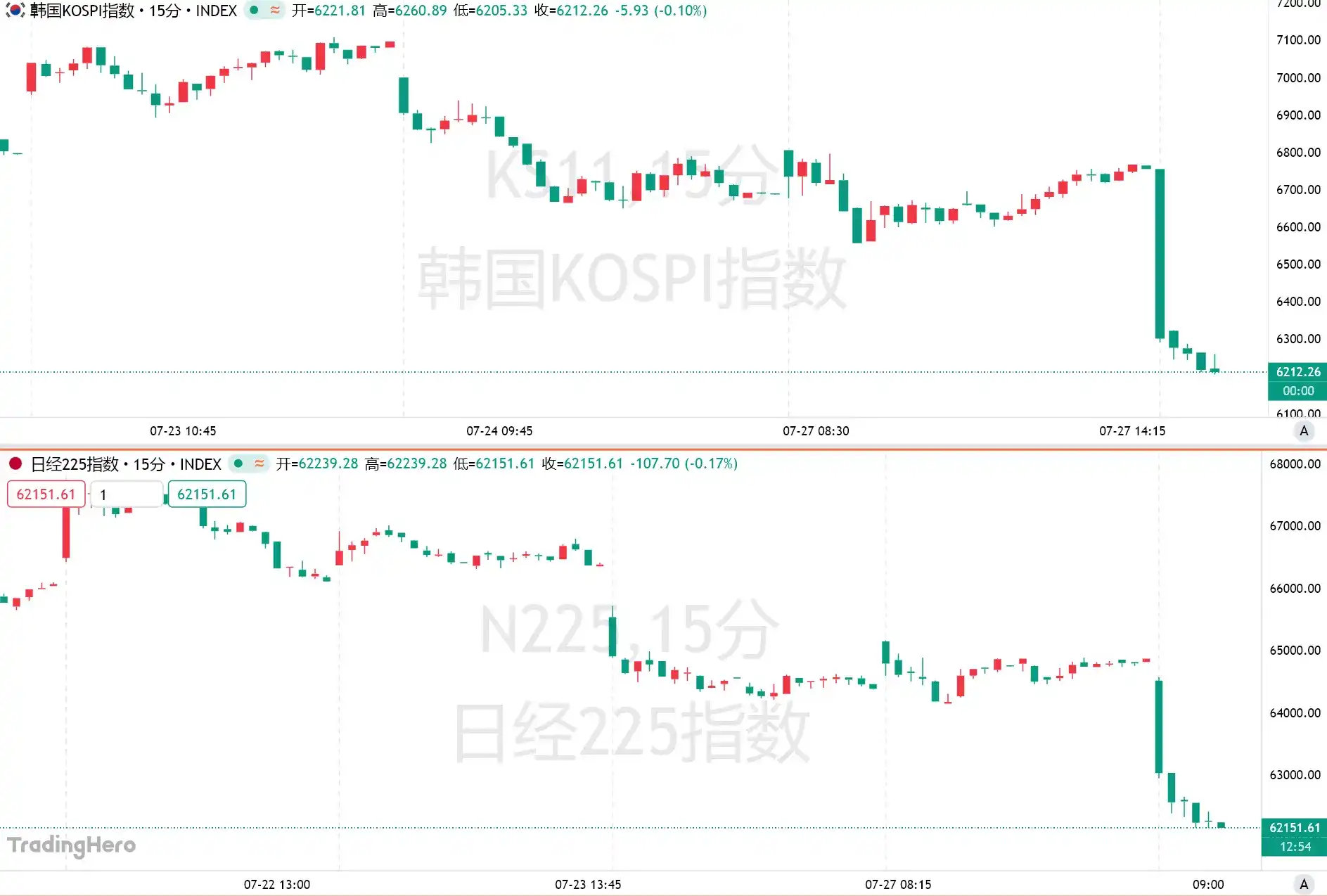
These declines point to deepening concerns in the market regarding crowded stock positioning and rising corporate debt levels as AI infrastructure development advances.

"The recent sell-off in semiconductor stocks seems to be driven more by sharply deteriorating market sentiment than by any immediate change in fundamentals," said Jung In Yun, CEO of Fibonacci Asset Management Global. "Investors are increasingly questioning whether the pace of AI infrastructure spending can be sustained."

Chris Larkin of Morgan Stanley E*Trade said: "This week is packed with potential surprises, both good and bad. Geopolitics and oil prices could be the biggest variables, but an optimistic reaction to strong earnings from the Magnificent Seven is not a given, especially if AI spending levels continue to surprise."

Kyle Rodda, Senior Analyst at Capital.com, wrote in a note to clients: "These companies embody the key themes currently affecting market sentiment—excessive capital expenditure and spending by AI companies, which investors worry will erode returns."

This week, several top tech companies, including Meta Platforms Inc. (META), are set to release key earnings. News earlier this month that Meta planned to sell excess AI computing capacity had already sparked concerns about demand. Apple Inc. (AAPL) has issued warnings about cost pressures, and reports indicate it is lobbying for approval to purchase memory components from competitors.

Investors are also awaiting the full results for Samsung Electronics' June quarter. Kim Minji, a portfolio manager at Seoul's Must Asset Management, said the world's largest traditional memory chipmaker is catching up to SK Hynix in the HBM field.

Furthermore, although SK Hynix is expected to announce another quarter of record-breaking earnings on Wednesday, investor sentiment has clearly weakened. The core market concern is that continuously rising memory prices may force customers to reduce purchases and seek lower-cost alternatives.

Since hitting a historic high in June, SK Hynix's stock price has cumulatively fallen 38%, with market worries about overcrowded trading and leverage amplifying price volatility. In this round of adjustment, the company's market capitalization shrinkage is second only to SpaceX (SPCX) globally.

In just over a month, approximately $470 billion in market value has evaporated from SK Hynix. The South Korean memory chipmaker, once seen as one of the world's hottest AI trades, is now becoming one of the most contentious holdings in investor portfolios.

Shawn Oh, Head of Korea Cash Equities Business at NH Investment & Securities, stated in a research report that, considering the current attractive valuation and the ongoing deleveraging by Korean retail investors, SK Hynix remains "an extremely attractive buying opportunity." However, he also noted that the market is reducing stock positions ahead of the U.S. tech company earnings season.

The market expects SK Hynix's June quarter sales to more than double year-on-year, reaching about $57 billion; operating profit is projected to increase sixfold year-on-year. But James Ooi, a market strategist at Tiger Brokers, said the significance of SK Hynix's earnings may transcend the company itself.

"SK Hynix's performance could also become a sentiment barometer for the global AI hardware sector," he said, adding that market expectations have largely been priced in already, so "even a slight miss could trigger a sharp reaction."

Hebe Chen, Senior Market Analyst at Vantage Global Prime, said: "The recent sell-off in chipmakers shows that doubts about spending, returns, and valuations are deepening, not subsiding. With several major catalysts approaching, the hesitation to buy the dip suggests investors are waiting for stronger evidence before rebuilding risk exposure."


Trend Kriptolar

İlgili Sorular

QWhat were the main factors cited as causing the sharp decline in Japanese and South Korean stock markets on Tuesday morning?

AThe main factors were investor concerns about NVIDIA's major AI supply agreement and increasing market competition, which negatively impacted sentiment. Specific triggers included a surge in NVIDIA's debt default insurance costs within the large AI-related deal wave and worries about competition from China in semiconductor manufacturing equipment for Japanese firms.

QWhat specific market mechanisms were triggered in the South Korean market due to the sell-off, and for what key stock index?

AFor the South Korean KOSPI index, the decline widened to 8%, triggering a market-wide circuit breaker which halted trading for 20 minutes. The Korea Exchange also initiated a sidecar mechanism for the KOSPI, temporarily suspending program selling.

QWhich semiconductor and equipment stocks were mentioned as leading the declines, and what were some of their significant losses?

ATokyo Electron, Kioxia, Samsung Electronics, and SK Hynix were mentioned as leading the declines. Specific notable losses included SK Hynix's stock plunging as much as 30% (its biggest-ever daily drop) and Kioxia's stock falling up to 18% (its largest drop since November of the previous year).

QAccording to analysts cited in the article, what is the core investor worry regarding the current AI boom that is driving the market sell-off?

AThe core investor worry, as stated by analysts, is skepticism about the sustainability of AI infrastructure spending and capital expenditure. Investors are increasingly questioning whether the pace of AI-related spending can continue, fearing it will erode company returns. The sell-off reflects deepening concerns over crowded stock positions and rising corporate debt levels in the AI build-out.

QWhy is SK Hynix's upcoming earnings report considered significant beyond the company's own performance, and what potential market reaction is anticipated?

ASK Hynix's earnings report is seen as a potential sentiment barometer for the global AI hardware sector. The market has largely priced in high expectations, so even a slight miss in earnings could trigger a significant and volatile negative reaction across related stocks. Its performance is being watched for clues about the broader health and trajectory of AI demand.

İlgili Okumalar

Michael Saylor: Bitcoin Halved, My Digital Credit is Making Money

Michael Saylor discusses Bitcoin, digital credit, and corporate treasury strategies in a recent roundtable. He explains that while Bitcoin remains "digital capital" with no counterparty risk, its ~40% annual volatility makes it unsuitable for most institutional and retail capital. To attract this capital, he advocates for Bitcoin-backed "digital credit" and "digital currency" products. These offer low volatility against fiat currencies, generate yield, and compete with traditional money market funds, stablecoins, and other yield-bearing crypto assets. Saylor clarifies that these products are not meant to replace direct Bitcoin ownership but to onboard capital that otherwise wouldn't enter the Bitcoin ecosystem. He provides examples: during a period when Bitcoin fell 50%, his company's digital credit products (STRC, SATA) delivered positive returns of 3-4%, demonstrating their ability to strip out ~90% of Bitcoin's volatility. He frames "digital currency" as a fiat-referenced, yield-bearing, stable-value asset backed by Bitcoin, designed to meet the needs of the global capital pool. This approach, he argues, can expand the Bitcoin network's reach by 10x to 100x more effectively than pure education. The discussion also covers corporate finance for Bitcoin treasury companies. Saylor argues that equity issuance is not inherently dilutive if done above net asset value per share and if the acquired asset (Bitcoin or cash) supports future value creation. He distinguishes between debt with maturity dates and hybrid capital like preferred shares (e.g., STRC), which offer issuer options and do not force liquidation. Evaluating these companies requires modeling based on future Bitcoin price and volatility assumptions, not relying on a single metric like mNAV (market-adjusted net asset value). The business models are still evolving, and investors must analyze full disclosures to form a complete view.

marsbit2 saat önce

Michael Saylor: Bitcoin Halved, My Digital Credit is Making Money

marsbit2 saat önce

Getting Ahead of the Tide and Drowning First: The Fall of 'Crypto x AI' Pioneer ai16z

"ai16z, an early pioneer of the 'crypto x AI' narrative, has officially shut down. In late 2024, its token launch sparked a massive speculative frenzy around AI Agent tokens, briefly propelling the project to a $2.6 billion valuation. However, by 2026, as functional AI agents from companies like Anthropic and OpenAI became mainstream reality, the crypto-native AI projects built largely on hype began to collapse. The founder of its underlying project, Eliza OS, announced the termination in a bitter post, citing legal threats from token holders and a depleted foundation. He expressed disillusionment with the crypto community, contrasting it with the 'optimistic' builders in pure AI. While the Eliza framework itself remains active as open-source software—ironically with contributions from AI like Claude—the token-dependent venture failed. The story highlights a core flaw: the crypto market often prices narratives far ahead of functional technology. When the promised AI future arrived, it was delivered by traditional tech companies with sustainable business models, not token projects. The episode suggests the initial path of 'tokenizing AI concepts' is broken. However, integration may still occur in reverse—with AI tools enhancing crypto analytics and trading—or in coordinating real resources like decentralized compute, as seen in projects like Bittensor and Render."

marsbit2 saat önce

Getting Ahead of the Tide and Drowning First: The Fall of 'Crypto x AI' Pioneer ai16z

marsbit2 saat önce

İşlemler

Spot

Popüler Makaleler

4 Nasıl Satın Alınır

HTX.com’a hoş geldiniz! 4 (4) satın alma işlemlerini basit ve kullanışlı bir hâle getirdik. Adım adım açıkladığımız rehberimizi takip ederek kripto yolculuğunuza başlayın. 1. Adım: HTX Hesabınızı OluşturunHTX'te ücretsiz bir hesap açmak için e-posta adresinizi veya telefon numaranızı kullanın. Sorunsuzca kaydolun ve tüm özelliklerin kilidini açın. Hesabımı Aç2. Adım: Kripto Satın Al Bölümüne Gidin ve Ödeme Yönteminizi SeçinKredi/Banka Kartı: Visa veya Mastercard'ınızı kullanarak anında 4 (4) satın alın.Bakiye: Sorunsuz bir şekilde işlem yapmak için HTX hesap bakiyenizdeki fonları kullanın.Üçüncü Taraflar: Kullanımı kolaylaştırmak için Google Pay ve Apple Pay gibi popüler ödeme yöntemlerini ekledik.P2P: HTX'teki diğer kullanıcılarla doğrudan işlem yapın.Borsa Dışı (OTC): Yatırımcılar için kişiye özel hizmetler ve rekabetçi döviz kurları sunuyoruz.3. Adım: 4 (4) Varlıklarınızı Saklayın4 (4) satın aldıktan sonra HTX hesabınızda saklayın. Alternatif olarak, blok zinciri transferi yoluyla başka bir yere gönderebilir veya diğer kripto para birimlerini takas etmek için kullanabilirsiniz.4. Adım: 4 (4) Varlıklarınızla İşlem YapınHTX'in spot piyasasında 4 (4) ile kolayca işlemler yapın.Hesabınıza erişin, işlem çiftinizi seçin, işlemlerinizi gerçekleştirin ve gerçek zamanlı olarak izleyin. Hem yeni başlayanlar hem de deneyimli yatırımcılar için kullanıcı dostu bir deneyim sunuyoruz.

510 Toplam GörüntülenmeYayınlanma 2025.10.20Güncellenme 2026.06.02

4 Nasıl Satın Alınır

Tartışmalar

HTX Topluluğuna hoş geldiniz. Burada, en son platform gelişmeleri hakkında bilgi sahibi olabilir ve profesyonel piyasa görüşlerine erişebilirsiniz. Kullanıcıların 4 (4) fiyatı hakkındaki görüşleri aşağıda sunulmaktadır.

活动图片