Japan plans major shift as crypto moves from payments to securities law

cointelegraph2025-12-10 tarihinde yayınlandı2025-12-10 tarihinde güncellendi

Özet

Japan's Financial Services Agency (FSA) is planning to shift cryptocurrency regulation from the Payment Services Act to the Financial Instruments and Exchange Act (FIEA), treating crypto primarily as investment products rather than payment methods. This move aims to enhance user protection by imposing stricter disclosure rules for initial exchange offerings (IEOs), including mandatory pre-sale information, third-party code audits, and issuer identity disclosure. The new framework also strengthens measures against unregistered platforms and explicitly prohibits insider trading. The regulatory shift coincides with government discussions to implement a flat 20% tax rate on crypto trading profits.

Japan’s financial regulators are preparing to move crypto asset oversight out of the country’s payments regime and into a framework designed for investment and securities markets.

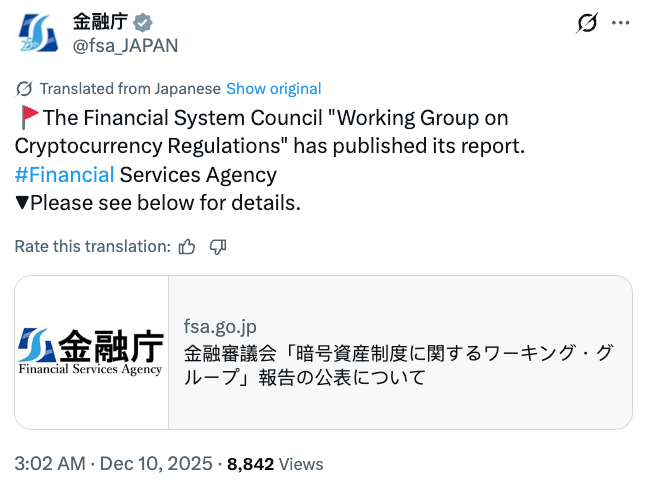
The Financial Services Agency (FSA) on Wednesday released a comprehensive report from the Financial System Council’s Working Group on the regulatory status of cryptocurrencies across multiple sectors.

The document outlines a plan to shift the legal basis for crypto regulation from the Payment Services Act (PSA) to the Financial Instruments and Exchange Act (FIEA), which is the primary law regulating securities markets, issuance, trading and disclosures.

“Crypto assets are increasingly being used as investment targets both domestically and internationally,” the report noted, underscoring the need to protect users by providing regulation that treats crypto as a financial product.

Strengthening data disclosure regulations

One of the core changes brought by bringing crypto under FIEA regulatory scope is strengthening data disclosure requirements for initial exchange offerings (IEOs), or token sales managed by crypto exchanges.

“Crypto transactions conducted by users are similar to securities transactions, and may involve the sale of new crypto assets or the buying and selling already in circulation,” the document reads, highlighting the importance of timely information during IEO sales.
Source: FSA Japan

Among the requirements for IEOs, the proposal mandates that exchanges provide pre-sale disclosures, including detailed information about the core entities behind the offering. It also requires code audits by independent third-party experts and encourages consideration of feedback from self-regulatory organizations.

In addition to exchanges, it places responsibilities on issuers, requiring them to disclose their identities, regardless of whether the project is decentralized, and how tokens are issued and distributed.

Related: Crypto payments coming to PlayStation as Sony plans stablecoin launch in 2026

The proposed framework would also give regulators stronger tools to crack down on unregistered platforms, particularly those operating from overseas or tied to decentralized exchanges. It also includes explicit prohibitions on insider trading, echoing provisions of the European Union’s Markets in Crypto-Assets (MiCA) framework and South Korea’s regulations.

The news came amid the Japanese government’s consideration of plans to reduce the maximum tax rate on crypto profits by imposing a flat rate of 20% on all gains from crypto trading.

On Tuesday, FSA also signaled a cautious stance on permitting derivatives for foreign crypto asset exchange-traded funds, reportedly describing the underlying assets as “not desirable.”

Magazine: When privacy and AML laws conflict: Crypto projects’ impossible choice

İlgili Okumalar

Within Strategy's Framework, STRC's Dividend Yield Remains at 12% as Share Price Stays Below Par Value

Michael Saylor, Executive Chairman of Strategy (MSTR), confirmed that the dividend rate for its STRC perpetual preferred shares will remain at 12.00% through August 2026. The rate has increased from 9% at its July 2025 launch to the current high via a "ratchet" mechanism, which permanently raises the rate by 0.5% whenever the share price falls below $95. This mechanism is intended to push the price back toward its $100 par value and support Strategy's "at-the-market" (ATM) program for issuing new shares to fund Bitcoin purchases. However, the mechanism has not worked as intended. STRC shares closed at $89.46 on July 31, remaining about 10-11% below par value despite the record-high dividend. Competition from rival Strive's higher-yielding SATA securities has pressured demand. The persistent discount has forced Strategy to suspend new STRC issuances via its ATM program, limiting this funding channel for Bitcoin acquisitions. STRC's struggles reflect Bitcoin's own volatility, as the preferred shares historically move in tandem. Analysts have warned the ratchet structure carries long-term, one-way risk. A law firm is investigating Strategy's ability to maintain dividend payments if Bitcoin's price stays low. Retail investors own roughly 83% of outstanding STRC shares, a group seen as prone to panic selling during downturns. In response, Strategy has established financial reserves, including a liquidity cushion covering about 26 months of dividend/interest obligations, and a $2 billion share buyback program alongside a Bitcoin monetization framework, though the company emphasized it is not obligated to sell any Bitcoin.

cryptonews.ru41 dk önce

Within Strategy's Framework, STRC's Dividend Yield Remains at 12% as Share Price Stays Below Par Value

cryptonews.ru41 dk önce

Analyst: Bitcoin's Price Will Drop to $60k in August, Then Rebound to $70k

Financial analyst Andrey Poroshin has provided a new forecast for Bitcoin's price dynamics in August. Poroshin, an analyst at the Bitbanker exchange, expects the cryptocurrency market to experience a downturn this month, with prices retesting the $60,000 level due to a lack of supportive macroeconomic catalysts. He noted that the recent US Federal Reserve decision to hold interest rates did not significantly impact the market, while inflation remains above the 2% target. Poroshin stated that Bitcoin is ending July under pressure from moderate volatility and a lack of new macroeconomic stimuli, leading to continued market caution. According to his base scenario, Bitcoin will drop to a range of $60,000 to $62,000 before recovering to $70,000. He pointed out that even $70,000 remains below the cost of mining in the US, which has prompted some miners to shift towards AI data center operations. Poroshin cited the winding down of BitMEX's operations as a potential catalyst for a price rebound, suggesting the exit of weaker players often coincides with market reversals and reduced short-term selling pressure. He believes Bitcoin is currently less susceptible to geopolitical shocks, such as the Iran-US conflict, and does not expect significant market changes in August related to the pending CLARITY Act. Looking ahead, Poroshin forecasts that September will bring more active price fluctuations driven by potential Fed rate decisions and possible discussions or approval of the CLARITY Act.

cryptonews.ru41 dk önce

Analyst: Bitcoin's Price Will Drop to $60k in August, Then Rebound to $70k

cryptonews.ru41 dk önce

İşlemler

Spot
活动图片




