January Crypto Market Analysis: Prices Decline, But Institutional Infrastructure Accelerates

marsbit2026-02-10 tarihinde yayınlandı2026-02-10 tarihinde güncellendi

Özet

January 2026 presented a paradox in the crypto market: prices fell by 25%, yet infrastructure supporting institutional adoption accelerated. While Bitcoin dropped to a 10-month low near $73,000 and leveraged traders liquidated $2.2 billion in positions, institutional developments advanced rapidly. BlackRock identified digital assets as a key 2026 investment theme, DTCC launched production-level tokenization for U.S. Treasuries and equities, and Y Combinator announced it would fund startups in USDC. The sell-off was driven by macro shocks—not crypto-specific weakness—including stress in Japanese government bonds and the nomination of a hawkish Fed chair, triggering global deleveraging. Bitcoin correlated with risk assets rather than acting as a hedge, raising questions about its institutional role. Despite price volatility, regulatory clarity improved, and jurisdictions like Hong Kong and Dubai competed to attract crypto capital. Protocol development continued unabated, with Ethereum and Solana pushing scalability upgrades. However, security losses exceeded $370 million, highlighting operational risks. The divergence between price action and structural progress defines this cycle, indicating that institutional maturity is advancing independently of short-term valuations.

Author: Dhruvang Choudhari (AMINA Bank)

Compiled by: Deep Tide TechFlow

Deep Tide Introduction: January 2026 presented a paradox: crypto prices fell by 25%, but the infrastructure supporting institutional adoption was accelerating. While Bitcoin dropped to a ten-month low of $73,000, BlackRock listed digital assets as a decisive investment theme for 2026.

While leveraged traders liquidated $2.2 billion in positions, the Depository Trust and Clearing Corporation (DTCC) launched production-level tokenization for U.S. Treasuries and stocks. While sentiment indices reached extreme pessimism, Y Combinator announced it would begin funding startups in USDC.

AMINA Bank's analysis points out that this is not a rejection of digital assets, but a repricing within an evolving global monetary system. The divergence between price action and structural progress defines the current phase of the cycle.

Full Text Below:

Introduction

January 2026 presented a paradox: crypto prices fell by 25%, but the infrastructure supporting institutional adoption was accelerating.

While Bitcoin dropped to a ten-month low near $73,000, BlackRock listed digital assets as a decisive investment theme for 2026. While leveraged traders liquidated $2.2 billion in positions, the Depository Trust and Clearing Corporation (DTCC) launched production-level tokenization for U.S. Treasuries and stocks. While sentiment indices reached extreme pessimism, Y Combinator announced it would begin funding startups in USDC.

The first two months of 2026 marked a decisive shift in the digital asset market. What initially seemed like chaotic selling was actually a broad macro repricing driven by sovereign risk, changes in the monetary system, and forced unwinding of global leverage. Unlike previous crypto downturns, this event did not originate from within the digital asset ecosystem itself. It emerged from the outside.

January and February revealed a paradox that is now central to the institutional crypto era. Market prices deteriorated sharply, yet regulatory clarity, infrastructure deployment, and institutional commitment advanced at an unprecedented pace. This divergence between price action and structural progress defines the current phase of the cycle.

This update analyzes how the macroeconomic shock disrupted crypto market structure, why Bitcoin faces an identity challenge as a macro asset, and how institutional capital continues to build amidst volatility rather than retreat from it.

Institutional Expansion Amid Market Weakness

Despite deteriorating spot prices, institutional participation accelerated rather than slowed. This acceleration reveals a fundamental shift in how mature allocators approach digital assets: infrastructure maturity now matters more than price momentum.

Tokenization as a Core Strategy

BlackRock formally listed digital assets and tokenization as decisive investment themes for 2026, alongside AI, as structural drivers for capital markets.

At Franklin Templeton, innovation leadership described 2026 as the beginning of a wallet-native financial system, where stocks, bonds, and funds are held directly in digital wallets, rather than through traditional custody frameworks.

Y Combinator sent a key signal, announcing that starting with the Spring 2026 batch, startups may receive funding in USDC on Ethereum, Base, and Solana. Stablecoin settlements now typically clear in less than a second at a cost below $0.01, offering a clear advantage over cross-border fiat rails.

Reduced Regulatory Friction

Regulatory developments quietly removed long-standing structural barriers. The SEC rescinded previous accounting guidance that hindered banks from offering digital asset custody services. Simultaneously, the Depository Trust and Clearing Corporation (DTCC) launched a production-level tokenization program for U.S. Treasuries, large-cap stocks, and ETFs, confirming the legal equivalence between tokenized securities and traditional securities.

This marks a shift from experimental adoption to an upgrade of internal financial infrastructure.

Regional Competition for Crypto Capital

Jurisdictions are increasingly deploying policy as a competitive lever.

Hong Kong announced zero-tax incentives on qualified digital asset income for funds and family offices, positioning itself as a major institutional crypto hub in Asia. As of January 2026, 11 licensed virtual asset trading platforms are operating.

Meanwhile, Dubai continues to execute its blockchain-first government strategy, aiming for on-chain processing of 50% of public sector transactions by the end of 2026. Crypto penetration in the UAE has reached approximately 39%, representing over 3.7 million users.

Macroeconomic Shock Shattering the Calm

Understanding why institutions continue to build requires understanding what drove the sell-off. The relative stability of 2025 fostered expectations that crypto had entered a low-volatility, institutionally-anchored phase. These assumptions were shattered in January.

Japan and the Unwinding of Global Leverage

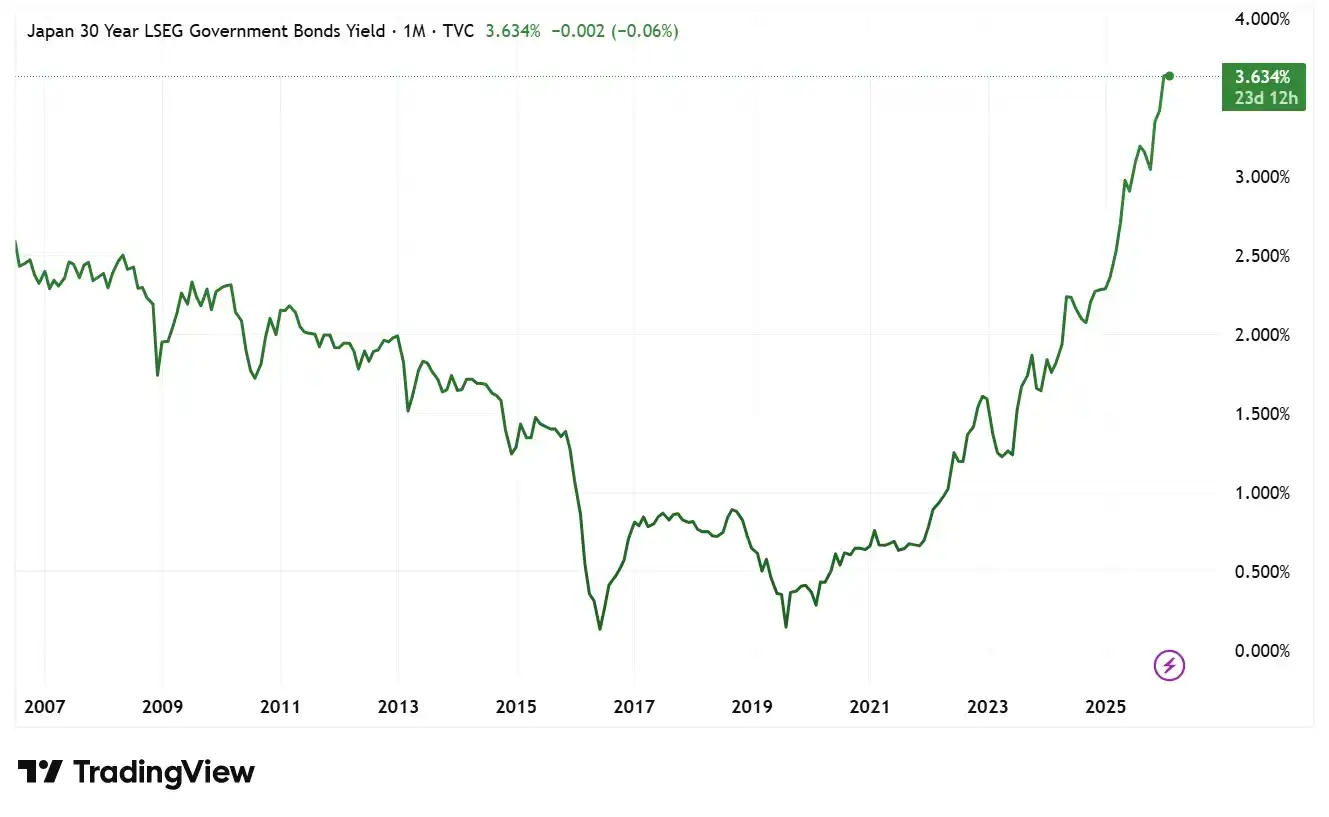
On January 20, 2026, the Japanese Government Bond (JGB) market entered a period of acute stress. The 30-year JGB yield surged over 30 basis points to 3.91%, its highest level in 27 years, following fiscal rhetoric from Prime Minister Sanae Takaichi that heightened concerns about debt sustainability. Japan's debt-to-GDP ratio has exceeded 250%, making it a focal point for global bond markets.

Figure 1: Japan 30-Year Government Bond Yield (Historical)
Source: TradingView

The immediate consequence was the rapid unwinding of the yen carry trade, one of the largest sources of cheap global leverage. As yen funding costs rose, investors were forced to liquidate risk assets to meet margin requirements. Bitcoin fell below $91,000 not due to crypto-specific weakness, but because it served as a liquidity proxy for balance sheet repair.

Warsh Nomination and Monetary Repricing

This pressure escalated on January 30th with the nomination of Kevin Warsh as the next Federal Reserve Chair. Warsh's long-standing preference for higher real interest rates and a significant reduction of the Fed's balance sheet was interpreted as a clear shift away from accommodative monetary policy.

Within 24 hours, the total cryptocurrency market capitalization fell by about $430 billion. Bitcoin fell approximately 7% in a single trading session, while Ethereum and high-beta altcoins experienced double-digit percentage pullbacks. This move reflected a repricing of global dollar liquidity expectations, not speculative panic.

Price Action and Bitcoin's Identity Crisis

The macro shock revealed an uncomfortable truth about Bitcoin's evolution as an institutional asset. The last week of January produced one of the most severe single-day dislocations of the institutional era.

On January 29th, Bitcoin fell from $96,000 to $80,000, a drop of approximately 15% in a single day. The crypto derivatives market liquidated over $2.2 billion in leveraged positions. The significance of this move lies not in its magnitude, but in its correlation characteristics.

Bitcoin failed to decouple from stocks, instead trading in sync with high-beta tech stocks. During a global deleveraging event, it behaved not as a defensive asset, but as a liquidity-sensitive risk instrument.

By early February, sentiment indicators reflected extreme pessimism. The Crypto Fear & Greed Index dropped to 19, and key technical levels, including the 0.786 Fibonacci retracement at $85,400, were decisively broken. The high $70,000s range became the market's primary structural support zone.

Figure 2: Bitcoin Price Decline Driven by Global Macro Events (Jan-Feb 2026)

Source: AMINA Bank

The correlation characteristics raise fundamental questions about Bitcoin's role in institutional portfolios. If it behaves as a high-beta tech proxy rather than a defensive hedge during stress, the allocation thesis must adjust accordingly. Yet, institutional commitment continues regardless, suggesting mature allocators are pricing Bitcoin's long-term structural role, not its short-term correlation behavior.

Protocol Evolution and Competitive Differentiation

While prices fell and macro conditions worsened, foundational layer development continued unabated. This demonstrates a key feature of the current cycle: infrastructure development has decoupled from price momentum.

Ethereum remains focused on scaling through execution efficiency, censorship resistance, and MEV mitigation. The upcoming Glamsterdam upgrade aims to increase the gas limit to 200 million, approaching a throughput of nearly 10,000 TPS theoretically.

Solana is pursuing aggressive performance enhancements. Its Alpenglow upgrade aims to reduce transaction finality from 12.8 seconds to approximately 100-150 milliseconds, positioning it as one of the fastest settlement layers in production.

These technical advancements continue regardless of market sentiment, reflecting long-term capital commitment and engineering development independent of price action.

Security Losses Highlight Operational Risks

Even as institutional infrastructure matures, security incidents highlight ongoing operational vulnerabilities. January 2026 recorded over $370 million in stolen funds, the highest monthly total in nearly a year. Over $311 million in losses stemmed from phishing and social engineering attacks, not smart contract failures.

The single largest event, exceeding $280 million, involved AI-generated voice impersonation targeting hardware wallet users. These incidents emphasize a structural shift in risk. Human and operational vulnerabilities now represent the primary attack surface for institutional crypto participants.

This pattern reinforces why custody frameworks operating under regulatory oversight offer competitive advantages beyond compliance. Operational security protocols, institutional-grade key management, and insurance frameworks have become mandatory requirements.

Conclusion

The retracement of January-February 2026 is not a rejection of digital assets, but a repricing within a changing global monetary system. Crypto now reacts directly to sovereign bond markets, central bank leadership, and geopolitical escalation. This sensitivity introduces volatility, but it also confirms integration.

Simultaneously, institutional adoption, regulatory clarity, and protocol development advanced during the sell-off. Tokenization shifted from narrative to deployed infrastructure, wallet-native finance from theory to implementation.

Early 2026 did not mark a collapse of the crypto market. It marked its first real stress test of institutional maturity. While prices failed the test, the underlying infrastructure passed with flying colors.

The divergence between price action and structural progress will not persist indefinitely, as institutional deployment, regulatory clarification, and infrastructure maturity will ultimately be reflected in market valuations.

İlgili Sorular

QWhat was the key paradox observed in the crypto market in January 2026 according to the article?

AThe key paradox was that while crypto prices fell by 25%, the infrastructure supporting institutional adoption was accelerating.

QWhich major financial institution listed digital assets as a definitive investment theme for 2026, alongside AI?

ABlackRock listed digital assets and tokenization as a definitive investment theme for 2026, alongside AI.

QWhat major macroeconomic event in Japan triggered a global deleveraging event that impacted crypto prices?

AAcute stress in the Japanese Government Bond (JGB) market, where 30-year JGB yields surged over 30 basis points to 3.91%, triggered a rapid unwinding of yen carry trades and forced liquidations of risk assets like crypto.

QWhat significant policy change did the SEC make regarding digital asset custody services?

AThe SEC rescinded previous accounting guidance that had prevented banks from offering digital asset custody services.

QHow did Bitcoin's price behavior during the January 2026 sell-off challenge its perceived role as an institutional asset?

ABitcoin failed to act as a defensive asset or decouple from equities. Instead, it traded in sync with high-beta tech stocks, behaving like a liquidity-sensitive risk tool during a global deleveraging event, which raised questions about its role in institutional portfolios.

İlgili Okumalar

İşlemler

Spot
Futures

Popüler Makaleler

$BANK Nedir

Bank AI: Bankacılıkta Devrimsel Bir Adım Giriş Teknolojideki hızlı ilerlemelerin damgasını vurduğu bir çağda, Bank AI, yapay zeka (AI) ve bankacılık hizmetleri kesişiminde yer almaktadır. Bu yenilikçi proje, finansal manzarayı yeniden tanımlamayı, operasyonel verimliliği, güvenlik önlemlerini ve müşteri deneyimlerini AI'nin gücüyle geliştirmeyi hedefliyor. Bank AI yolculuğuna çıkarken, projenin içeriğine, operasyonel dinamiklerine, tarihsel bağlamına ve önemli kilometre taşlarına dalacağız. Bank AI Nedir? Bank AI, yapay zekanın çeşitli bankacılık operasyonlarına entegrasyonunu hedefleyen dönüştürücü bir girişimi temsil etmektedir. Bu proje, süreçleri otomatikleştirmek, risk yönetimi protokollerini geliştirmek ve kişiselleştirilmiş hizmetler aracılığıyla müşteri etkileşimini artırmak için AI'nin yeteneklerinden yararlanmaktadır. Bank AI'nin temel hedefleri şunlardır: Bankacılık Fonksiyonlarının Otomasyonu: AI teknolojilerini kullanarak, Bank AI rutin görevleri otomatikleştirmeyi, insan kaynakları üzerindeki yükü azaltmayı ve verimliliği artırmayı amaçlamaktadır. Geliştirilmiş Risk Yönetimi: Proje, dolandırıcılık ve diğer tehditlere karşı güvenlik önlemlerini güçlendirerek riski tahmin edip tanımlamak için AI algoritmalarını kullanmaktadır. Bankacılık Hizmetlerinin Kişiselleştirilmesi: Bank AI, müşteri verilerini ve davranışlarını analiz ederek, özel finansal ürünler ve hizmetler sunmaya odaklanmaktadır. Müşteri Deneyimini İyileştirme: Chatbotlar ve sanal asistanlar gibi AI destekli çözümlerin uygulanması, kullanıcıların daha insana yakın etkileşimler yaşamasını sağlamayı hedeflemekte, bankalarla etkileşim biçimlerini devrim niteliğinde değiştirmektedir. Bu hedeflerle, Bank AI, bankacılığı daha verimli, güvenli ve kullanıcı odaklı hale getiren önemli bir oyuncu olarak kendini konumlandırmaktadır. Bank AI'nin Yaratıcısı Kimdir? Bank AI'nin yaratıcısı hakkında detaylar bilinmemektedir. Bu nedenle, mevcut bilgilerde belirli bir kişi veya organizasyon tanımlanmamıştır. Projenin başlangıcı etrafındaki anonimlik soruları gündeme getirse de, bunun iddialı vizyonu ve hedefleri üzerinde bir olumsuz etkisi yoktur. Bank AI'nin Yatırımcıları Kimlerdir? Proje yaratıcılarında olduğu gibi, Bank AI'nin yatırımcıları veya destekleyen organizasyonları hakkında da özel bilgiler açıklanmamıştır. Bu bilgiler olmadan, projenin ilerlemesini destekleyen finansal destek ve kurumsal destek hakkında bir çerçeve çizmek zordur. Yine de, böyle yenilikçi bir alanda gelişimi sürdürmek için sağlam bir yatırım temelinin önemi büyüktür. Bank AI Nasıl Çalışır? Bank AI, geleneksel bankacılık çerçevelerinden ayıran benzersiz faktörlere odaklanarak birden fazla yenilikçi alanda faaliyet göstermektedir. İşte temel operasyonel özellikler: Otomasyon: Makine öğrenimi algoritmalarını uygulayarak, Bank AI bankalar içindeki çeşitli manuel süreçleri otomatikleştirir. Bu, operasyonel maliyetleri azaltır ve insan çalışanların daha stratejik faaliyetlere yönelmelerini sağlar. Gelişmiş Risk Yönetimi: Risk yönetimi uygulamalarına AI entegrasyonu, bankaların dolandırıcılık gibi potansiyel tehditleri doğru bir şekilde tahmin etme araçlarıyla donatılmasını sağlar, böylece müşteri bilgileri ve varlıkları güvence altına alınır. Özelleştirilmiş Finansal Tavsiyeler: Müşteri etkileşimlerinden sürekli olarak öğrenerek, AI sistemleri kullanıcı ihtiyaçlarının daha iyi anlaşılmasını sağlar ve finansal kararlar hakkında özelleştirilmiş tavsiyeler sunar. Geliştirilmiş Müşteri Etkileşimleri: AI destekli chatbotlar ve sanal asistanlar kullanarak, Bank AI daha etkileşimli bir müşteri deneyimi sunar, kullanıcıların sorularını hızlı bir şekilde çözmelerine imkan tanır, bekleme sürelerini azaltır ve memnuniyet seviyelerini artırır. Bu operasyonel özellikler, Bank AI'yi bankacılık sektöründe bir öncü olarak konumlandırmakta ve hizmet sunumu ile operasyonel mükemmeliyet için yeni standartlar belirlemektedir. Bank AI Zaman Çizelgesi Bank AI'nin gidişatını anlamak için tarihsel bağlamına bir göz atmak gerekmektedir. Aşağıda önemli kilometre taşlarını ve gelişmeleri vurgulayan bir zaman çizelgesi bulunmaktadır: 2010'ların Başları: AI entegrasyonunun bankacılık hizmetlerine olan ilgisi arttı, bankacılık kurumları potansiyel faydalarını tanımaya başladılar. 2018: Bankaların temel müşteri hizmetleri ve geliştirilmiş güvenlik yönetimi için risk yönetim sistemlerinde chatbotlar gibi AI araçları kullanmaya başlamasıyla AI teknolojilerinin uygulanmasında belirgin bir artış yaşandı. 2023: AI'nin karmaşıklığı artmaya devam etti ve belge işleme ile gerçek zamanlı yatırım analizi gibi daha karmaşık görevler için üretken AI devreye alındı. Bu yıl, AI teknolojisi sayesinde bankaların sahip olduğu yeteneklerde önemli bir sıçrama yaşandı. 2024-Güncel Durum: Bu yıl itibarıyla, Bank AI yükselişte, devam eden araştırmalar ve geliştirmeler bankacılık operasyonlarındaki yetenekleri daha da artırmaya hazırlanıyor. AI uygulamalarının sürekli araştırılması, heyecan verici gelişmelere işaret etmektedir. Bank AI Hakkında Anahtar Noktalar Bankacılıkta AI Entegrasyonu: Bank AI, bankacılık süreçlerini kolaylaştırmak ve kullanıcı deneyimlerini geliştirmek için yapay zekanın benimsenmesine odaklanmaktadır. Otomasyon ve Risk Yönetimi Vurgusu: Proje, rutin görevlerin yükünü azaltmayı amaçlarken, tahmine dayalı analizlerle güvenlik çerçevelerini geliştirmeye büyük önem vermektedir. Kişiselleştirilmiş Bankacılık Çözümleri: Müşteri verilerinden yararlanarak, Bank AI bireysel kullanıcı ihtiyaçlarına yönelik özelleştirilmiş bankacılık hizmetleri sunar. Gelişime Bağlılık: Bank AI, teknolojinin sürekli evrimi ile uyumlu olmasını sağlamak ve güncel kalmak için sürekli araştırma ve geliştirme çabalarına bağlı kalmaktadır. Sonuç Özetle, Bank AI bankacılık endüstrisinde önemli bir adımı temsil etmekte, yapay zekayı kullanarak operasyonel paradigmaları yeniden şekillendirmekte, güvenliği artırmakta ve müşteri memnuniyetini teşvik etmektedir. Yaratıcı ve yatırımcılar hakkındaki bilgi eksikliklerine rağmen, Bank AI'nin net hedefleri ve işlevsel mekanizmaları, devam eden evrimi için güçlü bir temel sunmaktadır. AI teknolojisi gelişmeye ve bankacılık sektörüyle birleşmeye devam ettikçe, Bank AI finansal hizmetlerin geleceğini önemli ölçüde etkilemeye hazır durumda, bankacılıkla olan anlayışımızı ve etkileşim biçimlerimizi geliştirmektedir.

145 Toplam GörüntülenmeYayınlanma 2024.04.06Güncellenme 2024.12.03

$BANK Nedir

BANK Nasıl Satın Alınır

HTX.com’a hoş geldiniz! Lorenzo Protocol (BANK) satın alma işlemlerini basit ve kullanışlı bir hâle getirdik. Adım adım açıkladığımız rehberimizi takip ederek kripto yolculuğunuza başlayın. 1. Adım: HTX Hesabınızı OluşturunHTX'te ücretsiz bir hesap açmak için e-posta adresinizi veya telefon numaranızı kullanın. Sorunsuzca kaydolun ve tüm özelliklerin kilidini açın. Hesabımı Aç2. Adım: Kripto Satın Al Bölümüne Gidin ve Ödeme Yönteminizi SeçinKredi/Banka Kartı: Visa veya Mastercard'ınızı kullanarak anında Lorenzo Protocol (BANK) satın alın.Bakiye: Sorunsuz bir şekilde işlem yapmak için HTX hesap bakiyenizdeki fonları kullanın.Üçüncü Taraflar: Kullanımı kolaylaştırmak için Google Pay ve Apple Pay gibi popüler ödeme yöntemlerini ekledik.P2P: HTX'teki diğer kullanıcılarla doğrudan işlem yapın.Borsa Dışı (OTC): Yatırımcılar için kişiye özel hizmetler ve rekabetçi döviz kurları sunuyoruz.3. Adım: Lorenzo Protocol (BANK) Varlıklarınızı SaklayınLorenzo Protocol (BANK) satın aldıktan sonra HTX hesabınızda saklayın. Alternatif olarak, blok zinciri transferi yoluyla başka bir yere gönderebilir veya diğer kripto para birimlerini takas etmek için kullanabilirsiniz.4. Adım: Lorenzo Protocol (BANK) Varlıklarınızla İşlem YapınHTX'in spot piyasasında Lorenzo Protocol (BANK) ile kolayca işlemler yapın.Hesabınıza erişin, işlem çiftinizi seçin, işlemlerinizi gerçekleştirin ve gerçek zamanlı olarak izleyin. Hem yeni başlayanlar hem de deneyimli yatırımcılar için kullanıcı dostu bir deneyim sunuyoruz.

662 Toplam GörüntülenmeYayınlanma 2025.05.09Güncellenme 2025.05.09

BANK Nasıl Satın Alınır

Tartışmalar

HTX Topluluğuna hoş geldiniz. Burada, en son platform gelişmeleri hakkında bilgi sahibi olabilir ve profesyonel piyasa görüşlerine erişebilirsiniz. Kullanıcıların BANK (BANK) fiyatı hakkındaki görüşleri aşağıda sunulmaktadır.

活动图片