Jack Ma Just Concluded an AI Mobilization Meeting, and the 'Soul Figure' of Qwen Left

marsbit2026-03-04 tarihinde yayınlandı2026-03-04 tarihinde güncellendi

Özet

A major leadership shakeup has hit Alibaba's AI division following a high-level strategic meeting. Ma Yun, along with core executives from Alibaba and Ant Group, convened on March 3rd to signal a full commitment to AI. However, the very next day, Lin Junyang, the 32-year-old P10 technical lead and key architect behind Alibaba’s open-source Qwen large language models, abruptly announced his resignation on social media platform X. Reports suggest the departure was not voluntary. The trigger appears to be an internal restructuring plan for the Qwen team. The plan, from the Tongyi Lab, aimed to break up Lin’s vertically integrated, full-stack team into separate, horizontally divided modules reporting directly to the lab, which would significantly reduce his management scope. This clashed fundamentally with Lin's belief that deep collaboration within a full-process team is essential for LLM innovation. The incident highlights a growing tension within Alibaba between the open-source technical ideals championed by Lin and the company's increasing focus on commercial returns from AI. Despite Qwen's global open-source success—topping Hugging Face downloads with over 1 billion—internal skepticism about its revenue potential and pressure from competitors were mounting. Lin's resignation has sent shockwaves through the global AI community, prompting an outpouring of support. Several key Qwen team members have also resigned. His departure marks a pivotal moment for Alibaba AI, signalin...

Author: Hu Shixin, Deep Net · Tencent News Xiaoman Studio

Editor: Ye Jinyan

On March 3, Jack Ma, along with core executives from Alibaba and Ant Group such as Joe Tsai, Wu Yongming, Shao Xiaofeng, Jiang Fan, as well as Ant Group's Jing Xiandong and Han Xinyi, made a rare gathering at YunGu School in Hangzhou. This discussion, the first stop after the New Year's resumption of work, focused on the opportunities and challenges brought by AI, sending a strong strategic signal to the outside world that both groups are "All in AI".

Dramatically, on the early morning of the next day after this high-level discussion concluded, the technical leader who single-handedly pushed Alibaba's Qwen to the pinnacle of global open source, the youngest P10 in the group, Lin Junyang, suddenly posted on social platform X: "me stepping down. bye my beloved qwen." This update ignited the global AI community.

Overnight, Alibaba's Qwen lost its "helmsman".
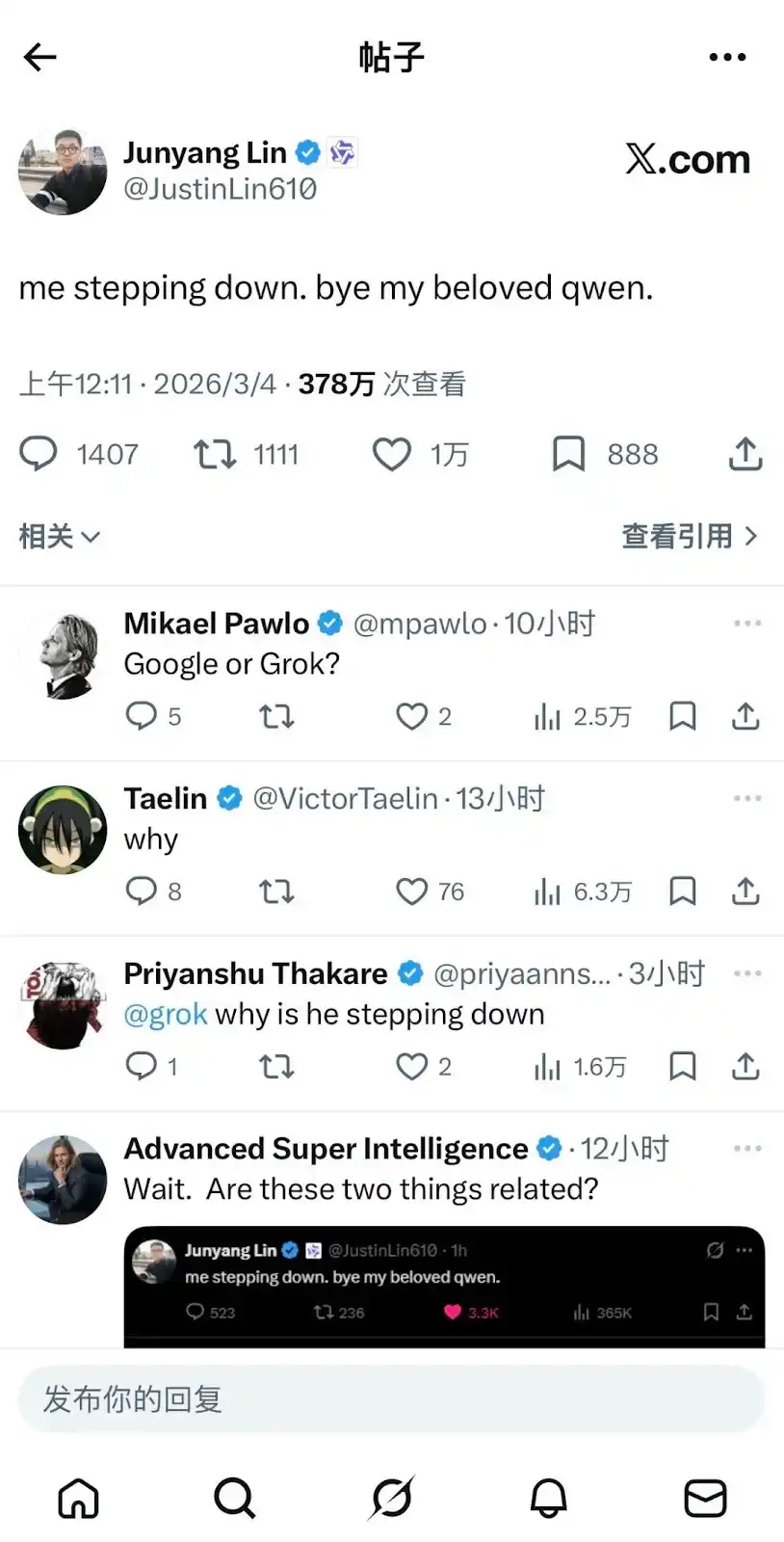
(Lin Junyang's latest update on X)

Was Lin Junyang's Departure Voluntary?

Based on information from multiple sources, we have reconstructed the key points of this departure incident.

On the evening of March 2, Lin Junyang's team released four small-scale open-source models of Qwen3.5, which immediately attracted global attention from the tech community. Elon Musk even commented that they showed "impressive intelligence density," and Lin Junyang himself reposted the comment to express gratitude. On the same day, Alibaba officially announced the unification of its B-end and C-end large model brands under "Qwen," establishing it as the group's core AI brand.

According to reports from LatePost and Phoenix Net Technology, on the afternoon of March 3, Lin Junyang left an internal meeting due to disagreements, submitted his resignation to Alibaba, and informed the Qwen team. Some colleagues were moved to tears upon hearing the news.

On the evening of March 3, Lin Junyang reposted the song "A Toast to Myself" on his WeChat Moments.

In the early hours of March 4, Lin Junyang publicly announced his resignation on platform X. As of 4 PM today, the post had received over 10,000 likes and more than 1,400 comments. Numerous industry developers left messages thanking him and the Qwen team for their contributions to the open-source field. Official accounts of AI companies like MiniMax also appeared in the comments to express recognition.

On the morning of March 4, Yu Bowen, head of Qwen post-training, and Li Kaixin, core contributor to Qwen3.5/VL/Coder, announced their resignations.

On the afternoon of March 4, Lin Junyang posted on his Moments: "Sorry friends, I won't be replying to messages and calls today. I really need to rest. Brothers of Qwen, keep working according to the original plan. It will be fine."

It is worth noting that Qwen team core contributor Chen Cheng said bluntly when forwarding Lin Junyang's post: "My heart is truly broken. I know leaving wasn't your choice. Just last night, we were standing side by side releasing the Qwen3.5 small models. I can't imagine what Qwen will be like without you."

This comment fueled the rapid spread of the involuntary departure theory within the industry. As of now, Alibaba has not publicly responded to this personnel change. A source close to Alibaba believes that Lin Junyang's resignation was not voluntary, and his quick posting of the resignation notice on X was likely due to an inability to control his emotions at the time.

Why Did He Leave?

Lin Junyang's sudden departure caused a huge shock in the industry, leading to widespread speculation. At its root, it was the concentrated eruption of long-standing multiple conflicts within Alibaba regarding organizational structure, technical路线 (path/approach), commercial goals, and talent landscape.

The trigger likely came from a team restructuring. According to LatePost, the Tongyi Lab planned to break the vertically integrated R&D model of the Qwen team. The original full-process closed-loop team covering pre-training, post-training, multimodal R&D, and infrastructure building was to be split into several independent horizontal modules, all directly managed and coordinated by the Tongyi Lab. Consequently, Lin Junyang's management authority and business scope would be narrowed.

Behind the structural adjustment lies a fundamental conflict in large model development philosophy between Lin Junyang and Alibaba's top management. Lin Junyang believes that the core competitiveness of large model R&D comes from the deep collaboration of a full-process team. Fragmented assembly-line division of labor would severely damage R&D efficiency and innovation space, and his team had already built a self-developed infrastructure system. The lab's direction of splitting and dispersing the work was completely contrary to his judgment of the development trend of large model technology.

Even harder to reconcile than the technical route分歧 (divergence/disagreement) is the deep-seated contradiction between the open-source route and the group's commercial goals. Under Lin Junyang's leadership, Qwen topped the global open-source large model rankings with a comprehensive open-source strategy, becoming a benchmark for Chinese large models going global. However, Alibaba's core assessment of Qwen has shifted from building technical influence to commercial落地 (landing/commercialization).

However, there have always been internal doubts about the revenue efficiency of the open-source model. It is reported that some executives even评价 (evaluated) the Qwen-3.5, which debuted on New Year's Eve, as an unfinished "semi-product." Coupled with the market pressure from the Qwen App's 3 billion RMB subsidy in the C-end not meeting expectations and the B-end AI cloud business facing aggressive competition from rivals, the misalignment between technical ideals and commercial goals became increasingly difficult to reconcile.

Behind this change, the restructuring of the talent landscape within the Tongyi Lab also led to a dilution of core decision-making power. Since 2025, Alibaba has continuously引入 (brought in) top global AI talent. After IEEE Fellow Xu Zhuhong transferred to the Tongyi Lab, the business he was responsible for overlapped significantly with Qwen's布局 (layout/plan). In early 2026, former DeepMind senior researcher Zhou Hao joined, reporting directly to the head of the lab, and was also set to take over the work of the departing post-training head Yu Bowen.

The lab's shift from a Lin Junyang-led single-core model to a "multi-power parallel" structure,叠加 (coupled with) the successive loss of Qwen's core founding team members, contributed to this industry-shaking departure incident.

Who Can Replace Lin Junyang?

The reason this departure caused连锁 (chain) reactions within Alibaba and the global open-source community lies in Lin Junyang's key industry status within the Qwen team, Alibaba's AI system, and even the global open-source large model field.

As a rare, entirely locally grown technical leader in China's AI industry, Lin Junyang, born in 1993, has an interdisciplinary background with a bachelor's degree in Computer Science from Peking University and a master's degree in Linguistics and Applied Linguistics. This also gave him a unique advantage in large language model R&D.

After graduating with his master's degree in 2019, he chose not to study abroad but joined Alibaba DAMO Academy directly, starting as a senior algorithm engineer. He was promoted four levels in 6 years, becoming Alibaba's youngest P10 technical expert at 32, standing shoulder to shoulder with technical leaders like Tang Jie from Zhipu AI, Yang Zhilin from MoonShot AI, and Yao Shunyu from Tencent (who have overseas PhD backgrounds), and跻身 (stepping into) the industry-recognized ranks of the "Four Heroes of Foundation Models" in China.

When Lin Junyang took over as technical lead of Tongyi Qianwen (Qwen) at the end of 2022, the domestic large model track was just emerging, and Alibaba's large model布局 (layout) had not yet formed a clear differentiated advantage. Under his leadership, Qwen embarked on a comprehensive open-source strategy, creating a model family covering full parameter sizes from 0.8B to 72B. The trillion-parameter flagship model Qwen3-Max, launched in 2025, surpassed同期 (contemporary) international mainstream models in多项 (multiple) evaluations like GPQA.

As of January 2026, the number of derivative models of the Qwen series on Hugging Face, the world's largest AI open-source community, exceeded 200,000, with downloads surpassing 1 billion, firmly ranking first globally for open-source large models. Stanford University's "2025 AI Index Report" showed that the performance gap between top Chinese and US AI large models narrowed to 0.3%, with Qwen's core model contribution ranking third globally.

After Lin Junyang's departure, two main doubts arose externally.

  • Who will succeed Lin Junyang? According to internal sources, due to the suddenness of the incident, there is currently no candidate who can fully replace Lin Junyang. His originally responsible full-stack management work will be decomposed into multiple parallel teams following the team split.
  • Where will Lin Junyang go? A long-time Alibaba industry observer stated that there is a high probability he will start his own business independently, or possibly join a明星 (star) team focused on embodied AI or world models. The probability of being persuaded to stay is very small.

For Alibaba AI, the primary heavy impact brought by this personnel change is the risk of a chain reaction of core team loss and dampened team morale. According to Phoenix Net Technology, Alibaba's top management is still communicating with him to try to retain Lin Junyang.

Within just three months, the technical lead, post-training lead, code lead, and other early core founding members of Qwen have resigned successively. This will not only directly affect the subsequent iteration rhythm of the Qwen model but may also trigger further talent loss.

Lin Junyang's departure is a标志性 (symbolic) node marking a comprehensive gear shift in Alibaba's AI strategy. This means Alibaba's large model will bid farewell to the stage focused on building technical benchmarks and global open-source ecosystem construction, and fully transition to a new cycle centered on commercial落地 (landing/commercialization).

But what lies ahead for Alibaba is the disruption to the R&D rhythm caused by the loss of the core team, fluctuations in trust within the global open-source ecosystem, and intense industry competition from rivals like ByteDance and Tencent. The chain reaction caused by this personnel shock will directly test the落地韧性 (landing resilience) of Alibaba's All in AI strategy.


Trend Kriptolar

İlgili Sorular

QWho is Lin Junyang and what was his role at Alibaba's Qwen project?

ALin Junyang was the technical leader of Alibaba's Qwen project, responsible for driving its open-source strategy and development. He was the youngest P10-level technical expert at Alibaba and a key figure in establishing Qwen as a leading global open-source large model.

QWhat event triggered Lin Junyang's sudden resignation from Alibaba?

ALin Junyang resigned following an internal meeting disagreement on March 3, where he reportedly left the meeting abruptly and submitted his resignation. The restructuring of the Qwen team and conflicts over technical and commercial strategies were key factors.

QHow did the global AI community react to Lin Junyang's departure?

AThe global AI community expressed shock and appreciation for Lin Junyang's contributions. His announcement on X received over 10,000 likes and 1,400 comments, with developers and AI companies like MiniMax thanking him for his work in open-source AI.

QWhat were the underlying reasons for the conflict leading to Lin Junyang's resignation?

AThe conflict arose from disagreements over team restructuring, technical approaches, and commercial goals. Lin advocated for integrated team collaboration, while Alibaba's leadership pushed for a divided, modular structure focused on commercialization, leading to irreconcilable differences.

QWhat impact might Lin Junyang's departure have on Alibaba's AI strategy?

AHis departure signals a shift in Alibaba's AI strategy from open-source ecosystem building to commercialization. It risks team morale, talent retention, and Qwen's development pace, while intensifying competition with rivals like ByteDance and Tencent.

İlgili Okumalar

Debate: Korean Workers Fear Unemployment, While Musk Envisions a Society 'Without Work'?

While South Korean auto workers fear job losses from robotics, Elon Musk envisions a future where AI and robots render most work optional. This article explores the growing tension between immediate anxieties over automation and long-term visions of a post-work society. The piece begins with recent strikes at Hyundai's Korean plants, where unions, amid standard wage negotiations, also sought job guarantees against advancing robotics—specifically mentioning Boston Dynamics' Atlas. This reflects how anxiety about technological displacement is emerging even before robots are fully capable of replacing skilled labor on assembly lines. The author argues that while current robotics still struggle with the nuanced, experiential knowledge of veteran workers, the *perception* of imminent replacement is fueling social conflict prematurely. This modern "Luddite" sentiment is compared to the 19th-century English textile workers who smashed machines. Historically, Luddites weren't simply anti-technology; they were protesting the rapid devaluation of their skills and the unequal distribution of productivity gains. Similarly, today's workers ask who will bear the cost of transition and share in the new wealth created by machines. In contrast, figures like Elon Musk propose an optimistic endpoint: with AI and robotics driving extreme abundance, the link between work and survival could break. He suggests concepts like "Universal High Income" could allow society to share the technological bounty, transforming work from a necessity into a choice. The core challenge, however, lies in the transition. The author notes that technology's benefits diffuse slowly, while its disruptive costs—job losses, skill obsolescence—can be concentrated and immediate. The risk is a painful interim period where productivity gains are captured by a few before new social contracts, safety nets, and retraining systems are established. The conclusion calls for proactive governance. Just as past industrial revolutions gave rise to labor standards and social safety nets, the robotics era needs its own frameworks. These should address job transition support, distribution of productivity gains, safety liability, and ethical deployment. Embracing such "constraints" is not opposition to progress but a necessary step to ensure technology benefits society broadly. The discussion sparked by Hyundai's workers, therefore, is not premature but essential.

marsbit3 dk önce

Debate: Korean Workers Fear Unemployment, While Musk Envisions a Society 'Without Work'?

marsbit3 dk önce

CATL Invests in a 00s Graduate from Harbin Institute of Technology

Contemporary Amperex Technology Co., Limited (CATL) has exclusively invested in the Pre-A round of RoboParty, a company founded by 22-year-old Huang Yi. A former student at Harbin Institute of Technology, Huang built a bipedal humanoid robot in his dorm room and later dropped out to launch RoboParty in Shanghai. The company focuses on developing a fully open-source platform for humanoid robots, combining self-developed hardware, operating systems (Party OS), and foundational models. RoboParty's strategy emphasizes open-source collaboration to accelerate development and build a developer ecosystem, positioning itself as foundational infrastructure for embodied AI. Since its 2025 founding, the team—composed largely of top-tier university graduates—has secured six funding rounds in eight months, with investors including Matrix Partners, Xiaomi, and now CATL. This investment by CATL's corporate venture arm signals strong industry confidence in RoboParty's potential for real-world manufacturing and complex scenarios. Huang Yi prioritizes technological excellence and developer community growth over rapid commercialization. The company has already garnered significant interest from developers and research institutions globally. With a focus on continuous, rapid iteration and open innovation, RoboParty aims to prove the versatility of humanoid robots and drive the field toward an open-source future.

marsbit6 dk önce

CATL Invests in a 00s Graduate from Harbin Institute of Technology

marsbit6 dk önce

Will SpaceX's First Quarterly Report Rescue Its Stock Price Under the Pressure of 1.2 Billion Shares Unlocking?

SpaceX is set to release its first quarterly earnings report since going public, a key test for its stock which has declined 20% from its IPO price. Approximately 9.12 billion shares are set to unlock on August 6, with an additional 3.19 billion following a week later, creating potential selling pressure from early investors. A strong report may be the only catalyst to reverse the downtrend. The report will cover three segments: Space, Connectivity (Starlink), and AI. The AI business, centered on the merged xAI, is the biggest uncertainty. While it generated $818 million in revenue last quarter, it also reported a $2.5 billion operating loss and $7.7 billion in capital expenditures. New data center rental agreements with Anthropic and Google, particularly the substantial $1.25 billion monthly deal with Anthropic, add significant revenue variability this quarter. Investors await guidance on AI's future outlook and the timeline for launching AI computing satellites via Starship. Starlink remains the stable profit driver, ending last quarter with 10.3 million subscribers. Key metrics will be user growth, average revenue per user (ARPU), and enterprise/government contract backlogs. The Space segment, which posted a $657 million operating loss last quarter, will be scrutinized for updates on Starship development following its 13th test flight and the pace of Falcon 9 launches, many of which support internal Starlink deployment. Wall Street expects Q2 revenue of around $6.9 billion and EBITDA of $2.1 billion. However, as this is the first earnings report, analyst forecasts lack a historical baseline and could see significant variance. With a current market cap of ~$1.4 trillion and a high valuation, the market's reaction post-earnings will hinge on the report's strength, the magnitude of post-lockup selling, and ongoing investor concerns.

marsbit6 dk önce

Will SpaceX's First Quarterly Report Rescue Its Stock Price Under the Pressure of 1.2 Billion Shares Unlocking?

marsbit6 dk önce

Soaring 20% Then Dropping 5%: When Will the Bottom of the Korean Stock Market Be?

"South Korean stocks face a turbulent period as the KOSPI index, after a 20% surge, fell 5% to 6257 points. The market is grappling with severe issues: over 500,000 leveraged retail accounts have been liquidated, and more than 24 trillion won has flowed from stocks into bank deposits for safety. This reflects a significant loss of market liquidity and shaken investor confidence. In response, Korean financial regulators are taking action. They have tripled the minimum保证金 (margin) requirement for single-stock leveraged ETF trades to 30 million won and are considering granting themselves "emergency intervention" powers. These could include capping leverage ratios and setting investment limits on these ETFs, seen by many as amplifying market volatility. Initial results show a 75% drop in these products' trading volume post-regulation. The market downturn has political repercussions, pushing President Yoon Suk-yeol's approval rating to a new low. Meanwhile, foreign investors made a record net purchase of 7.18 trillion won during a recent rebound, while domestic retail investors sold off massively. Morgan Stanley has upgraded South Korean stocks to "overweight," citing the ongoing "leverage unwinding" and potential for a 36% upside, with giants like Samsung Electronics and SK Hynix providing valuation support. However, analysts caution that the market's structure remains vulnerable to foreign capital flows, and the current low may not be the bottom."

marsbit21 dk önce

Soaring 20% Then Dropping 5%: When Will the Bottom of the Korean Stock Market Be?

marsbit21 dk önce

İşlemler

Spot

Popüler Makaleler

DOGE M Nedir

Doge Matrix ($doge m): Topluluk Destekli Kripto Paranın Yeni Türü Giriş Kripto para dünyası sürekli evrilen bir manzaraya sahipken, yeni projeler sürekli olarak ortaya çıkmakta ve her biri yatırımcıların ve meraklıların ilgisini çekmeyi hedeflemektedir. Bu alandaki en son katılımcılardan biri, $doge m sembolü ile temsil edilen Doge Matrix'tir. Bu proje, Dogecoin etrafındaki popüler meme kültürüne dayanan kökleri sayesinde dikkat çekmiş ve web3 alanında kendine bir yer edinmiştir. Bu makale, Doge Matrix'in genel bir analizini sunmayı amaçlamakta; genel bakış, yaratıcı, yatırımcılar, işlevsellik, zaman çizelgesi ve dikkat çekici yönleri kapsayacaktır. Doge Matrix ($doge m) Nedir? Doge Matrix, görünüşte Dogecoin'in geniş çekiciliği üzerine inşa edilen, topluluk destekli bir kripto para projesidir. Dogecoin, Shiba Inu maskotu ve meme kökenleri ile bilinen bir dijital para birimidir. Doge Matrix'in genel hedefleri geniş bir şekilde tanımlanmamış olsa da, topluluk katılımı ve desteğini kullanma taahhüdü ile karakterize edilmektedir. Geleneksel kripto paralardan farklı olarak, genellikle altyapı teknolojileri aracılığıyla fayda veya içsel değer vurgulayan Doge Matrix, kripto paraların kültürel fenomenini benimseyen bir alanda kendini konumlandırmaktadır; özellikle meme tabanlı varlıkların ethos'u ile özdeşleşenlere hitap etmektedir. Dogeoin topluluğunun güçlü yönlerinden yararlanan Doge Matrix, daha geniş bir ekosistemin parçası olarak faaliyet göstermekte ve kripto para ve dijital alanla ilgilenen kullanıcıların katılımını ve etkileşimini davet etmektedir. Doge Matrix'in ($doge m) Yaratıcısı Kimdir? Doge Matrix'in yaratıcısının kimliği bilinmemektedir. Bu şeffaflık eksikliği, bazı projelerin kurucularının kimliklerini açıklamadan başlatıldığı kripto para alanında yaygın bir durumdur. Kurucu ekip hakkında bilgi eksikliği, potansiyel yatırımcılar arasında projenin hesap verebilirliği ve yönü hakkında sorular doğurabilir. Doge Matrix'in ($doge m) Yatırımcıları Kimlerdir? Şu anda, Doge Matrix'i destekleyen yatırımcılar veya yatırım fonları hakkında kamuya açık bir bilgi bulunmamaktadır. Proje, esasen topluluk desteğine dayanmakta ve kurumsal yatırım yerine bu desteği kullanmaktadır. Bu model, girişimin topluluk destekli doğası ile uyumlu olup, projenin yönünün katılımcılar tarafından şekillendirildiği bir ortam yaratmaktadır. Doge Matrix ($doge m) Nasıl Çalışır? Doge Matrix'in operasyonel mekanizmaları ile ilgili ayrıntılar biraz belirsizdir ve bu durum, meme coin alanındaki projelerin genel bir eğilimini yansıtmaktadır; burada yenilikçi işlevsellikler her zaman net bir şekilde ifade edilmemektedir. Bununla birlikte, Doge Matrix'in mevcut kripto para ekosisteminden yararlanmayı ve kullanıcı katılımını teşvik etmeyi amaçladığı görünmektedir; ayrıca Dogecoin ile ilişkilendirilen tanıdık kültürel referansları kullanmaktadır. Potansiyel olarak benzersiz özellikleri, teknolojik ilerlemelerden ziyade topluluk etkileşimlerinden kaynaklanmakta ve token sahipleri arasında paylaşılan deneyimleri ve işbirliğini vurgulamaktadır. Kesin yenilikler açıkça belirtilmemiş olsa da, proje, topluluk üyelerinin katılabileceği, fikir paylaşabileceği ve projenin potansiyelini ileriye taşıyabileceği bir alan yaratmaktadır. Doge Matrix'in ($doge m) Zaman Çizelgesi Projenin zaman çizelgesine bakmak, şimdiye kadar tanımlayıcı olayları ortaya koymaktadır: 25 Kasım 2024: Doge Matrix, erken tarihindeki önemli bir dönüm noktası olarak tüm zamanların en yüksek değerine ulaştı. 1 Ocak 2025: Aksine, Doge Matrix tüm zamanların en düşük değerine ulaştı ve bu durum, kripto paralarla sıkça ilişkilendirilen dalgalanmayı göstermektedir; özellikle bir projenin yaşam döngüsünün erken aşamalarında. Devam Ediyor: Proje, topluluğu tarafından aktif bir şekilde işlem görmeye ve desteklenmeye devam etmekte, ancak belirli gelecekteki dönüm noktaları veya hedefler henüz açıklanmamıştır. Doge Matrix ($doge m) Hakkında Ana Noktalar Topluluk Odaklılık Doge Matrix'in merkezinde topluluk katılımına olan taahhüt bulunmaktadır. Proje, üyeleri arasında işbirliği ve ortak hedefler üzerine inşa edilmiştir ve kolektif çabanın önemini vurgulamaktadır. Genellikle tanımlı bir liderlik yapısına sahip merkezi projelerin aksine, Doge Matrix şu anda her topluluk üyesinin sesinin önemli olduğu daha akışkan bir yönetişim yaklaşımını sergilemektedir. Dalgalanma Kripto para piyasası, dalgalanması ile ünlüdür ve Doge Matrix de bu durumdan muaf değildir. Fiyat geçmişi, yüksek ve düşük değerler arasında önemli dalgalanmaları yansıtmaktadır; bu durum birçok yeni kripto para için tipik olmakla birlikte, yeni token'lara yapılan yatırımlarla ilişkili riskleri vurgulamaktadır. Ayrıntılı Bilgi Eksikliği Doge Matrix hakkında en çarpıcı özelliklerden biri, teknolojik altyapısı ve operasyonel mekanizmaları ile ilgili ayrıntılı bilginin kıtlığıdır. Bu belirsizlik, potansiyel yatırımcıların projeye katılmadan önce kapsamlı bir araştırma yapmalarını gerektirmektedir. Sonuç Özetle, Doge Matrix ($doge m), topluluk katılımı ve kültürel anlamda önem taşıyan projelerin yeni bir dalgasını temsil etmektedir. Belirli ayrıntılardan yoksun olsa da—örneğin, net bir liderlik, tanımlı hedefler ve ayrıntılı işlevsellik—proje, meme kültürünün yerleşik çekiciliğinden yararlanarak kripto topluluğunda ilgi uyandırmayı başarmıştır. Kripto para alanındaki herhangi bir yatırımda olduğu gibi, doğasında var olan riskleri anlamak ve kapsamlı bir araştırma yapmak, potansiyel katılımcılar için esastır. Doge Matrix, kripto endüstrisinin dinamik, bazen öngörülemez doğasının bir hatırlatıcısı olarak durmakta; sürekli evrim ve topluluk destekli girişimlere olan heyecan ile işaretlenmektedir.

432 Toplam GörüntülenmeYayınlanma 2025.02.03Güncellenme 2025.02.03

DOGE M Nedir

$M Nedir

Mantis'i Anlamak ($M): Zincirler Arası İşlemde Yeni Bir Dönem Web3 ve kripto para dünyasının sürekli gelişen manzarasında, yeni projeler kullanıcı deneyimini artırmayı ve merkeziyetsiz finans ekosistemindeki işlevsel olanakları genişletmeyi amaçlayan yenilikçi çözümler sunmaya çalışıyor. Dikkat çeken projelerden biri, zincirler arası etkileşim ve niyet tabanlı uzlaşma ilkeleri üzerine kurulu öncü bir protokol olan Mantis ($M). Bu makale, Mantis'in temel işlevselliği, yaratıcıları, yatırım destekleri, yenilikçi özellikleri ve kritik dönüm noktaları dahil olmak üzere temel yönlerini inceliyor. Mantis ($M) Nedir? Mantis, çok alanlı niyet uzlaşma protokolü olarak tanımlanır ve kullanıcıların çeşitli blockchain platformları arasında karmaşık finansal işlemleri sorunsuz bir şekilde gerçekleştirmelerini sağlar. Protokol, üç ana katman üzerinden çalışır: Niyet İfadesi: Kullanıcılar, DISE LLM adlı gelişmiş bir AI dil modeli aracılığıyla doğal dil kullanarak işlem hedeflerini ifade edebilirler. Örneğin, bir kullanıcı belirli bir kayma toleransı ile Ethereum (ETH) ile Solana (SOL) takası yapmak istediğini ifade edebilir. İcra: Bu katman, kullanıcı niyetlerini yerine getirmek için rekabet eden bir çözücü ağı kullanır. İşlemler, kullanıcı taleplerinin en iyi şekilde karşılanmasını sağlayan İsteklerin Tesadüfü (CoWs) ve Emir Akışı İhaleleri (OFAs) gibi mekanizmalarla gerçekleştirilir. Uzlaşma: Mantis, Inter-Blockchain Communication (IBC) protokolünü kullanarak atomik zincirler arası işlemleri mümkün kılar ve kullanıcıların Ethereum, Solana ve Cosmos dahil olmak üzere çeşitli desteklenen zincirler arasında işlem yapmalarını sağlar. Mantis, tüm süreç boyunca işlemlerin bütünlüğünü korumak için kriptografik kanıtlar kullanarak yerel getiri üretimi sunmak üzere tasarlanmıştır. Yaratıcılar ve Geliştirme Ekibi Mantis, blockchain etkileşim çözümlerine vurgu yapan araştırma odaklı bir kuruluş olan Composable Foundation tarafından tasarlanmıştır. Bu vakıf, Mantis'in mimarisi ve işlevselliğini bilgilendiren kapsamlı araştırma ve geliştirme çabalarına katkıda bulunan Harvard Üniversitesi ve Lizbon Üniversitesi gibi saygın akademik kurumlarla işbirliği yapmaktadır. Composable Foundation'ın blockchain alanında yeniliği teşvik etme konusundaki kararlılığı, Mantis'i çoklu blockchain ağları arasında artan etkileşim talebine yönelik sağlam bir çözüm olarak konumlandırmaktadır. Yatırımcılar ve Destek Bireysel yatırımcılarla ilgili belirli detaylar kamuya açıklanmamış olsa da, Mantis çeşitli kuruluşlardan önemli destek almaktadır: IBC destekli zincirlerden ekosistem hibeleri, protokolün büyümesini ve merkeziyetsiz finans ekosistemleri içindeki entegrasyonunu destekler. Altyapı sağlayıcılarıyla stratejik ortaklıklar, Mantis'in ağ yeteneklerini ve dağıtım stratejilerini geliştirmektedir. Composable Foundation'ın hazinesi aracılığıyla finansman, sürekli gelişim ve operasyonel maliyetler için sürdürülebilir finansal destek sağlamaktadır. Bu işbirlikçi çabalar, paydaşlar arasında zincirler arası işlevselliği artırmanın önemine ve Mantis'in altyapısal yeniliklerinin potansiyel faydasına dair bir uzlaşmayı yansıtmaktadır. Ana Yenilikler Mantis, işlevselliğini ve faydasını artıran birkaç öncü yenilikle kendini farklı kılar: Zincir Bağımsız Niyetler: Kullanıcılar, herhangi bir desteklenen zincirden işlem başlatabilirken, başka bir zincirde uzlaşma yapabilirler. Bu esneklik, kullanıcıları güçlendirir ve farklı platformlar arasında etkileşimi artırır. AI Destekli Arayüz: DISE LLM entegrasyonu, kullanıcıların doğal dil kullanarak karmaşık DeFi işlemleri gerçekleştirmelerini sağlar, böylece etkileşimleri basitleştirir ve blockchain teknolojisini daha geniş bir kitleye erişilebilir hale getirir. Zincirler Arası MEV Yakalama: Mantis, çözücüler arasında rekabet yoluyla maksimum çıkarılabilir değer (MEV) için iç bir pazar oluşturur. Bu yenilikçi yaklaşım, karmaşık işlemlerde daha büyük verimlilik ve değer çıkarımı sağlar. Modüler Uzlaşma Katmanı: Protokol, sıfır bilgi kanıtları ve iyimser rolluplar gibi çeşitli doğrulama yöntemlerini destekleyerek, ortaya çıkan blockchain teknolojilerine uyum sağlayabilen çok yönlü bir çerçeve sunar. Tarihsel Zaman Çizelgesi Mantis'in gelişimi, yolculuğunu ve büyümesini belirleyen birkaç kritik dönüm noktası ile işaretlenmiştir: | Yıl | Dönüm Noktası | |———–|————————————————————————–| | 2022 | Composable Foundation'ın araştırma bölümünde ilk konsept geliştirilmesi. | | Q3 2024 | Solana ve Ethereum arasında köprüleme yetenekleri ile testnet'in başlatılması. | | Q1 2025 | Ana ağ lansmanı ile birlikte beklenen Token Üretim Etkinliği (TGE). | | Q2 2025 | DISE LLM entegrasyonu ve zincirler arası yeteneklerin genişletilmesi bekleniyor. | | 2025 H2 | Daha fazla IBC güncellemeleri ile 15'ten fazla zincir için planlanan destek. | Bu zaman çizelgesi, Mantis'in evrimini, kavramsal tartışmalardan aktif uygulamaya ve gelecekteki büyüme aşamalarına kadar özetlemektedir. Ekosistem Büyüme Stratejisi Mantis'in ekosistem büyüme stratejisi, kullanıcı katılımını ve geliştirici etkileşimini teşvik etmeyi amaçlayan birkaç girişim içermektedir: Kredi Sistemi: Kullanıcılar, likidite sağlayarak ve referans programlarına katılarak protokol kredileri kazanabilirler. Bu krediler, gelecekte teşvikler için kullanılabilir, böylece güçlü bir kullanıcı topluluğu oluşturur. Modüler Yazılım Geliştirme Kiti (SDK): Bu araç seti, geliştiricilerin Mantis'in altyapısını kullanarak niyet odaklı modellere dayalı uygulamalar oluşturmasını sağlar ve böylece ekosistem içinde yeniliği teşvik eder. Yönetim Modeli: Protokol olgunlaştıkça, $M token sahipleri protokol yönetiminde söz sahibi olacak, önerilen güncellemeler ve değişiklikler üzerinde oy kullanabilecek, böylece topluluk katılımını ve merkeziyetsizliği artıracaktır. Mantis, zincirler arası mimaride önemli bir ilerlemeyi temsil etmektedir. Gelişmiş AI algoritmalarını sağlam bir uzlaşma çerçevesi ile sorunsuz bir şekilde entegre ederek, Mantis çoklu zincir ekosistemlerindeki parçalanma sorunlarını ele almayı hedeflemektedir. Yenilikçi yaklaşımı, geliştirilmiş kullanıcı deneyimlerini önceliklendirirken, merkeziyetsizlik ve güvenlik ilkelerine bağlı kalmakta ve blockchain teknolojilerinin gelecekteki etkileşimi için yeni bir standart belirlemektedir. Mantis, büyüme ve uygulama yolculuğuna devam ederken, Web3 ve merkeziyetsiz finans alanındaki rekabetçi manzarada dikkatle izlenmesi gereken bir proje olma vaadini taşımaktadır. Sınırları aşma ve kullanıcı katılımını artırma konusundaki odaklanmasıyla, Mantis kripto para alanındaki gelecekteki gelişmelerin ayrılmaz bir parçası olmaya hazırlanıyor.

85 Toplam GörüntülenmeYayınlanma 2025.03.18Güncellenme 2025.03.18

$M Nedir

M Nasıl Satın Alınır

HTX.com’a hoş geldiniz! MemeCore (M) satın alma işlemlerini basit ve kullanışlı bir hâle getirdik. Adım adım açıkladığımız rehberimizi takip ederek kripto yolculuğunuza başlayın. 1. Adım: HTX Hesabınızı OluşturunHTX'te ücretsiz bir hesap açmak için e-posta adresinizi veya telefon numaranızı kullanın. Sorunsuzca kaydolun ve tüm özelliklerin kilidini açın. Hesabımı Aç2. Adım: Kripto Satın Al Bölümüne Gidin ve Ödeme Yönteminizi SeçinKredi/Banka Kartı: Visa veya Mastercard'ınızı kullanarak anında MemeCore (M) satın alın.Bakiye: Sorunsuz bir şekilde işlem yapmak için HTX hesap bakiyenizdeki fonları kullanın.Üçüncü Taraflar: Kullanımı kolaylaştırmak için Google Pay ve Apple Pay gibi popüler ödeme yöntemlerini ekledik.P2P: HTX'teki diğer kullanıcılarla doğrudan işlem yapın.Borsa Dışı (OTC): Yatırımcılar için kişiye özel hizmetler ve rekabetçi döviz kurları sunuyoruz.3. Adım: MemeCore (M) Varlıklarınızı SaklayınMemeCore (M) satın aldıktan sonra HTX hesabınızda saklayın. Alternatif olarak, blok zinciri transferi yoluyla başka bir yere gönderebilir veya diğer kripto para birimlerini takas etmek için kullanabilirsiniz.4. Adım: MemeCore (M) Varlıklarınızla İşlem YapınHTX'in spot piyasasında MemeCore (M) ile kolayca işlemler yapın.Hesabınıza erişin, işlem çiftinizi seçin, işlemlerinizi gerçekleştirin ve gerçek zamanlı olarak izleyin. Hem yeni başlayanlar hem de deneyimli yatırımcılar için kullanıcı dostu bir deneyim sunuyoruz.

534 Toplam GörüntülenmeYayınlanma 2025.07.02Güncellenme 2026.06.02

M Nasıl Satın Alınır

Tartışmalar

HTX Topluluğuna hoş geldiniz. Burada, en son platform gelişmeleri hakkında bilgi sahibi olabilir ve profesyonel piyasa görüşlerine erişebilirsiniz. Kullanıcıların M (M) fiyatı hakkındaki görüşleri aşağıda sunulmaktadır.

活动图片