
It's Time to Start Making Money Again: The Breakout of the Russell 2000 Index May Sound the Charge for Crypto

marsbit2026-01-13 tarihinde yayınlandı2026-01-13 tarihinde güncellendi

Özet

The Russell 2000 Index, a key benchmark for US small-cap stocks, has broken out to a new all-time high above 2600 points—a move that has preceded major "altcoin seasons" in the past, such as those in 2017 and 2021. This breakout, supported by strong volume and broad participation, signals a return of risk-on sentiment and suggests capital is moving down the risk curve in search of higher returns. Small-cap stocks are highly sensitive to liquidity conditions. Their outperformance indicates that underlying macro liquidity is improving, driven by Federal Reserve actions, Treasury cash deployment, and marginally easier fiscal policy. This liquidity typically flows first into bonds and equities, then into higher-beta assets like small-caps, and finally into alternative assets like cryptocurrencies. The current crypto market—with thin order books, low leverage, and improved infrastructure (such as ETFs and clearer regulation)—is positioned to absorb this incoming liquidity. Historical patterns suggest a 1-3 month lag between Russell breakouts and significant crypto rallies. While each cycle has unique narratives, the underlying mechanism of liquidity-driven risk appetite remains consistent. The Russell 2000’s breakout should not be ignored by crypto traders, as it has historically marked the beginning of a broader altcoin recovery and a potential "super-cycle" characterized by structural support, absorbed pullbacks, and capital rotation into high-beta crypto assets.

Author: Our Crypto Talk

Compiled by: Yuliya, PANews

This article is not about a cryptocurrency chart, nor is it about the narrative of a meme coin, and it doesn't even concern Bitcoin for the moment. What we need to focus on is that the Russell 2000 Index is quietly accomplishing a feat that has only happened twice in its history: achieving a breakout, and thereby driving the return of risk appetite.

If you've been in the market long enough, then you've seen this "movie" more than once.

A Pattern That the Majority Continues to Overlook

History always repeats itself; even if you don't believe in cycles, you should respect this repetitiveness.

  • In 2017, the Russell 2000 Index broke out, and subsequently, the "altcoin season" arrived.

  • In 2021, the Russell 2000 Index broke out again, and subsequently, the "altcoin season" played out once more.

Although the market narratives and the popular tokens were different each time, the underlying driving mechanism was the same.

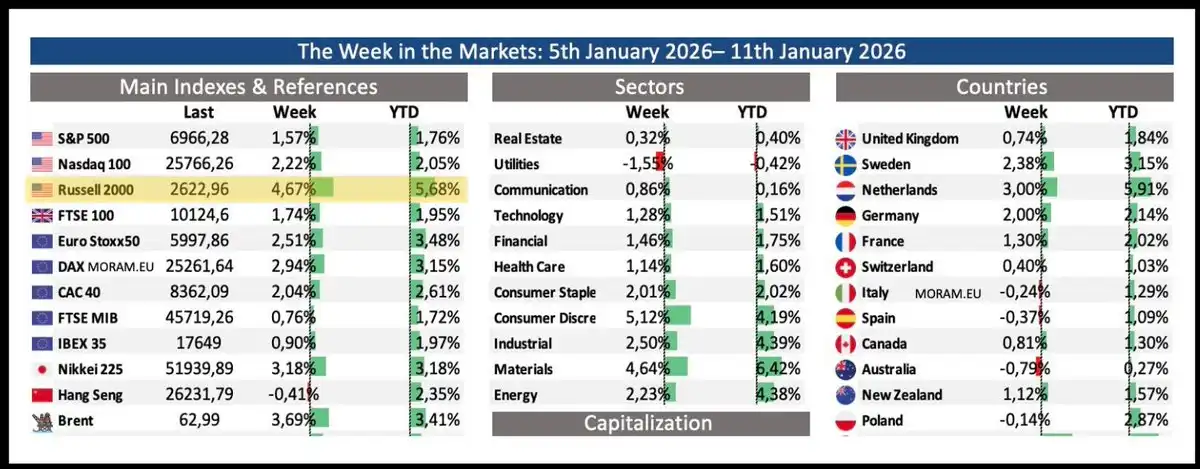
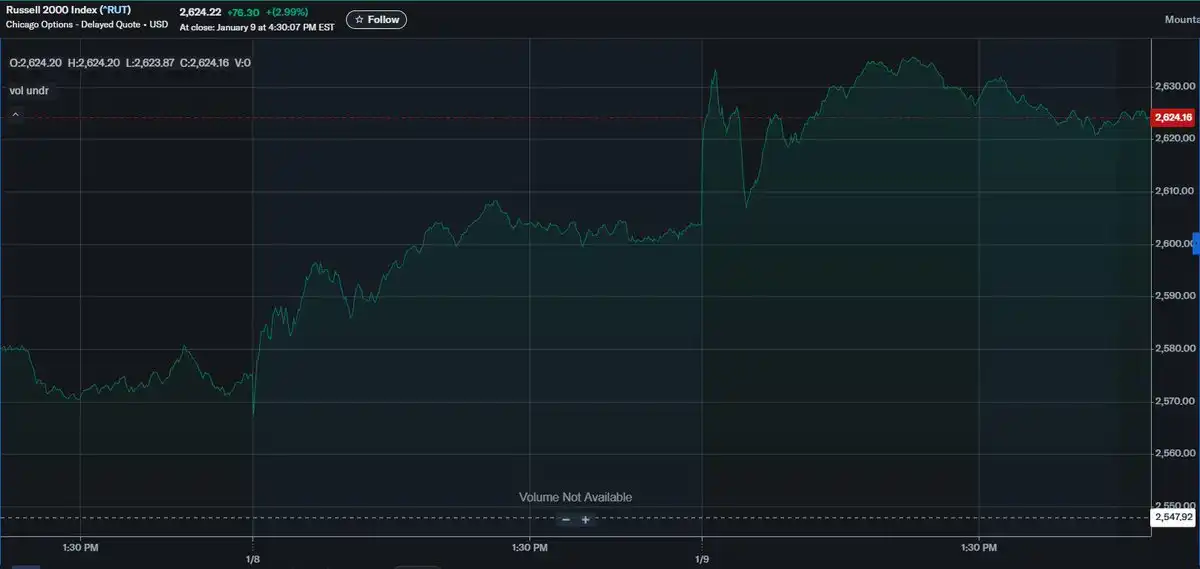
Now, in January 2026, the Russell Index has broken through the 2600-point mark for the first time in history.
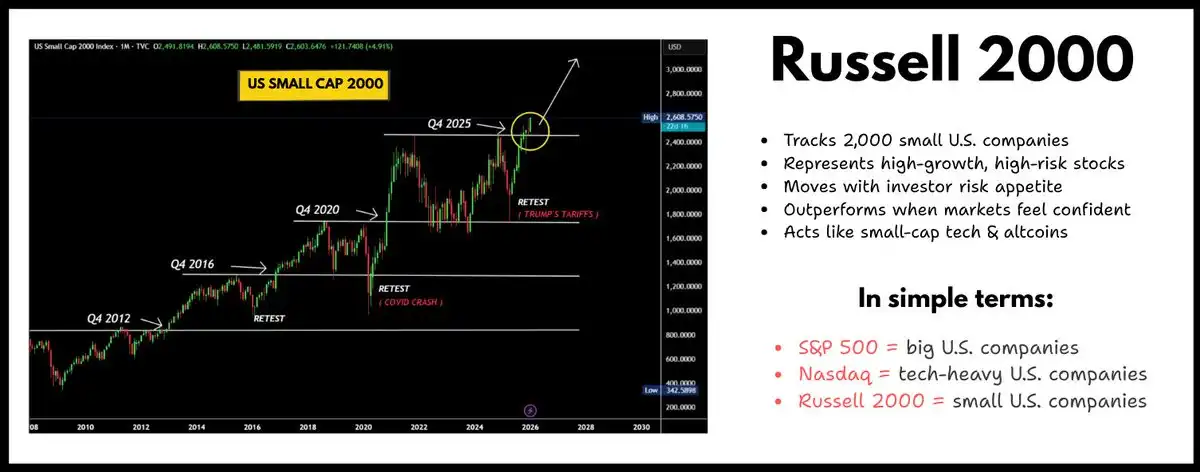
This breakout is not an illusion, nor is it a false fluctuation caused by thin trading during the holidays; it is a comprehensive breakout with huge trading volume and a broad base. The index has risen by approximately 15% year-to-date.

What Does the Russell Index Truly Represent?

Small-cap stocks are not traded based on market sentiment or feeling; it's a trade about liquidity.

The Russell Index tracks about 2000 smaller US companies, including regional banks, industrial enterprises, biotech companies, etc. The survival and development of these enterprises are closely related to the lending environment and growth expectations.

  • When liquidity tightens, these companies are hit hard.

  • When liquidity is loose, they lead the entire market.

This is why in defensive markets, the Russell Index never takes the lead; but when risk appetite returns, it often becomes the frontrunner. Therefore, the breakout of this index is not a simple technical phenomenon; it is a clear signal: capital is moving down the risk curve, seeking higher returns.

This Is Not an Isolated Event: Macro Backdrop Support

Zooming out, you will find that the current macro backdrop fits this movement in a strikingly congruent way.
  • The Federal Reserve is quietly supporting market reserves by purchasing Treasury bills. This is not full-blown quantitative easing (QE), but it is enough to ease funding pressures and inject lubricant into the credit market.

  • The U.S. Treasury is reducing the balance of its General Account (TGA), which means pushing cash back into market circulation rather than withdrawing it.

  • Fiscal policy is gradually easing at the margins, such as larger tax refunds, potential consumer subsidies, and lowering interest rates by purchasing mortgage bonds, thereby releasing the balance sheets of households and businesses.

Individually, none of these measures is a strong "stimulus" signal. But when they converge, they form a powerful liquidity waterfall. And liquidity never stands still.

The True Transmission Path of Liquidity

This is the part people often misunderstand. Liquidity doesn't magically "teleport" from cash to altcoins; it flows in a certain sequence and hierarchy:

  • First, it stabilizes the bond and financing markets.

  • Then, it pushes up the stock market.

  • Next, it seeks higher-beta (higher risk, higher return) assets within the stock market.

  • Only after that does it spill over into alternative assets.

Small-cap stocks are in the middle of this chain. They are riskier than mega-cap stocks, but their logic is clear and easy to understand for institutional investors. When small caps start to outperform, it usually means that capital's gaze has moved beyond "safety" and started chasing "growth".

This is why the breakout of the Russell Index has historically presaged a broader expansion of risk assets. This is not a coincidence, but a mechanical, inevitable transmission process.

Cryptocurrency's Place in This

The cryptocurrency market is not the leader of the liquidity cycle, but an amplifier.

When the Russell Index enters a sustained uptrend, higher-beta assets tend to follow with a lag. Historical data has repeatedly shown that ETH and altcoins typically react one to three months later.
This is not because traders are staring intently at the Russell Index on their trading software (like TradingView), but because the same liquidity that pushes capital into small caps will eventually go looking for assets with higher "convexity" (Convexity, meaning seeking huge potential returns with relatively small risk).

And cryptocurrency, especially a crypto market that has experienced capitulation selling, has thin order book depth, and exhausted selling pressure, is precisely the endpoint of that search. This is exactly the landscape the crypto market faces in early 2026.

Why Does It Feel Different This Time, But the Essence Remains Unchanged?

Every cycle has its reasons for "this time is different".

  • In 2017, it was the excessive bubble of ICOs.

  • In 2021, it was excessive leverage and market froth.

  • In 2026, it's regulatory uncertainty, macroeconomic doubts, and market fatigue.

These surface explanations change, but the rules of capital flow do not.

What is different from the past is that the market's "plumbing system" (i.e., infrastructure) has greatly improved: clearer regulatory frameworks, institutional-grade custody standards, spot ETFs continuously absorbing market supply, and reduced excessive speculative leverage at the market's edges.

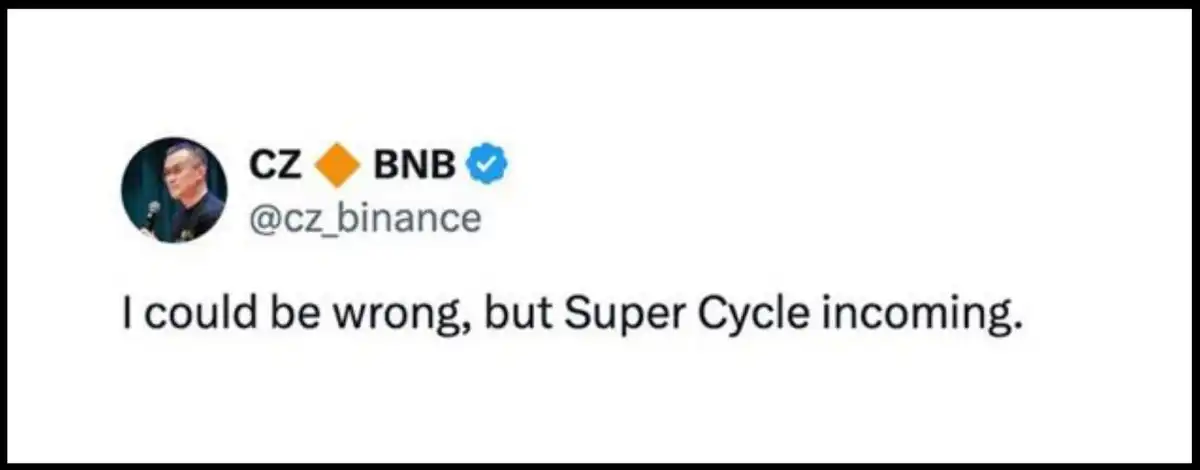
Even industry insiders have begun to talk openly about views that were once kept secret. When CZ talks about a potential "super cycle," he is pointing not to hype, but to the synergy of multiple factors: liquidity, regulation, and market structure finally beginning to move in the same direction. This synergy is extremely rare.
The Mistake Crypto-Native Traders Are Making

Most cryptocurrency traders are still staring at crypto charts, waiting for confirmation signals from the market itself. But this is usually too late.

By the time altcoin prices start to spike, the capital rotation has already been completed in other markets. The signal for the return of risk appetite,

first appears in markets that can rise without relying on hype. Small-cap stocks are one such market. They don't pump on memes; they rise because borrowing becomes easier and capital regains confidence.

Therefore, ignoring the Russell Index breakout because "this has nothing to do with crypto" completely misses the point.

The True Meaning of a "Super Cycle"

A "super cycle" does not mean that all assets will rise forever. It means:

  • Structural Support: The rally lasts longer than people expect because it is driven by market structure rather than fleeting狂热情绪 (feverish sentiment).

  • Pullbacks Are Absorbed: Market pullbacks are absorbed by buying interest and do not turn into cascading crashes.

  • Capital Rotation, Not Exit: Capital rotates between different sectors rather than completely exiting the market.

  • High-Beta Assets Come to Life: After years of suppression, high-risk, high-return assets finally get breathing room and room to rise.

This is precisely the environment where altcoins historically stop "bleeding" and begin to re-rate. Not all altcoins will rise, and the gains will not be uniform, but the trend will be decisive.

The Signal Is on the Table

The Russell Index breaking to new all-time highs is no accident. It happens when liquidity is easing, risk tolerance is returning, and capital decides to move out.

  • It did so in 2017.

  • It did so in 2021.

  • It is doing so now.

You don't need to predict specific price targets, nor precisely time the exact moment of rotation. You just need to recognize that when small caps lead the market, it's telling you what comes next.

The crypto market has ignored this signal before, often regretting it months later.

İlgili Sorular

QWhat is the significance of the Russell 2000 Index breaking through 2600 points in January 2026, as mentioned in the article?

AThe Russell 2000 Index breaking through 2600 points is significant because it represents a major breakthrough, historically high trading volume, and broad-based participation. This indicates a return of risk appetite, with capital moving down the risk curve in search of higher returns, which has preceded 'altcoin seasons' in the past, such as in 2017 and 2021.

QAccording to the article, what does the Russell 2000 Index primarily represent in the market?

AThe Russell 2000 Index tracks around 2,000 smaller U.S. companies, such as regional banks, industrial firms, and biotech companies. Its performance is a liquidity trade, reflecting the borrowing environment and growth expectations. It leads the market's risk-on sentiment, as capital flows into higher-risk assets when liquidity is ample.

QHow does liquidity flow through the market according to the article, and where do cryptocurrencies fit in this process?

ALiquidity flows in a specific sequence: it first stabilizes bond and financing markets, then pushes up the stock market, seeks higher-beta assets within equities, and finally spills over into alternative assets like cryptocurrencies. Cryptocurrencies act as amplifiers in this cycle, typically reacting one to three months after small-cap stocks like those in the Russell 2000 begin to outperform.

QWhat macro background factors support the Russell 2000 Index's breakout, as outlined in the article?

AKey macro factors include the Federal Reserve's support through Treasury bill purchases, the U.S. Treasury reducing its TGA balance to inject cash into the market, and marginally easier fiscal policies like larger tax refunds and potential consumer subsidies. Together, these create a powerful liquidity flow that benefits risk assets.

QWhat does the term 'super cycle' mean in the context of this article, and how does it relate to current market conditions?

AA 'super cycle' refers to a structurally supported uptrend driven by market infrastructure rather than short-term hype. It features longer duration rallies, buy-side absorption of pullbacks, capital rotation between sectors instead of withdrawal, and revitalization of high-beta assets. This environment allows cryptocurrencies, especially altcoins, to stop bleeding and begin revaluation after years of suppression.

İlgili Okumalar

Must-Watch Events Next Week|CLARITY Act Could Face Senate Vote; SpaceX, Circle to Report Earnings (8.3-8.9)

**Summary: Key Events and Developments to Watch (August 3-9)** The upcoming week is marked by significant financial disclosures, key legislative deadlines, and notable product updates. **Major Financial Events:** Several companies are scheduled to release their Q2 2026 earnings. American Bitcoin (ABTC) will report on August 3, followed by SpaceX and Hut 8 Mining Corp. on August 4, and Circle on August 5. Notably, a significant portion of SpaceX shares (up to 12% of total shares) will be unlocked on August 6 following their earnings release. **Key Legislative Deadline:** The U.S. Senate faces an August 7 deadline to secure 60 votes for the CLARITY Act, a bipartisan bill aiming to establish a federal regulatory framework for cryptocurrencies. The Senate may hold a full vote on the bill during the week. **Economic Data:** The U.S. July Non-Farm Payrolls report will be released on August 7, providing crucial labor market data. **Technology & Product Updates:** * **Shutdowns:** DeFi portfolio tracker Zapper and wallet app Ctrl Wallet will cease operations on August 3. * **Upgrades:** LayerZero will deprecate its v1 relayers on August 3. XRP Ledger's new version 3.3.0, featuring five new functions, is expected next week. * **AI:** Elon Musk announced that the advanced Grok 4.6 AI model is set for release around August 7. * **Bitcoin:** The BIP-110 forced signaling for a potential Bitcoin network change is scheduled to begin around August 8. **Other Notable Events:** Chinese robotics firm Unitree Tech has set its preliminary price inquiry for its IPO for August 5. South Korean exchange Upbit will delist AQT and AERGO tokens on August 3.

marsbit1 saat önce

Must-Watch Events Next Week|CLARITY Act Could Face Senate Vote; SpaceX, Circle to Report Earnings (8.3-8.9)

marsbit1 saat önce

Stocks Are Plummeting More Sharply Than Cryptocurrencies. Where Has the Money Gone?

Stock Markets Plunge Deeper Than Cryptocurrencies: Where Did the Money Go? In late July, Seoul's Kospi index triggered circuit breakers for two consecutive days, plummeting over 40% from its June high. The collapse was led by heavyweight stocks like SK Hynix, whose record profits still disappointed investors, and devastating leveraged ETFs, with one major product losing over 83% of its value. This signaled a global, forced deleveraging targeting the most crowded trades. Interestingly, while stocks exhibited extreme volatility akin to crypto markets, Bitcoin rose nearly 15% in July after a prior steep drop. Analysis shows the money fleeing equities did not flow into Bitcoin. Instead, Bitcoin had already absorbed its sell-off in May-June, when U.S. spot Bitcoin ETFs saw historic outflows. The true safe-haven beneficiary was gold, whose price rose over 20% year-on-year, highlighting a decoupling between Bitcoin and gold as "digital gold." The sell-off was a targeted unwinding of leveraged positions in tech and semiconductors, accelerated by broker-dealer risk management and shifts in the AI narrative, including new competition from Chinese memory chipmakers. The retreat path was clear: from high-valuation tech stocks to cash and U.S. Treasuries, then to gold. For Bitcoin to attract sustained institutional inflows, conditions like eased global liquidity pressure, a "soft-landing" Fed rate cut, and U.S. regulatory clarity via legislation like the stalled CLARITY Act are needed. Currently, Bitcoin is not a safe haven but an already-cleared asset. Its low correlation with tech stocks, however, makes it a potential diversification play for institutional portfolios once the storm passes. The money isn't here yet, but the positioning is underway.

marsbit1 saat önce

Stocks Are Plummeting More Sharply Than Cryptocurrencies. Where Has the Money Gone?

marsbit1 saat önce

In Conversation with Ray Dalio: We Are Currently in an AI Bubble, with 1% of My Portfolio in Bitcoin

Ray Dalio, founder of Bridgewater Associates, warns in an interview that the current AI boom shows classic bubble characteristics, which could lead to significant economic downturns as seen in past cycles like 1929 or 2000. He explains that speculative enthusiasm, fueled by debt and overvaluation, often precedes a crash when rising rates or taxation force asset sales, causing widespread losses and recession. Dalio also outlines his "Big Cycle" theory, describing an approximate 80-year pattern where widening wealth gaps, massive government deficits, and shifting geopolitical power (like China's rise) create internal conflict and global instability. He emphasizes that we are in a late-cycle, transitional phase where traditional powers like the US and UK face decline. For personal wealth protection, Dalio advises diversification beyond cash into assets like stocks, bonds, real estate, and particularly gold, which he prefers over Bitcoin. While he holds about 1% of his portfolio in Bitcoin as a non-printable hard asset, he views gold as more secure from technological or governmental threats. Regarding AI's impact, Dalio believes it will disproportionately benefit capital owners, worsening inequality by replacing both physical and cognitive labor. He suggests that human intuition and emotional intelligence, combined with AI, will be key for future workers. On taxation, Dalio argues that wealth taxes are impractical and risk triggering asset sell-offs, reducing productive investment. He points to the UK as a cautionary example of debt, low productivity, and political strife. Geopolitically, Dalio foresees a more regionalized world, with the US showing weakness in prolonged conflicts like with Iran, akin to past imperial declines. The ideal outcome, he suggests, is coexisting powerful blocs (e.g., Americas, China-Asia Pacific) without major war.

marsbit5 saat önce

In Conversation with Ray Dalio: We Are Currently in an AI Bubble, with 1% of My Portfolio in Bitcoin

marsbit5 saat önce

İşlemler

Spot
活动图片





