Is XRP Poised To Replace SWIFT As Global Payments Infrastructure?

bitcoinist2026-02-08 tarihinde yayınlandı2026-02-08 tarihinde güncellendi

Özet

The article examines the potential for XRP and Ripple's payment infrastructure to replace the SWIFT network as the global standard for cross-border payments. It highlights SWIFT's limitations in real-time settlement and discusses a significant shift towards faster, digital financial systems. Crypto analyst Archie suggests SWIFT is now testing integration with the XRP Ledger, mimicking Ripple's approach. Analysts speculate that if XRP captures even a small portion of SWIFT's massive annual transaction flow, its value could surge dramatically, with some predictions reaching over $3,000. The piece also draws parallels between XRP's current market cycle and its historic 2016-2018 breakout, noting similar price consolidation and indicator patterns that may signal another major bull run. The integration of Ripple's stablecoin, RLUSD, into core banking platforms is further bridging crypto and traditional finance.

For decades, SWIFT has served as the backbone of global payments, enabling banks to message one another across borders but not to settle value in real time. As global commerce becomes faster, more digital, and more interconnected, the limitations of legacy messaging-based systems are becoming increasingly visible. This has brought renewed attention to XRP and Ripple’s payment infrastructure that aims to enable near-instant, low-cost settlement of value.

From Bank Messaging To Real-Time Settlement Rails

A massive 1.5 quadrillion financial shift is quietly unfolding, and it’s already shaking the foundations of global banking. Crypto analyst Archie has mentioned on X that SWIFT, the decades-old backbone of cross-border payments, is copying Ripple’s playbook for a real-time transfer system and testing the XRP Ledger integration that could flip the script on slow, outdated cross-border payments.

Meanwhile, analysts are suggesting that if XRP captures even a fraction of SWIFT’s estimated $150 trillion annual flow by 2030, the upside could be enormous, while some stated that the altcoin might surge to $3,000+. With Ripple’s RLUSD stablecoin integrating directly into core banking and treasury platforms, the bridge between crypto rails and fiat liquidity is rapidly taking shape.

Currently, there’s a speculation that XRP is being reviewed as a full SWIFT replacement in the US document, and trillions are flowing into the XRP Ledger. Meanwhile, banks like Citi are tokenizing, and Ripple technology is capable of leading the charge. Archie believes that Citi is already somewhere running on Ripple technology.

How The Last Major XRP Breakout Took Shape

A side-by-side comparison chart of XRP’s historical and current market cycles suggests that history may be rhyming once again. Analyst Archie has also pointed out that in the 2016 to 2018 cycle, the price started trading at a low level around $0.003, gradually building along a rising trendline, then dipping in the orange box, before the price exploded to highs near $3.50.

During that period, the Relative Strength Index (RSI) formed a clear low around the 50 level, signaling a momentum reset rather than a breakdown. The current 2025 to 2027 cycle is showing a structurally similar pattern. XRP is consolidating around the dollar mark, following a similar trend line, with a dip marked in an orange box to $0.70, and the formed bottom closer to the 40 mark.
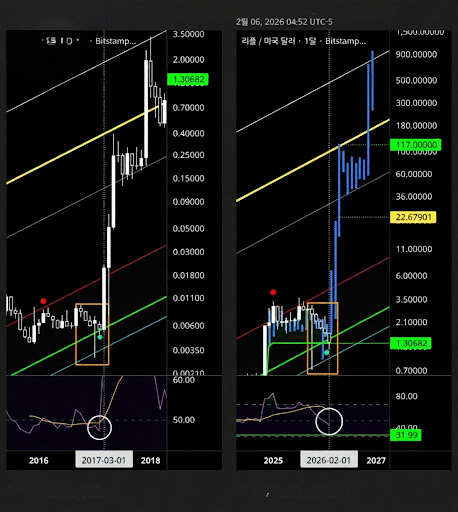
Source: Chart from Archie on X

Archie noted that the patterns in price action, the dips, and the indicator signals across cycles are repeating almost identically. While history never repeats perfectly, these recurring fractal patterns suggest that XRP may be priming for an epic bull run phase, from fractions to dollars, now potentially from dollars to triple digits, like the projected $117 range. Archie is bullish because the riddlers were right all along, and believes Phoenix will rise.

XRP trading at $1.40 on the 1D chart | Source: XRPUSDT on Tradingview.com

İlgili Sorular

QWhat is the main limitation of the current SWIFT system that XRP and Ripple aim to address?

ASWIFT enables banks to message one another across borders but does not settle value in real time, whereas XRP and Ripple's payment infrastructure aims to enable near-instant, low-cost settlement of value.

QAccording to the analyst Archie, what significant development is SWIFT undertaking regarding the XRP Ledger?

ASWIFT is copying Ripple's playbook for a real-time transfer system and testing the XRP Ledger integration to improve slow, outdated cross-border payments.

QWhat potential price target for XRP is mentioned if it captures a fraction of SWIFT's annual flow by 2030?

ASome analysts suggest that if XRP captures a fraction of SWIFT's estimated $150 trillion annual flow by 2030, the altcoin might surge to $3,000 or more.

QHow does the current market cycle for XRP (2025-2027) compare to its 2016-2018 cycle, according to the analysis?

AThe current cycle is showing a structurally similar pattern: XRP is consolidating around the dollar mark, following a similar trend line, with a dip to $0.70, mirroring the previous cycle where the price built along a trendline before exploding to highs near $3.50.

QWhat role does Ripple's RLUSD stablecoin play in the broader financial ecosystem, as mentioned in the article?

ARipple's RLUSD stablecoin is integrating directly into core banking and treasury platforms, which is rapidly building a bridge between crypto rails and fiat liquidity.

İlgili Okumalar

Only a 50% Chance of Passing This Year, Can the CLARITY Bill Succeed Before the Midterm Elections?

The CLARITY Act, which passed the House in July 2025 with strong bipartisan support (294-134), faces a critical juncture in the Senate. The Senate Banking Committee is expected to hold a markup soon, but key issues remain unresolved, including stablecoin yield provisions, DeFi regulations, and securing full Republican committee support. Other contentious points involve the Blockchain Regulatory Certainty Act (BRCA), ethics amendments for government officials, and SEC-related matters. The legislative calendar is tight, with limited time before the midterm elections. If the committee markup is delayed beyond mid-May, the chances of passage in 2026 drop significantly. Senator Cynthia Lummis has warned that failure this year could delay comprehensive crypto market structure legislation until 2030 or later. Galaxy estimates the probability of the CLARITY Act becoming law in 2026 is only about 50%. The bill provides crucial regulatory clarity by defining jurisdictional boundaries between the SEC and CFTC, establishing a path for decentralization, and bringing digital commodity intermediaries under federal regulation. Its passage is seen as vital before potential power shifts in the next Congress, which could bring less favorable leadership to key committees. The timeline is compressed, and the bill must compete for floor time with other priorities like Iran authorization and DHS appropriations. Key hurdles include finalizing the stablecoin yield compromise text, addressing law enforcement concerns about BRCA, and navigating political dynamics around SEC nominations. The outcome of the Banking Committee markup and the level of bipartisan support will be critical indicators of its future success.

marsbit1 dk önce

Only a 50% Chance of Passing This Year, Can the CLARITY Bill Succeed Before the Midterm Elections?

marsbit1 dk önce

Dialogue with Xinhuo Chief Economist Fu Peng: Macro Bear Market Expected to End This Year, Prioritize Allocation to Value Assets

Fu Peng, Chief Economist at New Huo Group, discusses the integration of crypto assets into traditional finance, marking a shift from a speculative phase to institutionalization. He highlights the current era as the second major fusion of finance and technology, driven by AI, data, and computing power, with crypto assets becoming part of the FICC+C (Fixed Income, Currencies, Commodities + Crypto) framework. Regulatory clarity in the U.S., such as the GENIUS and Clarity Acts, has paved the way for institutional adoption by defining digital assets as financial instruments. Fu views RWA (Real World Assets) as a tool for asset tokenization rather than a standalone asset class, noting that financial innovation differs between Eastern and Western markets due to cultural approaches to risk and regulation. He emphasizes that stablecoins are essential for future finance, but Asian markets, including Hong Kong, will adopt them cautiously. Macro liquidity now significantly influences crypto markets, as institutional participation increases correlation with traditional assets. Fu suggests the macro-driven bear market may end by year-end, reducing the relevance of Bitcoin’s four-year cycle. For asset allocation, he recommends value-oriented AI stocks for stability, Bitcoin for moderate certainty, and Ethereum for higher volatility.

marsbit9 dk önce

Dialogue with Xinhuo Chief Economist Fu Peng: Macro Bear Market Expected to End This Year, Prioritize Allocation to Value Assets

marsbit9 dk önce

Only a 50% Chance of Passing This Year, Can the CLARITY Bill Succeed Before the Midterm Elections?

The CLARITY Act, which passed the U.S. House in July 2025 with strong bipartisan support (294-134), faces a critical juncture in the Senate. The Senate Banking Committee is expected to hold a markup soon, but key issues remain unresolved, including stablecoin yield provisions, DeFi regulations, and securing full Republican committee support. Additional challenges involve the Blockchain Regulatory Certainty Act (BRCA), ethics amendments for government officials, and SEC-related concerns. Galaxy estimates only a 50% chance of the bill becoming law in 2026. The tight legislative calendar, competing priorities like Iran military authorization and DHS appropriations, and the impending midterm elections create significant time pressure. If the bill is not passed before the new Congress convenes in 2027, comprehensive crypto market structure legislation could be delayed until 2030 or later, especially if leadership changes result in less favorable committee chairs. The act provides crucial regulatory clarity by defining the jurisdictional boundaries between the SEC and CFTC, establishing a path for decentralized networks to be classified as non-securities, and bringing digital commodity intermediaries under federal regulation. The outcome of ongoing Senate negotiations, particularly the release of revised text on stablecoin yields, will be a key indicator of its future prospects.

Odaily星球日报11 dk önce

Only a 50% Chance of Passing This Year, Can the CLARITY Bill Succeed Before the Midterm Elections?

Odaily星球日报11 dk önce

Four-Dimensional Resonance: Hong Kong Web3 Carnival Sub-Forum Co-Creates Blueprint for Global Financial New Infrastructure

The "Four-Dimensional Resonance: 2026 Global Financial New Infrastructure" forum, a core event of the Hong Kong Web3 Festival, was successfully held at the Hong Kong Convention and Exhibition Centre. Co-hosted by Web3Labs and DeShang Singularity Tech, with joint support from Bitroot, Injective, Microsoft, and Z Oracle, the event gathered policymakers, industry leaders, and investors to explore the integration and innovation of global financial infrastructure, focusing on RWA, AI, DeFi, and compliant payments. Policy speakers, including Hong Kong Legislative Council Member Mr. Wu Jiezhuang, South Korean National Assembly Member Mr. Min Byung-duk, and ACED Chairman Mr. Yun Seok-hun, emphasized the importance of cross-border regulatory collaboration and an open policy environment for fintech innovation. Web3Labs CEO Caspar and DeShang Singularity Tech CEO Chang Shuai highlighted Hong Kong’s role as a financial innovation center and the approaching "singularity moment" for global financial infrastructure. Technical insights were shared by MagnetX, Bitroot, Microsoft, and Injective on topics including AI Agent economies, the evolution of public blockchains, and AI’s transformative role in finance. Key partnerships and initiatives were launched: - GWDC 2026 Korea collaboration between Hong Kong and South Korea. - A strategic agreement between Web3Labs and Microsoft. - The launch of a public anti-fraud alliance by Z Oracle and partners. - The "Injective Rising Star" program to support AI and Web3 projects. Panel discussions delved into AI-driven smart payments, compliant cross-border transactions, and the fusion of RWA and DeFi. Participants agreed that integrating RWA with DeFi is crucial for the next stage of financial infrastructure, enabling a shift from physical to digital finance. The forum underscored Hong Kong’s pivotal role in advancing a globalized and sustainable Asian fintech ecosystem.

marsbit20 dk önce

Four-Dimensional Resonance: Hong Kong Web3 Carnival Sub-Forum Co-Creates Blueprint for Global Financial New Infrastructure

marsbit20 dk önce

İşlemler

Spot
Futures
活动图片