Is Washington About To Kill Crypto Prediction Markets For Good? — Why Congress Suddenly Cares

bitcoinist2026-03-26 tarihinde yayınlandı2026-03-26 tarihinde güncellendi

Özet

On March 25, two separate acts were introduced to ban U.S. congressional staff, members of Congress, and federal officials from trading on prediction markets. Representative Seth Moulton of Massachusetts issued an immediate office-wide ban, calling these markets “playgrounds for corrupt insiders” that create perverse incentives. Separately, Representatives Adrian Smith and Nikki Budzinski introduced the bipartisan PREDICT Act, which would prohibit elected officials, senior appointees, and their families from trading on political and policy outcome markets. Violators would face a 10% fine on the value of the trade and forfeiture of profits. The moves reflect growing concern in Washington over insider trading risks in prediction markets, especially following instances of traders making large profits on geopolitical events. These actions may lead to stricter regulations and increased scrutiny on crypto-based prediction platforms.

Two different acts banning congressional staff, members of congress and federal officials from trading on prediction markets were introduced on Wednesday, March 25, one of them being effective immediately.

Massachusetts Bans Crypto Prediction Market

Washington’s battle against prediction markets rages on. Following a bipartisan Senate bill introduced on Monday that targets sports‐style bets on platforms like Polymarket and Kalshi, democratic representative Seth Moulton of Massachusetts (MA-06) formally banned all of his staff from “participating in prediction markets”, such as the aforementioned, “to trade or hold positions on political, legislative, regulatory, geopolitical outcomes, or any information that is learned in an official capacity”. The press release frames it as the first such explicit office-wide ban in Congress.

Moulton’s rationale is clear: staff are meant to serve constituents, not profit from policy choices and global events. As he views it, prediction markets have become ethically questionable “playgrounds for corrupt insiders”:

Prediction markets have become a playground for corrupt insiders who are able to place bets on things like election outcomes, wars, and even the deaths of public figures. This is creating a perverse incentive structure that poses a genuine threat to American society today.

Congressional staff and the Members they work for exist to serve the constituents of the districts they represent, not to profit off of the very policy decisions and world events that we are here to respond to.

Nebraska Bans Crypto Prediction Market Too

On Nebraska’s side, Congressman Adrian Smith (R-NE-03) and Congresswoman Nikki Budzinski (D-IL-13) introduced the Preventing Real-time Exploitation and Deceptive Insider Congressional Trading Act (PREDICT Act), another bipartisan effort that aims to ban members of Congress, their spouses and children, the president and vice president, and senior appointees from trading on political and policy outcome markets.

Their core argument and statement are very similar to Moulton’s. Recent episodes of little‐known traders making massive profits on contracts tied to war with Iran or the length of government shutdowns have sharpened fears about insider information leaking into these markets. Smith said:

Serving the American people is a privilege, not a pathway to profit. Our commonsense, bipartisan bill will give Americans confidence that the decisions of their elected officials are guided by merit, not personal profit.

Budzinski added:

The American people are tired of politicians using their influence for personal gain, and the rise of prediction markets has made those concerns even more relevant. In recent months, we’ve seen instances of little-known traders making massive profits on events ranging from war with Iran to how long a government shutdown will last, raising necessary questions about the use of inside information.

Breaking the PREDICT Act would trigger a civil fine equal to 10% of the value of the banned trade, plus a requirement to hand over all profits from it to the U.S. Treasury, the announcement states.

A Growing Concern For Washington?

These new episodes come on top of earlier efforts like Rep. Ritchie Torres’s Financial Prediction Markets Public Integrity Act, following the capture of Venezuela’s former dictator Nicolás Maduro, which also targeted insider trading on platforms such as Polymarket.

For on‐chain and offshore prediction markets, a hard ban on US officials could actually de‐risk the space by reducing headline “insider” scandals, but it also raises the odds of stricter KYC and monitoring requirements in the US.

As it becomes increasingly clear that Washington has its attention set on ethically questionable crypto ventures, it is not too far-fetched to think that similar logic could be extended to other high‐beta crypto venues where policy and profit visibly collide (e.g., tokens tightly linked to election or war outcomes). Traders would do well pricing in regulatory overhang alongside usual market risk.
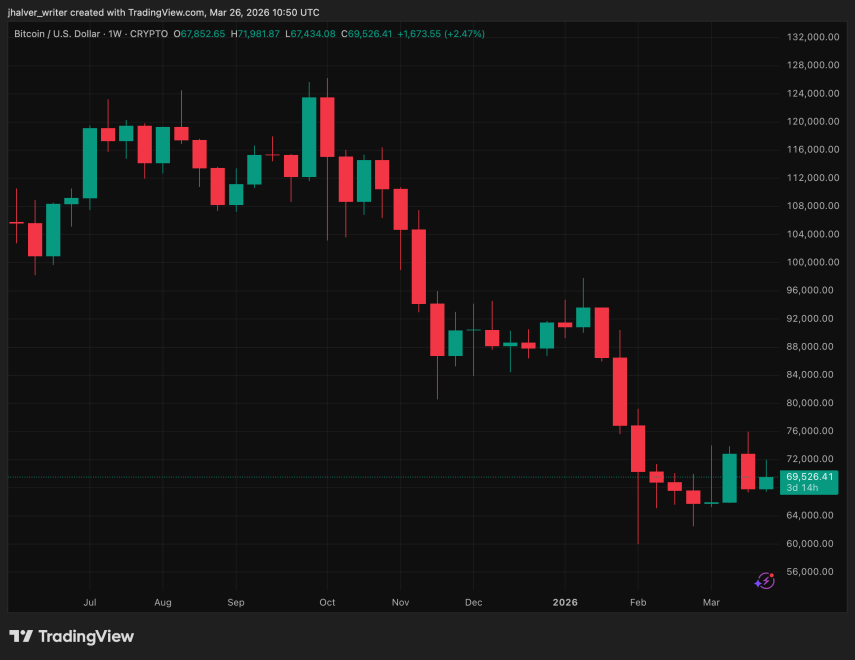
BTC’s price drops slightly after reaching $71k yesterday, trading for around $69k today. Source: BTCUSD on Tradingview

Cover image from Perplexity, BTCUSD chart from Tradingview

İlgili Sorular

QWhat is the main reason cited by Representative Seth Moulton for banning his staff from participating in prediction markets?

AMoulton believes staff should serve constituents, not profit from policy choices and global events, and views prediction markets as ethically questionable 'playgrounds for corrupt insiders'.

QWhat is the name of the bipartisan act introduced by Congressman Adrian Smith and Congresswoman Nikki Budzinski to ban trading on political prediction markets?

AThe Preventing Real-time Exploitation and Deceptive Insider Congressional Trading Act (PREDICT Act).

QWhat are the penalties for violating the PREDICT Act according to the announcement?

AA civil fine equal to 10% of the value of the banned trade, plus a requirement to hand over all profits from it to the U.S. Treasury.

QWhich earlier legislative effort targeted insider trading on platforms like Polymarket, as mentioned in the article?

ARep. Ritchie Torres's Financial Prediction Markets Public Integrity Act.

QHow might a hard ban on US officials using prediction markets affect the crypto prediction market space?

AIt could de-risk the space by reducing headline 'insider' scandals but also increase the likelihood of stricter KYC and monitoring requirements in the US.

İlgili Okumalar

Dan Koe: The Counterintuitive Truth—You Don't Need to Remember Everything You Read

Dan Koe: The Counterintuitive Truth — You Don't Need to Remember Everything You Read The central idea is that deliberately trying to remember information is often misguided. True learning isn't about memorizing facts but about having important knowledge surface naturally when needed through use. Most forgetting is normal, not a failure. The article reframes learning using a control theory framework—a four-step feedback loop: having a clear Goal, accurately Sensing your current state, Comparing the gap, and Acting to close it. Most learning stalls because people only do step 2 (blind input) without a goal to create the necessary "error signal" for focused action. The most effective method is to start with output, not input. Begin a meaningful personal project first, and learn only what's necessary to complete it. This project-driven, "just-in-time" learning ensures knowledge is contextual and retained. The concept of a "Second Brain" often fails because it becomes a digital graveyard—over-collected and under-utilized. The goal should be building a "Second Subconscious"—a dynamic system that proactively surfaces relevant ideas during creation, not a static storage vault. Tools like Obsidian+Claude or Eden can help by automating organization and enabling semantic search, but their value depends on linking knowledge to active projects. Ultimately, what matters is not what you store, but what you filter and internalize. Focus on ideas that shape your worldview, use projects as filters, and transform collected material through writing and sharing. AI should be used to reduce friction in research and editing, not to formulate your core views. In conclusion, remembering is a byproduct, not the goal. Knowledge that sticks comes from pursuing personal goals, applying it in real projects, and digesting it through creation. The tools are merely aids; the crucial step is to start doing meaningful work and let the necessary knowledge find you.

marsbit52 dk önce

Dan Koe: The Counterintuitive Truth—You Don't Need to Remember Everything You Read

marsbit52 dk önce

A New Era: The Fundamental Transformation of China's Entrepreneurs

A profound generational shift is underway among Chinese entrepreneurs. The wealth and influence once dominated by real estate and internet giants is now being claimed by a new wave of founders driving breakthroughs in AI, semiconductors, and robotics. This change is vividly reflected in 2026's wealth rankings. Figures like Zhang Yiming (ByteDance), Liang Wenfeng (DeepSeek), Chen Tianshi (Cambricon), and Wang Xingxing (Unitree Robotics) are ascending. Their wealth stems not from traditional business models but from market expectations for future technological competitiveness, with AI, chips, and smart hardware becoming the primary engines of wealth creation. Their common trait is a foundational focus on technology, often starting from the laboratory rather than a business plan. Examples include Chen Tianshi's decade-long push in AI chips, Liang Wenfeng's core algorithmic innovations at DeepSeek with a compact team, and Zhu Yiming's "no salary until profitable" 9-year journey to build Changxin Memory into a global DRAM player. This transition marks a fundamental shift in China's economic imperative: from commercial expansion and learning to indigenous innovation and deep industrial capability. While the previous generation built the foundational market and infrastructure, this new cohort is tasked with achieving global leadership in core technologies, moving China from "keeping pace" to pioneering original, breakthrough innovations that are industrialized at scale. The baton is being passed to those competing on the world stage through technological originality.

marsbit52 dk önce

A New Era: The Fundamental Transformation of China's Entrepreneurs

marsbit52 dk önce

Once-Popular Web3 Enters Wave of Layoffs

The once-hot Web3 industry is experiencing a severe wave of layoffs. While many companies attribute job cuts to AI-driven restructuring, the primary reason is often financial pressure. The Web3 sector, at the intersection of tech and finance, has been hit particularly hard. Employees at major cryptocurrency exchanges report sudden, impersonal layoffs—often with system access revoked overnight—and minimal or no severance. Common tactics include setting impossible performance targets or terminating employees for minor policy violations. The working atmosphere has become toxic, marked by intense monitoring, excessive meetings, and management obsessed with control and internal politics rather than product innovation. The industry's core business model is collapsing. Exchange revenue from trading fees and listing charges has plummeted due to a decline in quality projects and retail investor exodus. Events like the massive forced liquidation on October 10th further shattered confidence. Competition from on-chain derivatives platforms and prediction markets is intensifying the downturn. As layoffs continue, displaced workers struggle to find new opportunities. Many transition to the AI sector, but face significant bias from traditional finance and even some AI firms, which view crypto industry experience with suspicion. The current downturn appears more structural than cyclical, driven by unsustainable practices, internal strife, and a failure to innovate, raising questions about the industry's future trajectory.

marsbit1 saat önce

Once-Popular Web3 Enters Wave of Layoffs

marsbit1 saat önce

İşlemler

Spot
活动图片