Is Washington About To Kill Crypto Prediction Markets For Good? — Why Congress Suddenly Cares

bitcoinist2026-03-26 tarihinde yayınlandı2026-03-26 tarihinde güncellendi

Özet

On March 25, two separate acts were introduced to ban U.S. congressional staff, members of Congress, and federal officials from trading on prediction markets. Representative Seth Moulton of Massachusetts issued an immediate office-wide ban, calling these markets “playgrounds for corrupt insiders” that create perverse incentives. Separately, Representatives Adrian Smith and Nikki Budzinski introduced the bipartisan PREDICT Act, which would prohibit elected officials, senior appointees, and their families from trading on political and policy outcome markets. Violators would face a 10% fine on the value of the trade and forfeiture of profits. The moves reflect growing concern in Washington over insider trading risks in prediction markets, especially following instances of traders making large profits on geopolitical events. These actions may lead to stricter regulations and increased scrutiny on crypto-based prediction platforms.

Two different acts banning congressional staff, members of congress and federal officials from trading on prediction markets were introduced on Wednesday, March 25, one of them being effective immediately.

Massachusetts Bans Crypto Prediction Market

Washington’s battle against prediction markets rages on. Following a bipartisan Senate bill introduced on Monday that targets sports‐style bets on platforms like Polymarket and Kalshi, democratic representative Seth Moulton of Massachusetts (MA-06) formally banned all of his staff from “participating in prediction markets”, such as the aforementioned, “to trade or hold positions on political, legislative, regulatory, geopolitical outcomes, or any information that is learned in an official capacity”. The press release frames it as the first such explicit office-wide ban in Congress.

Moulton’s rationale is clear: staff are meant to serve constituents, not profit from policy choices and global events. As he views it, prediction markets have become ethically questionable “playgrounds for corrupt insiders”:

Prediction markets have become a playground for corrupt insiders who are able to place bets on things like election outcomes, wars, and even the deaths of public figures. This is creating a perverse incentive structure that poses a genuine threat to American society today.

Congressional staff and the Members they work for exist to serve the constituents of the districts they represent, not to profit off of the very policy decisions and world events that we are here to respond to.

Nebraska Bans Crypto Prediction Market Too

On Nebraska’s side, Congressman Adrian Smith (R-NE-03) and Congresswoman Nikki Budzinski (D-IL-13) introduced the Preventing Real-time Exploitation and Deceptive Insider Congressional Trading Act (PREDICT Act), another bipartisan effort that aims to ban members of Congress, their spouses and children, the president and vice president, and senior appointees from trading on political and policy outcome markets.

Their core argument and statement are very similar to Moulton’s. Recent episodes of little‐known traders making massive profits on contracts tied to war with Iran or the length of government shutdowns have sharpened fears about insider information leaking into these markets. Smith said:

Serving the American people is a privilege, not a pathway to profit. Our commonsense, bipartisan bill will give Americans confidence that the decisions of their elected officials are guided by merit, not personal profit.

Budzinski added:

The American people are tired of politicians using their influence for personal gain, and the rise of prediction markets has made those concerns even more relevant. In recent months, we’ve seen instances of little-known traders making massive profits on events ranging from war with Iran to how long a government shutdown will last, raising necessary questions about the use of inside information.

Breaking the PREDICT Act would trigger a civil fine equal to 10% of the value of the banned trade, plus a requirement to hand over all profits from it to the U.S. Treasury, the announcement states.

A Growing Concern For Washington?

These new episodes come on top of earlier efforts like Rep. Ritchie Torres’s Financial Prediction Markets Public Integrity Act, following the capture of Venezuela’s former dictator Nicolás Maduro, which also targeted insider trading on platforms such as Polymarket.

For on‐chain and offshore prediction markets, a hard ban on US officials could actually de‐risk the space by reducing headline “insider” scandals, but it also raises the odds of stricter KYC and monitoring requirements in the US.

As it becomes increasingly clear that Washington has its attention set on ethically questionable crypto ventures, it is not too far-fetched to think that similar logic could be extended to other high‐beta crypto venues where policy and profit visibly collide (e.g., tokens tightly linked to election or war outcomes). Traders would do well pricing in regulatory overhang alongside usual market risk.
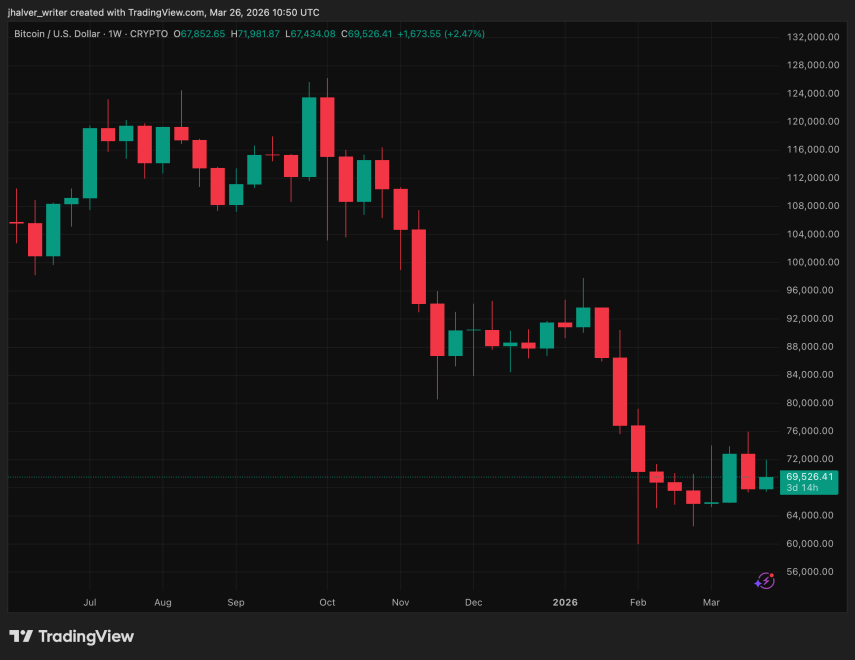
BTC’s price drops slightly after reaching $71k yesterday, trading for around $69k today. Source: BTCUSD on Tradingview

Cover image from Perplexity, BTCUSD chart from Tradingview

İlgili Sorular

QWhat is the main reason cited by Representative Seth Moulton for banning his staff from participating in prediction markets?

AMoulton believes staff should serve constituents, not profit from policy choices and global events, and views prediction markets as ethically questionable 'playgrounds for corrupt insiders'.

QWhat is the name of the bipartisan act introduced by Congressman Adrian Smith and Congresswoman Nikki Budzinski to ban trading on political prediction markets?

AThe Preventing Real-time Exploitation and Deceptive Insider Congressional Trading Act (PREDICT Act).

QWhat are the penalties for violating the PREDICT Act according to the announcement?

AA civil fine equal to 10% of the value of the banned trade, plus a requirement to hand over all profits from it to the U.S. Treasury.

QWhich earlier legislative effort targeted insider trading on platforms like Polymarket, as mentioned in the article?

ARep. Ritchie Torres's Financial Prediction Markets Public Integrity Act.

QHow might a hard ban on US officials using prediction markets affect the crypto prediction market space?

AIt could de-risk the space by reducing headline 'insider' scandals but also increase the likelihood of stricter KYC and monitoring requirements in the US.

İlgili Okumalar

Dialogue with a Macro Analyst: AI Drains All Liquidity from U.S. Stocks, $40K Bitcoin is the True Bottom

In a recent discussion, macro strategist Luke Groman, founder of FFT LC, presented a sobering analysis of current markets. He argues that while the S&P 500 hits new highs, this is largely driven by just seven AI stocks, which are "sucking all the oxygen and liquidity out of the room." Bitcoin, which he calls the "last working smoke alarm for liquidity," is signaling trouble, having entered a difficult period. Groman explains that the AI boom is fueled by accounting practices that front-load revenue, creating an illusion of high profits while cash is being depleted. He warns this cycle could reverse sharply when construction slows. His base case is that stocks will rise in dollar terms but fall significantly when measured in gold or Bitcoin, highlighting that long-term US Treasury futures have already lost 90% of their value against gold over the past decade. He points to major structural risks, including China's dominance in rare earths—a small commodity market underpinning trillions in tech stock value—and the prolonged closure of the Strait of Hormuz, which he calls a "Suez Moment" for the US. This, combined with a shift towards a "no ticky, no washy" proof-of-work system for settling trade (using gold, not trust), signals deeper systemic distrust. Regarding US debt, Groman notes that historically, all 58 countries that reached a 130% debt-to-GDP ratio defaulted, primarily through inflation. The US crossed this threshold in 2020. He also highlights a contradiction in the AI narrative: if it's as transformative as claimed, it must destroy white-collar jobs, threatening half of US tax revenue—a reality at odds with the "no job loss" messaging from tech leaders. On Bitcoin, Groman sold most of his position near the top and hasn't fully re-entered. Citing technical analysis from Northstar Bad Charts, he suggests a potential bottom around $40,000 could materialize in Q3 or Q4. He concludes that while he may be labeled a doomsayer, his view is simply realistic, grounded in historical precedents and current macro pressures.

marsbit54 dk önce

Dialogue with a Macro Analyst: AI Drains All Liquidity from U.S. Stocks, $40K Bitcoin is the True Bottom

marsbit54 dk önce

Apple's Desired On-Device AI Sees a Dark Horse Emerge: The First Cognitive Model is Born, 4B Matches GPT-5.4

A Chinese company, Tomorrow's Journey (Nextie), has introduced what it is calling the industry's first "cognitive model" for edge devices. Named New Journey Alpha, this 4-billion-parameter model reportedly matches the performance of trillion-parameter giants like GPT-5.4 in group intelligence tasks such as debate and collective decision-making. The development follows Andrej Karpathy's vision of stripping vast factual knowledge from large language models to retain only a smaller "cognitive core" capable of reasoning, planning, and knowing its own limits. This approach directly addresses the soaring computational costs and token expenses hindering AI's widespread deployment, as highlighted by incidents like Amazon shutting down an internal AI tool due to prohibitive costs. Trained via reinforcement learning on a corpus of academic papers from 1800-2020 to enhance generalization, the model enables three key advancements: 1) Improved decision quality in multi-agent systems, 2) Drastically reduced compute costs, allowing for cost-effective cloud or on-device (e.g., MacBook) deployment, and 3) The feasibility of "proactive" AI agents that act autonomously without user prompts, unlocking new commercial possibilities beyond today's reactive models. Built by the former Microsoft Xiaoice team—known for creating a 3.6B model that outperformed a 65B Llama model—the company is now focusing on the multi-agent systems sector, a field gaining significant investor interest. The model's economic impact is profound; by achieving high-level performance with minimal parameters, it fundamentally alters the cost structure of AI services, challenging the prevailing model of ever-larger parameter counts.

marsbit3 saat önce

Apple's Desired On-Device AI Sees a Dark Horse Emerge: The First Cognitive Model is Born, 4B Matches GPT-5.4

marsbit3 saat önce

İşlemler

Spot
Futures
活动图片