Is the Crypto Market Doomed to Face Pressure in Q1? Progress of the CLARITY Act Becomes a Key Factor

marsbit2026-01-13 tarihinde yayınlandı2026-01-13 tarihinde güncellendi

Özet

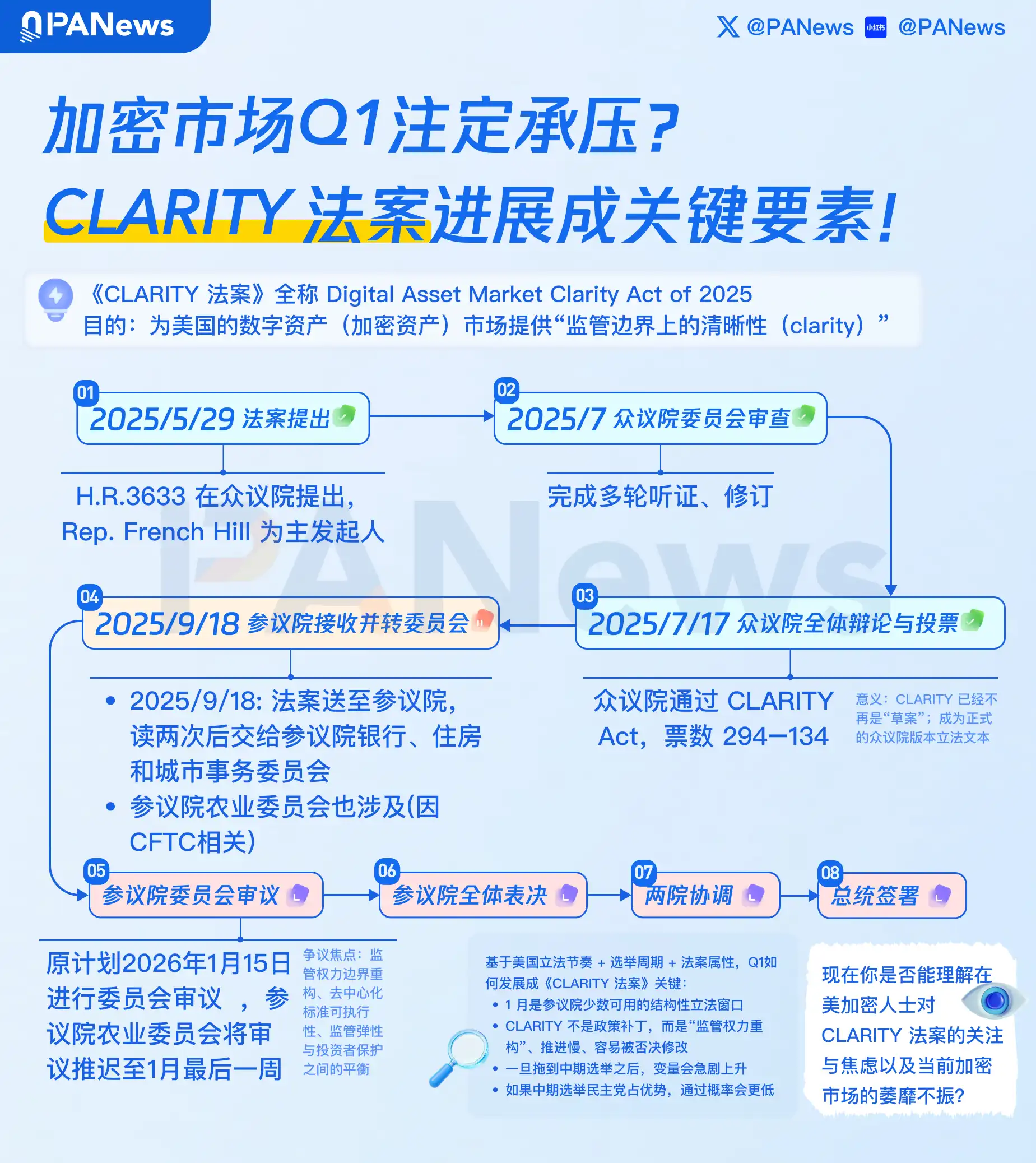
The CLARITY Act, introduced in the U.S. House of Representatives on May 29, 2025, aims to provide regulatory clarity for the digital asset market. It is currently stalled in the Senate after being received and referred to committee. Market participants are concerned that without significant progress in Q1, the bill faces increasing obstacles. Key reasons include the limited legislative window in the Senate from January to March, which is typically reserved for complex, non-urgent bills like CLARITY. If no substantive committee action occurs in January, the bill risks being sidelined by the legislative schedule. The Act is not a minor policy adjustment but a restructuring of regulatory authority, making it slow-moving, highly amendable, and prone to delays rather than outright rejection. If delayed until after the midterm elections, its prospects become even more uncertain due to potential shifts in Congressional power. Should Democrats gain influence post-election, the bill’s chances would likely decrease. Democratic leadership generally favors broader SEC authority, regulatory flexibility, and is hesitant to limit enforcement discretion—contrary to CLARITY’s goal of defining regulatory boundaries and reducing regulation by enforcement. In a Democrat-led Senate, the bill could be substantially rewritten, broken into smaller pieces, or indefinitely postponed. These factors explain the anxiety among U.S. crypto stakeholders and contribute to current market pessimism.

The purpose of the "CLARITY Act" is to provide "clarity at the regulatory boundaries" for the digital asset (crypto asset) market in the United States. It was introduced in the House of Representatives on May 29, 2025, primarily sponsored by Rep. French Hill, and is currently stuck at "received in the Senate and referred to committee." The market is widely concerned that if the CLARITY Act does not make significant progress in Q1, delays will make the situation increasingly unfavorable!

The reasons are multiple:

January is one of the few structural legislative windows for the Senate


Every year from January to March is the main period for the Senate to handle highly complex, non-urgent bills. The CLARITY Act falls into the category of a "highly complex + highly controversial + non-urgent" market structure bill, naturally ranking lower in priority. If it fails to enter substantive advancement (such as clear action at the committee level) in January, it is very likely to be "naturally squeezed out" by the overall legislative schedule.

CLARITY is not a policy patch, but a "regulatory power restructuring"
The characteristics of such bills are: slow progress, repeated demands for amendments, and a high tendency to be postponed rather than rejected.

Once delayed until after the midterm elections, variables will increase sharply


Midterm elections = a reset of the congressional power structure. Bills that have been advanced but not completed will have their priorities reshuffled. The CLARITY Act, which has not yet taken effect, has not formed strong bipartisan consensus, and highly relies on the support of the current committee, is very likely to be "re-evaluated" or even redrafted after a change in the power structure.

If the Democratic Party gains an advantage in the midterm elections, the probability of passage will be even lower The mainstream stance of the Democratic Party tends to: strengthen the coverage of securities laws, retain regulatory agency interpretation flexibility, and be highly cautious about "limiting the space for law enforcement agencies through legislation."
The core effect of the CLARITY Act, however, is to: predefine some regulatory boundaries, limit "regulation by enforcement," and reduce the SEC's discretionary power in gray areas. Therefore, in a Senate environment dominated by Democrats, the CLARITY Act is more likely to: be required to undergo substantial revisions (effectively a rewrite), be broken down into multiple sub-bills, or be shelved for a long time.

Can you now understand the attention and anxiety of crypto professionals in the U.S. regarding the CLARITY Act and the current sluggishness of the crypto market?
İlgili Sorular

QWhat is the main purpose of the CLARITY Act mentioned in the article?

AThe CLARITY Act aims to provide regulatory clarity and establish clear boundaries for the digital asset (crypto asset) market in the United States.

QWhy is January considered a critical legislative window for the CLARITY Act in the Senate?

AJanuary is one of the few structural legislative windows in the Senate, as the period from January to March is typically used to handle highly complex, non-urgent bills. If the CLARITY Act does not see substantial progress (such as committee-level action) by January, it risks being pushed out of the legislative schedule.

QHow might the midterm elections impact the progression of the CLARITY Act?

AThe midterm elections could lead to a reset of congressional power structures, causing bills that are in progress but not yet passed to have their priorities reshuffled. The CLARITY Act, which lacks strong bipartisan consensus and relies heavily on current committee support, is particularly vulnerable to being re-evaluated or even redrafted after the elections.

QWhy would the CLARITY Act face lower chances of passing if Democrats gain an advantage in the midterm elections?

ADemocrats generally favor strengthening securities law coverage, preserving regulatory agency flexibility, and are cautious about limiting enforcement agency discretion through legislation. The CLARITY Act, which aims to predefine regulatory boundaries and restrict 'regulation by enforcement,' would likely face significant amendments, be broken into sub-bills, or be shelved indefinitely in a Democrat-dominated Senate.

QWhat are the key characteristics of the CLARITY Act that make its legislative process challenging?

AThe CLARITY Act is a highly complex and controversial market structure bill that is non-urgent, making it low priority. It involves a 'regulatory power restructuring,' which leads to slow progress, frequent demands for revisions, and a high likelihood of delays rather than outright rejection.

İlgili Okumalar

Goldman Sachs: July Smashes Through Crowded Trades, U.S. Stock Bull Market Not Broken but Harder to Navigate

Goldman Sachs: July Sees Crowded Trades Unwound, U.S. Bull Market Intact but Getting Tougher. The U.S. stock market in July did not see an index-level crash, but rather a significant unwinding of speculative positions. While the S&P 500 remained stable—trading within a narrow 3.5% range and staying within 2% of its high—underlying market dynamics were volatile. Heavily crowded trades, particularly in high-momentum tech, AI-linked stocks, and Asian strategies, faced severe pressure and forced deleveraging. Data indicates this was a meaningful cleanse, not a minor adjustment. Global tech exposure saw its largest sell-off in over five years, leverage in Korean equity ETFs plummeted, and Goldman's prime brokerage recorded the largest gross exposure reduction since late 2022. Leverage on momentum factors among fundamental long/short clients fell to the 28th percentile of its one-year range. The AI trade narrative shifted from pure potential to a focus on tangible returns. While Meta failed to show clear AI monetization, Microsoft and Amazon provided evidence that massive capital expenditure is translating into scalable revenue and product growth, preventing a blanket sell-off of the AI sector. The Federal Reserve's more opaque communication style and volatility in long-end Treasury yields have introduced new friction, particularly for rate-sensitive growth and tech stocks. The broader outlook for U.S. equities remains favorable, supported by a strong economy, robust earnings, and substantial AI capital expenditure. However, risk/reward is no longer cheap, and the market's upward elasticity has weakened. The Nasdaq 100's trajectory—up 12% year-to-date despite significant pullbacks—illustrates that the bull trend persists but the path is becoming more difficult. The key lesson from July is that the market no longer rewards crowded, highly leveraged trades, requiring more disciplined and liquid portfolio approaches.

marsbit17 dk önce

Goldman Sachs: July Smashes Through Crowded Trades, U.S. Stock Bull Market Not Broken but Harder to Navigate

marsbit17 dk önce

Interview with Robinhood Executive: Meme + Tokenized US Stocks as "Barbell" Customer Acquisition Strategy, All Business Lines Achieve Hundreds of Millions in Revenue

Interview with Robinhood executive Johann Kerbrat reveals the company's "barbell" customer acquisition strategy for its new Robinhood Chain, combining meme tokens with tokenized stocks. Three weeks after mainnet launch, the chain has seen over $3B in weekly DEX volume and 105M transactions. Kerbrat explains the logic behind the permissionless chain: meme tokens attract DeFi users, while tokenized real-world assets (RWA), currently over 90 US stocks and ETFs accessible in 120+ countries, serve global users. The goal is to bring Robinhood's 27 million funded accounts on-chain by simplifying DeFi with a user-friendly interface, exemplified by features like Robinhood Earn which offers yield without requiring wallet management. Built on Arbitrum's technology stack for its speed, low cost, and Ethereum's security, the chain focuses on financial products like Earn, spot trading, and perpetuals. Kerbrat downplays direct competition with platforms like Base, emphasizing the goal of expanding the overall market for on-chain assets. He details selective partnerships (e.g., Morpho, Lighter) based on compliance, unique UX, and differentiation. While regulatory clarity is pending for US perpetuals, the expansion continues via Bitstamp in Europe. Finally, Kerbrat positions Robinhood as a "super app" integrating stocks, options, crypto, banking, and AI trading, with all major business lines generating hundreds of millions in revenue. For the chain, current priority is driving adoption over maximizing gas fee revenue.

marsbit2 saat önce

Interview with Robinhood Executive: Meme + Tokenized US Stocks as "Barbell" Customer Acquisition Strategy, All Business Lines Achieve Hundreds of Millions in Revenue

marsbit2 saat önce

Fidelity Q3 Report: BTC, ETH, and SOL Continue to Build Bottoms; How Much Further Will This Crypto Bear Market Go?

Fidelity's Q3 Crypto Signal Report analyzes the current bear market, noting Bitcoin (BTC), Ethereum (ETH), and Solana (SOL) are in a prolonged bottoming phase. Key indicators like the weighted Net Unrealized Profit/Loss (NUPL) have turned negative (-0.01), signaling the market is slightly below its aggregate cost basis, with BTC acting as the primary stabilizing asset. BTC's dominance has risen to 68%, indicating a lack of capital rotation to other digital assets. Performance has been weak across the board, with BTC, ETH, and SOL down significantly year-to-date. Market sentiment is depressed, exacerbated by substantial outflows from spot ETPs and a challenging macro environment. The report compares the current ~203-day downtrend to historical ~300-day bottoming cycles, suggesting the process may be two-thirds complete, with late 2026 as a potential timeframe to monitor. For Bitcoin, NUPL at 0.09 indicates cautious sentiment, while momentum signals remain negative. The Yardstick metric points to potential undervaluation relative to network security (hashrate). Ethereum's NUPL is deep in the "capitulation" zone at -0.43, a historically positive signal for future returns, though its momentum and network fee revenue are negative. Solana shows the deepest NUPL at -0.72 but demonstrates relative resilience in on-chain activity and stablecoin transfer volume. The report concludes that while several metrics are near historical capitulation levels, a definitive market bottom has not yet been established. The path forward likely involves continued consolidation, with BTC's relative strength and fundamental on-chain usage for ETH and SOL providing key areas for investor observation.

marsbit2 saat önce

Fidelity Q3 Report: BTC, ETH, and SOL Continue to Build Bottoms; How Much Further Will This Crypto Bear Market Go?

marsbit2 saat önce

İşlemler

Spot
活动图片





