Is The Altcoin Market Dead? Why These Cryptocurrencies Have Failed To Move

bitcoinist2026-03-17 tarihinde yayınlandı2026-03-17 tarihinde güncellendi

Özet

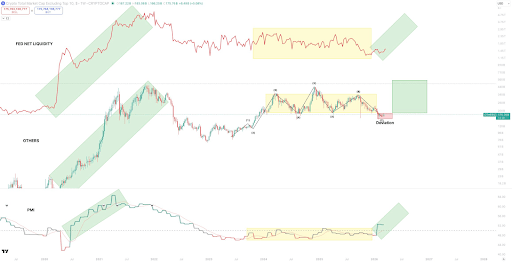
The altcoin market has been a source of deep frustration for investors, failing to experience a sustained breakout despite numerous analyst predictions. According to crypto analyst Sykodelic, this stagnation is not due to the asset class being finished, but because the necessary macro backdrop for altcoin expansion never materialized. Altcoins are highly dependent on excess liquidity, performing best when money is loose, economic activity is strong, and investors are willing to move beyond Bitcoin. Sykodelic's analysis compares the OTHERS index (tracking cryptocurrencies outside the top ten) with two macro indicators: Federal Reserve Net Liquidity and the Purchasing Managers’ Index (PMI). Historically, these three have moved in tandem. During the 2020/2021 cycle, all rose together, with the OTHERS index surging from below $100 billion to nearly $600 billion. However, in the current cycle, Fed Net Liquidity has oscillated without a clear trend, and the PMI spent 26 consecutive months in contraction until returning to expansion in January 2026. Consequently, the OTHERS index has chopped sideways. Now, conditions may be improving. Fed net liquidity appears to have bottomed and reversed upward, while the PMI has moved into expansion territory (registering 52.6% in January 2026). These changes could finally build the foundation for an altcoin season, with Sykodelic’s chart projecting a potential rise in the OTHERS index market cap to the $560 billion range.

The altcoin market has become a source of deep frustration for crypto investors during this cycle. Despite numerous forecasts from analysts, a clear and sustained altcoin phase has yet to appear in recent months.

This has led to growing frustration as traders wait for a broad breakout among altcoins. But according to crypto analyst Sykodelic, that frustration misses the bigger picture. Altcoins have not failed because the asset class is finished. They have failed to move because the macro backdrop that normally leads to major altcoin expansions never arrived.

Altcoins Are Stuck In A Liquidity Desert

Altcoins are the part of the crypto market most dependent on excess liquidity. They tend to perform best when money is loose, economic activity is improving, and crypto participants are willing to move further out of Bitcoin and invest in other cryptocurrencies. That environment, according to Sykodelic, has never truly shown up in force this cycle.

The chart Sykodelic shared places the OTHERS index, which tracks the total market capitalization of cryptocurrencies outside the top ten, alongside two macro indicators: the Federal Reserve Net Liquidity and the Purchasing Managers’ Index (PMI). The interesting thing is that those three have always moved in the same direction.
Source: Chart from Sykodelic on X

During the 2020/2021 cycle, for example, all three moved in the same direction. The Fed Net Liquidity rose very fast, PMI was in expansion, and the OTHERS index increased from a market cap below $100 billion to almost $600 billion.

The current cycle has told a different story. Fed Net Liquidity spent the better part of two years in a prolonged ranging pattern and oscillating without a clear directional trend. The PMI, meanwhile, spent most of that stretch in contraction, registering below 50 for 26 consecutive months before returning to expansion in January 2026. The OTHERS index, reflecting these conditions faithfully, has chopped sideways without the rally needed for an altcoin season.

The Setup For An AltSeason May Finally Be Forming

Once the diagnosis is established, the next step is what could come next for the possibility of an altcoin season. Interestingly, Sykodelic’s analysis also looks at what may be changing now for the altcoin market. According to the analyst, the correct environment is being built for the alt expansion.

His chart suggests Fed net liquidity has bottomed and started to reverse upward, while PMI has moved back above contraction territory and into expansion. For instance, the ISM Manufacturing PMI registered 52.6% in January 2026, which is a 4.7-percentage-point jump from December’s reading of 47.9%. The PMI fell to 52.4 in February 2026 from 52.6 in January but remained above market expectations of 51.8.

Those two changes, taken together, could begin building the exact background that altcoins were missing. The green projection box to the right of the current price, as drawn on the chart above, targets a move back to the $560 billion range for the OTHERS index market cap.

Overall crypto market at $1.01 trillion on the 1D chart | Source: TOTAL2 on Tradingview.com

İlgili Sorular

QAccording to the article, why has the altcoin market failed to see a sustained breakout in recent months?

AThe altcoin market has failed to move because the macro backdrop that normally leads to major altcoin expansions, namely excess liquidity and economic expansion, never arrived this cycle.

QWhat two key macro indicators does analyst Sykodelic correlate with the performance of the altcoin market?

AThe two key macro indicators are the Federal Reserve Net Liquidity and the Purchasing Managers’ Index (PMI).

QWhat was the primary reason given for why altcoins are particularly sensitive to these macro conditions?

AAltcoins are the part of the crypto market most dependent on excess liquidity, performing best when money is loose, economic activity is improving, and investors are willing to take risks beyond Bitcoin.

QWhat recent changes in the macro indicators suggest a potential setup for an altcoin season is forming?

AFed net liquidity has bottomed and started to reverse upward, while the PMI has moved back above 50 into expansion territory, as seen in January and February 2026.

QWhat is the projected price target for the OTHERS index market cap, as indicated by the green box on the analyst's chart?

AThe projection targets a move back to the $560 billion range for the OTHERS index market cap.

İlgili Okumalar

Within Strategy's Framework, STRC's Dividend Yield Remains at 12% as Share Price Stays Below Par Value

Michael Saylor, Executive Chairman of Strategy (MSTR), confirmed that the dividend rate for its STRC perpetual preferred shares will remain at 12.00% through August 2026. The rate has increased from 9% at its July 2025 launch to the current high via a "ratchet" mechanism, which permanently raises the rate by 0.5% whenever the share price falls below $95. This mechanism is intended to push the price back toward its $100 par value and support Strategy's "at-the-market" (ATM) program for issuing new shares to fund Bitcoin purchases. However, the mechanism has not worked as intended. STRC shares closed at $89.46 on July 31, remaining about 10-11% below par value despite the record-high dividend. Competition from rival Strive's higher-yielding SATA securities has pressured demand. The persistent discount has forced Strategy to suspend new STRC issuances via its ATM program, limiting this funding channel for Bitcoin acquisitions. STRC's struggles reflect Bitcoin's own volatility, as the preferred shares historically move in tandem. Analysts have warned the ratchet structure carries long-term, one-way risk. A law firm is investigating Strategy's ability to maintain dividend payments if Bitcoin's price stays low. Retail investors own roughly 83% of outstanding STRC shares, a group seen as prone to panic selling during downturns. In response, Strategy has established financial reserves, including a liquidity cushion covering about 26 months of dividend/interest obligations, and a $2 billion share buyback program alongside a Bitcoin monetization framework, though the company emphasized it is not obligated to sell any Bitcoin.

cryptonews.ru28 dk önce

Within Strategy's Framework, STRC's Dividend Yield Remains at 12% as Share Price Stays Below Par Value

cryptonews.ru28 dk önce

Analyst: Bitcoin's Price Will Drop to $60k in August, Then Rebound to $70k

Financial analyst Andrey Poroshin has provided a new forecast for Bitcoin's price dynamics in August. Poroshin, an analyst at the Bitbanker exchange, expects the cryptocurrency market to experience a downturn this month, with prices retesting the $60,000 level due to a lack of supportive macroeconomic catalysts. He noted that the recent US Federal Reserve decision to hold interest rates did not significantly impact the market, while inflation remains above the 2% target. Poroshin stated that Bitcoin is ending July under pressure from moderate volatility and a lack of new macroeconomic stimuli, leading to continued market caution. According to his base scenario, Bitcoin will drop to a range of $60,000 to $62,000 before recovering to $70,000. He pointed out that even $70,000 remains below the cost of mining in the US, which has prompted some miners to shift towards AI data center operations. Poroshin cited the winding down of BitMEX's operations as a potential catalyst for a price rebound, suggesting the exit of weaker players often coincides with market reversals and reduced short-term selling pressure. He believes Bitcoin is currently less susceptible to geopolitical shocks, such as the Iran-US conflict, and does not expect significant market changes in August related to the pending CLARITY Act. Looking ahead, Poroshin forecasts that September will bring more active price fluctuations driven by potential Fed rate decisions and possible discussions or approval of the CLARITY Act.

cryptonews.ru28 dk önce

Analyst: Bitcoin's Price Will Drop to $60k in August, Then Rebound to $70k

cryptonews.ru28 dk önce

İşlemler

Spot
活动图片




