Is Quantum Computing A Threat To Bitcoin? ARK Invest Breaks It Down

bitcoinist2026-03-12 tarihinde yayınlandı2026-03-12 tarihinde güncellendi

Özet

ARK Invest and Unchained's research paper examines the potential threat quantum computing poses to Bitcoin's cryptography. The authors conclude it is a legitimate long-term concern but not an imminent threat. Current quantum systems are in the "NISQ era" with limited qubits and high error rates, far from the estimated requirement of at least 2,330 logical qubits to break Bitcoin's encryption. The report describes quantum development as a gradual progression, not a sudden event, providing ample warning and time for the market and network to adapt. It estimates that roughly 35% of Bitcoin's supply could theoretically be exposed, but many of these coins are either lost or can be migrated to safer address formats. The paper highlights that meaningful quantum breakthroughs would disrupt broader internet security first, triggering a coordinated response. While the technical risk is distant, it raises future governance challenges, as upgrading Bitcoin's cryptography would require community consensus. The authors frame the issue as a manageable long-term engineering problem rather than an abrupt point of failure.

A new research paper from ARK Invest and Unchained examines one of the most persistent questions in Bitcoin: whether advances in quantum computing could eventually break it’s cryptography.

The authors conclude that while the technology represents a legitimate long-term concern, it does not pose an immediate threat to the network. Published March 11 and authored by Dhruv Bansal, Tom Honzik and David Puell, the report argues that current quantum systems remain far from the capabilities required to compromise Bitcoin’s cryptographic foundations.

Bitcoin Quantum Threat Is Distant, Not Immediate

The paper’s central thesis is straightforward: quantum computing represents a real but gradual risk.

“Our two central arguments are as follows,” the authors write. “Quantum is a long-term risk but not an imminent threat. The community must continue to research and make plans for protecting the network as quantum computers improve.”

They add that even if breakthroughs occur, exploiting them against Bitcoin would be costly and slow. “If quantum computing were to affect Bitcoin’s cryptography, the process would be protracted and undertaken at meaningful cost to the attacker.”

In practical terms, the report notes that today’s machines fall well short of the scale needed to attack the elliptic-curve cryptography used by Bitcoin keys. Current devices operate in what researchers call the “NISQ era,” characterized by limited logical qubits and high error rates.

Breaking Bitcoin’s cryptography would require significantly more advanced systems. “To do so would require at least 2,330 logical qubits and tens of millions to billions of quantum gates,” the authors write, far beyond the roughly hundred-qubit systems typical today.

Rather than a sudden technological shock, the paper outlines a staged progression toward any meaningful threat. The authors describe a series of milestones in quantum development. Early stages involve experimental systems with limited commercial usefulness. Later phases would see applications in fields like chemistry or materials science long before cryptographic attacks become viable.

Only in more advanced stages would quantum computers become capable of breaking elliptic-curve cryptography — and even then the process could take longer than Bitcoin’s roughly 10-minute block interval.
The researchers emphasize that this gradual progression would create numerous warning signals. “In our view, quantum development will be a gradual technological progression—not a sudden ‘Q-day’ event—giving markets and the Bitcoin network time to adapt.”

The implication is that the broader internet security ecosystem would likely face disruption before Bitcoin specifically becomes vulnerable. “Meaningful breakthroughs would disrupt internet security first,” the paper states, “triggering coordinated responses well beyond Bitcoin.”

The report also estimates how much bitcoin could theoretically be vulnerable if large-scale quantum attacks became feasible. According to the analysis, roughly 1.7 million BTC stored in older P2PK address types are considered exposed but likely lost. Another 5.2 million BTC sit in address formats that could be migrated if necessary.

Combined, the authors estimate that roughly 35% of the total outstanding supply could theoretically face quantum exposure in its current form. However, because many of those coins are inactive or capable of being moved to safer address types, the researchers frame the issue as manageable rather than catastrophic.

Governance And Upgrades Remain Open Questions

While the technical threat may be distant, the report highlights governance challenges that could emerge if the ecosystem eventually needs to adopt post-quantum cryptography. Upgrading Bitcoin’s cryptographic primitives would require consensus changes, meaning coordination across developers, miners, node operators, and the broader community.

The authors also raise unresolved questions around coins whose public keys are already exposed on-chain. “There is no consensus about protecting coins that remain vulnerable to quantum,” the report notes, pointing to ongoing debates about whether such coins should be migrated, restricted, or treated as recoverable by quantum attackers.

The researchers ultimately frame the issue as a long-range engineering problem rather than a near-term existential risk. “Quantum risk will evolve over an extended period of time, with many intermediate warning signals and decision points,” the authors conclude. “An abrupt single point of failure is unlikely.”

At press time, Bitcoin traded at $69,496.
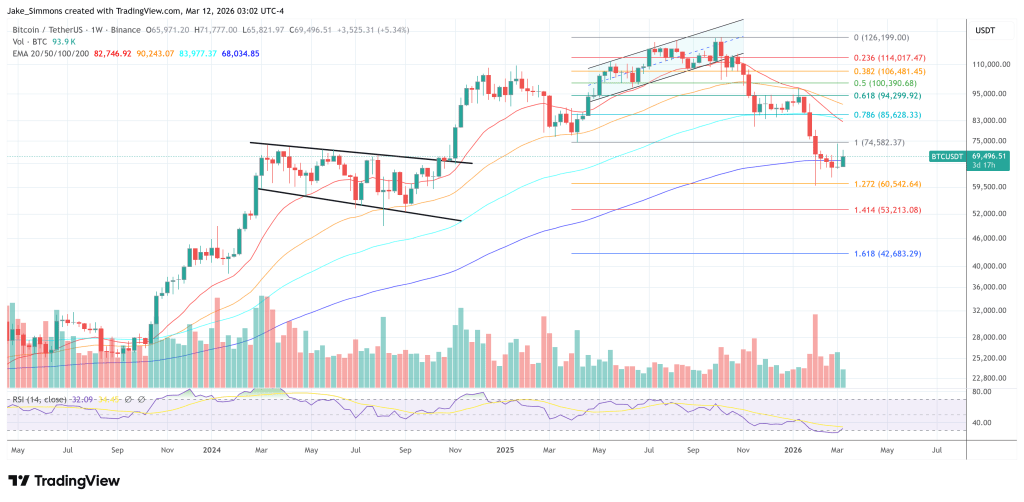
Bitcoin must break above the 1.0 Fib level, 1-week chart | Source: BTCUSDT on TradingView.com

Trend Kriptolar

İlgili Sorular

QWhat is the main conclusion of the ARK Invest and Unchained research paper regarding quantum computing and Bitcoin?

AThe paper concludes that while quantum computing represents a legitimate long-term concern, it does not pose an immediate threat to the Bitcoin network, as current systems are far from the capabilities required to break its cryptography.

QHow many logical qubits would be required to break Bitcoin's elliptic-curve cryptography according to the report?

AThe report states that breaking Bitcoin's cryptography would require at least 2,330 logical qubits, which is beyond the roughly hundred-qubit systems typical today.

QWhat percentage of Bitcoin's total outstanding supply is estimated to be theoretically vulnerable to quantum exposure?

AThe authors estimate that roughly 35% of the total outstanding Bitcoin supply could theoretically face quantum exposure in its current form.

QWhat does the report say about the nature of the quantum threat to Bitcoin? Is it a sudden event or a gradual progression?

AThe report describes the quantum threat as a gradual technological progression, not a sudden 'Q-day' event, which would provide markets and the Bitcoin network time to adapt.

QWhat governance challenge does the report highlight in relation to a potential quantum threat?

AThe report highlights that upgrading Bitcoin's cryptographic primitives to post-quantum cryptography would require consensus changes, meaning coordination across developers, miners, node operators, and the broader community.

İlgili Okumalar

Podcast Notes | Conversation with GSR Asset Management Head: To Determine if This Crypto Rally is Real, Just Watch the Lending Rates on Aave

Podcast Summary: Dialogue with GSR's Head of Asset Management: To Determine if This Crypto Rally is Real, Just Check Lending Rates on Aave Andy Baehr, Managing Director of Asset Management at GSR, discusses the current crypto market, characterizing it as stuck in a state of "ambivalence" with short-lived, unsustainable rallies. He outlines a simple framework: the market moves between "ambivalence" and "conviction" (sustained upward momentum). Currently, every rally resembles a single-stage rocket booster that quickly fizzles out. Baehr identifies three key signals to watch: 1) DeFi lending rates, 2) the potential passage of the CLARITY Act, and 3) the market forming a consensus on the "Fed hawkish peak." He emphasizes that the most immediate indicator for the sustainability of the recent CPI-triggered rally is the USDC borrowing rate on Aave, currently around 3.75%—close to U.S. Treasury yields. The absence of a credit spread indicates low leverage demand and a lack of market energy. He explains that a healthy, sustained rally requires layered buying pressure. Last year's rally progressed from an ETH short squeeze to crypto-native trader influx and finally to ETF inflows. Currently, this structure is missing. Other potential structural buyers like Digital Asset Treasury (DAT) companies are absent, and ETF flows have proven transient. Baehr notes that while small-cap crypto tokens outperformed large caps in Q2—a potential sign of capitation in major assets—capital is also flowing to more exciting opportunities like AI stocks and tech IPOs, leaving crypto sidelined. Regarding DeFi, he highlights that platforms like Aave provide a clear, real-time signal of leverage demand through their supply/demand-driven interest rates. A significant, sustained rate increase would signal genuine market conviction. He also observes the quiet emergence of fixed-income-like products and vaults in DeFi. On regulation, the probability of the CLARITY Act passing before the August 7th deadline has dropped linearly from 75% to below 40% on Polymarket. Baehr suggests its passage would be treated as a bullish surprise, a potent driver for price movement. However, political hurdles, including ethical clause debates and disclosures about the First Family's crypto profits, remain significant obstacles. Ultimately, the market awaits clarity on the Fed's terminal rate under Chair Warsh. Until the "Fed Solstice"—the point where the market collectively understands the peak of hawkish policy—sustained conviction will be difficult to achieve.

marsbit32 dk önce

Podcast Notes | Conversation with GSR Asset Management Head: To Determine if This Crypto Rally is Real, Just Watch the Lending Rates on Aave

marsbit32 dk önce

7 Months After the Collapse of Huiwang, Southeast Asia's Escrow Platforms Undergo a Major Reshuffle

Following the collapse of Huione Pay—dubbed the "Alipay of Southeast Asia"—seven months ago, the region's underground financial guarantee platform sector is undergoing a significant reshuffle. This power vacuum has been swiftly filled by emerging platforms such as XinBi, Tiger/Navigator, JinBei (renamed JinBo), Dali/Tiancheng, and FullyLight. These platforms, operating largely via Telegram and offering services like escrow for illicit transactions, have absorbed the vast user base and markets left behind by Huione. While positioning themselves as "trust intermediaries," their primary clientele consists of networks involved in online scams, money laundering, illegal gambling, and even human trafficking. For instance, the Tiger/Navigator platform explicitly provides "escrow" services for kidnapping-for-ransom operations ("强押车交易"). Data underscores the immense scale: Huione alone processed over $103 billion in cryptocurrency payments and facilitated over $31 billion through its escrow market before its downfall, linking it to Cambodia's notorious Prince Group. Since its collapse, competitors have seen explosive growth. For example, the XinBi platform has accumulated over $1.6 billion in total USDT revenue, while platforms like NewPay, OkPay (under Dali), and FullyLight Wallet collectively processed over $4.8 billion in USDT in a single year. This ecosystem thrives in regions like Cambodia and Myanmar, where regulatory gaps allow these platforms to act as critical financial infrastructure for sprawling cybercrime industries, from scam compounds to online casinos. The article concludes that the moniker "Southeast Asian Alipay" is a misnomer, obscuring the platforms' fundamental role in enabling serious criminal enterprises rather than representing legitimate financial innovation.

Odaily星球日报1 saat önce

7 Months After the Collapse of Huiwang, Southeast Asia's Escrow Platforms Undergo a Major Reshuffle

Odaily星球日报1 saat önce

İşlemler

Spot

Popüler Makaleler

ONE Nasıl Satın Alınır

HTX.com’a hoş geldiniz! Harmony (ONE) satın alma işlemlerini basit ve kullanışlı bir hâle getirdik. Adım adım açıkladığımız rehberimizi takip ederek kripto yolculuğunuza başlayın. 1. Adım: HTX Hesabınızı OluşturunHTX'te ücretsiz bir hesap açmak için e-posta adresinizi veya telefon numaranızı kullanın. Sorunsuzca kaydolun ve tüm özelliklerin kilidini açın. Hesabımı Aç2. Adım: Kripto Satın Al Bölümüne Gidin ve Ödeme Yönteminizi SeçinKredi/Banka Kartı: Visa veya Mastercard'ınızı kullanarak anında Harmony (ONE) satın alın.Bakiye: Sorunsuz bir şekilde işlem yapmak için HTX hesap bakiyenizdeki fonları kullanın.Üçüncü Taraflar: Kullanımı kolaylaştırmak için Google Pay ve Apple Pay gibi popüler ödeme yöntemlerini ekledik.P2P: HTX'teki diğer kullanıcılarla doğrudan işlem yapın.Borsa Dışı (OTC): Yatırımcılar için kişiye özel hizmetler ve rekabetçi döviz kurları sunuyoruz.3. Adım: Harmony (ONE) Varlıklarınızı SaklayınHarmony (ONE) satın aldıktan sonra HTX hesabınızda saklayın. Alternatif olarak, blok zinciri transferi yoluyla başka bir yere gönderebilir veya diğer kripto para birimlerini takas etmek için kullanabilirsiniz.4. Adım: Harmony (ONE) Varlıklarınızla İşlem YapınHTX'in spot piyasasında Harmony (ONE) ile kolayca işlemler yapın.Hesabınıza erişin, işlem çiftinizi seçin, işlemlerinizi gerçekleştirin ve gerçek zamanlı olarak izleyin. Hem yeni başlayanlar hem de deneyimli yatırımcılar için kullanıcı dostu bir deneyim sunuyoruz.

558 Toplam GörüntülenmeYayınlanma 2024.12.12Güncellenme 2026.06.02

ONE Nasıl Satın Alınır

Tartışmalar

HTX Topluluğuna hoş geldiniz. Burada, en son platform gelişmeleri hakkında bilgi sahibi olabilir ve profesyonel piyasa görüşlerine erişebilirsiniz. Kullanıcıların ONE (ONE) fiyatı hakkındaki görüşleri aşağıda sunulmaktadır.

活动图片













