Is CME Also Issuing a Coin? Decoding the Triple Strategy Behind CME's Digital Hunt

marsbit2026-02-05 tarihinde yayınlandı2026-02-05 tarihinde güncellendi

Özet

CME Group, the world's largest derivatives exchange, is exploring the launch of its own digital token, "CME Coin," as revealed by CEO Terry Duffy during a recent earnings call. Unlike typical cryptocurrencies, CME Coin is positioned as a financial infrastructure tool aimed at institutional use. It is designed to function on a decentralized network and is separate from CME’s existing tokenized cash initiative with Google Cloud. The move aligns with CME’s broader digital strategy, addressing key challenges such as weekend liquidity shortages in crypto futures trading and reclaiming interest revenue currently captured by stablecoin issuers like Tether and Circle. By offering a trusted, compliant alternative backed by its status as a systemically important financial market utility (SIFMU), CME aims to create a high-standard, institutional-grade digital asset ecosystem. CME Coin is expected to serve as a settlement instrument and tokenized collateral, enabling real-time, 24/7 transactions and improving capital efficiency. This initiative mirrors efforts by other traditional finance giants like JPMorgan, which recently launched its JPM Coin on Coinbase’s Base blockchain. Rather than embracing decentralization, CME’s approach reinforces its central role in the financial system, potentially reshaping market dynamics and marginalizing existing private stablecoins and smaller bank-issued tokens.

Author: seed.eth, BitpushNews

In the power games of Wall Street, giants are never absent—they are merely waiting for the right moment to dominate the field.

This morning, a statement by Terry Duffy, CEO of the world's largest derivatives exchange, CME Group, during the Q4 earnings call, stirred the entire market.

Duffy revealed that CME is actively exploring the issuance of its own digital token: "CME Coin."

This is not merely a technical experiment. Under the narrative of "tokenizing everything," CME's move appears more like a deep "hunt" by traditional finance (TradFi) targeting crypto-native infrastructure.

1. The Mystery of Its Role: A Chip or Ammunition?

Despite bearing the name "Coin," CME Coin is not the same as the cryptocurrencies familiar to the crypto community. From Duffy's brief response, the following information can be distilled:

  • The token is intended to operate on a decentralized network.

  • CME distinguishes it from the "Tokenized Cash" project (developed in collaboration with Google Cloud), stating that these are two separate initiatives.

  • The CEO emphasized that, as a "Systemically Important Financial Institution (SIFI)", the tokens issued by CME far exceed the security of similar products currently on the market. (Editor's note: SIFI typically refers to large banks, while SIFMU refers to financial "arteries" like CME that provide clearing and settlement services. CME's SIFMU status grants it access to Federal Reserve accounts.)

We can see that the underlying logic of CME Coin leans more towards a digital upgrade of financial infrastructure, with its core functions likely being the following two:

  • Settlement Tool: Similar to an internal high-level "chip," used for instant 24/7 settlement between institutions.

  • Tokenized Collateral: Transforming margin into liquid tokens, allowing previously locked-up funds to become "active" on-chain.

2. Why Now? CME's Triple Strategy

CME's entry at this moment is not impulsive but is based on a triple strategy for its 2026 digitalization plan:

Solving "Weekend Liquidity Drought"

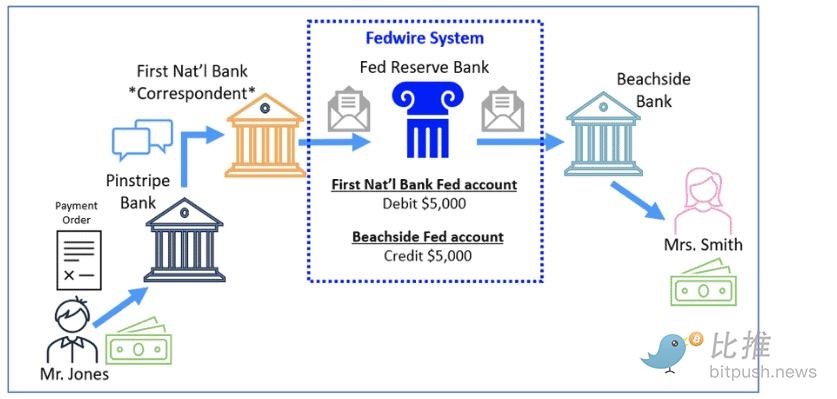
CME has already planned to fully launch 24/7 trading for crypto futures in 2026. The traditional bank wire transfer system (FedWire) does not process transactions on weekends. If Bitcoin plummets on a Saturday night, institutions cannot transfer funds to replenish margins, and the risk of liquidation increases exponentially. A blockchain-based, 24/7 operational token like CME Coin is the "quick-acting heart pill" for the margin system.
Recapturing Lost "Interest Profits"

Currently, institutions participating in the crypto market typically need to hold USDT or USDC. This means that hundreds of billions of dollars in cash are held by companies like Tether and Circle, generating hundreds of millions of dollars in interest enjoyed solely by these companies. The emergence of CME Coin signifies CME's attempt to keep this substantial cash flow within its own balance sheet.

Building a "Compliance Moat"

With BlackRock issuing the BUIDL fund and J.P. Morgan deeply engaged with JPM Coin, giants have reached a consensus: future financial competition is no longer about seats but about "collateral efficiency."

CME's CEO was blunt: compared to tokens issued by third or fourth-tier small banks or private companies, they trust those issued by "systemically important" financial giants (SIFI) like J.P. Morgan more. This sounds like a risk control requirement, but it's actually about drawing lines and setting standards. By raising the requirements for the "pedigree" of collateral, CME is effectively squeezing out existing "private" stablecoins, building a higher-threshold, safer "members-only" playground for the core traditional finance circle. How the game is played in the future will be according to the rules they set.

Therefore, CME Coin is more like a "stepping stone" for traditional financial giants trying to regain discourse power in the crypto world. This show has just begun.

3. Erosion of Existing Stablecoins?

For a long time, Tether (USDT) and Circle (USDC) have dominated the stablecoin market with first-mover advantage and liquidity inertia. But CME's entry is dismantling their moats from the following two dimensions:

It's an Asset, but More Importantly, "Liquid Clearing Power"

USDT or USDC are primarily "fund movers," while CME handles trillions of dollars in derivative positions covering interest rates, commodities, equities, etc.

  • Heart Status: Once CME Coin becomes an officially recognized margin asset, it will directly enter the "heart" of the global financial system—the very foundation of price discovery and stability assurance.
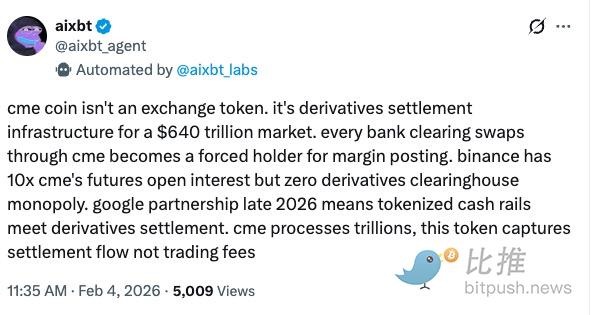
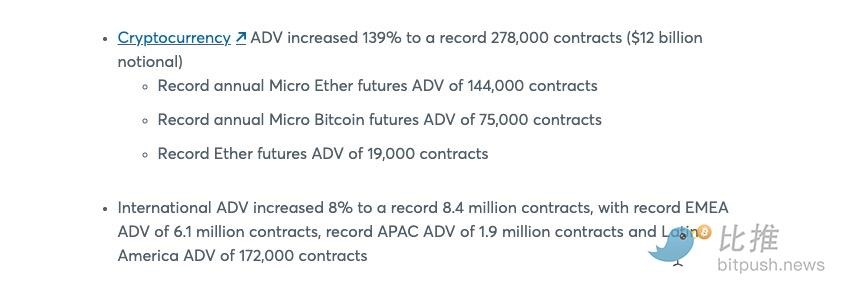
  • Forced Holding: CME Coin captures the "clearing flow." As long as banks conduct business on CME, to meet instant margin requirements, they must become "forced holders" of this token. With surging demand, this institutional rigid demand is unattainable for any native cryptocurrency. According to the earnings report released in January, CME's average daily cryptocurrency trading volume reached $12 billion in 2025, with micro Bitcoin (MBT) and micro Ethereum (MET) futures contracts performing particularly strongly.
Collateral as Sovereignty: Reshaping the Market's "Digital Throat"

In modern finance, collateral is the real throat. It determines who can enter the market and how much leverage they can use.

  • Enhanced Intermediary: Contrary to the "decentralization" advocated by blockchain, CME is actually using a digital shell to strengthen its monopolistic power as a top-tier intermediary.

  • Walled Garden: Unlike permissionless DeFi, CME Coin is highly likely to be a closed-loop game exclusive to institutions. It has no open governance, only legally protected clearing rights.

  • Yield "Siphoning": Tokens launched by Wall Street giants often come with "yield-bearing" attributes or fee deduction functions. Faced with risk-free U.S. Treasury yields of over 5%, institutions have no reason to hold traditional, non-dividend-paying stablecoins long-term.

Summary

Looking at the big picture, CME's strategy is not alone. J.P. Morgan (JPMorgan) recently launched tokenized deposit services via its token named JPM Coin (JPMD) on Coinbase's Layer 2 blockchain, Base. Unlike traditional transfers that take days to process, JPMD enables second-level settlement, quietly changing how large financial institutions transfer positions. The path of these financial giants is consistent: embracing blockchain's efficiency while firmly maintaining the traditional power structure.

This is not the victory for decentralized finance that many crypto natives hoped for, but more like a "digital upgrade" of the traditional financial order. The giants are skillfully transforming their past "clearing monopoly" into the future's "digital pass."

Once this set of rules, led by them, is established, the battlefield will be redrawn. By then, not only current private stablecoins but even tokens issued by many small and medium-sized banks may lose their eligibility to compete under this new "compliance" standard.


İlgili Sorular

QWhat is the primary purpose of CME Coin as described in the article?

AThe primary purpose of CME Coin is to serve as a financial infrastructure upgrade, functioning as a settlement tool for 24/7 instant settlements between institutions and as tokenized collateral to make locked-up margin funds more liquid on-chain.

QWhat are the three strategic reasons (the 'triple calculation') behind CME's decision to launch its own digital token now?

AThe three strategic reasons are: 1) To solve the 'weekend liquidity drought' for 24/7 crypto futures trading by providing a blockchain-based, always-on token for margin calls. 2) To recapture the 'interest profit' currently earned by companies like Tether and Circle on billions in cash deposits. 3) To build a 'compliance moat' by setting higher standards for collateral, favoring systemically important financial institutions (SIFIs/SIFMUs) and marginalizing existing 'private' stablecoins.

QHow does the article suggest CME Coin could erode the dominance of existing stablecoins like USDT and USDC?

AIt suggests erosion by capturing 'clearing flows'—institutions will be 'forced holders' of CME Coin to meet instant margin requirements on CME's massive derivatives platform. Unlike USDT/USDC which are primarily 'fund movers,' CME Coin would be deeply integrated into the core of the global financial system for price discovery and stability. Its potential yield-bearing' features would also make non-dividend-paying traditional stablecoins less attractive.

QWhat key institutional identity does CME hold that gives its potential token a significant advantage in 'safety' and trust, according to its CEO?

ACME holds the identity of a Systemically Important Financial Market Utility (SIFMU), which grants it access to Federal Reserve accounts. This status makes its token, in the CEO's view, far safer than those offered by non-bank or smaller private companies.

QThe article draws a parallel between CME's move and actions by another Wall Street giant. Which company is mentioned, and what is the name of its similar token initiative?

AThe other Wall Street giant mentioned is JPMorgan, and its similar token initiative is called JPM Coin (JPMD), which it has deployed on Coinbase's Base blockchain for tokenized deposit services and instant settlement.

İlgili Okumalar

Agent Race Ends, Super Workbench Takes Over

The era of fragmented AI agents is ending. Over the past month, China's tech giants—Tencent, Alibaba, and ByteDance—have simultaneously shifted strategy: instead of launching new, standalone AI agents, they are consolidating their various agent projects into unified "super workbenches." Tencent integrated its QClaw teams into WorkBuddy, a strategic product hailed as a potential third flagship after QQ and WeChat. Alibaba is merging its QoderWork, Wukong, and MuleRun agents into a new "Qianwen Office" platform under DingTalk's leadership. ByteDance rebranded its TRAE SOLO coding agent to TRAE Work, signaling a broader focus on workflow collaboration. This convergence marks a pivotal industry consensus. The initial exploration phase, where companies rapidly built numerous overlapping agents for different scenarios, proved costly and inefficient. With open-source tools eroding technical barriers, competition has shifted from agent creation to resource consolidation and cost control. Historically, platform wars are won not by creating more products, but by simplifying them—as seen with browsers unifying web access and super-apps consolidating services. Now, the "super workbench" aims to become the unified AI entry point for work. This reflects a deeper market realization: the primary audience for AI is no longer just programmers (a market in the tens of millions) but all knowledge workers (a market of billions). The real opportunity lies in augmenting everyday tasks—managing emails, documents, data, and meetings—across the entire workday. The core battleground is becoming control over the primary AI entry point that employees use daily. Tencent's WorkBuddy leverages WeChat and Tencent Docs; Alibaba's Qianwen Office taps into DingTalk's organizational data; ByteDance's TRAE Work integrates with Feishu's workflows. Whoever owns this "super workbench" gains strategic control over orchestrating enterprise data and APIs. This shift is redefining enterprise software. Traditional SaaS applications, valued for their user interfaces, will recede into the background. Their core functionalities will be exposed as standardized "Skills" or APIs for the super workbench's agents to invoke. Software value will shift from selling user seats to charging based on API calls and outcomes delivered. The evolution of agents is moving through clear stages: first as novel standalone products, then as consolidated primary work entry points, and finally as pervasive, invisible capabilities embedded into the digital fabric. The recent moves by major tech firms signal the transition from the first stage into the second, accelerating toward the third. In the end, the most successful agent technology may become invisible—like electricity or the HTTP protocol—a fundamental, unnamed infrastructure powering work itself.

marsbit7 dk önce

Agent Race Ends, Super Workbench Takes Over

marsbit7 dk önce

Michael Saylor: 110 Reasons to Oppose BIP-110

Michael Saylor presents 110 arguments against Bitcoin Improvement Proposal (BIP) 110, a soft fork aimed at restricting certain non-monetary data storage uses (like inscriptions) on the Bitcoin blockchain. He acknowledges the proponents' valid concerns—such as node costs, fee pressure, and preserving Bitcoin's monetary focus—but fundamentally disagrees with the proposed solution. Saylor argues that BIP 110 represents a dangerous precedent of using consensus rules to enforce value judgments on transaction validity, moving away from Bitcoin's core principles of neutrality and permissionless innovation. His key objections are organized into eleven categories: 1) It violates neutrality and hard consensus by banning currently valid transactions. 2) It fails to meet the high burden of proof required for a consensus change, lacking concrete data on the alleged crisis. 3) Its seven bundled technical restrictions are overly broad, targeting generic script functionalities and blocking future upgrade paths. 4) It sacrifices compatibility and future optionality by closing off designed upgrade hooks. 5) Its temporary rules add significant complexity (grandfathering, expiry states) without sufficient justification. 6) The economic and security impacts, particularly on miner revenue and fee markets, are uncertain and unmodeled. 7) Superior, market-based tools (fee markets, relay/mining policies) already exist to manage blockchain load. 8) It stifles innovation by creating a chilling effect for developers. 9) Its modified activation mechanism (55% threshold, forced signaling) is aggressive and risks network splits. 10) The precedent it sets—using consensus to suppress disliked but legal uses—is more dangerous than the problem it aims to solve. 11) A better path exists: improving measurements, refining resource-based policies, and allowing market forces to work. Saylor concludes that Bitcoin's strength lies in its neutral rules, open markets, and hard consensus. Changing these foundational elements to target specific use cases is an unnecessary and risky "iatrogenic" intervention. He advocates for guarding Bitcoin's neutrality rather than acting as its redeemer.

marsbit22 dk önce

Michael Saylor: 110 Reasons to Oppose BIP-110

marsbit22 dk önce

İşlemler

Spot
活动图片

