Is Chainlink Ready to Reverse Its Downtrend?

TheNewsCrypto2026-02-26 tarihinde yayınlandı2026-02-26 tarihinde güncellendi

Özet

Chainlink (LINK) is trading around $9.24, showing modest gains amid a broader cryptocurrency market rise. It remains above a key monthly support level between $7 and $7.3, which has historically attracted accumulation. However, LINK continues to trade below its 50-day ($10.63) and 200-day ($16.21) moving averages, both of which are declining, indicating sustained downward pressure. Technical indicators like the RSI (near 49) and MACD show neutral to weak momentum, with no strong bullish signals yet. The price is consolidating within a range, with near-term support at $8.20–$8.80 and resistance at $10.00. Overall, LINK appears to be in a phase of short-term consolidation without a decisive trend.

As the cryptocurrency market rose today, supported by a strong short squeeze and resumed institutional inflows, Chainlink (LINK) has shown modest upside, trading around $9.24, with a daily low of $9.08 and a high of $9.54.

While short-term volatility continues to draw attention, LINK remains positioned above a key monthly low between $7 and $7.3. Strong accumulation and buying interest have historically been seen in this area on longer timeframes. It now represents an important structural level, separating broader downside risk from the potential for a sustained recovery if maintained.

Major altcoins followed Bitcoin’s move, posting notable gains as overall market sentiment shifted away from extreme fear levels. At the time of writing, LINK is priced at $9.25 with a market cap of $6.5 billion. Still, the token’s price action continues to reflect consolidation below key moving averages.

On the daily timeframe, Chainlink remains below its 50-day MA near $10.63 and the 200-day MA around $16.21, with the bearish crossover structure still intact. Both moving averages are sloping downwards, a pattern typically associated with sustained downward pressure. The 50-day MA is currently acting as near-term resistance.
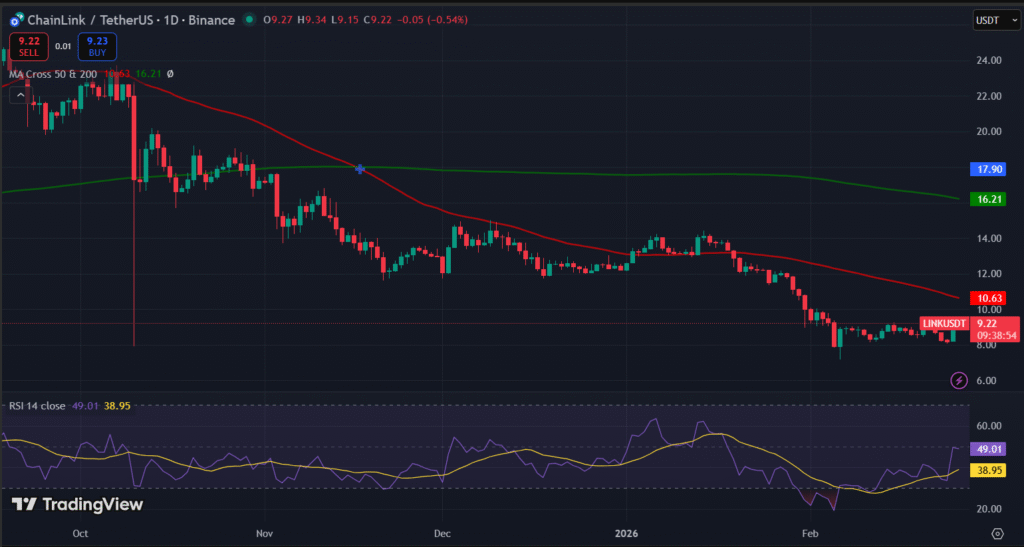
The RSI on the daily chart is near neutral at roughly 49, having rebounded from oversold territory earlier. This indicates that recent selling pressure has eased, but that bullish momentum has not yet strengthened meaningfully.

Zooming in, the MACD indicator remains close to the zero line, with no confirmed bullish crossover. This suggests limited directional momentum in either direction at present.
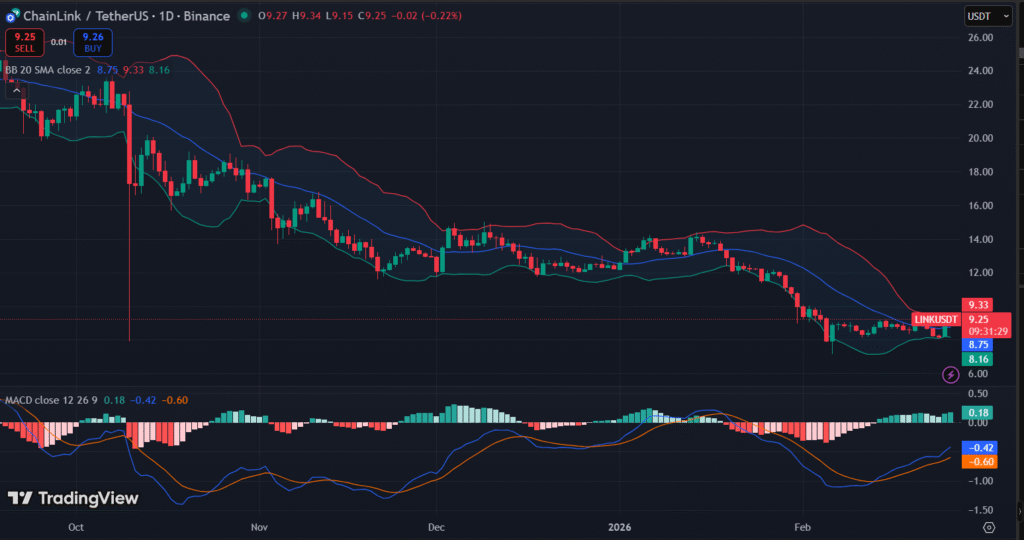
Meanwhile, Bollinger Bands are moderately wide, and the price is trading nearer to the lower band, reflecting recent consolidation and volatility contraction. Price hugging the lower band typically suggests the market is range-bound, rather than signaling a breakout.

If LINK continues the seesaw movement, the immediate support levels are found near the $8.80–$8.20 range, with additional support below these levels if selling pressure intensifies. If momentum picks up further, near-term resistance lies at $10.00, with the 50-day MA serving as a key technical barrier. Overall, Chainlink’s price action suggests continued consolidation in the short term.


TagsAltcoinChainlinkCrypto MarketLINK

İlgili Sorular

QWhat is the current price of Chainlink (LINK) and its key daily trading range as mentioned in the article?

AChainlink is trading around $9.24, with a daily low of $9.08 and a high of $9.54.

QAccording to the technical analysis, what are the moving averages acting as resistance for LINK?

AThe 50-day moving average near $10.63 and the 200-day moving average around $16.21 are acting as resistance, with the 50-day MA serving as near-term resistance.

QWhat does the RSI level of approximately 49 indicate about LINK's momentum?

AAn RSI near 49 indicates that recent selling pressure has eased, but bullish momentum has not yet strengthened meaningfully, placing it in a neutral territory.

QWhat key support level does the article identify for LINK if selling pressure increases?

AThe immediate support levels are found near the $8.80–$8.20 range, with additional support below these levels if selling pressure intensifies.

QWhat overall market condition contributed to the rise in major altcoins including Chainlink?

AMajor altcoins rose due to a strong short squeeze and resumed institutional inflows, which shifted overall market sentiment away from extreme fear levels.

İlgili Okumalar

From Theory to Countdown: Google Sounds the Blockchain Quantum Resistance Alarm with Zero-Knowledge Proofs

An article discusses the significant threat quantum computing poses to blockchain and classical encryption systems, triggered by Google's recent research. By optimizing Shor's algorithm, Google reduced the logical qubits required to break 256-bit elliptic curve encryption from around 6,000 to just 1,200—slashing computational costs by 20 times. This advancement sets a potential countdown, with Google estimating 2029 as the deadline for upgrading to quantum-resistant cryptography. Both Bitcoin and Ethereum face severe risks. About 25-35% of Bitcoin addresses have exposed public keys, making them vulnerable to attacks, especially during transaction processing. Ethereum’s design exposes public keys upon first use, jeopardizing its entire network if signatures aren’t updated. Historical blockchain data remains permanently available for future quantum attacks. The solution lies in adopting post-quantum cryptography (PQC). Ethereum is already implementing account abstraction and PQC-based signatures, leveraging its upgradeable architecture. Bitcoin is considering BIP-360 to introduce quantum-resistant algorithms like FALCON or CRYSTALS-Dilithium, though consensus may delay action. Notably, Google used zero-knowledge proofs to disclose this threat responsibly, aiming to prevent panic. Collaboration with Ethereum Foundation researchers suggests抗量子 (quantum resistance) could become a major narrative, aligning with crypto’s cryptographic roots.

marsbit19 dk önce

From Theory to Countdown: Google Sounds the Blockchain Quantum Resistance Alarm with Zero-Knowledge Proofs

marsbit19 dk önce

How is the 'Bottom Structure' of a Bear Market Formed, and Where Are We Now?

This article analyzes the formation of Bitcoin's bear market "bottom structure" by examining the relationship between cost basis and price action, particularly the behavior of short-term holders (STH). Historically, the cost basis of coins held for 1-3 months (1-3m_RP) has acted as a key resistance level during bear market rallies. This group's supply is often less committed; many entered the market expecting quick gains but were trapped. When the price rebounds to their break-even point, they tend to sell, creating resistance. Data shows that as of mid-April, the 1-3m_RP is approximately $75,400, a level Bitcoin is currently testing for the second time this cycle. The first test in mid-January failed, leading to a pullback. The author suggests a high probability of a similar outcome this time, as historical cycles show the second test rarely results in an immediate reversal. An alternative, less likely scenario is a break above this level, only to face stronger resistance at the broader STH-RP (average cost basis for all short-term holders) near $81,000, where a much larger supply of 2.31 million BTC resides. This could lead to price consolidation around the 1-3m_RP. A definitive bottom structure is confirmed only when the 1-3m_RP trend reverses from down to up, signaling a transition from a bear to a bull market. This process takes time, requiring patience to observe whether breakouts are genuine.

marsbit1 saat önce

How is the 'Bottom Structure' of a Bear Market Formed, and Where Are We Now?

marsbit1 saat önce

İşlemler

Spot
Futures
活动图片