Is Bitcoin’s Reset Complete? BTC Steadies Above $70K as Markets Debate the Next Move

bitcoinist2026-02-10 tarihinde yayınlandı2026-02-10 tarihinde güncellendi

Özet

After a sharp decline to $60,000, Bitcoin has stabilized above $70,000, though the recovery remains fragile. On-chain data shows significant deleveraging, with a major whale selling over $340 million in BTC and reducing holdings from $11 billion to $2.2 billion. Open interest also fell sharply, indicating reduced market leverage and momentum. While some view the sell-off as a healthy reset, others caution it may be a bull trap. Key support is at $60,000, with resistance near $73,000–$75,000. Broader factors like equity market rebounds and ETF inflows provide some stability, but the market awaits clearer signals from macro conditions and institutional conviction.

After one of its sharpest swings in over a year, Bitcoin (BTC) is attempting to find balance. Prices have stabilized above $70,000 following a rapid drop to $60,000 last week, but the calm has done little to settle the broader debate; is this a completed reset, or just a pause before another move lower?

The recent volatility has flushed out leverage, forced large players to cut risk, and shifted sentiment from optimism to caution. While dip buyers have returned, on-chain data, derivatives metrics, and macro signals suggest the market remains in a fragile holding pattern rather than a clear recovery.
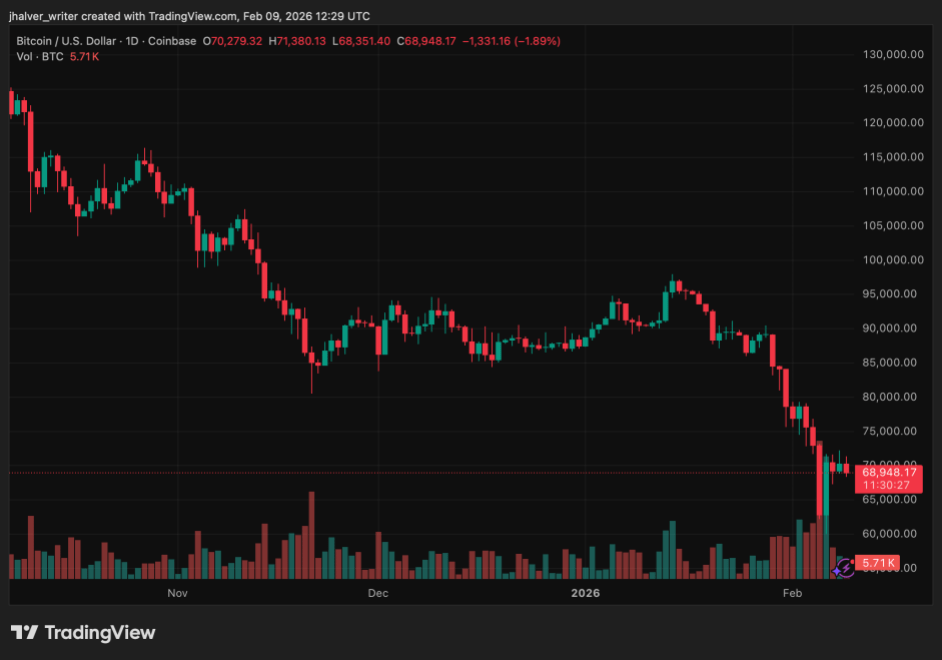
BTC's price trends to the downside on the daily chart. Source: BTCUSD on Tradingview

Whales Step Back as Leverage Unwinds

One of the clearest signs of the reset came from whale activity. On-chain data shows that the so-called Hyperunit whale sold more than $340 million in Bitcoin, sending the funds to Binance after months of aggressive, leveraged trading across crypto markets. The move followed a major liquidation on a large Ethereum position, which reportedly resulted in losses of roughly $250 million.

At its peak, the wallet held over $11 billion in Bitcoin. Holdings have since fallen to about $2.2 billion, signaling a shift away from expansion toward capital preservation.

The selling coincided with a broader decline in Bitcoin open interest, which fell from around $61 billion to near $49 billion, pointing to widespread deleveraging rather than fresh short positioning.

This reduction in leverage has eased immediate downside pressure but has also reduced momentum, leaving Bitcoin without strong directional conviction.

Bitcoin Price Stabilizes, But Signals Remain Mixed

Bitcoin was trading around $70,000–$71,000 in Asian hours on Monday, holding steady after last week’s rapid rebound. Technical indicators still show weak momentum, with subdued volume and no clear signs of either buyers or sellers being firmly in control.

Market participants are split. Some analysts argue that the recent washout has removed excess risk and created conditions for a healthier base. Others warn that similar rebounds in this cycle have turned into bull traps, especially when driven by short-term traders rather than long-term accumulation.

Support near $60,000 remains a key level to watch, while resistance between $73,000 and $75,000 is seen as a test for any sustained upside.

Macro, Sentiment, and Structural Questions

Beyond price action, broader factors are shaping the debate. Global equity markets rebounded, helping risk assets stabilize, while US spot Bitcoin ETFs recorded modest inflows as investors selectively bought the dip.

At the same time, concerns around long-term narratives, from Bitcoin’s safe-haven role to emerging discussions about quantum computing risks, continue to hover in the background.

Bitcoin’s ability to hold above $70,000 suggests the forced reset may be largely complete. Whether that turns into a durable recovery or another leg lower will depend on liquidity, conviction from larger players, and how markets respond to upcoming macro data.

Cover image from ChatGPT, BTCUSD chart on Tradingview

İlgili Sorular

QWhat is the current price range of Bitcoin and what key level is being watched for support?

ABitcoin is currently trading around $70,000–$71,000, with the key support level to watch near $60,000.

QWhat significant action did the 'Hyperunit whale' take, and what did it signal?

AThe 'Hyperunit whale' sold more than $340 million in Bitcoin, sending the funds to Binance. This move, which followed a major liquidation on a large Ethereum position, signaled a shift away from aggressive, leveraged trading toward capital preservation.

QWhat does the decline in Bitcoin open interest indicate about the market?

AThe decline in Bitcoin open interest, which fell from around $61 billion to near $49 billion, points to widespread deleveraging across the market rather than the establishment of fresh short positions.

QAccording to the article, what are the two opposing views among analysts regarding the recent price action?

ASome analysts argue the recent washout has removed excess risk and created conditions for a healthier base, while others warn that similar rebounds have turned into bull traps, especially when driven by short-term traders rather than long-term accumulation.

QBesides price, what broader factors are influencing the Bitcoin market debate?

ABroader factors include the rebound in global equity markets, modest inflows into US spot Bitcoin ETFs, and lingering concerns around long-term narratives such as Bitcoin's safe-haven role and emerging discussions about quantum computing risks.

İlgili Okumalar

Apple Also Has to Pay Rent Now

Apple Pays Rent Too: The Two-Way Flow of "Traffic Tax" and "AI Capability Rent" Between Tech Giants For over two decades, Google has paid Apple an estimated $20 billion annually to remain the default search engine on Safari, a "traffic tax" for a critical user entry point. However, in 2026, the direction of this cash flow partially reversed. Apple agreed to pay Google roughly $1 billion per year to license its Gemini AI models, as Apple's own models reportedly struggled with complex tasks. This creates a unique dynamic: Apple acts as the "landlord" in the established search ecosystem, collecting rent from Google for access. Simultaneously, in the emerging AI arena, Apple becomes the "tenant," paying Google for access to cutting-edge AI capabilities it cannot currently match internally. While Apple claims its new models are "distilled" from Gemini outputs and contain "not a drop" of Google's original code, core dependencies remain. Its knowledge base is refined using Gemini's outputs, and its most powerful cloud model runs on Google's infrastructure. Apple has structured the deal as non-exclusive, allowing it to theoretically switch AI suppliers—a hedge against over-reliance. The future hinges on whether advanced AI models become a commodity (cheap and abundant) or remain a concentrated, scarce resource (expensive and controlled by few). Apple is betting on the former, leveraging its massive device ecosystem to be a powerful, choosy customer. If the latter proves true, its bargaining power could erode. This power dynamic is extending to developers. Apple, Google, and WeChat are all pushing for apps to expose their core functions as standardized "actions" or "intents" that their respective AI assistants (Siri, Gemini, WeChat AI) can directly call. The new scarce resource is no longer just app store visibility, but "being selected by the AI." The currency of "rent" has changed from a 30% revenue share to ceding control over how users interact with an app's functions.

marsbit10 dk önce

Apple Also Has to Pay Rent Now

marsbit10 dk önce

Missed the SpaceX IPO? WEEX's "First Trade Protection" Lets You Experience US Stock Trading Risk-Free.

With the excitement around SpaceX's recent public listing reigniting interest in the US stock market, Chinese investors face significant challenges accessing compliant and convenient trading channels following regulatory actions against major online brokers. This article explores the available options, highlighting their risks and limitations. Traditional paths for US stock investments remain problematic. Qualified Domestic Institutional Investor (QDII) and Listed Open-Ended Fund (LOF) products, while compliant, suffer from high fees, significant purchase premiums, and a very limited selection of assets. Small, unregulated offshore brokers pose substantial risks, including potential insolvency. While secure, VIP accounts at banks in Hong Kong or Singapore require high minimum deposits (often 1-2 million RMB) and in-person visits, placing them out of reach for most retail investors. The article positions cryptocurrency exchanges, specifically their TradFi (traditional finance on-chain) offerings, as a compelling alternative. Platforms like WEEX are noted for providing access to a wide range of US stocks and ETFs, including SpaceX (SPCXON), through tokenized assets. This method offers advantages such as a single account for both crypto and traditional assets, USDT-based settlement avoiding fiat complexities, flexible leverage, and robust risk management. To attract users, WEEX is promoting a "First Trade Guarantee" campaign. Running from June 15 to July 8 (UTC+8), it features a $30,000 prize pool. Users who trade $500 worth of US stock contracts can qualify for a guarantee on their first eligible trade: 100% loss coverage up to $30 or a 20% bonus on profits up to $30. The campaign is presented as a low-risk opportunity for both crypto natives and traditional investors to experience US stock trading.

marsbit12 dk önce

Missed the SpaceX IPO? WEEX's "First Trade Protection" Lets You Experience US Stock Trading Risk-Free.

marsbit12 dk önce

How Difficult is Chip Making? A Division Error Costs 475 Million Dollars

How Hard Is It to Make a Chip? A Division Error Cost $475 Million Chip expert Shi Kan, a researcher at the Chinese Academy of Sciences and a popular tech creator, explains the immense challenges of chip development. Chips are foundational to modern technology, but their creation is extraordinarily difficult. The journey from sand to a functional chip involves complex design and manufacturing, but a critical bottleneck is verification—ensuring the design works flawlessly before costly production. A single, undetected bug can have catastrophic consequences, as illustrated by the infamous 1994 Intel Pentium FDIV bug. A flaw in the floating-point division unit forced a recall costing $475 million. Unlike software, chips cannot be easily patched after manufacture, making "first-time success" paramount. However, industry surveys show only 24% of chip projects achieve this; over three-quarters require at least one costly re-spin due to design flaws. Verification has thus become the dominant phase, consuming up to 70% of the design cycle. The core challenge is a "verification impossible triangle" between high performance, good debuggability, and low cost. Exhaustively verifying a modern CPU core could take 15,000 years with software simulation, or 30 years with advanced hardware emulation—timeframes utterly impractical for development. Despite being essential, verification is often seen as unglamorous "dirty work," receiving less academic attention than fields like AI. Shi and his team are tackling this by developing an agile verification research framework called ENCORE, based on FPGA technology, to improve verification efficiency and debug capability. Beyond research, Shi engages in public science communication through long-form video content, aiming to demystify chip technology, AI, and computer science. He argues for the value of pursuing "hard and long-term" endeavors, whether in the meticulous world of chip verification or in creating substantive educational content, believing such sustained effort is likely the right path forward.

marsbit21 dk önce

How Difficult is Chip Making? A Division Error Costs 475 Million Dollars

marsbit21 dk önce

Blockchain Has Finally Started to Sail into the Mainstream After 18 Years

Blockchain Finds Its True Path After 18 Years: Becoming the Financial Backbone for AI Agents and Autonomy This analysis explores a pivotal shift in the blockchain and crypto investment landscape, driven by the dominance of AI. Major venture capital firms, including Variant, Paradigm, Haun Ventures, and YZi Labs, are moving beyond pure "crypto" investment theses. They are expanding their focus to AI, robotics, and frontier tech, signaling that blockchain is no longer seen as a standalone sector but as an underlying infrastructure layer. The core argument is that blockchain's killer application may not be user-facing apps, but rather providing the economic rails for the coming wave of AI agents, autonomous robots, and automated systems. Key capabilities like self-custody wallets, programmable stablecoins for micropayments, on-chain identity, and verifiable smart contracts are positioned as essential for a future where machines conduct economic activity. The recent $1.4 billion investment by Tether (via its venture arm) in German robotics company NEURA Robotics exemplifies this, aiming to embed Tether's wallet tools directly into robots for autonomous transactions. While many "AI + Crypto" projects remain superficial, the article concludes that true value lies where crypto is a necessary component—enabling machine-to-machine payments, agent autonomy, verifiable data provenance, and open financial settlement for the AI era. For crypto venture capital, this convergence with AI represents both an adaptation to shifting capital flows and a potential path to unlocking the large-scale, non-speculative utility the industry has long sought.

marsbit42 dk önce

Blockchain Has Finally Started to Sail into the Mainstream After 18 Years

marsbit42 dk önce

İşlemler

Spot
Futures

Popüler Makaleler

MOVE Nasıl Satın Alınır

HTX.com’a hoş geldiniz! Movement (MOVE) satın alma işlemlerini basit ve kullanışlı bir hâle getirdik. Adım adım açıkladığımız rehberimizi takip ederek kripto yolculuğunuza başlayın. 1. Adım: HTX Hesabınızı OluşturunHTX'te ücretsiz bir hesap açmak için e-posta adresinizi veya telefon numaranızı kullanın. Sorunsuzca kaydolun ve tüm özelliklerin kilidini açın. Hesabımı Aç2. Adım: Kripto Satın Al Bölümüne Gidin ve Ödeme Yönteminizi SeçinKredi/Banka Kartı: Visa veya Mastercard'ınızı kullanarak anında Movement (MOVE) satın alın.Bakiye: Sorunsuz bir şekilde işlem yapmak için HTX hesap bakiyenizdeki fonları kullanın.Üçüncü Taraflar: Kullanımı kolaylaştırmak için Google Pay ve Apple Pay gibi popüler ödeme yöntemlerini ekledik.P2P: HTX'teki diğer kullanıcılarla doğrudan işlem yapın.Borsa Dışı (OTC): Yatırımcılar için kişiye özel hizmetler ve rekabetçi döviz kurları sunuyoruz.3. Adım: Movement (MOVE) Varlıklarınızı SaklayınMovement (MOVE) satın aldıktan sonra HTX hesabınızda saklayın. Alternatif olarak, blok zinciri transferi yoluyla başka bir yere gönderebilir veya diğer kripto para birimlerini takas etmek için kullanabilirsiniz.4. Adım: Movement (MOVE) Varlıklarınızla İşlem YapınHTX'in spot piyasasında Movement (MOVE) ile kolayca işlemler yapın.Hesabınıza erişin, işlem çiftinizi seçin, işlemlerinizi gerçekleştirin ve gerçek zamanlı olarak izleyin. Hem yeni başlayanlar hem de deneyimli yatırımcılar için kullanıcı dostu bir deneyim sunuyoruz.

289 Toplam GörüntülenmeYayınlanma 2024.12.13Güncellenme 2026.06.02

MOVE Nasıl Satın Alınır

Tartışmalar

HTX Topluluğuna hoş geldiniz. Burada, en son platform gelişmeleri hakkında bilgi sahibi olabilir ve profesyonel piyasa görüşlerine erişebilirsiniz. Kullanıcıların MOVE (MOVE) fiyatı hakkındaki görüşleri aşağıda sunulmaktadır.

活动图片