Iranian Crypto Outflows Hit $10.3 Million After US‑Israeli Airstrikes, Chainalysis Finds

bitcoinist2026-03-04 tarihinde yayınlandı2026-03-04 tarihinde güncellendi

Özet

Following joint US-Israeli airstrikes on February 28, Iranian cryptocurrency exchanges experienced significant outflows totaling approximately $10.3 million, according to Chainalysis data. The report highlights crypto's critical role in Iran's sanction-hit economy, serving both ordinary citizens and state-affiliated entities. With traditional banking access severed due to sanctions, Iranians increasingly rely on Bitcoin and stablecoins as hedges against hyperinflation and capital controls. Notably, half of Iran's $7.78 billion in crypto activity is attributed to the Islamic Revolutionary Guard Corps, underscoring digital assets' dual function as both economic lifeline and sanctions-evasion tool. The incident demonstrates crypto's rapid responsiveness to geopolitical shocks and ongoing regulatory challenges.

On‐chain data shows that in the days after joint US‐Israeli airstrikes on February 28, Iranian exchanges saw a sharp spike in withdrawals, with roughly 10.3 million dollars in crypto fleeing.

Iran’s Crypto Use Amidst Economical Collapse

Crypto has become a financial lifeline for both ordinary households and state‐affiliated networks in Iran, according to an article posted on our sister website NewsBTC. Years of US and EU financial and oil sanctions have strained the economy, cutting Iranian banks off from SWIFT and dollar funding, and now even targeting Iran‐linked crypto platforms through recent US Treasury designations. Add to this cocktail a runaway inflation and a collapsing rial, and it becomes clear why many Iranians increasingly look to Bitcoin and stablecoins as an alternative store of value and cross‐border payment rail.

A Lifeline Of Hope For Ordinary Folk?

Chainalysis has estimated that Iran’s crypto activity reached roughly 7.78 billion dollars in 2025, with usage spiking around protests, bombings and other security crises as people rush to move funds off local platforms and into self‐custody.

In its latest report, Chainalysis visualizes this idea with a series of charts that track hourly outflows from major Iranian exchanges before and after the February 28 airstrikes.
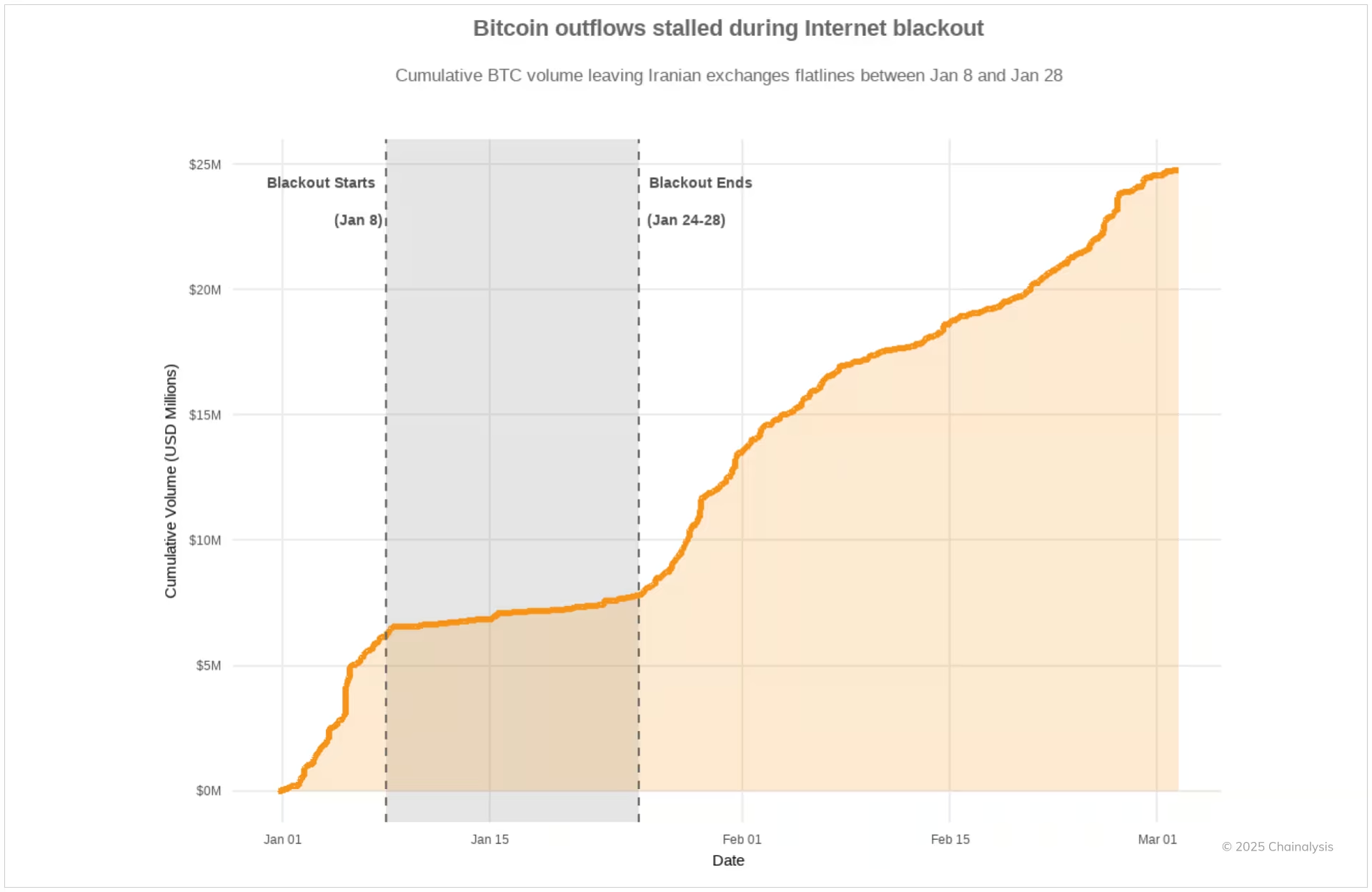
Bitcoin outflows stalled during Internet blackout. Source: Chainalysis

The graphs show relatively modest, choppy activity in the hours leading up to the strikes, followed by a sudden jump where hourly withdrawals approach or exceed roughly 2 million dollars and cumulative outflows climb to about 10.3 million dollars by March 2.
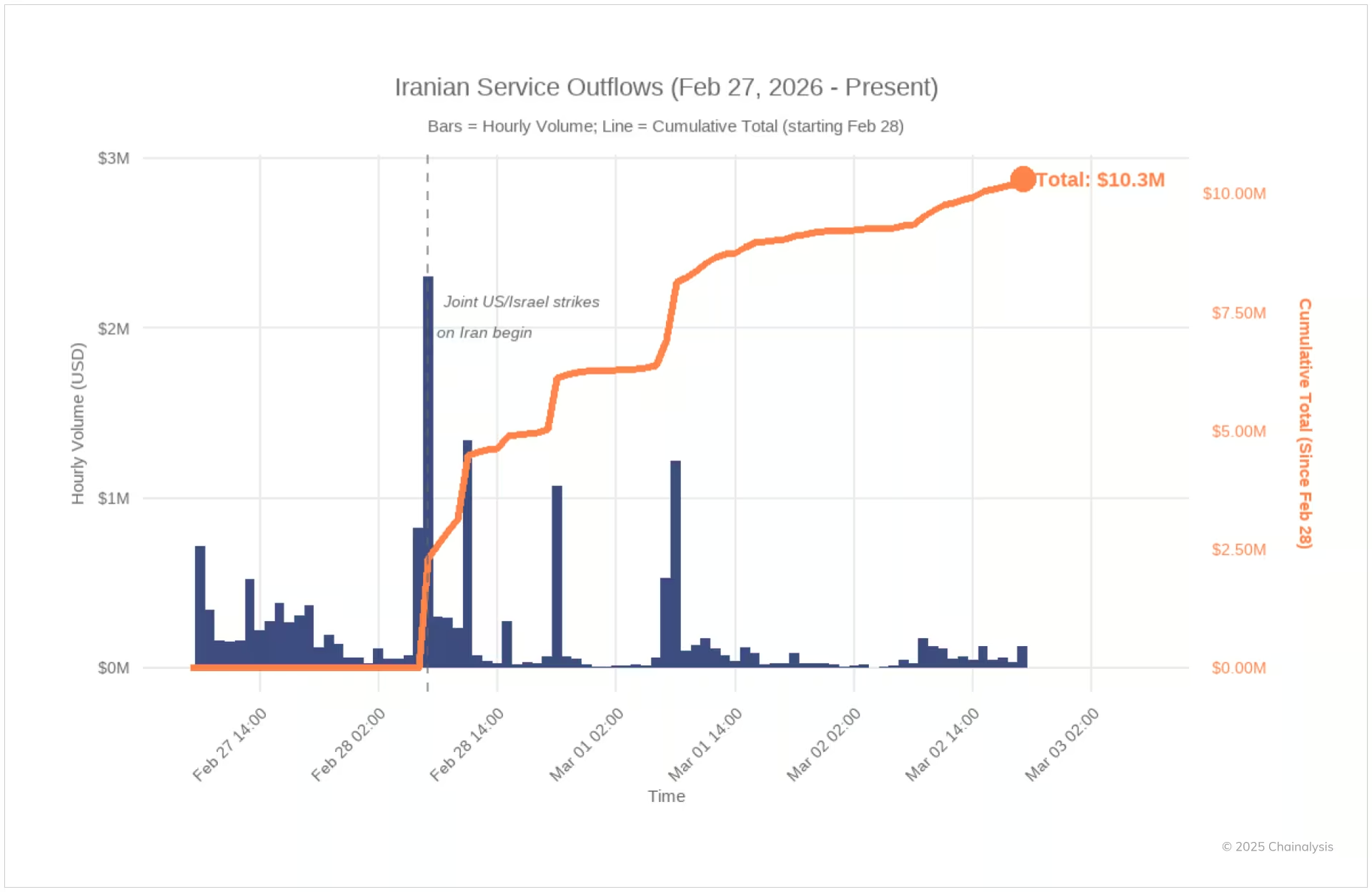
Iranian service outflows (Feb 27, 2026 - Present). Source: Chainalysis

For many ordinary Iranians, Bitcoin and stablecoins now function as a hedge against currency collapse and capital controls, while addresses tied to the Islamic Revolutionary Guard Corps (IRGC) account for roughly half of on‐chain activity, highlighting crypto’s dual role as both a survival tool and a sanctions‐evasion channel.

However, it is worth noting that while some observers praise Chainalysis for helping exchanges and regulators track hacks, scams, and sanctions evasion, civil‐liberties advocates criticize its tools as opaque and potentially overreaching in terms of financial surveillance.

What This Means For The Future Of Iranians

For ordinary users, digital assets may remain a pressure valve against inflation and capital controls, even as regulators tighten the screws on Iran‐linked platforms and wallets. For policymakers, the question now is whether new rounds of enforcement will meaningfully curb sanctions evasion or imply push more of Iran’s crypto activity into harder‐to‐track channels.

What is for sure is that the the latest spike in Iranian exchange outflows comes to show, once more, how quickly crypto reacts to geopolitical shocks and sanctions risk: the market is, after all, in the hands of the people.
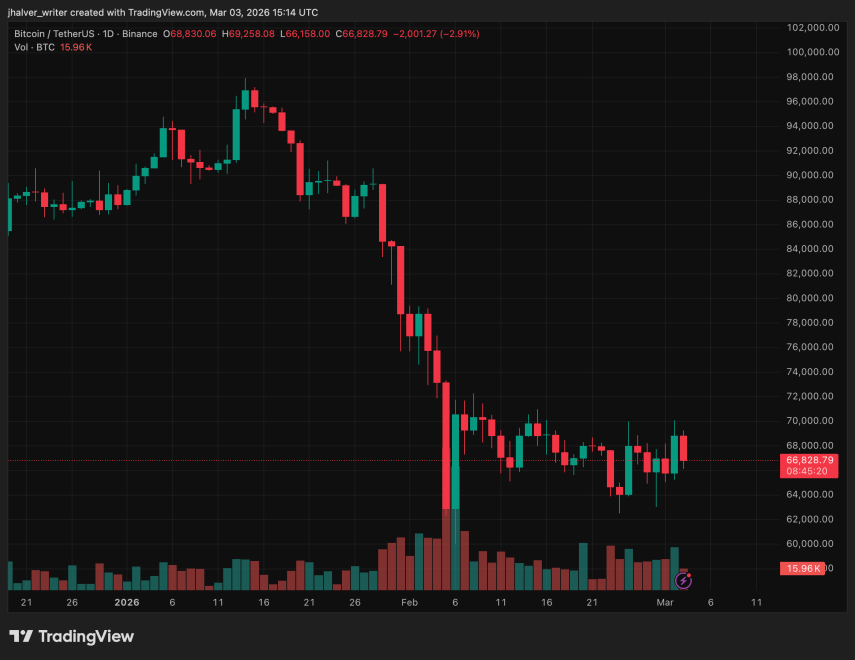
BTC's price trends to the downside on the daily chart. Source: BTCUSDT on Tradingview

Cover image from ChatGPT, BTCUSDT chart from Tradingview

İlgili Sorular

QWhat was the total value of crypto outflows from Iranian exchanges following the US-Israeli airstrikes on February 28, according to Chainalysis?

A$10.3 million

QWhy have many Iranians turned to Bitcoin and stablecoins, according to the article?

AAs a hedge against currency collapse, capital controls, and as an alternative store of value and cross-border payment rail due to economic strain from sanctions, runaway inflation, and a collapsing rial.

QWhat two contrasting roles does cryptocurrency play in Iran, as highlighted in the report?

AIt serves as a survival tool for ordinary households and as a sanctions-evasion channel for state-affiliated networks like the Islamic Revolutionary Guard Corps (IRGC).

QWhat event caused a temporary stall in Bitcoin outflows, as shown in one of the Chainalysis charts?

AAn Internet blackout.

QWhat is the central question for policymakers regarding new enforcement on Iran-linked crypto platforms?

AWhether new enforcement will meaningfully curb sanctions evasion or simply push more activity into harder-to-track channels.

İlgili Okumalar

In Jinjiang, Fujian, a Storage Super Unicorn Lies Quiet

In Fujian's Jinjiang, a city known for sportswear, lies a quiet semiconductor giant: Fujian Jinhua Integrated Circuit Co. (JHICC). Once a promising domestic DRAM manufacturer alongside Yangtze Memory and ChangXin Memory Technologies (CXMT), its journey was derailed in 2018 when the U.S. placed it on an Entity List and filed criminal charges for alleged trade secret theft. This halted production for years. A turning point came in February 2024 when a U.S. federal court found JHICC not guilty. However, it had lost crucial time. While CXMT soared to become a top-valued A-share company in 2024, JHICC, with an estimated valuation of 80 billion RMB, was just restarting. Its current output is primarily customized DDR4 chips, not the advanced DDR5/HBM demanded for AI, but it still benefits from the broader memory chip upcycle. JHICC's story is tied to Chen Zhengkun, a veteran engineer who left Micron to lead the venture. Founded in 2016 with state-backed funding, JHICC partnered with Taiwan's UMC to develop DRAM technology. Rapid progress was cut short by the U.S. actions, which Micron initiated, partly due to its heavy reliance on the Chinese market. Post-sanctions, Chen's team worked to rebuild the production line with reduced reliance on U.S. technology. According to its records, JHICC achieved small-scale production and revenue growth under immense pressure. It now focuses on the stable "niche" DRAM market (e.g., TVs, routers) with a monthly capacity of ~40,000 wafers, aiming for 60,000 by 2026. It holds over 1,000 patents but remains on the Entity List. For Jinjiang, investing in JHICC was a bold industrial leap. The local government provided unwavering financial and logistical support during the crisis, helping the company survive. JHICC has become the anchor for a growing local semiconductor cluster. Though its scale lags behind domestic peers, JHICC's persistence symbolizes a hard-won foothold in a global market long dominated by Samsung, SK Hynix, and Micron. Having missed one boom, it seeks a place in the new AI-driven memory supercycle.

marsbit1 saat önce

In Jinjiang, Fujian, a Storage Super Unicorn Lies Quiet

marsbit1 saat önce

İşlemler

Spot
活动图片





