Iranian Crypto Outflows Hit $10.3 Million After US‑Israeli Airstrikes, Chainalysis Finds

bitcoinist2026-03-04 tarihinde yayınlandı2026-03-04 tarihinde güncellendi

Özet

Following joint US-Israeli airstrikes on February 28, Iranian cryptocurrency exchanges experienced significant outflows totaling approximately $10.3 million, according to Chainalysis data. The report highlights crypto's critical role in Iran's sanction-hit economy, serving both ordinary citizens and state-affiliated entities. With traditional banking access severed due to sanctions, Iranians increasingly rely on Bitcoin and stablecoins as hedges against hyperinflation and capital controls. Notably, half of Iran's $7.78 billion in crypto activity is attributed to the Islamic Revolutionary Guard Corps, underscoring digital assets' dual function as both economic lifeline and sanctions-evasion tool. The incident demonstrates crypto's rapid responsiveness to geopolitical shocks and ongoing regulatory challenges.

On‐chain data shows that in the days after joint US‐Israeli airstrikes on February 28, Iranian exchanges saw a sharp spike in withdrawals, with roughly 10.3 million dollars in crypto fleeing.

Iran’s Crypto Use Amidst Economical Collapse

Crypto has become a financial lifeline for both ordinary households and state‐affiliated networks in Iran, according to an article posted on our sister website NewsBTC. Years of US and EU financial and oil sanctions have strained the economy, cutting Iranian banks off from SWIFT and dollar funding, and now even targeting Iran‐linked crypto platforms through recent US Treasury designations. Add to this cocktail a runaway inflation and a collapsing rial, and it becomes clear why many Iranians increasingly look to Bitcoin and stablecoins as an alternative store of value and cross‐border payment rail.

A Lifeline Of Hope For Ordinary Folk?

Chainalysis has estimated that Iran’s crypto activity reached roughly 7.78 billion dollars in 2025, with usage spiking around protests, bombings and other security crises as people rush to move funds off local platforms and into self‐custody.

In its latest report, Chainalysis visualizes this idea with a series of charts that track hourly outflows from major Iranian exchanges before and after the February 28 airstrikes.
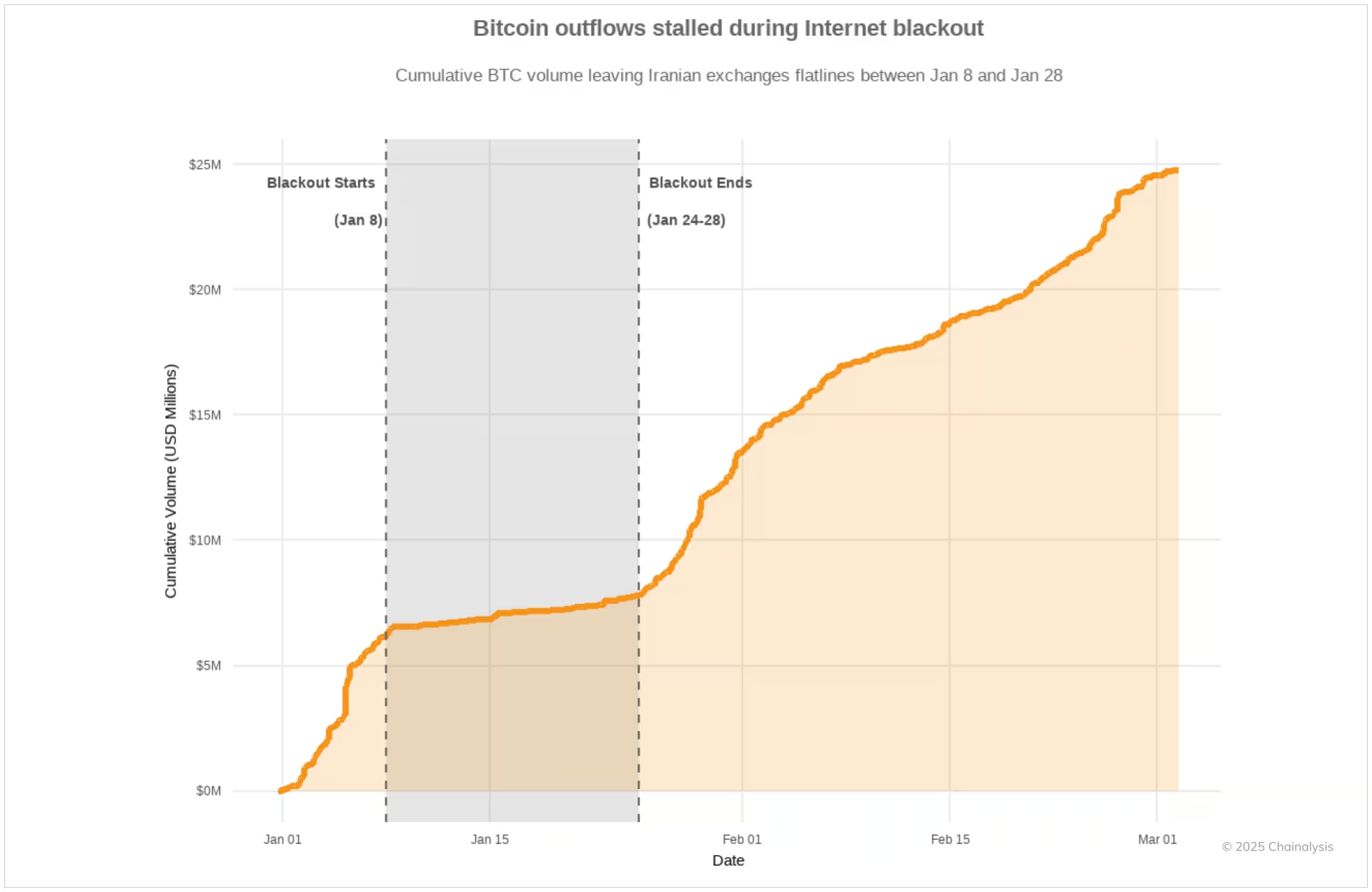
Bitcoin outflows stalled during Internet blackout. Source: Chainalysis

The graphs show relatively modest, choppy activity in the hours leading up to the strikes, followed by a sudden jump where hourly withdrawals approach or exceed roughly 2 million dollars and cumulative outflows climb to about 10.3 million dollars by March 2.
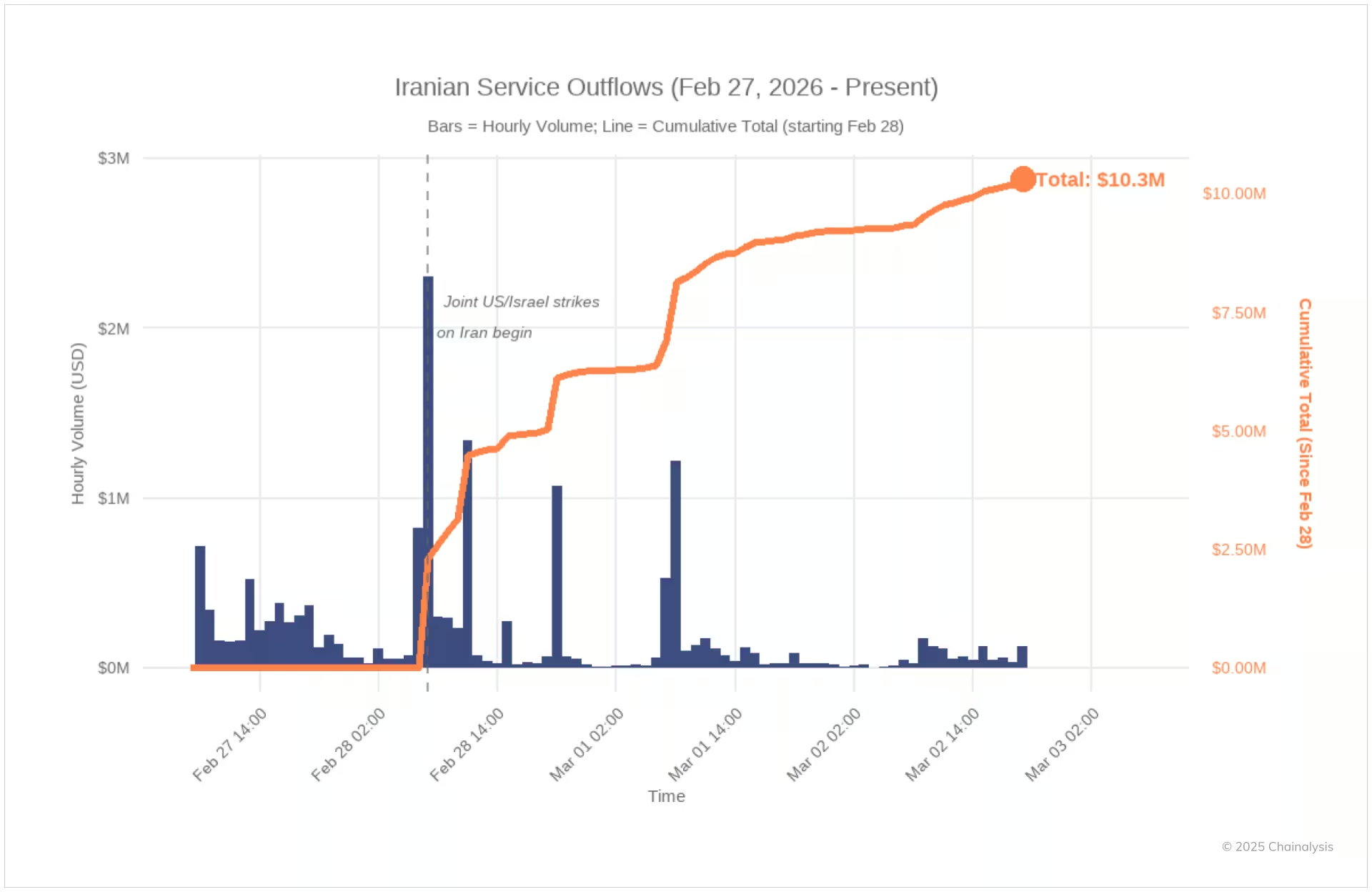
Iranian service outflows (Feb 27, 2026 - Present). Source: Chainalysis

For many ordinary Iranians, Bitcoin and stablecoins now function as a hedge against currency collapse and capital controls, while addresses tied to the Islamic Revolutionary Guard Corps (IRGC) account for roughly half of on‐chain activity, highlighting crypto’s dual role as both a survival tool and a sanctions‐evasion channel.

However, it is worth noting that while some observers praise Chainalysis for helping exchanges and regulators track hacks, scams, and sanctions evasion, civil‐liberties advocates criticize its tools as opaque and potentially overreaching in terms of financial surveillance.

What This Means For The Future Of Iranians

For ordinary users, digital assets may remain a pressure valve against inflation and capital controls, even as regulators tighten the screws on Iran‐linked platforms and wallets. For policymakers, the question now is whether new rounds of enforcement will meaningfully curb sanctions evasion or imply push more of Iran’s crypto activity into harder‐to‐track channels.

What is for sure is that the the latest spike in Iranian exchange outflows comes to show, once more, how quickly crypto reacts to geopolitical shocks and sanctions risk: the market is, after all, in the hands of the people.
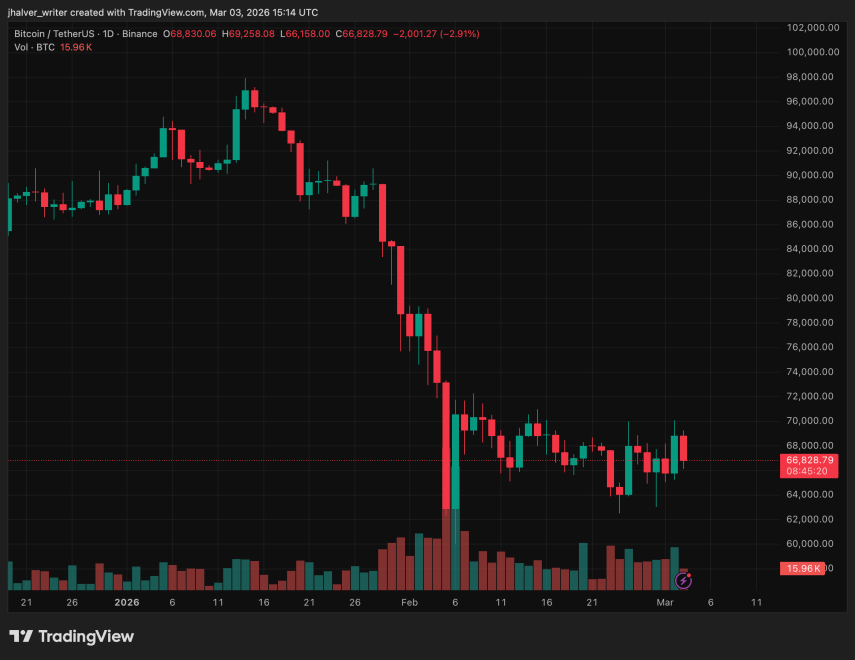
BTC's price trends to the downside on the daily chart. Source: BTCUSDT on Tradingview

Cover image from ChatGPT, BTCUSDT chart from Tradingview

İlgili Sorular

QWhat was the total value of crypto outflows from Iranian exchanges following the US-Israeli airstrikes on February 28, according to Chainalysis?

A$10.3 million

QWhy have many Iranians turned to Bitcoin and stablecoins, according to the article?

AAs a hedge against currency collapse, capital controls, and as an alternative store of value and cross-border payment rail due to economic strain from sanctions, runaway inflation, and a collapsing rial.

QWhat two contrasting roles does cryptocurrency play in Iran, as highlighted in the report?

AIt serves as a survival tool for ordinary households and as a sanctions-evasion channel for state-affiliated networks like the Islamic Revolutionary Guard Corps (IRGC).

QWhat event caused a temporary stall in Bitcoin outflows, as shown in one of the Chainalysis charts?

AAn Internet blackout.

QWhat is the central question for policymakers regarding new enforcement on Iran-linked crypto platforms?

AWhether new enforcement will meaningfully curb sanctions evasion or simply push more activity into harder-to-track channels.

İlgili Okumalar

Bitcoin Boom in Full Swing: Saylor's Latest Statement Fuels Buying Speculation

MicroStrategy's Executive Chairman Michael Saylor has fueled speculation about a new Bitcoin purchase by posting "Bitcoin Drive engaged" on August 2, accompanied by the company's customary purchase tracker. This aligns with his pattern of hinting at treasury changes ahead of weekly reports. The accompanying report showed MicroStrategy's Bitcoin holdings at 843,775 BTC, with an average cost of $75,653 per coin and an unrealized loss of -$10.58B. A similar signal preceded the company's July 27 announcement, strengthening expectations for a treasury update on Monday. However, MicroStrategy's real-time ledger reflects two recent Bitcoin sales totaling 3,588 BTC, reducing holdings from 847,363 BTC to the current 843,775 BTC. The company stated these sales funded preferred stock dividends and replenished its U.S. dollar reserve. Recent reports indicate the company made no Bitcoin purchases the week ending July 26 while increasing its dollar reserve to approximately $3.75B. The company faces financial headwinds after reporting an $8.33B operating loss for Q2 2026, including an $8.32B unrealized loss on its digital assets. Management may sell up to $1.25B more in Bitcoin to meet cash obligations. The expected Monday update will reveal if the "Bitcoin Drive" signal marks a return to accumulation as MicroStrategy balances its massive Bitcoin stash against growing cash commitments.

cryptonews.ru1 saat önce

Bitcoin Boom in Full Swing: Saylor's Latest Statement Fuels Buying Speculation

cryptonews.ru1 saat önce

İşlemler

Spot
活动图片





