Iran Launches Bitcoin Payment Platform For Strait Of Hormuz Insurance

bitcoinist2026-05-18 tarihinde yayınlandı2026-05-18 tarihinde güncellendi

Özet

Iran has launched a maritime insurance platform named "Hormuz Safe" for cargo transiting the Strait of Hormuz, with insurance payments settled in Bitcoin. According to a report from Iran's Fars News Agency, the state-backed initiative could generate significant revenue and embeds Bitcoin into a critical global shipping corridor. The platform offers cryptographically verifiable policies for cargo moving through the Persian Gulf and surrounding waterways, with coverage beginning upon payment confirmation. This move occurs amid heightened geopolitical tensions in the strait, a vital chokepoint for global oil shipments. The report did not specify technical details on Bitcoin payment processing or identify external partners.

Iran has launched a new maritime insurance platform for cargo moving through the Strait of Hormuz, with payments settled in Bitcoin, according to a report from Iran’s semi-official Fars News Agency. The project places Bitcoin inside one of the world’s most politically sensitive shipping corridors, where energy flows, sanctions pressure and maritime risk have become increasingly intertwined.

Iran Officially Turns To Bitcoin

Fars reported that the platform, called “Hormuz Safe,” has begun offering insurance for maritime cargo passing through the Strait of Hormuz. The outlet said a document obtained by its reporter showed Iran’s Ministry of Economic Affairs and Finance had been working since early Ordibehesht, the second month of the Iranian calendar, on a plan to make management of the strait possible through insurance. The same report said the scheme could issue maritime insurance policies and financial responsibility certificates, potentially generating more than $10 billion in revenue for Iran.

The most crypto-relevant element is the settlement layer. Fars said the platform’s rules provide “fast, cryptographically verifiable” insurance policies for cargo moving through the Persian Gulf, the Strait of Hormuz and surrounding waterways. “Payments are settled with Bitcoin,” the report said, adding that cargo is covered “from the moment of confirmation” and that owners receive a signed receipt.

That wording makes the story more specific than a generic Bitcoin-payment initiative. The Fars report names Bitcoin directly, rather than referring only to crypto assets, stablecoins or blockchain-based payment rails. It also frames the product not as a consumer-facing wallet or exchange service, but as infrastructure for a maritime insurance and compliance process around ships and cargo.

Related Reading: Bitcoin Social Euphoria Hits Yearly High Amid CLARITY Act Buzz

The launch comes amid heightened scrutiny of the Strait of Hormuz, the narrow waterway between Iran and Oman that connects the Persian Gulf with the Gulf of Oman and Arabian Sea. The US Energy Information Administration has called Hormuz the world’s most important oil chokepoint, noting that oil flows through the strait averaged 21 million barrels per day in 2022, equal to about 21% of global petroleum liquids consumption.

The geopolitical context has become even more acute in recent months. Iran had begun allowing some Chinese vessels to transit the Strait of Hormuz after an understanding over Iranian management protocols for the waterway. Iran had severely restricted transit following the start of US and Israeli strikes on February 28, while a US blockade on Iranian ports after an early-April ceasefire had prolonged the crisis in a corridor through which one-fifth of global oil and natural gas transit.

Fars did not provide technical details on how Bitcoin payments are received, whether the platform uses on-chain settlement directly, third-party custody, internal accounting, or conversion into local or foreign currency. It also did not identify counterparties, underwriters, wallet infrastructure, or any external insurers connected to the platform.

At press time, BTC traded at $76,685.
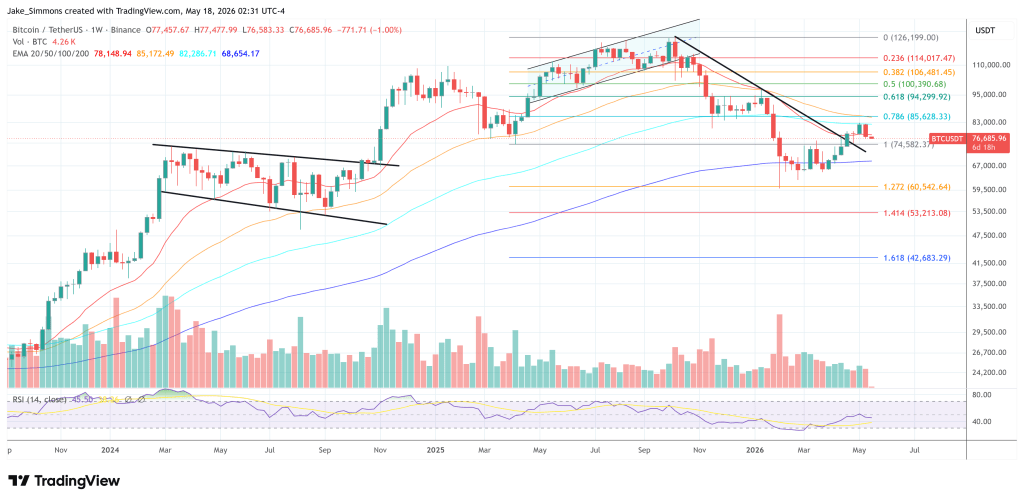
Bitcoin bulls rejected at the 100-week EMA, 1-week chart | Source: BTCUSDT on TradingView.com

İlgili Sorular

QWhat is the name of the new Bitcoin-based maritime insurance platform launched by Iran, and which waterway does it specifically cover?

AThe platform is called 'Hormuz Safe,' and it offers insurance for maritime cargo passing through the Strait of Hormuz and surrounding waterways like the Persian Gulf.

QAccording to the Fars News Agency report, what specific cryptocurrency is used for payment settlement on the 'Hormuz Safe' platform?

APayments on the 'Hormuz Safe' platform are settled with Bitcoin.

QWhat major geopolitical and economic significance does the Strait of Hormuz hold, as mentioned in the article?

AThe Strait of Hormuz is described as the world's most important oil chokepoint, with oil flows averaging 21 million barrels per day in 2022, equal to about 21% of global petroleum liquids consumption.

QWhat details about the Bitcoin payment process did the Fars report notably NOT provide, according to the article?

AThe report did not provide technical details on how Bitcoin payments are received, whether the platform uses on-chain settlement directly, third-party custody, internal accounting, or currency conversion. It also did not identify counterparties, underwriters, wallet infrastructure, or any external insurers.

QWhat was the approximate price of Bitcoin (BTC) at the time the article was published?

AAt press time, BTC traded at $76,685.

İlgili Okumalar

Must-Watch Events Next Week|CLARITY Act Could Face Senate Vote; SpaceX, Circle to Report Earnings (8.3-8.9)

**Summary: Key Events and Developments to Watch (August 3-9)** The upcoming week is marked by significant financial disclosures, key legislative deadlines, and notable product updates. **Major Financial Events:** Several companies are scheduled to release their Q2 2026 earnings. American Bitcoin (ABTC) will report on August 3, followed by SpaceX and Hut 8 Mining Corp. on August 4, and Circle on August 5. Notably, a significant portion of SpaceX shares (up to 12% of total shares) will be unlocked on August 6 following their earnings release. **Key Legislative Deadline:** The U.S. Senate faces an August 7 deadline to secure 60 votes for the CLARITY Act, a bipartisan bill aiming to establish a federal regulatory framework for cryptocurrencies. The Senate may hold a full vote on the bill during the week. **Economic Data:** The U.S. July Non-Farm Payrolls report will be released on August 7, providing crucial labor market data. **Technology & Product Updates:** * **Shutdowns:** DeFi portfolio tracker Zapper and wallet app Ctrl Wallet will cease operations on August 3. * **Upgrades:** LayerZero will deprecate its v1 relayers on August 3. XRP Ledger's new version 3.3.0, featuring five new functions, is expected next week. * **AI:** Elon Musk announced that the advanced Grok 4.6 AI model is set for release around August 7. * **Bitcoin:** The BIP-110 forced signaling for a potential Bitcoin network change is scheduled to begin around August 8. **Other Notable Events:** Chinese robotics firm Unitree Tech has set its preliminary price inquiry for its IPO for August 5. South Korean exchange Upbit will delist AQT and AERGO tokens on August 3.

marsbit1 saat önce

Must-Watch Events Next Week|CLARITY Act Could Face Senate Vote; SpaceX, Circle to Report Earnings (8.3-8.9)

marsbit1 saat önce

Stocks Are Plummeting More Sharply Than Cryptocurrencies. Where Has the Money Gone?

Stock Markets Plunge Deeper Than Cryptocurrencies: Where Did the Money Go? In late July, Seoul's Kospi index triggered circuit breakers for two consecutive days, plummeting over 40% from its June high. The collapse was led by heavyweight stocks like SK Hynix, whose record profits still disappointed investors, and devastating leveraged ETFs, with one major product losing over 83% of its value. This signaled a global, forced deleveraging targeting the most crowded trades. Interestingly, while stocks exhibited extreme volatility akin to crypto markets, Bitcoin rose nearly 15% in July after a prior steep drop. Analysis shows the money fleeing equities did not flow into Bitcoin. Instead, Bitcoin had already absorbed its sell-off in May-June, when U.S. spot Bitcoin ETFs saw historic outflows. The true safe-haven beneficiary was gold, whose price rose over 20% year-on-year, highlighting a decoupling between Bitcoin and gold as "digital gold." The sell-off was a targeted unwinding of leveraged positions in tech and semiconductors, accelerated by broker-dealer risk management and shifts in the AI narrative, including new competition from Chinese memory chipmakers. The retreat path was clear: from high-valuation tech stocks to cash and U.S. Treasuries, then to gold. For Bitcoin to attract sustained institutional inflows, conditions like eased global liquidity pressure, a "soft-landing" Fed rate cut, and U.S. regulatory clarity via legislation like the stalled CLARITY Act are needed. Currently, Bitcoin is not a safe haven but an already-cleared asset. Its low correlation with tech stocks, however, makes it a potential diversification play for institutional portfolios once the storm passes. The money isn't here yet, but the positioning is underway.

marsbit1 saat önce

Stocks Are Plummeting More Sharply Than Cryptocurrencies. Where Has the Money Gone?

marsbit1 saat önce

In Conversation with Ray Dalio: We Are Currently in an AI Bubble, with 1% of My Portfolio in Bitcoin

Ray Dalio, founder of Bridgewater Associates, warns in an interview that the current AI boom shows classic bubble characteristics, which could lead to significant economic downturns as seen in past cycles like 1929 or 2000. He explains that speculative enthusiasm, fueled by debt and overvaluation, often precedes a crash when rising rates or taxation force asset sales, causing widespread losses and recession. Dalio also outlines his "Big Cycle" theory, describing an approximate 80-year pattern where widening wealth gaps, massive government deficits, and shifting geopolitical power (like China's rise) create internal conflict and global instability. He emphasizes that we are in a late-cycle, transitional phase where traditional powers like the US and UK face decline. For personal wealth protection, Dalio advises diversification beyond cash into assets like stocks, bonds, real estate, and particularly gold, which he prefers over Bitcoin. While he holds about 1% of his portfolio in Bitcoin as a non-printable hard asset, he views gold as more secure from technological or governmental threats. Regarding AI's impact, Dalio believes it will disproportionately benefit capital owners, worsening inequality by replacing both physical and cognitive labor. He suggests that human intuition and emotional intelligence, combined with AI, will be key for future workers. On taxation, Dalio argues that wealth taxes are impractical and risk triggering asset sell-offs, reducing productive investment. He points to the UK as a cautionary example of debt, low productivity, and political strife. Geopolitically, Dalio foresees a more regionalized world, with the US showing weakness in prolonged conflicts like with Iran, akin to past imperial declines. The ideal outcome, he suggests, is coexisting powerful blocs (e.g., Americas, China-Asia Pacific) without major war.

marsbit4 saat önce

In Conversation with Ray Dalio: We Are Currently in an AI Bubble, with 1% of My Portfolio in Bitcoin

marsbit4 saat önce

İşlemler

Spot
活动图片




