Iran and the Fed -- Three Scenarios That Will Impact Global Markets Next

marsbit2026-05-28 tarihinde yayınlandı2026-05-28 tarihinde güncellendi

Özet

"Three Scenarios for Iran and the Fed Shaping Global Markets" Iranian geopolitics and the Fed's monetary policy path are two dominant themes for markets. Deutsche Bank Research outlines three scenarios linking Iran ceasefire outcomes to Fed policy, with oil prices as the key transmission channel. **Scenario 1: Peace Deal.** A breakthrough leading to the Strait of Hormuz reopening would ease near-term Fed tightening pressure. Recent inflation would be viewed as a temporary energy shock. However, medium-term risks remain; rate hikes could resurface in 2027 if inflation persists. **Scenario 2: Stalemate.** A breakdown in talks and a prolonged Strait closure, but no major escalation, is deemed the scenario with the *highest* Fed hike risk. Sustained high oil prices would feed into core inflation and threaten inflation expectations, while not severely damaging demand enough to give the Fed a reason to pause. This environment could necessitate multiple Fed rate hikes in 2026. **Scenario 3: Conflict Escalation.** Renewed conflict and sharply higher oil prices create a two-way risk for Fed policy. On one hand, it would risk severe inflation expectations de-anchoring, forcing a hawkish response. On the other, extreme oil prices could severely damage demand and the labor market, potentially shifting the Fed's focus toward easing. The ultimate policy decision would depend on which risk materializes first. Overall, Deutsche Bank's framework emphasizes that the path for oil prices, d...

Author: Dong Jing

Source: Wall Street News

The direction of the Iran situation and the outlook for the Federal Reserve's monetary policy are becoming the two most critical factors influencing global markets.

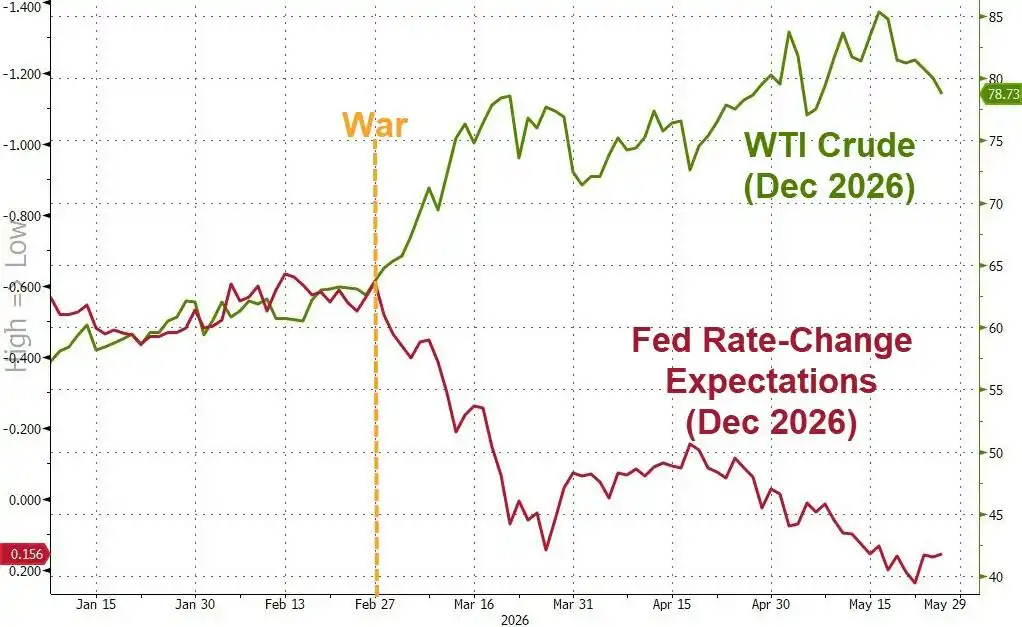
Deutsche Bank's economic research team, in its latest report, systematically outlined the potential impact on the Fed's policy path based on three possible outcomes of the Iran ceasefire negotiations—ranging from the fading of near-term interest rate hike risks to multiple hikes in 2026, and to two-way policy uncertainty. Each scenario corresponds to a distinct market logic.

The analysis points out that oil price movements will directly affect the anchoring of inflation expectations, thereby determining whether the Fed needs to restart rate hikes. In the bank's view, the most concerning scenario currently is not the extreme conflict escalation, but the intermediate state of "failed negotiations and a stalemate"—this scenario is most likely to force the Fed to take substantive tightening action in 2026 due to persistently high oil prices.

Currently, the latest developments in the geopolitical situation show that negotiations on extending the ceasefire agreement and reopening the Strait of Hormuz have made some progress, with markets reacting optimistically. Brent crude oil futures fell below $100 per barrel, touching a near one-month low; the yield on the 10-year U.S. Treasury note also retreated significantly, erasing most of the gains from the past week. However, uncertainties remain in the negotiation details, and core disputes such as Iran's nuclear program remain unresolved.
Scenario One: A Peace Agreement is Reached – Near-term Rate Hike Pressure Fades, but Medium-term Risks Linger

In Deutsche Bank's first scenario, the negotiations achieve a breakthrough, the Strait of Hormuz reopens, oil prices extend their recent downward trend but remain above pre-war levels; U.S. Treasury yields fall further, risk asset markets strengthen overall as tail risks dissipate, and financial conditions ease.

Against this backdrop, the pressure on the Fed to raise interest rates at its upcoming meetings will significantly diminish. With overall inflation data softening and short-term inflation expectations retreating, Fed officials would be inclined to view recent core inflation pressures as temporary disturbances caused by the energy price shock, opting to "look through" them rather than respond immediately. Deutsche Bank expects the new Fed Chair, Warsh, to reinforce this inclination.

However, the bank simultaneously warns that the baseline narrative of "inflation not being persistent" will take time to be disproven, and rate hike risks do not disappear entirely. If the labor market remains tight, inflation expectations shift further upward, or inflation remains stubbornly high after tariff and energy pressures fade, the risk of policy rate increases will more likely materialize in 2027.

Scenario Two: Negotiations Fail, Stalemate Persists – Highest Rate Hike Risk in 2026

Deutsche Bank characterizes the second scenario as having the "highest rate hike risk" among the three current ones. In this scenario, peace agreement talks fail, the Strait of Hormuz remains closed long-term, but the conflict does not escalate further, with oil prices maintaining high levels rather than surging sharply.

Persistently high oil prices would transmit more significantly into core inflation and pose a greater risk of unanchoring inflation expectations. Meanwhile, oil prices in this scenario are not high enough to severely damage demand and force the Fed to shift its focus to the labor market, meaning the Fed would face one-sided inflation pressure without the justification to "stand pat due to an economic downturn."

The bank believes the Fed is unlikely to take rate hike action before the September meeting—a policy pivot would need to go through multiple steps: removing the easing bias (June), some officials publicly discussing the possibility of rate hikes (July to September), and the committee reaching a consensus.

However, it also points out that Fed Governor Waller recently stated that rate hikes could be a reasonable choice if "inflation does not decline fast enough," suggesting the Fed may be willing to tighten policy more rapidly. Therefore, the possibility of multiple rate hikes in 2026 should not be ruled out.

Scenario Three: Conflict Escalates Again – Policy Outlook Faces Two-way Risks

The third scenario envisions a renewed escalation in the Iran situation, leading to a larger and more persistent surge in oil prices. Deutsche Bank believes this scenario does not necessarily mean the Fed will unilaterally move towards rate hikes, but rather introduces two-way uncertainty to the policy outlook.

On one hand, conflict escalation would drive a larger and more sustained rise in overall inflation, with core inflation facing more significant transmission risks, and the possibility of inflation expectations becoming unanchored would rise tangibly. The Fed would then need to signal clearly through policy communication its willingness to tighten policy to address price stability risks.

On the other hand, a significant and sustained rise in oil prices would increase the risk of non-linear shocks to the real economy, eventually affecting the labor market.

Deutsche Bank notes that consumers can currently still tolerate energy prices near current levels, with tax cut policies partially offsetting the pressure from rising oil prices; but if oil and gas prices rise substantially further, this buffer will be depleted. At that point, the labor market could slide out of its current fragile equilibrium of "low hiring, low layoffs," with further demand contraction or a wave of layoffs finally arriving.

In this scenario, the Fed's ultimate policy stance would depend on the sequence in which the above two types of risks materialize: if the economy remains resilient but inflation expectations become unanchored first, forceful tightening would be needed; if cracks appear in the labor market first, the Fed might instead lean towards rate cuts, citing prospective easing price pressures.

Synthesizing the three scenarios, Deutsche Bank's analytical framework reveals a clear logic chain: the Iran situation determines oil price trends, oil price trends determine the nature and duration of inflation pressure, and whether inflation expectations become unanchored ultimately determines the Fed's policy space.

Key signals currently worth monitoring include: substantive progress in ceasefire talks, whether Brent crude can stabilize below $100 per barrel, and changes in the rhetoric of Fed officials in upcoming meetings—particularly whether they begin to remove the easing bias or if any officials publicly discuss the possibility of rate hikes. These signals will be crucial observation windows for judging the probability distribution of the above three scenarios.


İlgili Sorular

QAccording to the Deutsche Bank report, which of the three Iran scenario poses the highest risk of triggering Fed rate hikes in 2026?

AThe second scenario, where peace talks fail and a stalemate ensues with the Strait of Hormuz remaining closed, presents the highest risk of Fed rate hikes in 2026. In this case, persistently high oil prices would significantly transmit to core inflation and risk unanchoring inflation expectations, without causing enough demand destruction to give the Fed a reason to stay on hold.

QWhat is the key factor that connects the Iran situation to the Federal Reserve's monetary policy decisions, as outlined in the article?

AThe key connecting factor is the path of oil prices. The Iran situation directly influences oil price movements, which in turn determine the nature and duration of inflationary pressures. Whether these pressures cause inflation expectations to become unanchored ultimately determines the Federal Reserve's policy space and potential actions.

QWhat are the two opposing risks for Fed policy in the scenario of a renewed escalation of conflict in Iran?

AIn the conflict escalation scenario, Fed policy faces a two-way risk. On one hand, a large, sustained oil price spike could unanchor inflation expectations, necessitating a hawkish policy response. On the other hand, such a spike could non-linearly damage the real economy and labor market, which could force the Fed to consider a dovish pivot and potential rate cuts.

QWhy does the 'peace deal' scenario not completely eliminate the risk of future Fed tightening, according to Deutsche Bank?

AWhile a peace deal would ease near-term rate hike pressure by allowing the Fed to 'look through' temporary energy price shocks, the risk of future tightening does not disappear. If a tight labor market persists, inflation expectations continue to rise, or inflation remains stubbornly high even after tariff and energy pressures fade, the risk of policy rate increases could materialize later, potentially in 2027.

QWhat specific signals does the article suggest are crucial for assessing the probability of the three different scenarios?

AThe key signals to watch are: 1) Substantive progress in the ceasefire negotiations. 2) Whether Brent crude oil stabilizes below $100 per barrel. 3) Changes in the rhetoric from Federal Reserve officials in upcoming meetings, particularly if they begin removing the easing bias or if some officials start publicly discussing the possibility of rate hikes.

İlgili Okumalar

Six Complaints from an Ethereum Developer

A disgruntled early Ethereum developer and token holder presents six core criticisms of the project's trajectory, contrasting it with Solana's rise. 1. **Premature Complacency**: The Ethereum Foundation shifted from a "building" to an "infrastructure" mindset too soon, adopting a passive, "retired chairman" posture before securing market dominance, reflected in ETH's ~65% decline against BTC post-Merge. 2. **Misguided Messaging**: The Merge was marketed primarily on ESG (99.95% energy reduction) rather than user benefits like speed or yield, appealing to internal ideals instead of market demands. 3. **Delayed Execution**: Proof-of-Stake, on the roadmap since 2015, took seven years to launch, ceding critical narrative and development windows. Competitors like Solana built entire ecosystems in that time. 4. **Poor Native Staking UX**: Years after the Merge, there is still no first-party, user-friendly staking application, forcing reliance on centralized services like Lido and undermining ETH's "sound money" narrative. 5. **Managed Decline**: The rollup-centric roadmap deliberately weakens the base layer's fee capture, outsourcing value and profitability to L2s like Arbitrum and Base, which issue their own tokens and fragment capital. 6. **Ideology Over Product**: Ethereum culture prioritizes philosophical purity ("credible neutrality," "public goods") over competitive product delivery that meets user demands (e.g., financialization), while Solana's ecosystem focuses on coordinated execution. The diagnosis is accumulated execution debt, not a coordination failure. Ethereum possessed a structural advantage in 2021 but spent years in governance debates, while Solana efficiently executed. The current market cap reflects these specific strategic failures, not abstract theory.

marsbit2 saat önce

Six Complaints from an Ethereum Developer

marsbit2 saat önce

Six Complaints from an Ethereum Developer

Six Grievances from an Ethereum Developer The author, an early investor and developer still building on Ethereum, expresses deep frustration with its trajectory and declining ETH/BTC price since the merge. The core argument is that Ethereum's current market position stems from concrete failures in execution and strategy, not abstract coordination problems. The first grievance targets a shift in the Ethereum Foundation's mentality from builders to "infrastructure," adopting a premature posture of a retired victor. Second, marketing the Merge around ESG (99.95% energy reduction) is seen as talking to its own conscience rather than the market, which prioritizes user experience and yield. Third, the seven-year delay in delivering Proof-of-Stake (PoS) ceded critical narrative and development time to competitors like Solana. Fourth, three years post-merge, there is still no user-friendly first-party staking application, forcing reliance on centralized services like Lido and undermining ETH's monetary narrative. Fifth, the rollup-centric roadmap has strategically surrendered base-layer fee capture to L2s, fragmenting value within the ecosystem while Solana demonstrates an integrated L1's value accrual. Finally, the author criticizes an institutional culture that prioritizes philosophical ideals (credible neutrality, pluralism) over competitive product delivery focused on what users actually want. The diagnosis is "accumulated execution debt." Ethereum possessed a structural advantage in 2021 but spent years in governance debates, while Solana's ecosystem coordinated efficiently to deliver and capture the next wave of value. The conclusion is that Ethereum's market cap reflects its abandonment of the fight for asset appreciation.

链捕手2 saat önce

Six Complaints from an Ethereum Developer

链捕手2 saat önce

Token Budget Wars: Enterprise AI Enters the 'Accounting Era'

Token Budget Wars: Enterprise AI Enters the "Accounting Era" Enterprise AI is shifting from the question of "whether to adopt" to "how to account for it." As AI inference costs evolve from experimental budgets into ongoing operational expenses, CEOs and CFOs are demanding proof of value: what tangible results does each dollar spent on tokens deliver? The core of "Token Budget Wars" is not simply about reducing AI bills, but about intelligently allocating compute resources. It involves determining which business processes warrant more computational power, which tasks can use cheaper models, which can be outsourced or handled manually, and which are merely inefficient consumption. A key insight is that AI usage (token consumption) does not equal value. While SaaS usage indicated software adoption, AI token usage only indicates the "meter is running." The same workflow can cost vastly different amounts due to factors like prompt quality, context, model choice, and retries. The critical metric for scaling is "marginal token utility"—the business value created per additional dollar of inference cost. However, this is difficult to measure due to challenges like the long tail of retries, context inflation (where costs can scale quadratically with context length), and inefficient model routing (defaulting to the most powerful model for all tasks). The competition for token allocation is intensifying because, in the AI era, influence is tied to how much intelligence one can command, not just team size. AI spending is essentially competing with labor costs, whether for replacing external BPOs, internal staff, or generating new revenue. BPO contracts provide a clearer benchmark as they are priced per completed unit. The missing layer is attribution from tokens to business outcomes. Companies need a system that connects inference spending to completed work and results, capturing the agent's decision trajectory—what it saw, retrieved, tried, and why it succeeded or failed. This recorded rationale becomes a valuable asset. Ultimately, those who master token-to-outcome attribution will control the allocation of AI resources within enterprises, deciding which workflows get more compute, which are capped, or which revert to humans. The first phase of enterprise AI proved models could do the work. The next phase will determine how much of that work is worth paying for.

marsbit2 saat önce

Token Budget Wars: Enterprise AI Enters the 'Accounting Era'

marsbit2 saat önce

İşlemler

Spot
Futures
活动图片