Interop Roadmap Accelerates: After Fusaka Upgrade, Ethereum Interoperability May Take a Key Leap

marsbit2025-12-11 tarihinde yayınlandı2025-12-11 tarihinde güncellendi

Özet

Recent Ethereum Fusaka upgrade, while primarily focused on Blob capacity expansion, introduced the underappreciated EIP-7825, a critical enabler for Ethereum's zero-knowledge (ZK) and interoperability roadmap. This proposal sets a hard per-transaction gas limit (~16.78 million gas), preventing "mega-transactions" from monopolizing a block. This change transforms block proof generation from a sequential logic problem into a parallelizable computational task, making real-time ZK proofs an engineering feasibility rather than a theoretical impossibility. This foundational shift is pivotal for the L1 zkEVM vision, where Ethereum itself generates verifiable proofs for its state transitions. L1 zkEVM acts as a universal "trust anchor," allowing Layer 2s (L2s) to instantly and trustlessly verify the mainnet's state without waiting for challenge periods. This eliminates the speed-trust decentralization trade-off, enabling near-instant, decentralized cross-chain interoperability. Concurrently, ZK technology is evolving from EVM-compatible zkEVMs to more efficient, ZK-optimized zkVMs. EIP-7825's parallelizable environment allows these zkVMs to operate at peak efficiency, drastically reducing proof generation cost and time. The convergence of EIP-7825, L1 zkEVM, and advanced zkVMs paves the way for the final stage of interoperability (Interop)—abstracting away chain boundaries to deliver a single-chain user experience where cross-chain actions are seamless, secure, and instantaneous.

Author: imToken

In previous articles of the Interop series, we discussed OIF (Intent Framework) and EIL (Interoperability Layer), which respectively address the standardization of cross-chain intents (making the entire network understand what you want to do) and the execution channel problem (enabling funds to move in a standardized manner).

However, achieving a perfect "single-chain experience" still involves a trade-off between speed and trust. After all, in the current interoperability experience, one must either endure slowness (such as Optimistic Rollup requiring a 7-day challenge period to confirm finality) or sacrifice decentralization (relying on the trust assumptions of multi-signature bridges).

To break this "impossible triangle," it is essential to have a foundational capability that spans the "acceleration" and finalization of Ethereum's interoperability roadmap—the "real-time proof" brought by ZK technology (extended reading: "Ethereum Interop Roadmap: How to Unlock the 'Last Mile' of Mass Adoption").

And the recently activated Fusaka upgrade, with its inconspicuous EIP-7825, has cleared the biggest engineering obstacle for this ultimate goal.

I. Behind the Fusaka Upgrade: The Underestimated EIP-7825

On December 4, the Ethereum Fusaka upgrade was officially activated on the mainnet. Unlike the fanfare of the Dencun upgrade, the market spotlight was largely focused on Blob scaling and PeerDAS, with much discussion about the further reduction of L2 data costs.

But beyond this buzz, there was actually a low-profile proposal, EIP-7825, which removed the biggest obstacle to achieving L1 zkEVM and real-time proof for Ethereum, and can even be said to be quietly paving the way for the ultimate goal of Interop.
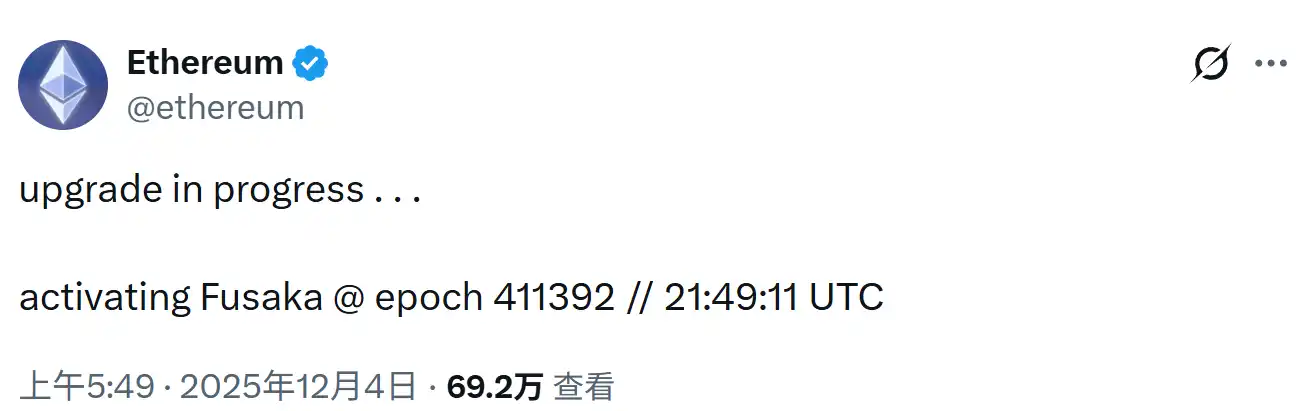
In this Fusaka upgrade, the focus was almost entirely on scaling: Blob capacity expanded by 8 times, combined with PeerDAS random sampling verification, making the cost narrative of the DA (Data Availability) track a thing of the past.

Indeed, cheaper L2s are a good thing, but for Ethereum's long-term ZK roadmap, EIP-7825 is the real game-changer because it sets a Gas limit for a single transaction on Ethereum (about 16.78 million Gas).

As we all know, Ethereum's block Gas Limit was increased to 60 million this year. But even as the upper limit continues to rise, theoretically, if they were willing to pay an extremely high Gas Price, someone could send a super-complex "Mega-Transaction" that directly occupies the entire block's 60 million Gas capacity, thereby clogging the entire block.

This was allowed before, but EIP-7825 introduces a new restriction: no single transaction can consume more than 16.78 million Gas, regardless of the block size.

So why limit the size of a single transaction? This change actually has no impact on ordinary user transfers, but for ZK Provers (proof generators), it is a matter of life and death, and it is also closely related to how ZK systems generate proofs.

To give a simple example, before EIP-7825, if a block contained a "Mega-Transaction" consuming 60 million Gas, the ZK Prover had to run this extremely complex transaction sequentially—it couldn't be split or parallelized. This is like a single-lane highway where a giant, extremely slow truck is in front, and all the cars behind (other transactions) have to wait for it to pass.

This would undoubtedly sentence "real-time proof" to death—because the time to generate the proof would be completely unpredictable, potentially taking dozens of minutes or even longer.

After EIP-7825, even if the block capacity expands to 100 million Gas in the future, since each transaction is forcibly limited to within 16.78 million Gas, each block is broken down into predictable, bounded, and parallelizable "small task units." This means that Ethereum's proof generation has changed from a tricky "logical puzzle" to a pure "money problem":

As long as enough parallel computing power is invested, we can process these split small tasks simultaneously in an extremely short time, thereby generating ZK proofs for huge blocks.

As Michael, co-founder and CEO of Brevis, said, EIP-7825 is the most underestimated upgrade on the future path of ZK and 100x scaling for Ethereum. It turns "real-time proof" from "theoretically impossible" to "engineerably schedulable." As long as we can solve the computing power problem through parallel computation, even a 200 million Gas block could achieve second-level proof. This is not only a breakthrough for ZK technology but also the physical foundation for Ethereum's Interoperability Layer (EIL) to achieve second-level cross-chain settlement.
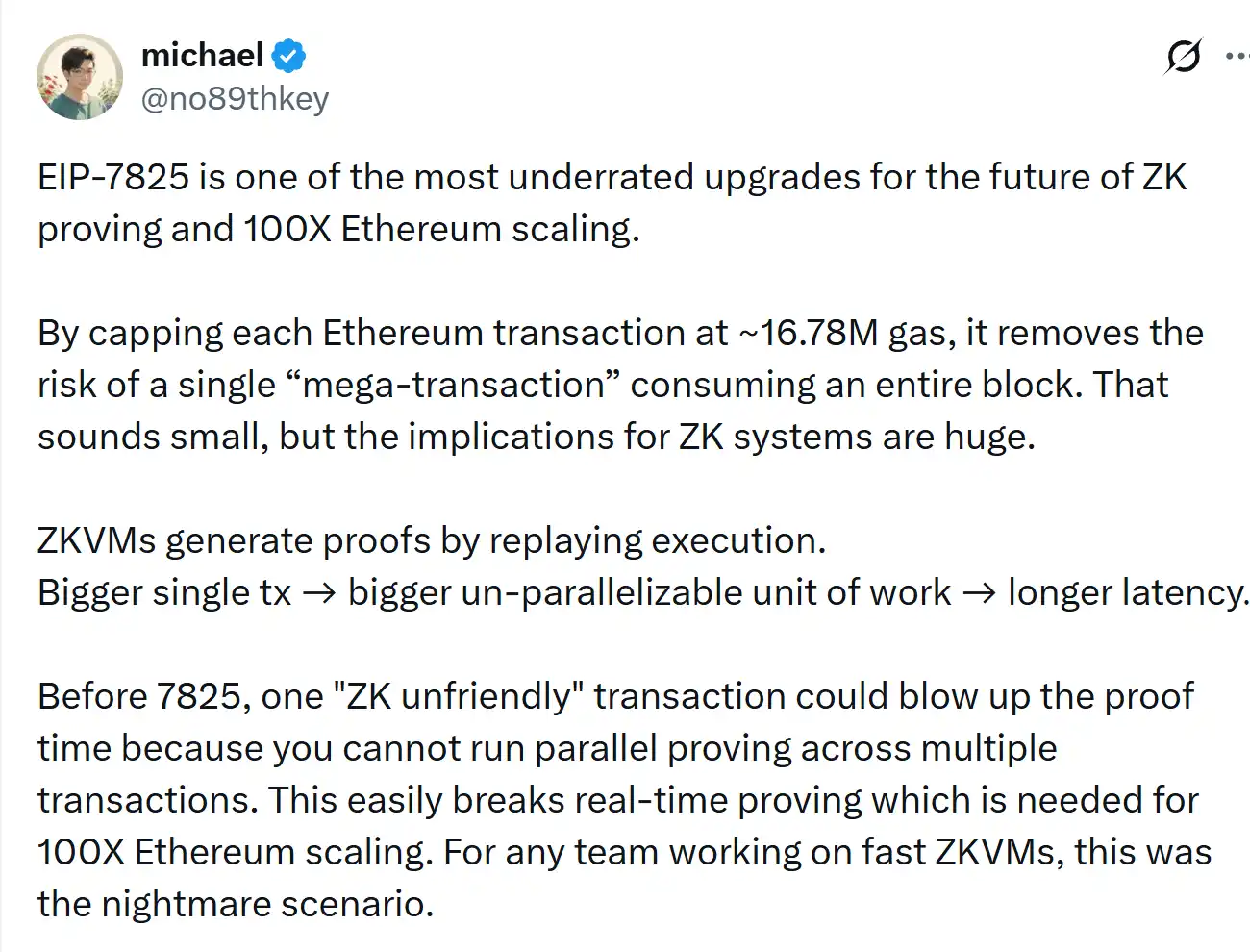
So this upgrade might not seem like the main event, but it is actually a huge breakthrough for the ZK roadmap and Ethereum's scaling future in 2026.

II. L1 zkEVM: The "Trust Anchor" for Ethereum Interoperability

However, although EIP-7825 paves the physical path (parallelizability) for real-time proof by limiting single transaction size, this is only one side of the coin. The other side is how the Ethereum mainnet itself utilizes this capability?

This involves the most hardcore narrative in Ethereum's roadmap—L1 zkEVM.

For a long time, zkEVM has been regarded as the "holy grail" for scaling Ethereum, not only because it can solve performance bottlenecks but also because it redefines the trust mechanism of blockchain. Its core idea is to enable the Ethereum mainnet to generate and verify ZK proofs.

In other words, in the future, after each Ethereum block is executed, it can output a verifiable mathematical proof, allowing other nodes (especially light nodes and L2s) to confirm the correctness of the result without repeating the calculation—if the ability to generate ZK proofs is directly written into the Ethereum protocol layer (L1), the proposer packs a block and generates a ZK proof, and validating nodes no longer need to rerun the transactions; they only need to verify this tiny mathematical proof.

What does this mean for interoperability?

In the context of Interop, the significance of L1 zkEVM far exceeds scaling itself. It can be said to be the "trust anchor" for all L2s. After all, if Ethereum L1 can generate proofs in real time, it means all L2s can read L1's final state in real time and trustlessly. This will bring about two qualitative changes:

  • Eliminate the Challenge Period: The confirmation time between chains will be compressed from "7 days (OP mechanism)" to "seconds (ZK mechanism)";
  • Decentralized Interconnection: Cross-chain will no longer require trust in third-party multi-signature bridges but will trust the mathematical truth of the Ethereum mainnet;

This is also the physical foundation we mentioned in the previous article for EIL (Interoperability Layer) to truly work—without real-time finality from L1, interoperability between L2s will never escape the shadow of "delay."

The goal is set (L1 zkEVM), and the physical limitation is removed (EIP-7825). So what about the specific implementation tools?

This leads to the subtle evolution happening in the ZK technology stack: from zkEVM to zkVM.

III. Fusaka & EIP-7825: The Interoperability Roadmap is Liberated

If EIP-7825 provides a "parallelizable hardware environment" for ZK by limiting single transaction size, then the evolution of the ZK technology stack is to find a "more efficient software architecture." This might sound like a tongue twister, but the difference is significant and represents two stages of ZK development.

The first stage is naturally zkEVM, which can be seen as the compatibility faction or the reformist faction.

The logic is to strive to imitate every instruction of the Ethereum EVM, allowing developers to deploy Solidity code directly, reducing migration costs and barriers.

In other words, the biggest advantage of zkEVM is its compatibility with existing Ethereum applications, greatly reducing the workload for Ethereum ecosystem developers. They can reuse most of the existing infrastructure and tools (including execution clients, block explorers, debugging tools, etc.).

However, precisely because of this, since the EVM was not designed with ZK-friendliness in mind, for the sake of compatibility, zkEVM's proof efficiency often has a ceiling, and proof times are much slower, burdened by historical baggage.

zkVM, on the other hand, belongs to the radical revolutionary faction, directly building a virtual machine that is extremely friendly to ZK proofs (such as based on RISC-V or WASM) to speed up proof time and achieve better execution speed and performance.

But it also loses compatibility with many EVM features and the ability to use existing tools (like low-level debuggers). However, a clear trend is that more and more L2 projects are shedding their baggage,极致 optimizing proof speed and cost, and exploring architectures based on zkVM.

So why is the Fusaka upgrade the unlocker?

After all, before EIP-7825, whether zkEVM or zkVM, once they encountered a Mega-Transaction on Ethereum, the proof generation time would skyrocket due to the inability to split the task.

Now, EIP-7825 forcibly breaks down transactions into predictable small units. With a parallelizable environment, an efficient architecture like zkVM can exert its maximum power. Even complex Ethereum blocks, when placed in a zkVM and combined with parallel computing power, can achieve real-time proof.

What does this mean for interoperability? The proliferation of zkVM combined with EIP-7825 means the cost of generating proofs will drop significantly. When the cost of generating a cross-chain proof is low enough to be negligible, and the speed is as fast as sending an email, traditional "cross-chain bridges" will completely disappear, replaced by underlying universal message protocols.

In Conclusion

As repeatedly mentioned in previous articles of the Interop series, the ultimate goal of Interop is not just asset "cross-chain," nor is it limited to the concept of "asset bridges" anymore. It is a comprehensive set of system-level capabilities, including cross-chain data communication, cross-chain logic execution, cross-chain user experience, cross-chain security, and consensus.

From this perspective, Interop can be understood as the universal language between future Ethereum ecosystem protocols. Its significance lies not only in transferring value but also in sharing logic. ZK's role in this is to guarantee execution correctness and support real-time state verification, making cross-domain calls "dare to do, able to do." It can even be said that without real-time ZK, there can hardly be truly usable Interop UX.

So when EIP-7825 was quietly activated in the Fusaka upgrade, and as L1 zkEVM gradually becomes a reality, we are getting closer to that ultimate goal: execution, settlement, and proof are completely abstracted in the background, and users are completely unaware of the chain's existence throughout the process.

This is the Interop endgame we all look forward to in the future.

Trend Kriptolar

İlgili Sorular

QWhat is the significance of EIP-7825 in the Fusaka upgrade for Ethereum's interoperability?

AEIP-7825 introduces a gas limit per transaction (approximately 16.78 million gas), which prevents a single complex 'mega-transaction' from blocking an entire Ethereum block. This allows for parallel processing of transactions, making it feasible to generate ZK proofs in real-time. This is a critical engineering enabler for Ethereum's ZK roadmap and interoperability, as it transforms proof generation from a logical challenge into a solvable computational problem, paving the way for near-instant cross-chain settlements.

QHow does L1 zkEVM serve as a 'trust anchor' for Ethereum interoperability?

AL1 zkEVM integrates the ability to generate and verify ZK proofs directly into the Ethereum protocol layer. This means every block produced on Ethereum L1 can be accompanied by a verifiable mathematical proof. For interoperability, this allows all L2s to read the final state of L1 in real-time without trust. It eliminates the need for long challenge periods (e.g., the 7-day wait in Optimistic Rollups) and enables decentralized cross-chain communication without relying on trusted multi-signature bridges, as chains can trust the mathematical truth of Ethereum's mainnet.

QWhat is the key difference between zkEVM and zkVM in the context of ZK technology evolution?

AzkEVM focuses on full compatibility with the Ethereum Virtual Machine (EVM), allowing developers to deploy existing Solidity code with minimal changes. However, this compatibility often results in slower proof generation due to EVM's design not being ZK-friendly. In contrast, zkVM is a more radical approach that builds a new virtual machine (e.g., based on RISC-V or WASM) optimized for ZK proof efficiency and execution speed. While zkVM sacrifices some EVM compatibility and existing tooling, it offers significantly faster proof generation and better performance, which is crucial for real-time interoperability.

QHow does the combination of EIP-7825 and zkVM architecture enhance Ethereum's interoperability capabilities?

AEIP-7825 ensures that Ethereum transactions are broken down into small, predictable units that can be processed in parallel. This eliminates the problem of 'mega-transactions' causing unpredictable proof generation times. When combined with the efficient architecture of zkVM, which is designed for speed and low cost, it becomes possible to generate ZK proofs for complex Ethereum blocks in real-time. This drastically reduces the cost and increases the speed of cross-chain proof generation, making traditional cross-chain bridges obsolete and enabling seamless,底层通用消息协议 for interoperability.

QWhat is the ultimate goal of Interop (interoperability) in the Ethereum ecosystem, as described in the article?

AThe ultimate goal of Interop is not just cross-chain asset transfers but a comprehensive system-level capability that includes cross-chain data communication, logic execution, user experience, security, and consensus. It aims to create a universal language for protocols within the Ethereum ecosystem, enabling not only value transfer but also logic sharing. ZK technology ensures execution correctness and real-time state verification, making cross-domain interactions feasible and user-friendly. The end vision is a fully abstracted backend where users are unaware of the underlying chains, experiencing seamless interoperability.

İlgili Okumalar

Will History Repeat Itself? Fidelity Lists Five Catalysts to End the Crypto Winter

Fidelity's new report suggests that the current crypto winter for Bitcoin may be nearing its end, identifying five potential catalysts that could drive a market turnaround based on historical patterns. First, Bitcoin's approximately four-year cycle, driven by its halving mechanism, historically marks peaks and troughs. The last bottom was in November 2022, potentially pointing to the next around November 2026, though cycle length can vary. Second, clearer regulation has often preceded past bull markets. The focus is now on the CLARITY Act, which aims to clarify US digital asset oversight between the SEC and CFTC. Its passage could unlock domestic activity currently held back by legal uncertainty. Third, Federal Reserve monetary policy plays a role. A shift to lower interest rates tends to correlate with rising crypto prices by reducing borrowing costs and boosting risk appetite, though markets may price this in well ahead of any official change. Fourth, the emergence of breakthrough applications can fuel investor interest. Current trends like real-world asset tokenization, AI-related crypto infrastructure, and stablecoins are being watched, but history shows the biggest catalysts are often unexpected. Fifth, a new wave of institutional adoption could be a trigger. While ongoing adoption in 2026 hasn't sparked a new bull run, a major unexpected move—like a significant purchase by a tech giant or adoption as a hedge in a global crisis—could create a powerful new narrative. Fidelity concludes that while the market is in a downturn, historical turning points have often resulted from a combination of such factors, and the next phase for Bitcoin may depend on which of these catalysts materializes first.

Foresight News9 dk önce

Will History Repeat Itself? Fidelity Lists Five Catalysts to End the Crypto Winter

Foresight News9 dk önce

US CFTC Launches Broad Investigation into Polymarket, Is the Prediction Market Party Coming to an End?

The U.S. Commodity Futures Trading Commission (CFTC) is conducting a broad investigation into the prediction market platform Polymarket, focusing on its business practices including social media promotions. This follows a bipartisan letter from U.S. senators urging the CFTC to probe alleged fraudulent marketing tactics used to promote gambling-like products. The action coincides with a period of explosive growth for the prediction market sector, driven by events like the World Cup, with platforms like Kalshi and Robinhood reporting record trading volumes and revenue. The investigation signals a potential end to the sector's unregulated expansion and may lead to clearer federal oversight, particularly regarding investor protection and distinguishing prediction markets from traditional sports betting. The CFTC's move has also intensified a jurisdictional conflict with multiple U.S. states (including Kentucky and New York), which have sued platforms like Polymarket and Kalshi, accusing them of operating illegal sports betting and threatening state gambling tax revenues. Furthermore, the CME Group has sued the CFTC, challenging its approval of certain prediction market products. The report also highlights the political and capital interests intertwined with the industry. Donald Trump Jr. holds advisory and investment roles in both Kalshi and Polymarket, and the Trump administration has previously emphasized federal regulatory authority over these markets. The CFTC's investigation into Polymarket is framed as a step towards formalizing the industry's regulatory landscape, moving it from a phase of "wild growth" towards a more structured future.

marsbit2 saat önce

US CFTC Launches Broad Investigation into Polymarket, Is the Prediction Market Party Coming to an End?

marsbit2 saat önce

U.S. CFTC Launches Extensive Investigation into Polymarket, Is the Prediction Market Frenzy Season Cooling Down?

The U.S. Commodity Futures Trading Commission (CFTC) has launched a broad investigation into the prediction market platform Polymarket, focusing on its business practices including social media activities. This follows a bipartisan letter from U.S. senators urging the CFTC to probe allegations of paid influencer false marketing and fraudulent promotion of gambling-like products to American users. The investigation comes as the prediction market sector experiences explosive growth, largely driven by the World Cup. Weekly trading volumes have hit record highs, exceeding $14.4 billion, with platforms like Kalshi and Robinhood's new venture seeing significant activity. Major firms like Meta are also showing interest in the space. This regulatory scrutiny signals a potential end to the sector's "wild growth" phase. The CFTC's move also highlights an escalating jurisdictional conflict between federal regulators and state authorities. Over a dozen states, including Kentucky and New York, have sued platforms like Polymarket and Kalshi, accusing them of operating illegal sports betting, which threatens state gambling tax revenues. The CFTC is countersuing to assert its exclusive federal jurisdiction over these "event contracts" as derivatives. Furthermore, the CFTC's approval of Kalshi's Bitcoin perpetual futures contract has sparked a lawsuit from traditional exchange CME, alleging regulatory overreach. The political and capital landscape is intricate, with Donald Trump Jr. holding advisory roles and investments in both Kalshi and Polymarket. This connects capital, political influence, and regulatory bodies, suggesting the current investigation may be a step toward formalizing the industry's rules rather than halting its progress.

Odaily星球日报2 saat önce

U.S. CFTC Launches Extensive Investigation into Polymarket, Is the Prediction Market Frenzy Season Cooling Down?

Odaily星球日报2 saat önce

İşlemler

Spot

Popüler Makaleler

NASDAQ100 Nasıl Satın Alınır

HTX.com’a hoş geldiniz! Nasdaq-100 Index (NASDAQ100) satın alma işlemlerini basit ve kullanışlı bir hâle getirdik. Adım adım açıkladığımız rehberimizi takip ederek kripto yolculuğunuza başlayın. 1. Adım: HTX Hesabınızı OluşturunHTX'te ücretsiz bir hesap açmak için e-posta adresinizi veya telefon numaranızı kullanın. Sorunsuzca kaydolun ve tüm özelliklerin kilidini açın. Hesabımı Aç2. Adım: Kripto Satın Al Bölümüne Gidin ve Ödeme Yönteminizi SeçinKredi/Banka Kartı: Visa veya Mastercard'ınızı kullanarak anında Nasdaq-100 Index (NASDAQ100) satın alın.Bakiye: Sorunsuz bir şekilde işlem yapmak için HTX hesap bakiyenizdeki fonları kullanın.Üçüncü Taraflar: Kullanımı kolaylaştırmak için Google Pay ve Apple Pay gibi popüler ödeme yöntemlerini ekledik.P2P: HTX'teki diğer kullanıcılarla doğrudan işlem yapın.Borsa Dışı (OTC): Yatırımcılar için kişiye özel hizmetler ve rekabetçi döviz kurları sunuyoruz.3. Adım: Nasdaq-100 Index (NASDAQ100) Varlıklarınızı SaklayınNasdaq-100 Index (NASDAQ100) satın aldıktan sonra HTX hesabınızda saklayın. Alternatif olarak, blok zinciri transferi yoluyla başka bir yere gönderebilir veya diğer kripto para birimlerini takas etmek için kullanabilirsiniz.4. Adım: Nasdaq-100 Index (NASDAQ100) Varlıklarınızla İşlem YapınHTX'in spot piyasasında Nasdaq-100 Index (NASDAQ100) ile kolayca işlemler yapın.Hesabınıza erişin, işlem çiftinizi seçin, işlemlerinizi gerçekleştirin ve gerçek zamanlı olarak izleyin. Hem yeni başlayanlar hem de deneyimli yatırımcılar için kullanıcı dostu bir deneyim sunuyoruz.

36 Toplam GörüntülenmeYayınlanma 2026.06.18Güncellenme 2026.06.18

NASDAQ100 Nasıl Satın Alınır

RE Nedir

I. Proje Tanıtımı1. Re Protokolü Nedir?Re Protokolü, stabilcoin sermayesini düzenlenmiş gerçek dünya reasürans pazarlarına bağlayan merkeziyetsiz bir reasürans protokolüdür. Kullanıcılar, Sigorta Sermaye Katmanı (ICL) akıllı sözleşmesine stabilcoin yatırır. Yatırılan fonlar, tamamen teminatlandırılmış reasürans sözleşmelerini desteklemek için kullanılır ve yatıranlar karşılığında ödüller kazanır. Getiri, hem zincir içi hem de zincir dışı kaynaklardan ve ayrıca token'a özel farklardan elde edilir. Protokol, Ethereum, Avalanche ve Arbitrum dahil olmak üzere birden fazla zincirde çalışmaktadır.2. Re Protokolü Nasıl Çalışır?Kullanıcılar, ICL akıllı sözleşmelerine onaylı varlıklar (örneğin USDC, USDe, sUSDe) yatırarak iki getiri getiren token'dan birini basarlar. Fonlar günlük olarak Fireblocks saklama kasasına toplanır, çoklu imza kontrolü altında tutulur ve bakiyeler günlük olarak Chainlink oracle'larına yayınlanır. Lisanslı reasürans şirketleri, bir Fazla Notası uyarınca fon çektiğinde, sermayenin bir kısmı ABD merkezli §114 reasürans güven hesaplarına aktarılır ve bu, reasürans şirketinin poliçeleri için uyumlu teminat olarak hizmet eder. Reasürans sözleşmeleri olgunlaştıkça ve aktüeryal ekip sermaye serbest bıraktıkça, likidite protokole geri akar, reUSD geri ödemelerini destekler ve her iki token için getiri birikir.Protokol, sermaye yapısındaki farklı dilimlere karşılık gelen iki token sunmaktadır:reUSD (Basis-Plus, Kıdemli Dilim): Getiri, bir karışık oran (SOFR ve 7 günlük sUSDe oranının ağırlıklı ortalaması) artı 250 baz puan farktır. Daha yüksek likidite sunar ve kapasite mevcut olduğunda anlık geri ödemeyi destekler.reUSDe (Sigorta Alfa, Genç Dilim): Getiri, aynı karışık oran artı 850 baz puan farktır ve kıdemli dilimden önce kayıpları absorbe etme karşılığında sunulur. Geri ödemeler üç aylıktır. reUSDe'nin en az 40 gün minimum tutma süresi vardır.Sermaye Koruma Katmanları: Reasürans şirketinin kendi öz sermayesi önce kayıpları absorbe eder, ardından reUSDe gelir, reUSD ise altındaki iki katman tarafından korunan en kıdemli dilimdir.3. Re Protokolünü Kim Kurdu?Karn Saroya, Kurucu Ortak ve CEO, MIT'den mezun olmuştur. Daha önce, girişim destekli sigorta teknolojisi platformu Cover'ı (lisanslı bir aracılık, daha sonra faaliyetlerini durdurdu) kurmuş ve daha önce moda uygulaması Stylekick'i (2015'te Shopify tarafından satın alındı) kurmuştur. Ayrıca daha önce finansal hizmetler danışmanlığı alanında çalışmıştır.Finansman Detayları:Eylül 2022: Re, Tribe Capital tarafından yönetilen 14 milyon dolarlık bir Seed turunu tamamladı (Tribe Crypto Labs aracılığıyla kuluçkaya alınmıştır) ve Framework Ventures, Morgan Creek Digital, Defy VC, Stratos, Exor, SiriusPoint ve diğerlerinin katılımıyla gerçekleşmiştir.Mayıs 2024: Electric Capital tarafından yönetilen 7 milyon dolarlık bir finansman turunu tamamladı.4. Re Protokolü TokenomisiRE, Re Protokolü'nün yönetim token'ıdır ve toplamda 1 milyar token ile sabit bir arzı vardır, enflasyonist bir mekanizma yoktur ve sürekli bir basım planı yoktur. Token, piyasa erişimi, teşvik bütçeleri, staking ve delege etme, komiteler, protokol yükseltmeleri ve paylaşılan dayanıklılık sermayesini kapsayan stake-to-vote modeli aracılığıyla yönetişim için kullanılır.Token dağılımı:Ekosistem (yüzde 50): Staking ödülleri, yönetişim katılımı, likidite, entegrasyonlar, hibe, piyasa genişlemesi ve ekosistem büyümesi için kullanılır. TGE'de 159.6 milyon token dolaşımda olup, geri kalanı 48 ay boyunca lineer olarak vestinge tabi olacaktır.Temel Katkıda Bulunanlar (yüzde 20): Protokolü, yönetişim sistemlerini, entegrasyonları, risk çerçevelerini ve piyasa altyapısını inşa eden temel katkıda bulunanlar ve danışmanları içerir; 12 aylık bir cliff ve ardından 36 aylık lineer vesting uygulanır.Yatırımcılar (yüzde 17): Stratejik destekçiler; 12 aylık bir cliff ve ardından 36 aylık lineer vesting uygulanır.Ekosistem Geliştirme Rezervi (yüzde 13): Gelecek katkılar ve katkıda bulunanlar için uzun vadeli rezerv.5. Anahtar Dönüm Noktalarının Zaman ÇizelgesiEylül 2022: Re, 14 milyon dolarlık bir Seed turunu tamamladı, halka açıldı ve ilk blockchain destekli reasürans protokolü olarak kendini konumlandırdı, başlangıçta Avalanche üzerinde inşa edildi.Mayıs 2024: Electric Capital tarafından yönetilen 7 milyon dolarlık bir finansman turunu tamamladı.18 Haziran 2026: $RE token resmi olarak piyasaya sürüldü.​II. Token BilgisiToken adı: RE(Re)III. İlgili BağlantılarWeb sitesi: https://re.xyz/Keşif Araçları: https://etherscan.io/token/0x526526528f35ac738177003b8773b402b8df8143Twitter: https://twitter.com/reNot: Proje tanıtımı, resmi proje ekibi tarafından yayımlanan veya sağlanan materyallerden alınmıştır, yalnızca referans amaçlıdır ve yatırım tavsiyesi niteliğinde değildir. HTX, doğrudan veya dolaylı olarak ortaya çıkan herhangi bir kayıptan sorumluluk kabul etmez.

253 Toplam GörüntülenmeYayınlanma 2026.06.18Güncellenme 2026.06.29

RE Nedir

RE Nasıl Satın Alınır

HTX.com’a hoş geldiniz! Re (RE) satın alma işlemlerini basit ve kullanışlı bir hâle getirdik. Adım adım açıkladığımız rehberimizi takip ederek kripto yolculuğunuza başlayın. 1. Adım: HTX Hesabınızı OluşturunHTX'te ücretsiz bir hesap açmak için e-posta adresinizi veya telefon numaranızı kullanın. Sorunsuzca kaydolun ve tüm özelliklerin kilidini açın. Hesabımı Aç2. Adım: Kripto Satın Al Bölümüne Gidin ve Ödeme Yönteminizi SeçinKredi/Banka Kartı: Visa veya Mastercard'ınızı kullanarak anında Re (RE) satın alın.Bakiye: Sorunsuz bir şekilde işlem yapmak için HTX hesap bakiyenizdeki fonları kullanın.Üçüncü Taraflar: Kullanımı kolaylaştırmak için Google Pay ve Apple Pay gibi popüler ödeme yöntemlerini ekledik.P2P: HTX'teki diğer kullanıcılarla doğrudan işlem yapın.Borsa Dışı (OTC): Yatırımcılar için kişiye özel hizmetler ve rekabetçi döviz kurları sunuyoruz.3. Adım: Re (RE) Varlıklarınızı SaklayınRe (RE) satın aldıktan sonra HTX hesabınızda saklayın. Alternatif olarak, blok zinciri transferi yoluyla başka bir yere gönderebilir veya diğer kripto para birimlerini takas etmek için kullanabilirsiniz.4. Adım: Re (RE) Varlıklarınızla İşlem YapınHTX'in spot piyasasında Re (RE) ile kolayca işlemler yapın.Hesabınıza erişin, işlem çiftinizi seçin, işlemlerinizi gerçekleştirin ve gerçek zamanlı olarak izleyin. Hem yeni başlayanlar hem de deneyimli yatırımcılar için kullanıcı dostu bir deneyim sunuyoruz.

86 Toplam GörüntülenmeYayınlanma 2026.06.18Güncellenme 2026.06.29

RE Nasıl Satın Alınır

Tartışmalar

HTX Topluluğuna hoş geldiniz. Burada, en son platform gelişmeleri hakkında bilgi sahibi olabilir ve profesyonel piyasa görüşlerine erişebilirsiniz. Kullanıcıların A (A) fiyatı hakkındaki görüşleri aşağıda sunulmaktadır.

活动图片