Interop Roadmap Accelerates: After Fusaka Upgrade, Ethereum Interoperability May Take a Key Leap

marsbit2025-12-11 tarihinde yayınlandı2025-12-11 tarihinde güncellendi

Özet

Recent Ethereum Fusaka upgrade, while primarily focused on Blob capacity expansion, introduced the underappreciated EIP-7825, a critical enabler for Ethereum's zero-knowledge (ZK) and interoperability roadmap. This proposal sets a hard per-transaction gas limit (~16.78 million gas), preventing "mega-transactions" from monopolizing a block. This change transforms block proof generation from a sequential logic problem into a parallelizable computational task, making real-time ZK proofs an engineering feasibility rather than a theoretical impossibility. This foundational shift is pivotal for the L1 zkEVM vision, where Ethereum itself generates verifiable proofs for its state transitions. L1 zkEVM acts as a universal "trust anchor," allowing Layer 2s (L2s) to instantly and trustlessly verify the mainnet's state without waiting for challenge periods. This eliminates the speed-trust decentralization trade-off, enabling near-instant, decentralized cross-chain interoperability. Concurrently, ZK technology is evolving from EVM-compatible zkEVMs to more efficient, ZK-optimized zkVMs. EIP-7825's parallelizable environment allows these zkVMs to operate at peak efficiency, drastically reducing proof generation cost and time. The convergence of EIP-7825, L1 zkEVM, and advanced zkVMs paves the way for the final stage of interoperability (Interop)—abstracting away chain boundaries to deliver a single-chain user experience where cross-chain actions are seamless, secure, and instantaneous.

Author: imToken

In previous articles of the Interop series, we discussed OIF (Intent Framework) and EIL (Interoperability Layer), which respectively address the standardization of cross-chain intents (making the entire network understand what you want to do) and the execution channel problem (enabling funds to move in a standardized manner).

However, achieving a perfect "single-chain experience" still involves a trade-off between speed and trust. After all, in the current interoperability experience, one must either endure slowness (such as Optimistic Rollup requiring a 7-day challenge period to confirm finality) or sacrifice decentralization (relying on the trust assumptions of multi-signature bridges).

To break this "impossible triangle," it is essential to have a foundational capability that spans the "acceleration" and finalization of Ethereum's interoperability roadmap—the "real-time proof" brought by ZK technology (extended reading: "Ethereum Interop Roadmap: How to Unlock the 'Last Mile' of Mass Adoption").

And the recently activated Fusaka upgrade, with its inconspicuous EIP-7825, has cleared the biggest engineering obstacle for this ultimate goal.

I. Behind the Fusaka Upgrade: The Underestimated EIP-7825

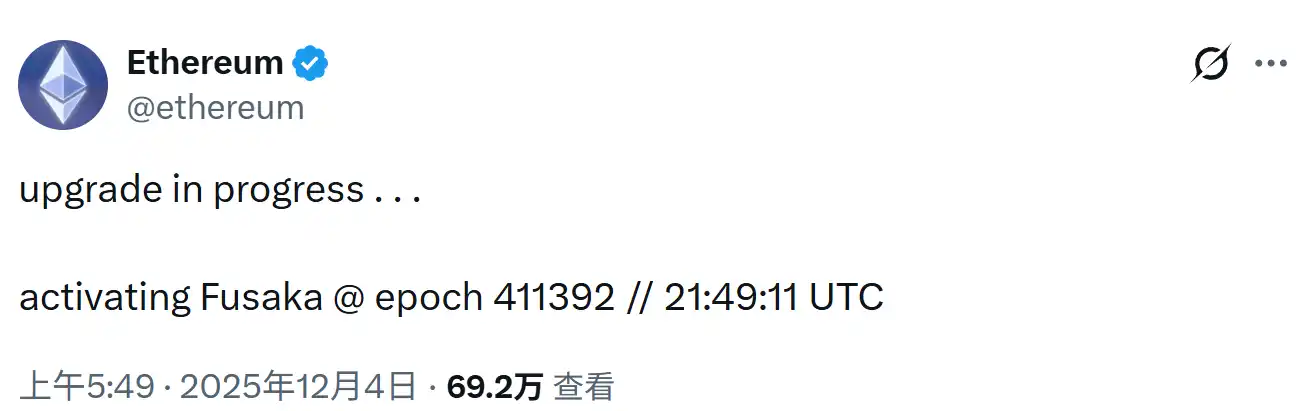
On December 4, the Ethereum Fusaka upgrade was officially activated on the mainnet. Unlike the fanfare of the Dencun upgrade, the market spotlight was largely focused on Blob scaling and PeerDAS, with much discussion about the further reduction of L2 data costs.

But beyond this buzz, there was actually a low-profile proposal, EIP-7825, which removed the biggest obstacle to achieving L1 zkEVM and real-time proof for Ethereum, and can even be said to be quietly paving the way for the ultimate goal of Interop.
In this Fusaka upgrade, the focus was almost entirely on scaling: Blob capacity expanded by 8 times, combined with PeerDAS random sampling verification, making the cost narrative of the DA (Data Availability) track a thing of the past.

Indeed, cheaper L2s are a good thing, but for Ethereum's long-term ZK roadmap, EIP-7825 is the real game-changer because it sets a Gas limit for a single transaction on Ethereum (about 16.78 million Gas).

As we all know, Ethereum's block Gas Limit was increased to 60 million this year. But even as the upper limit continues to rise, theoretically, if they were willing to pay an extremely high Gas Price, someone could send a super-complex "Mega-Transaction" that directly occupies the entire block's 60 million Gas capacity, thereby clogging the entire block.

This was allowed before, but EIP-7825 introduces a new restriction: no single transaction can consume more than 16.78 million Gas, regardless of the block size.

So why limit the size of a single transaction? This change actually has no impact on ordinary user transfers, but for ZK Provers (proof generators), it is a matter of life and death, and it is also closely related to how ZK systems generate proofs.

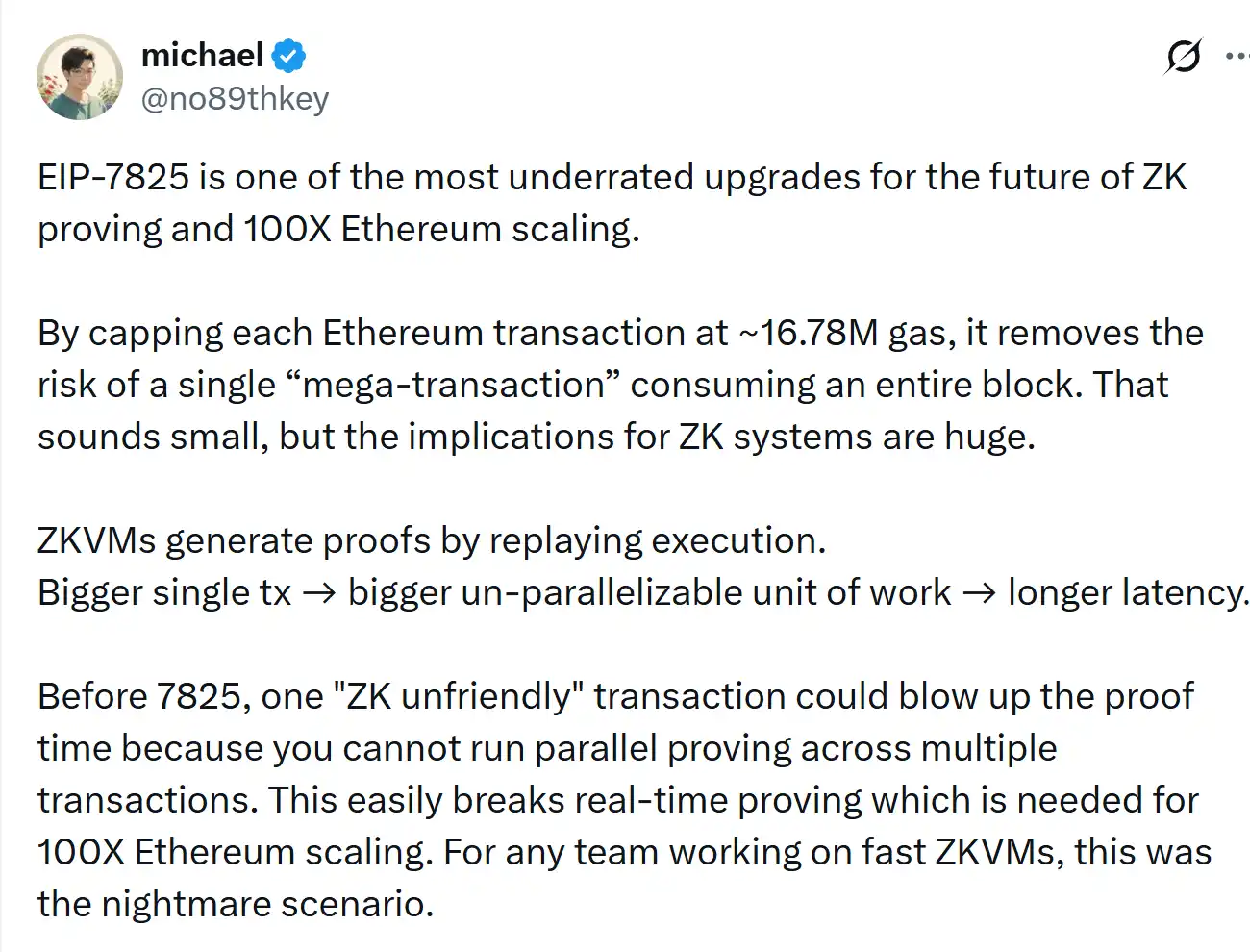
To give a simple example, before EIP-7825, if a block contained a "Mega-Transaction" consuming 60 million Gas, the ZK Prover had to run this extremely complex transaction sequentially—it couldn't be split or parallelized. This is like a single-lane highway where a giant, extremely slow truck is in front, and all the cars behind (other transactions) have to wait for it to pass.

This would undoubtedly sentence "real-time proof" to death—because the time to generate the proof would be completely unpredictable, potentially taking dozens of minutes or even longer.

After EIP-7825, even if the block capacity expands to 100 million Gas in the future, since each transaction is forcibly limited to within 16.78 million Gas, each block is broken down into predictable, bounded, and parallelizable "small task units." This means that Ethereum's proof generation has changed from a tricky "logical puzzle" to a pure "money problem":

As long as enough parallel computing power is invested, we can process these split small tasks simultaneously in an extremely short time, thereby generating ZK proofs for huge blocks.

As Michael, co-founder and CEO of Brevis, said, EIP-7825 is the most underestimated upgrade on the future path of ZK and 100x scaling for Ethereum. It turns "real-time proof" from "theoretically impossible" to "engineerably schedulable." As long as we can solve the computing power problem through parallel computation, even a 200 million Gas block could achieve second-level proof. This is not only a breakthrough for ZK technology but also the physical foundation for Ethereum's Interoperability Layer (EIL) to achieve second-level cross-chain settlement.
So this upgrade might not seem like the main event, but it is actually a huge breakthrough for the ZK roadmap and Ethereum's scaling future in 2026.

II. L1 zkEVM: The "Trust Anchor" for Ethereum Interoperability

However, although EIP-7825 paves the physical path (parallelizability) for real-time proof by limiting single transaction size, this is only one side of the coin. The other side is how the Ethereum mainnet itself utilizes this capability?

This involves the most hardcore narrative in Ethereum's roadmap—L1 zkEVM.

For a long time, zkEVM has been regarded as the "holy grail" for scaling Ethereum, not only because it can solve performance bottlenecks but also because it redefines the trust mechanism of blockchain. Its core idea is to enable the Ethereum mainnet to generate and verify ZK proofs.

In other words, in the future, after each Ethereum block is executed, it can output a verifiable mathematical proof, allowing other nodes (especially light nodes and L2s) to confirm the correctness of the result without repeating the calculation—if the ability to generate ZK proofs is directly written into the Ethereum protocol layer (L1), the proposer packs a block and generates a ZK proof, and validating nodes no longer need to rerun the transactions; they only need to verify this tiny mathematical proof.

What does this mean for interoperability?

In the context of Interop, the significance of L1 zkEVM far exceeds scaling itself. It can be said to be the "trust anchor" for all L2s. After all, if Ethereum L1 can generate proofs in real time, it means all L2s can read L1's final state in real time and trustlessly. This will bring about two qualitative changes:

  • Eliminate the Challenge Period: The confirmation time between chains will be compressed from "7 days (OP mechanism)" to "seconds (ZK mechanism)";
  • Decentralized Interconnection: Cross-chain will no longer require trust in third-party multi-signature bridges but will trust the mathematical truth of the Ethereum mainnet;

This is also the physical foundation we mentioned in the previous article for EIL (Interoperability Layer) to truly work—without real-time finality from L1, interoperability between L2s will never escape the shadow of "delay."

The goal is set (L1 zkEVM), and the physical limitation is removed (EIP-7825). So what about the specific implementation tools?

This leads to the subtle evolution happening in the ZK technology stack: from zkEVM to zkVM.

III. Fusaka & EIP-7825: The Interoperability Roadmap is Liberated

If EIP-7825 provides a "parallelizable hardware environment" for ZK by limiting single transaction size, then the evolution of the ZK technology stack is to find a "more efficient software architecture." This might sound like a tongue twister, but the difference is significant and represents two stages of ZK development.

The first stage is naturally zkEVM, which can be seen as the compatibility faction or the reformist faction.

The logic is to strive to imitate every instruction of the Ethereum EVM, allowing developers to deploy Solidity code directly, reducing migration costs and barriers.

In other words, the biggest advantage of zkEVM is its compatibility with existing Ethereum applications, greatly reducing the workload for Ethereum ecosystem developers. They can reuse most of the existing infrastructure and tools (including execution clients, block explorers, debugging tools, etc.).

However, precisely because of this, since the EVM was not designed with ZK-friendliness in mind, for the sake of compatibility, zkEVM's proof efficiency often has a ceiling, and proof times are much slower, burdened by historical baggage.

zkVM, on the other hand, belongs to the radical revolutionary faction, directly building a virtual machine that is extremely friendly to ZK proofs (such as based on RISC-V or WASM) to speed up proof time and achieve better execution speed and performance.

But it also loses compatibility with many EVM features and the ability to use existing tools (like low-level debuggers). However, a clear trend is that more and more L2 projects are shedding their baggage,极致 optimizing proof speed and cost, and exploring architectures based on zkVM.

So why is the Fusaka upgrade the unlocker?

After all, before EIP-7825, whether zkEVM or zkVM, once they encountered a Mega-Transaction on Ethereum, the proof generation time would skyrocket due to the inability to split the task.

Now, EIP-7825 forcibly breaks down transactions into predictable small units. With a parallelizable environment, an efficient architecture like zkVM can exert its maximum power. Even complex Ethereum blocks, when placed in a zkVM and combined with parallel computing power, can achieve real-time proof.

What does this mean for interoperability? The proliferation of zkVM combined with EIP-7825 means the cost of generating proofs will drop significantly. When the cost of generating a cross-chain proof is low enough to be negligible, and the speed is as fast as sending an email, traditional "cross-chain bridges" will completely disappear, replaced by underlying universal message protocols.

In Conclusion

As repeatedly mentioned in previous articles of the Interop series, the ultimate goal of Interop is not just asset "cross-chain," nor is it limited to the concept of "asset bridges" anymore. It is a comprehensive set of system-level capabilities, including cross-chain data communication, cross-chain logic execution, cross-chain user experience, cross-chain security, and consensus.

From this perspective, Interop can be understood as the universal language between future Ethereum ecosystem protocols. Its significance lies not only in transferring value but also in sharing logic. ZK's role in this is to guarantee execution correctness and support real-time state verification, making cross-domain calls "dare to do, able to do." It can even be said that without real-time ZK, there can hardly be truly usable Interop UX.

So when EIP-7825 was quietly activated in the Fusaka upgrade, and as L1 zkEVM gradually becomes a reality, we are getting closer to that ultimate goal: execution, settlement, and proof are completely abstracted in the background, and users are completely unaware of the chain's existence throughout the process.

This is the Interop endgame we all look forward to in the future.

Trend Kriptolar

İlgili Sorular

QWhat is the significance of EIP-7825 in the Fusaka upgrade for Ethereum's interoperability?

AEIP-7825 introduces a gas limit per transaction (approximately 16.78 million gas), which prevents a single complex 'mega-transaction' from blocking an entire Ethereum block. This allows for parallel processing of transactions, making it feasible to generate ZK proofs in real-time. This is a critical engineering enabler for Ethereum's ZK roadmap and interoperability, as it transforms proof generation from a logical challenge into a solvable computational problem, paving the way for near-instant cross-chain settlements.

QHow does L1 zkEVM serve as a 'trust anchor' for Ethereum interoperability?

AL1 zkEVM integrates the ability to generate and verify ZK proofs directly into the Ethereum protocol layer. This means every block produced on Ethereum L1 can be accompanied by a verifiable mathematical proof. For interoperability, this allows all L2s to read the final state of L1 in real-time without trust. It eliminates the need for long challenge periods (e.g., the 7-day wait in Optimistic Rollups) and enables decentralized cross-chain communication without relying on trusted multi-signature bridges, as chains can trust the mathematical truth of Ethereum's mainnet.

QWhat is the key difference between zkEVM and zkVM in the context of ZK technology evolution?

AzkEVM focuses on full compatibility with the Ethereum Virtual Machine (EVM), allowing developers to deploy existing Solidity code with minimal changes. However, this compatibility often results in slower proof generation due to EVM's design not being ZK-friendly. In contrast, zkVM is a more radical approach that builds a new virtual machine (e.g., based on RISC-V or WASM) optimized for ZK proof efficiency and execution speed. While zkVM sacrifices some EVM compatibility and existing tooling, it offers significantly faster proof generation and better performance, which is crucial for real-time interoperability.

QHow does the combination of EIP-7825 and zkVM architecture enhance Ethereum's interoperability capabilities?

AEIP-7825 ensures that Ethereum transactions are broken down into small, predictable units that can be processed in parallel. This eliminates the problem of 'mega-transactions' causing unpredictable proof generation times. When combined with the efficient architecture of zkVM, which is designed for speed and low cost, it becomes possible to generate ZK proofs for complex Ethereum blocks in real-time. This drastically reduces the cost and increases the speed of cross-chain proof generation, making traditional cross-chain bridges obsolete and enabling seamless,底层通用消息协议 for interoperability.

QWhat is the ultimate goal of Interop (interoperability) in the Ethereum ecosystem, as described in the article?

AThe ultimate goal of Interop is not just cross-chain asset transfers but a comprehensive system-level capability that includes cross-chain data communication, logic execution, user experience, security, and consensus. It aims to create a universal language for protocols within the Ethereum ecosystem, enabling not only value transfer but also logic sharing. ZK technology ensures execution correctness and real-time state verification, making cross-domain interactions feasible and user-friendly. The end vision is a fully abstracted backend where users are unaware of the underlying chains, experiencing seamless interoperability.

İlgili Okumalar

Analyzing the Impact of AI on Economic Growth and Productivity

**Title: Analyzing AI's Impact on Economic Growth and Productivity** This article examines three contrasting views on AI's influence on economic growth and productivity. **The Optimistic View** posits that AI, especially through automating R&D ("recursive self-improvement"), could dramatically accelerate growth, even triggering a technological "singularity" with explosive, potentially infinite, economic expansion. **The Moderate/Mainstream View** acknowledges AI's productivity benefits but emphasizes significant real-world constraints that could limit its impact. These include: limited cost savings per task, structural ceilings on which jobs and industries are "exposed" to AI, adoption bottlenecks (e.g., compute, energy, regulatory hurdles), and the "weak link" effect where non-automatable tasks cap overall gains. Consequently, the realized AI dividend may be far lower than optimistic projections, with estimates typically ranging from 0.1% to 1.3% annual productivity growth. **The Pessimistic View** stems from two strands. The first aligns with the moderate view but applies extremely conservative assumptions about task exposure and efficiency gains, yielding minimal projected impact. The second introduces a demand-side critique: if AI primarily replaces rather than augments labor, it could depress labor's share of income, weaken consumer demand, and create a "demand trap" that ultimately stifles growth, unless offset by redistribution policies. **The authors' assessment** is nuanced: * **Short-term (1-2 years):** AI will support growth primarily through investment spending, not significant productivity gains. * **Medium-term (3-5 years):** Three potential paths emerge based on AI demand and bottleneck severity: 1. **"Optimistic Path":** High demand, few bottlenecks. Rapid productivity gains but risk of major job displacement and social conflict without redistribution. 2. **"Moderate Path" (most likely):** High demand but significant, surmountable bottlenecks. Leads to moderate productivity gains, financial market volatility (K-shaped returns), and sectoral job losses. 3. **"Pessimistic Path":** Low demand or severe bottlenecks. Minimal productivity and growth impact, triggering financial market corrections but allowing a smoother societal transition with less labor disruption. * **Long-term:** AI holds potential for a major productivity revolution and prosperity. The conclusion stresses that no path is smooth. Technologically "optimistic" outcomes could be socially detrimental, while "pessimistic" technological diffusion might be more socially stable. Policymakers must monitor developments and prepare balanced responses to manage economic, financial, and social sustainability.

marsbit2 dk önce

Analyzing the Impact of AI on Economic Growth and Productivity

marsbit2 dk önce

The New Cold War is a Tech Stock War

The New Cold War is a Tech Stock War The article argues that the contemporary geopolitical and economic rivalry between the US and China represents a "New Cold War," but one fundamentally fought through technology and financial markets, not physical barriers or conventional trade. Historically, US dominance was secured through financial systems. The Soviet Union, reliant on the rigid "Transferable Ruble," was ultimately undermined by its dependency on the US dollar for oil trade. Later, Japan's semiconductor challenge was countered not just by tariffs (e.g., Plaza Accord, 301 investigations) but by binding it to US Treasury bonds. China presents a more complex, "embedded" challenger. While it holds vast dollar reserves and US debt like Japan, its industrial base is stronger and more diversified than the Soviet Union's. Surviving the initial 2018 trade war phase, the conflict has evolved into a "tech-financial war." The core battlefield is now the stock market. US tech stocks (AI, semiconductors) are treated as sovereign assets, buoyed by bipartisan national will. China is pushing to strengthen its own financial markets to convert industrial strength into financial power and fund its tech ambitions. Companies like ChangXin (semiconductors), Moonshot AI, and DJI compete not just for market share but as financial proxies for their respective systems. The new paradigm is moving from globally efficient monopolies (Apple, Google) towards companies that achieve monopolistic profits within their respective geopolitical spheres. This competition over "pricing power" and financial valuation in segmented markets defines the current era, making the stock market the primary arena for this tech-centric struggle.

marsbit12 dk önce

The New Cold War is a Tech Stock War

marsbit12 dk önce

RWA Weekly: Ten European Financial Institutions Establish Tokenized Asset Cooperative; Ondo Launches New Execution Network Ondo Network

RWA Weekly: European Banks Form Tokenized Asset Cooperative; Ondo Launches New Execution Network Ondo Network Covering July 24-31, 2026, the RWA sector saw a steady on-chain total value locked (TVL) of $36.8 billion, with holder count hitting a record high. However, stablecoin transfer volumes fell sharply (~30%), indicating low on-chain settlement demand. Key regulatory moves include South Korea advancing stablecoin legislation and a push to scrap crypto taxes, Kenya lowering capital requirements for stablecoin issuers, and Zimbabwe approving seven projects for its crypto sandbox. In project developments, BIS-led Project Agorá successfully tested cross-border payments with tokenized funds across six currencies. Ten major European financial institutions formed the RL1 blockchain cooperative to build tokenized asset infrastructure. Other notable updates: Aviva launched a tokenized dollar liquidity fund on XRPL, POSCO International tokenized commercial invoices on Injective, and a Brazilian farmer used tokenized cattle as collateral for a loan. Additional progress includes BNY Mellon migrating its core transfer agent operations to blockchain, Securitize gaining SEC investment advisor registration, and Tether’s compliant stablecoin USA₮ launching on Celo. Ondo Finance introduced Ondo Network, a new execution layer focused on speed and privacy, moving away from its initial chain plans. An analysis highlights that despite the growing scale of on-chain RWAs (~$32B), approximately 90% remain underutilized in DeFi, pointing to a critical challenge in unlocking liquidity and fostering real-world application beyond mere issuance.

marsbit12 dk önce

RWA Weekly: Ten European Financial Institutions Establish Tokenized Asset Cooperative; Ondo Launches New Execution Network Ondo Network

marsbit12 dk önce

South Korean Stock Market Sees Sharp Rebound After Forceful De-leveraging, SK Hynix Rises 30%

On July 31, South Korean stocks staged a historic rebound. The benchmark KOSPI index surged 18.27%, with chipmaker SK Hynix hitting a 30% gain limit. This followed a brutal, near-40% decline in the KOSPI over the previous month, driven largely by a deleveraging spiral involving leveraged ETFs. Analysts attributed the sharp sell-off to structural liquidity issues rather than deteriorating corporate fundamentals. The rally was triggered by a confluence of positive catalysts. Firstly, strong earnings from U.S. cloud giants Microsoft and Amazon alleviated fears of an "AI bubble burst," boosting global tech sentiment. Secondly, SK Group Chairman Chey Tae-won made a rare personal purchase of SK Hynix shares, seen as a strong vote of confidence. Thirdly, the South Korean government announced a 20 trillion won ($139 billion) AI investment fund. In response to the market turmoil, South Korean regulators are tightening controls on leveraged ETFs, admitting oversight shortcomings. Measures include raising minimum cash保证金 requirements for散户 investors and suspending new product launches. While the rebound signals eased liquidity pressure, analysts note deep structural issues remain. The market's future stability is seen as dependent on global tech capital expenditure trends and memory chip price cycles, with some viewing the surge as a technical correction rather than a definitive trend reversal.

marsbit32 dk önce

South Korean Stock Market Sees Sharp Rebound After Forceful De-leveraging, SK Hynix Rises 30%

marsbit32 dk önce

İşlemler

Spot

Popüler Makaleler

O Nasıl Satın Alınır

HTX.com’a hoş geldiniz! O1 exchange (O) satın alma işlemlerini basit ve kullanışlı bir hâle getirdik. Adım adım açıkladığımız rehberimizi takip ederek kripto yolculuğunuza başlayın. 1. Adım: HTX Hesabınızı OluşturunHTX'te ücretsiz bir hesap açmak için e-posta adresinizi veya telefon numaranızı kullanın. Sorunsuzca kaydolun ve tüm özelliklerin kilidini açın. Hesabımı Aç2. Adım: Kripto Satın Al Bölümüne Gidin ve Ödeme Yönteminizi SeçinKredi/Banka Kartı: Visa veya Mastercard'ınızı kullanarak anında O1 exchange (O) satın alın.Bakiye: Sorunsuz bir şekilde işlem yapmak için HTX hesap bakiyenizdeki fonları kullanın.Üçüncü Taraflar: Kullanımı kolaylaştırmak için Google Pay ve Apple Pay gibi popüler ödeme yöntemlerini ekledik.P2P: HTX'teki diğer kullanıcılarla doğrudan işlem yapın.Borsa Dışı (OTC): Yatırımcılar için kişiye özel hizmetler ve rekabetçi döviz kurları sunuyoruz.3. Adım: O1 exchange (O) Varlıklarınızı SaklayınO1 exchange (O) satın aldıktan sonra HTX hesabınızda saklayın. Alternatif olarak, blok zinciri transferi yoluyla başka bir yere gönderebilir veya diğer kripto para birimlerini takas etmek için kullanabilirsiniz.4. Adım: O1 exchange (O) Varlıklarınızla İşlem YapınHTX'in spot piyasasında O1 exchange (O) ile kolayca işlemler yapın.Hesabınıza erişin, işlem çiftinizi seçin, işlemlerinizi gerçekleştirin ve gerçek zamanlı olarak izleyin. Hem yeni başlayanlar hem de deneyimli yatırımcılar için kullanıcı dostu bir deneyim sunuyoruz.

348 Toplam GörüntülenmeYayınlanma 2026.06.19Güncellenme 2026.06.29

O Nasıl Satın Alınır

PROS Nasıl Satın Alınır

HTX.com’a hoş geldiniz! Pharos (PROS) satın alma işlemlerini basit ve kullanışlı bir hâle getirdik. Adım adım açıkladığımız rehberimizi takip ederek kripto yolculuğunuza başlayın. 1. Adım: HTX Hesabınızı OluşturunHTX'te ücretsiz bir hesap açmak için e-posta adresinizi veya telefon numaranızı kullanın. Sorunsuzca kaydolun ve tüm özelliklerin kilidini açın. Hesabımı Aç2. Adım: Kripto Satın Al Bölümüne Gidin ve Ödeme Yönteminizi SeçinKredi/Banka Kartı: Visa veya Mastercard'ınızı kullanarak anında Pharos (PROS) satın alın.Bakiye: Sorunsuz bir şekilde işlem yapmak için HTX hesap bakiyenizdeki fonları kullanın.Üçüncü Taraflar: Kullanımı kolaylaştırmak için Google Pay ve Apple Pay gibi popüler ödeme yöntemlerini ekledik.P2P: HTX'teki diğer kullanıcılarla doğrudan işlem yapın.Borsa Dışı (OTC): Yatırımcılar için kişiye özel hizmetler ve rekabetçi döviz kurları sunuyoruz.3. Adım: Pharos (PROS) Varlıklarınızı SaklayınPharos (PROS) satın aldıktan sonra HTX hesabınızda saklayın. Alternatif olarak, blok zinciri transferi yoluyla başka bir yere gönderebilir veya diğer kripto para birimlerini takas etmek için kullanabilirsiniz.4. Adım: Pharos (PROS) Varlıklarınızla İşlem YapınHTX'in spot piyasasında Pharos (PROS) ile kolayca işlemler yapın.Hesabınıza erişin, işlem çiftinizi seçin, işlemlerinizi gerçekleştirin ve gerçek zamanlı olarak izleyin. Hem yeni başlayanlar hem de deneyimli yatırımcılar için kullanıcı dostu bir deneyim sunuyoruz.

299 Toplam GörüntülenmeYayınlanma 2026.06.22Güncellenme 2026.06.29

PROS Nasıl Satın Alınır

VERONA Nedir

I. Proje Tanıtımı VERONA, zincir soyutlaması aracılığıyla herkes için, her yerde inşa edilmiş bir blok zinciridir. Genel Soyutlama katmanını kullanarak, VERONA, hesaplar, imzalar ve birlikte çalışabilirlik gibi karmaşık blok zinciri işlevlerini doğrudan protokol seviyesinde entegre ederek kendini ayırt eder. Bu yaklaşım, temel teknolojileri anlamaya gerek kalmadan blok zinciri uygulamalarıyla etkileşimde bulunmayı sağlar.1) Temel Bilgiler İsim: VERONA (VERONA)III. İlgili Bağlantılar Resmi web sitesi bağlantısı: https://xion.burnt.com/ Whitepaper: https://xion.burnt.com/whitepaper.pdf Keşif Araçları: https://explorer.burnt.com/ Sosyal Medya: https://x.com/burnt_xion Not: Proje tanıtımı, resmi proje ekibi tarafından yayımlanan veya sağlanan materyallerden alınmıştır, yalnızca referans içindir ve yatırım tavsiyesi teşkil etmez. HTX, ortaya çıkan doğrudan veya dolaylı kayıplardan sorumluluk kabul etmez.

298 Toplam GörüntülenmeYayınlanma 2026.06.22Güncellenme 2026.06.22

VERONA Nedir

Tartışmalar

HTX Topluluğuna hoş geldiniz. Burada, en son platform gelişmeleri hakkında bilgi sahibi olabilir ve profesyonel piyasa görüşlerine erişebilirsiniz. Kullanıcıların A (A) fiyatı hakkındaki görüşleri aşağıda sunulmaktadır.

活动图片