Institutions Are Using XRP As Collateral, Says Ripple Prime CEO

bitcoinist2026-03-19 tarihinde yayınlandı2026-03-19 tarihinde güncellendi

Özet

Ripple Prime CEO Mike Higgins states that institutions are beginning to use XRP as collateral within their market structures. Ripple's acquisition and rebranding of Hidden Road to Ripple Prime aims to integrate prime brokerage, clearing, custody, and treasury services. The platform enables firms to use XRP as collateral to finance trades without needing to liquidate it first, providing dollar credit for activities like trading CME futures. This approach, similar to traditional commodity finance, allows for balance-sheet efficiency and access to additional return strategies. Higgins highlights the advantages of digital collateral, such as 24/7 movement and liquidation, crucial for risk management. He emphasizes that institutional adoption requires compliance, transparency, and permissioned access, bridging traditional and digital finance. At the time of reporting, XRP was trading at $1.46.

Ripple Prime is pitching XRP not just as a traded asset, but as working collateral inside institutional market structure. In a March 17 interview with Jake Claver, international CEO Mike Higgins said Ripple’s acquisition of Hidden Road, now rebranded as Ripple Prime, is designed to bring prime brokerage, clearing, custody and treasury functions into a single institutional stack.

Higgins framed Ripple Prime as an access layer for firms trading across both traditional and digital markets. The core idea, he said, is that those markets are no longer separate for much longer, and institutions will need balance-sheet access, collateral mobility and cross-margining tools that work across both.

The Role Of XRP Within Ripple Prime

That is where XRP enters the picture. Higgins said Ripple Prime has built “innovative ways around taking XRP as collateral” and using it to finance trades, allowing institutional clients to post digital assets without first liquidating them into dollars. In practice, that means a firm holding XRP can keep the position on its balance sheet while still accessing leverage or liquidity in markets that do not natively accept XRP.

He gave a concrete example using CME futures. “If you wanted to trade futures on the CME, the CME doesn’t take XRP as good collateral,” Higgins said. “Instead of transforming that and selling that into dollars to give to your clearer, what you can do through Ripple Prime is post your XRP as good margin. We give you dollar credit to trade on the CME, and so now you could be long spot, front-month future, capturing the basis trade.”

That comparison was central to his argument. Higgins likened the model to traditional commodity finance, where a bank would lend against oranges, gold or Treasuries rather than require a client to sell the underlying asset first. The difference now is that crypto-native collateral is starting to be recognized inside institutional risk systems. For holders of assets like XRP, he said, that avoids crystallizing profit and loss, preserves treasury positions and opens up additional return strategies.

He also argued that digital collateral has one structural advantage over traditional assets: it can be moved and liquidated around the clock. That matters not only for trading, but for risk management. “When you trade traditional assets, they have an open and a close every day and they have weekends or long periods of holidays,” Higgins said. “What you get the next day are these huge gaps. A smooth 24/7 market where you can move collateral, that velocity of collateral to meet collateral calls shrinks.”

In Higgins’ telling, the institutional case for tokenization is broader than a single asset. He pointed to Treasury operations, tokenized repo, onchain money-market products and, eventually, tokenized equities as part of the same transition. “You already have crypto as an asset class itself. You have stablecoin usage,” he said. “The world is inexorably moving in this direction and the pace of that is increasing now that we’ve already proven out the thesis of using the technologies with crypto.”

Still, he did not suggest a clean handoff from legacy finance to open DeFi. Higgins repeatedly stressed compliance, counterparty transparency and permissioned access as prerequisites for serious institutional adoption.

Public decentralized venues may be winning market share, he said, but large firms still need AML, KYC and balance-sheet visibility before they can deploy capital at scale. That leaves prime brokers in a familiar role: connecting fragmented pools of liquidity while managing credit, margin and settlement across venues.

At press time, XRP traded at $1.46.
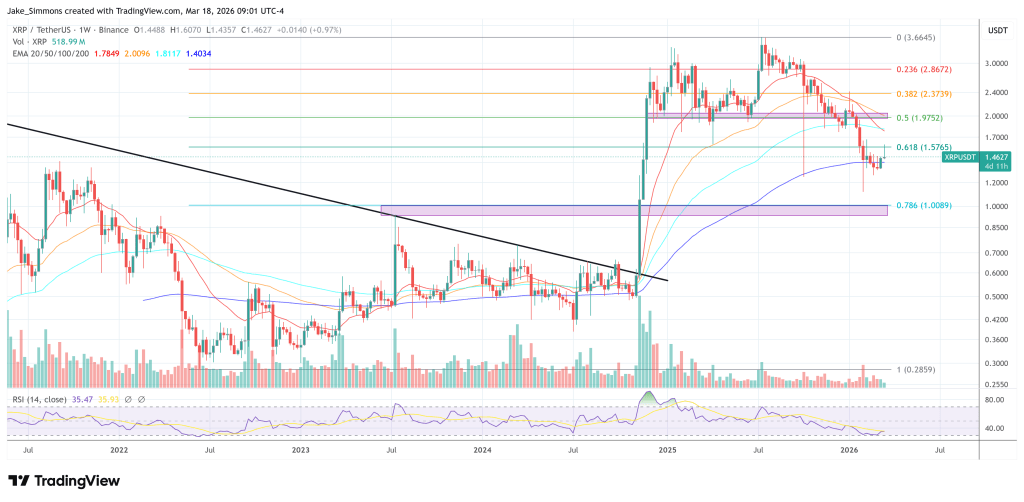
XRP must rise above the 0.618 Fib, 1-week chart | Source: XRPUSDT on TradingView.com

Trend Kriptolar

İlgili Sorular

QWhat is the primary function of Ripple Prime according to CEO Mike Higgins?

ARipple Prime serves as an access layer for firms trading across both traditional and digital markets, providing prime brokerage, clearing, custody, and treasury functions in a single institutional stack.

QHow is XRP being used as collateral within the Ripple Prime system?

ARipple Prime has built innovative ways to accept XRP as collateral, allowing institutional clients to post their XRP to obtain dollar credit for trading in markets like the CME without having to first liquidate their digital assets.

QWhat specific example did Higgins give to illustrate the use of XRP as collateral?

AHiggins gave the example of trading CME futures. Instead of selling XRP for dollars to post as margin, a firm can post its XRP directly with Ripple Prime, which then provides them with dollar credit to trade on the CME.

QWhat structural advantage does digital collateral like XRP have over traditional assets, according to the article?

ADigital collateral can be moved and liquidated 24/7, which provides a significant advantage for risk management and meeting collateral calls, unlike traditional assets which have market closures, weekends, and holidays.

QWhat prerequisites for serious institutional adoption did Higgins repeatedly stress?

AHiggins stressed that compliance, counterparty transparency, and permissioned access are essential prerequisites for serious institutional adoption of these new financial technologies.

İlgili Okumalar

Bitcoin Mining Farms Are Becoming AI Factories

Bitcoin mines are transforming into AI factories. This shift is driven by the convergence of three key assets from the previous crypto cycle: infrastructure, talent, and capital. Crypto mining companies like Crusoe, CoreWeave, and Bitdeer are repurposing their core competency—securing power, land, and grid connections in remote locations—to build data centers for AI clients. These firms are signing multi-billion dollar, long-term contracts with companies like Anthropic, AWS, and Microsoft, as AI's demand for reliable, high-capacity compute surpasses the profitability of Bitcoin mining. Simultaneously, crypto entrepreneurs and engineers are applying their skills to new AI ventures. Examples include OpenSea's co-founder launching OpenRouter (an AI model aggregator), and former Coinbase engineers building Fal.ai (a generative media infrastructure platform). Their experience in building scalable, global software networks translates effectively to the AI space. Furthermore, capital accumulated during the crypto boom is now fueling AI. Figures like Jed McCaleb (co-founder of Ripple) funded Voltage Park, a large-scale GPU cloud provider. Notably, some crypto investments, like FTX's early bets on Anthropic and Cursor, have generated astronomical paper returns, demonstrating how high-risk crypto capital flowed into AI before it became mainstream. The transition is not just about repurposing hardware, but about redirecting critical resources—power infrastructure, distributed systems expertise, and venture funding—to the next technological frontier: artificial intelligence.

链捕手16 dk önce

Bitcoin Mining Farms Are Becoming AI Factories

链捕手16 dk önce

Morpho Launches Fixed-Rate Product Midnight: Lenders and Borrowers Set Their Own Rates, Ending the Era of Interest Rate Models

Morpho Launches Fixed-Rate Product Midnight: Lenders and Borrowers Set Their Own Rates, Ending the Era of Algorithmic Interest Models On-chain lending has grown to $60 billion but remains minuscule compared to traditional finance's $200 trillion annual credit volume. Morpho identifies the lack of fixed rates and maturity dates as key bottlenecks. Institutions need predictability, not the passive floating rates set by algorithmic models. Midnight allows lenders and borrowers to directly quote rates, set terms, and become price makers, not takers. Fixed-rate lending is now viable due to cheaper, faster blockchains and the entry of institutions demanding control and certainty over returns, costs, and duration. Morpho Blue previously gave users control over risk; Midnight adds control over interest rates. Past attempts at on-chain fixed-rate lending failed primarily because they were built on top of floating-rate pools (creating unpredictability) or lacked sufficient active participants. Midnight avoids these pitfalls as a standalone primitive with fixed rates at its core, built upon Morpho Blue's existing large and active user base. Midnight offers distinct value: institutions gain predictable term structures and full control; fintech companies can offer tailored fixed-rate products; lenders/borrowers achieve predictability and efficiency; and curators can now differentiate by configuring both risk and interest rates. Morpho Midnight is not a replacement for Morpho Blue. The Morpho network will now feature two complementary market structures: floating-rate/open-term (Blue) for flexibility and fixed-rate/fixed-term (Midnight) for predictability. Liquidity can flow between them. The launch will be gradual, prioritizing security. Initially, it will support direct lending on Base network with one trading pair (cbBTC/USDC) and limited maturity dates. Advanced features like auto-rollovers will be introduced later.

marsbit16 dk önce

Morpho Launches Fixed-Rate Product Midnight: Lenders and Borrowers Set Their Own Rates, Ending the Era of Interest Rate Models

marsbit16 dk önce

human.tech Launches Clean SDK for Privacy-First Web3 Apps

human.tech has launched the Clean SDK, a toolkit enabling developers to build privacy-first Web3 applications with transparent accountability. Released alongside Aztec's version 5, the SDK provides components for integrating zero-knowledge identity verification, sanctions screening, and private transactions, without developers handling sensitive user data or building compliance infrastructure from scratch. It uses zero-knowledge proofs and programmable verification to allow apps to confirm user legitimacy and sanctions compliance while keeping identities confidential. The first application built on the SDK, Shield, a privacy bridge to Aztec, also launched. It allows users to transfer assets privately while proving a unique human is behind each transfer and that funds have passed sanctions checks, as verified by a May 2026 audit. The SDK offers three core verification techniques: Proof of Innocence (sanctions screening against 23 sources), Proof of Personhood (simpler verification via Human Passport), and Proof of Clean Hands (higher-assurance zero-knowledge government ID checks). This allows apps to authenticate users and transactions without exposing personal data. Designed for Aztec builders, the SDK lets developers add programmable privacy to decentralized apps, eliminating the need to create their own verification and ZK infrastructure. Shield demonstrates its practical use for private bridges, but the SDK aims to enable a wider ecosystem of private, accountable financial apps and services. The launch addresses growing demand for infrastructure that balances privacy and accountability. The SDK avoids traditional identity databases, storing encrypted data off-chain, screening at both entry and exit points, and including a gated disclosure mechanism for legal requests. human.tech's products, including the Clean SDK, focus on using zero-knowledge technology to enable verifiable personhood and privacy in digital systems.

TheNewsCrypto53 dk önce

human.tech Launches Clean SDK for Privacy-First Web3 Apps

TheNewsCrypto53 dk önce

İşlemler

Spot

Popüler Makaleler

XRP 2.0 Nedir

XRP 2.0: Kriptopara Manzarasında Yeni Bir Sınır XRP 2.0'a Giriş Kriptopara alanı sürekli olarak evriliyor, yeni projeler sürekli olarak dikkat ve benimseme için mücadele ediyor. Bu vaatkar girişimlerden biri, ileri düzey blok zinciri teknolojisi ve güçlü şifreleme yöntemlerini kullanmak üzere tasarlanmış yeni bir kriptopara projesi olan XRP 2.0'dır. İsim Ripple’ın XRP'si ile benzerlikler taşısa da, XRP 2.0'un bağımsız olarak çalıştığını, işlem güvenliğini, gizliliği ve ölçeklenebilirliği artırmaya odaklandığını belirtmek önemlidir. Dijital finansal alan giderek merkeziyetsiz çözümleri benimsedikçe, XRP 2.0, web3'e ve genel olarak kriptopara projelerinin genişlemesine anlamlı bir şekilde katkıda bulunmayı hedeflemektedir. XRP 2.0 Nedir? XRP 2.0'ın temelinde, güvenli ve merkeziyetsiz bir dijital para ekosistemi yaratmayı amaçlayan bir kriptopara projesidir. Temel teknolojisi, karmaşık blok zinciri prensiplerini ileri düzey şifreleme teknikleriyle entegre eder. XRP 2.0'ın ana hedefi, hızlı işlem yürütümünü sağlarken kullanıcılar için artırılmış gizlilik korumalarını öncelikli hale getirerek kendini güvenilir ve etkili bir platform olarak kurmaktır. Proje, mevcut kriptoparaların karşılaştığı birçok sınırlamanın çözümü olarak tanıtılmakta ve daha yüksek işlem hacimlerini, geliştirilmiş hız ve gizlilikle yönetebilen bir sistem önermektedir. Bu çok yönlülük, XRP 2.0'ı çeşitli dijital para birimleriyle dolu bir pazarda önemli bir rakip haline getiriyor. XRP 2.0’ın Yaratıcıları Kimdir? XRP 2.0'ın yaratıcısının kimliği 'Wilbur' olarak belirtilmiştir. Ancak, Wilbur veya ona bağlı varlıklar hakkında kapsamlı bilgiler ulaşılmaz durumdadır. Birçok kriptopara yaratıcısının anonimliği, genellikle bir derece gizlilik ve güvenliği korumayı amaçlayan endüstride yaygın bir olgudur. XRP 2.0’ın Yatırımcıları Kimlerdir? Şu anda, XRP 2.0’ı destekleyen yatırım kuruluşları veya organizasyonlarına dair spesifik bilgiler kamuya açık değildir. Kriptopara sektöründe, tanınmış yatırımcılar tarafından desteklenmek bir projenin güvenilirliğini ve başarısını önemli ölçüde etkileyebilir; ancak XRP 2.0'ın finansal destekçileri ile ilgili şeffaflık henüz sağlanmamıştır. XRP 2.0 Nasıl Çalışır? XRP 2.0, güvenli ve merkeziyetsiz işlemler sağlamak için blok zinciri teknolojisi ve gelişmiş şifreleme algoritmalarının bir kombinasyonunu kullanarak öne çıkmaktadır. Yenilikçi yapısı, kullanıcı etkileşimini artırmaya ve geleneksel kriptopara işlemlerinin ötesinde işlevselliği genişletmeye yönelik tasarlanmış benzersiz özellikler içerir. Bu özellikler arasında, XRP 2.0, metin-görüntü ve metin-ses işlevsellikleri gibi yapay zeka destekli yetenekler entegre etmektedir. Bu eklemeler, kullanıcılar için etkileşimli deneyimi artırmayı ve çeşitli sektörlerde daha geniş uygulama alanını teşvik etmeyi amaçlamaktadır. Teknolojik ilerlemeleri, kullanıcı odaklı tasarımla birleştirerek, XRP 2.0, kriptopara çözümlerini operasyonel çerçevelerine entegre etmeyi düşünen çeşitli bireyler ve işletmelerin dikkatini çekmeyi hedeflemektedir. XRP 2.0 Zaman Çizelgesi XRP 2.0'ı anlamak, şu ana kadar tanımladığı dönüm noktalarını incelemeyi gerektirir: 23 Temmuz 2023: XRP 2.0, blok zinciri alanında güvenli ve merkeziyetsiz işlem kabiliyetlerini devrim niteliğinde sunmayı hedefleyen yeni bir kriptopara projesi olarak tanıtıldı. 8 Eylül 2023: XRP20 adlı başka bir projenin lansmanı gerçekleşti, bu, XRP 2.0 ile ilgisi olmayan Ethereum blok zincirinde bir ERC-20 token'ın ortaya çıkışını işaret ediyor. 13 Kasım 2023: XRP Defteri, rippled sunucu yazılımının 2.0.0 versiyonunun yayınlanmasıyla önemli bir güncelleme aldı. Bu gelişmenin XRP 2.0 kriptopara projesi ile bağlantılı olmadığını belirtmek önemlidir. XRP 2.0 Hakkında Anahtar Noktalar XRP 2.0'ın özünü distile etmek için birkaç kritik faktör öne çıkmaktadır: Benzersiz Özellikler: AI destekli metin-görüntü ve metin-ses gibi özelliklerin eklenmesi, XRP 2.0'ın potansiyel uygulamalarını daha da çeşitlendirir. Blockchain Teknolojisi: Çerçeve, işlemler için güvenli ve merkeziyetsiz bir ortam sağlamak üzere gelişmiş blok zinciri mekanizmaları ve şifreleme protokolleri kullanır. Ölçeklenebilirlik ve Gizlilik: XRP 2.0, işlem süreçlerinde artırılmış gizlilik korumalarını ve büyüyen kullanıcı tabanını karşılamak için gerekli ölçeklenebilirliği önceliklendirir. Ripple ile İlişki Yok: Önemli olarak, adıyla birlikte hareket etmemesine rağmen, XRP 2.0’ın Ripple’ın XRP’si ile herhangi bir bağı veya iş birliği bulunmamaktadır; bu, onun kriptopara ekosistemindeki operasyonel çerçevesini ve hedeflerini belirgin bir şekilde ayırmaktadır. Sonuç XRP 2.0, kriptopara alanında güvenlik, gizlilik ve verimlilik kombinasyonu sunmayı hedefleyen iddialı bir girişimi temsil etmektedir. Karmaşık teknolojileri ve kullanıcı dostu özellikleri entegre ederek, proje kriptoparanın günümüz dijital ekonomisinde neler başarabileceğinin ufkunu genişletmeyi hedefliyor. Yaratıcısının anonimliği ve açıklanmayan yatırımcıların eksikliği bazıları için soru işaretleri oluşturabilir, ancak XRP 2.0'ın ileri düzey işlevsellikler ve merkeziyetsizlik konusundaki odaklanması, onu giderek kalabalıklaşan bir kriptopara pazarında çekici kılmaktadır. Kriptopara manzarası evrimini sürdürdükçe, XRP 2.0, güvenli ve ölçeklenebilir blok zinciri çözümlerinin genişlemesinde önemli bir oyuncu olarak ortaya çıkabilir.

202 Toplam GörüntülenmeYayınlanma 2024.04.05Güncellenme 2024.12.03

XRP 2.0 Nedir

XRP Nasıl Satın Alınır

HTX.com’a hoş geldiniz! XRP (XRP) satın alma işlemlerini basit ve kullanışlı bir hâle getirdik. Adım adım açıkladığımız rehberimizi takip ederek kripto yolculuğunuza başlayın. 1. Adım: HTX Hesabınızı OluşturunHTX'te ücretsiz bir hesap açmak için e-posta adresinizi veya telefon numaranızı kullanın. Sorunsuzca kaydolun ve tüm özelliklerin kilidini açın. Hesabımı Aç2. Adım: Kripto Satın Al Bölümüne Gidin ve Ödeme Yönteminizi SeçinKredi/Banka Kartı: Visa veya Mastercard'ınızı kullanarak anında XRP (XRP) satın alın.Bakiye: Sorunsuz bir şekilde işlem yapmak için HTX hesap bakiyenizdeki fonları kullanın.Üçüncü Taraflar: Kullanımı kolaylaştırmak için Google Pay ve Apple Pay gibi popüler ödeme yöntemlerini ekledik.P2P: HTX'teki diğer kullanıcılarla doğrudan işlem yapın.Borsa Dışı (OTC): Yatırımcılar için kişiye özel hizmetler ve rekabetçi döviz kurları sunuyoruz.3. Adım: XRP (XRP) Varlıklarınızı SaklayınXRP (XRP) satın aldıktan sonra HTX hesabınızda saklayın. Alternatif olarak, blok zinciri transferi yoluyla başka bir yere gönderebilir veya diğer kripto para birimlerini takas etmek için kullanabilirsiniz.4. Adım: XRP (XRP) Varlıklarınızla İşlem YapınHTX'in spot piyasasında XRP (XRP) ile kolayca işlemler yapın.Hesabınıza erişin, işlem çiftinizi seçin, işlemlerinizi gerçekleştirin ve gerçek zamanlı olarak izleyin. Hem yeni başlayanlar hem de deneyimli yatırımcılar için kullanıcı dostu bir deneyim sunuyoruz.

2.2k Toplam GörüntülenmeYayınlanma 2024.12.10Güncellenme 2026.06.02

XRP Nasıl Satın Alınır

Tartışmalar

HTX Topluluğuna hoş geldiniz. Burada, en son platform gelişmeleri hakkında bilgi sahibi olabilir ve profesyonel piyasa görüşlerine erişebilirsiniz. Kullanıcıların XRP (XRP) fiyatı hakkındaki görüşleri aşağıda sunulmaktadır.

活动图片