Institutional Adoption of Prediction Markets Stuck at the Third Stage

marsbit2026-04-17 tarihinde yayınlandı2026-04-17 tarihinde güncellendi

Özet

Prediction markets are transitioning from niche platforms focused on elections and sports to mainstream financial tools, as highlighted at Kalshi Research's inaugural conference. While sports still dominate trading volume (around 80%), non-sports categories like macroeconomics, politics, and entertainment are growing faster, signaling a shift from entertainment-based trading to information and risk management tools. Institutions, including Wall Street firms, are increasingly using prediction markets for data reference (Stage 1 adoption), with some progressing to system integration (Stage 2). However, full-scale trading (Stage 3) is limited due to the lack of margin trading, requiring full collateral for positions—a barrier for leverage-dependent entities. Kalshi is working with regulators to introduce margin mechanisms. Key insights from participants like Goldman Sachs and CNBC emphasize the value of real-time pricing for events (e.g., Fed decisions, tariffs), providing benchmarks previously unavailable. The path to maturity mirrors historical financial instruments like options, with expectations that prediction markets will become institutional staples within five years. Political leaders, including Trump and Schumer, now cite Kalshi odds, underscoring its growing influence. The platform rewards domain expertise over traditional finance backgrounds, attracting diverse participants from fields like music and poker. Ultimately, prediction markets are evolving into critical i...

Original Title:Prediction Markets: They Grow Up So Fast, Author: Alex Immerman(@aleximm)

Compiled | Odaily Planet Daily(@OdailyChina); Translator | Asher(@Asher_ 0210)

Editor's Note: At the end of March this year, prediction markets, once considered a niche area, reached a critical moment. Kalshi Research, the research arm of Kalshi, hosted its inaugural research conference in New York, bringing together academics, Wall Street executives, former politicians, and frontline traders. The composition of attendees sent a clear signal—prediction markets are moving from the fringe to the mainstream.

The conference opened with a dialogue between Kalshi co-founders Tarek Mansour and Luana Lopes Lara, moderated by Bloomberg reporter Katherine Doherty. This article excerpts and summarizes key insights from the conference.

Prediction Markets Are More Than Just Elections and Sports

For a long time, prediction markets have been defined by certain "highlight moments"—U.S. elections, the Super Bowl, March Madness. These events dominate news cycles and naturally consume most of the trading volume, leading outsiders to mistakenly believe that prediction markets' value stops there.
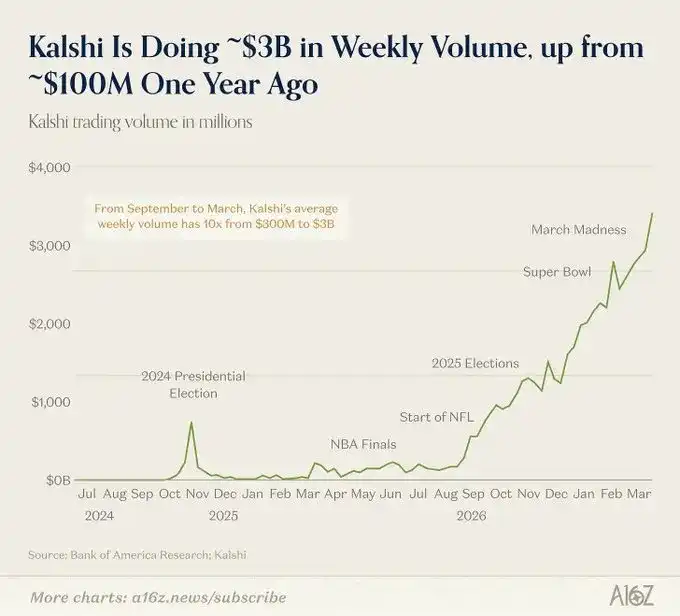
But this impression is being shattered. Just as the conference was held, weekly trading volume for sports predictions had nearly reached $3 billion, accounting for about 80% of Kalshi's total trading volume. While this seems dominant, it hides a more critical trend: sports' share is actually at a historical low.

In other words, all other categories are growing faster. Entertainment, crypto, politics, culture, and other areas are driving stronger user growth and more stable retention. Sports act more like an entry product—they are intuitive, emotionally driven, and have clear rhythms, making them suitable for attracting mass participation. Meanwhile, long-tail markets, which account for over 20% of total trading volume, are growing rapidly. These markets will play an important role in institutional hedging and information pricing in the future.
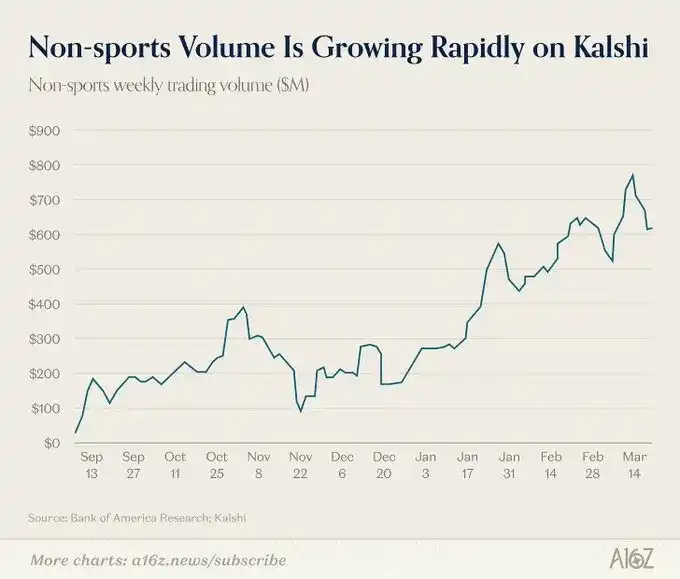
This is also confirmed on the institutional side. Cyril Goddeeris, Global Co-Head of Equity Business at Goldman Sachs, stated that predictions related to macro events and CPI are the categories Wall Street is most focused on currently; Sally Shin, Head of Growth Platforms at CNBC, mentioned that she already uses predictions related to the Fed Chair and non-farm payroll data as narrative tools; Troy Dixon, Global Co-Head of Markets at Tradeweb, envisioned a future where large investment banks will establish dedicated prediction market trading desks, with financial contracts as core products.

Prediction markets are shifting from "recreational trading" to "information and risk tools."

Why Kalshi Has Attracted Wall Street's Attention

Traditional financial markets operate efficiently largely because various assets have recognized benchmarks—the S&P 500 represents the average performance of 500 stocks, and crude oil has the ICE benchmark price. But for political and economic events (such as who will win an election, whether a certain tariff will pass, or the outcome of a Supreme Court case), there was almost no widely accepted, dynamically updated "benchmark" before.

Prediction markets change this. Now, almost any future event can have a real-time, liquid price benchmark. When the market can provide credible pricing for "the probability of a 30% tariff passing," institutions can trade around this price or hedge other risks in their portfolios. This makes the event itself a directly tradable object.

As Tradeweb's Troy Dixon said: "If you go back to when Trump was first elected, many people were hedging in the stock market, such as shorting the S&P, because they thought his election would cause the market to fall. But this was the wrong trade. The question is, how should these events be priced? Where is the benchmark?"

Tarek also mentioned that one motivation for founding Kalshi came from his previous work at Goldman Sachs, where he provided trading advice around the 2024 election and Brexit. Without prediction markets, when institutions hedge political or macro events through related assets, they actually need to make two layers of judgment—they must judge both the outcome of the event itself and the relationship between the event and the traded asset, with the latter carrying a separate risk of failure.

When the event itself has a direct price benchmark, the originally dispersed dual risks are merged into a single judgment. As Tarek said, the market has already begun pricing various events.

The Three Stages Toward Institutional Adoption

It is still too early to say that Wall Street institutions are participating in Kalshi trading on a large scale. Currently, most institutions use it primarily for data reference rather than actual trading.

However, Luana pointed out that the path to institutional adoption is already clear and can be divided into three stages:

  • The first stage is data access: Integrating prediction market prices into institutions' daily workflows, such as having Goldman Sachs investment managers view Kalshi odds like they view the VIX index. This stage has already been achieved to some extent. Jonathan Wright, a professor at Johns Hopkins University and former Fed official, stated that for Fed decisions, unemployment rates, and GDP, Kalshi is almost the only reference source;
  • The second stage is system integration: Including compliance approval, legal confirmation, technical access, and internal education, i.e., incorporating prediction markets into the usable financial tool system;
  • The third stage is actual trading: Institutions begin hedging risks on the platform, trading volume and liquidity gradually accumulate, forming a positive feedback loop. More hedgers attract more speculators, tighter spreads attract more hedgers, and benchmark prices continuously strengthen.

Currently, most institutions are still in the first stage, some have entered the second stage, and only a few have reached the third stage.

A major obstacle preventing institutions from entering the third stage is that current prediction market trading requires full margin—a $100 position requires depositing $100. This is acceptable for retail investors but is a significant limitation for hedge funds or banks that rely on leverage and capital efficiency. As Tarek said, if you want to hedge $100, you must put in $100, which is too costly for institutions; firms like Citadel or Millennium won't adopt this method. Kalshi has already received permission from the National Futures Association and is working with the Commodity Futures Trading Commission to introduce margin trading mechanisms.

What Happens Next?

Michael McDonough, Head of Market Innovation at Bloomberg, gave the most direct judgment: The sign of success is when these things become boring. He compared prediction markets to the options market in the 1970s, which also faced controversies over manipulation and regulatory uncertainty, but these issues were eventually resolved, evolving into an almost taken-for-granted infrastructure.

Toby Moskowitz, Partner at AQR, stated that he is willing to bet on the development of prediction markets. Within five years, or even sooner, it will become a viable tool at the institutional level.

Garrett Herren of Vote Hub described the final form: The question is no longer whether to use prediction markets, but how to use them. Once the discussion shifts to this level, it means they have become indispensable. In fact, although prediction markets are still relatively small, the hedging market itself is extremely large.
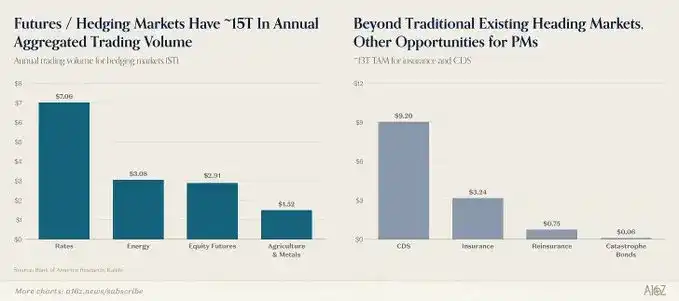
The normalization of prediction markets is already happening.

In discussions of political issues, former Congressman Mondaire Jones mentioned that senior figures from both parties, including Trump, House Minority Leader Jeffries, and Senate Minority Leader Schumer, have begun publicly citing Kalshi odds. Scott Tranter of DDHQ also confirmed that prediction market data has now become an important input for intra-party decision-making. Meanwhile, Vote Hub announced that it has directly integrated Kalshi data into its midterm election prediction model.

All of this barely existed two years ago. Back then, the most successful traders on Kalshi were still seen as amateurs. But now, the situation has changed, and it's even hard to define them with that term anymore.

In a roundtable, four traders shared their paths—one spent eleven years studying the Billboard charts, another has been participating in prediction markets since 2006—when it was still a cashless, somewhat geeky interest area. They did not come from the finance industry but from backgrounds in music, politics, and poker. But they agreed that the platform truly rewards deep domain knowledge, not resumes.

Summary

Prediction markets have come a long way. They were once seen as academic experiments, later became brief highlights during election cycles, and were also viewed as an extension of sports betting.

The message from this conference is clear: Prediction markets are gradually evolving into an infrastructure for pricing uncertainty, serving a wide range of participants from retail investors to large institutions and diverse application scenarios.

İlgili Sorular

QWhat are the three stages of institutional adoption of prediction markets as described in the article?

AThe three stages are: 1) Data Access - integrating prediction market prices into daily workflows; 2) System Integration - involving compliance approval, legal confirmation, technical access, and internal education; 3) Actual Trading - where institutions begin hedging risk on the platform, with trading volume and liquidity building up.

QWhat is identified as a major barrier preventing institutions from reaching the third stage of adoption on Kalshi?

AThe requirement for full margin trading, where a $100 position requires depositing $100, is a major barrier. This is cost-prohibitive and inefficient for hedge funds and banks that rely on leverage.

QAccording to the article, what significant shift is occurring in the perception of prediction markets' primary value?

APrediction markets are shifting from being seen as 'entertainment trading' towards becoming 'information and risk tools' for institutions, moving beyond just elections and sports.

QHow did the composition of the attendees at Kalshi Research's conference signal a change for prediction markets?

AThe presence of academia, Wall Street executives, former politicians, and frontline traders signaled that prediction markets are moving from a niche interest into the mainstream.

QWhat historical financial market does Michael McDonough compare the current state of prediction markets to, and what does he say is the marker of success?

AHe compares it to the options market of the 1970s. He states that the marker of success is when these tools become 'boring' and evolve into a fundamental, taken-for-granted infrastructure.

İlgili Okumalar

Has Hook Summer Truly Arrived? sato, Lo0p, FLOOD Ignite the New Uniswap v4 Narrative

With the broader market showing signs of recovery, a new wave of interest has emerged around Ethereum-based meme coins. Following ASTEROID, tokens like sato, sat1, Lo0p, and FLOOD, built upon the Uniswap v4 Hook protocol, are capturing market attention. Their market capitalizations range from millions to tens of millions of dollars, injecting much-needed focused liquidity into a market lacking narratives. This article explores whether this trend signifies an incoming "Hook Summer" and its potential impact on UNI's price. Hooks are essentially plug-in smart contracts for Uniswap v4 liquidity pools, allowing developers to inject custom logic at key points in a pool's lifecycle (like initialization, adding/removing liquidity, swaps). This transforms the AMM into programmable building blocks. Key highlighted projects include: * **sato**: Peaked over $38M market cap. It utilizes a v4 curve for minting/burning; buying locks ETH as reserve to mint new tokens, while selling redeems ETH from the reserve and burns tokens. * **sat1**: Market cap briefly exceeded $10M, promoted as an "optimized sato," but later declined significantly. * **Lo0p**: Reached nearly $6.6M. It's a lending AMM protocol where buying LO0P tokens locks them as collateral, allowing users to borrow ETH from the pool reserve at 40% LTV, aiming to improve capital efficiency for idle ETH in LPs. * **FLOOD**: Peaked near $6M. Its mechanism directs asset reserves from buys into Aave v3 to generate yield, with fees and interest retained in the pool to potentially influence the token's price long-term. In the long term, the development of the Hook ecosystem can attract users and liquidity to Uniswap v4, benefiting UNI's fundamentals—especially combined with the recent activation of the protocol fee switch, where a portion of fees is used to burn UNI. However, in the short term, these Hook-based tokens are unlikely to directly drive significant UNI price appreciation. Their impact is moderated by factors like token sustainability, price volatility, and broader market and regulatory conditions. Currently, Uniswap v4's TVL ($595M) still trails behind v2 and v3, indicating adoption and growth will take time. The article concludes that while the Hook ecosystem provides long-term "nourishment" for UNI, its short-term role is more of a "catalyst" than a "booster." Readers are cautioned that these are early-stage experimental tokens and may carry unknown risks.

Odaily星球日报7 dk önce

Has Hook Summer Truly Arrived? sato, Lo0p, FLOOD Ignite the New Uniswap v4 Narrative

Odaily星球日报7 dk önce

Interview with Michael Saylor: I Did Say I Would Sell Bitcoin, But Never a Net Sale

Interview with Michael Saylor: I Said We'd Sell Bitcoin, But Never Be a Net Seller In a recent podcast, MicroStrategy Executive Chairman Michael Saylor clarified the company's stance on potentially selling Bitcoin. Following MicroStrategy's earnings call statement about being prepared to sell BTC to fund dividends for its STRC (Strategic) credit product, Saylor emphasized the distinction between selling and being a "net seller." Saylor explained the core business model: MicroStrategy sells credit instruments like STRC and uses the proceeds to buy Bitcoin, which is viewed as "digital capital" expected to appreciate around 30-40% annually. A portion of these capital gains can then be used to pay the dividends on the credit products. He stressed that even if the company sells some Bitcoin for dividends, it simultaneously buys much more with new credit issuance. For example, after raising $3.2 billion from STRC sales in April, the dividend obligation was only $80-90 million, making the company a net buyer. The clarification aims to counter market narratives questioning the value of Bitcoin on MicroStrategy's balance sheet if it were never sold, and to dismiss claims of a "Ponzi scheme." Saylor reiterated his personal philosophy for investors: "Don't be a net seller of bitcoin" and ensure your Bitcoin holdings increase each year. Saylor also discussed Bitcoin's role as the foundation for "digital credit," noting that STRC has become the largest and most liquid preferred stock issue in the U.S., offering high risk-adjusted returns (Sharpe ratio). He highlighted Bitcoin's deep liquidity, stating that even large purchases by MicroStrategy do not move the market significantly, which is driven by macro factors, geopolitical tensions, and capital flows from ETFs and credit products. Finally, Saylor reflected on his early inspiration from sci-fi books, which motivated his path to MIT, and maintained his fundamental thesis on Bitcoin remains unchanged: it is superior digital capital enabling superior digital credit.

链捕手11 dk önce

Interview with Michael Saylor: I Did Say I Would Sell Bitcoin, But Never a Net Sale

链捕手11 dk önce

Beaten SK Hynix Employees in China: Year-end Bonus Less Than 5% of Korean Staff's

"SK Hynix Chinese Staff Hit Hard: Bonuses Less Than 5% of Korean Counterparts" Driven by the AI boom, South Korea's SK Hynix is experiencing record performance, with media reports predicting massive year-end bonuses for its employees, making them highly desirable in the matchmaking market. However, this prosperity starkly contrasts with the situation for the company's Chinese employees. According to reports, SK Hynix operates under a rule allocating 10% of operating profit for employee bonuses. While projections suggest Korean employees could receive bonuses reaching millions of RMB, a Chinese employee with over a decade of technical experience revealed the disparity: "If they get 3 million, Chinese staff get less than 5% of that." After adjustments based on KPI ratings, this employee's highest bonus was slightly over 100,000 RMB. Bonuses are paid annually in Korea but semi-annually in China. During the industry downturn in 2023-2024, Chinese employees received no bonus at all. The gap extends beyond bonuses. Recruitment posts for SK Hynix's Chinese factories (in Wuxi, Dalian, Chongqing) show engineer monthly salaries ranging from 10,000 to 35,000 RMB, with a 13th-month salary promised. Chinese employees also receive standard benefits like annual leave but lack stock incentives, which are reportedly unavailable to them. Furthermore, management positions in China are predominantly held by Korean personnel, though industry observers note a gradual increase in local middle managers over time. SK Hynix has confirmed the 10% bonus rule but cautioned that specific future bonus amounts remain unpredictable. The company forecasts strong demand for HBM and other high-value enterprise products for the next 2-3 years, driven by AI infrastructure investment. This focus on business-to-business markets may continue to constrain supply for consumer products, potentially prolonging price increases for components like memory.

链捕手24 dk önce

Beaten SK Hynix Employees in China: Year-end Bonus Less Than 5% of Korean Staff's

链捕手24 dk önce

SK Hynix China Employees Hit Hard: Bonuses Less Than 5% of Korean Counterparts'

"SK Hynix's Staggering Bonus Gap: Chinese Staff Receive Less Than 5% of Korean Counterparts' Payouts" Amid soaring AI-driven memory demand, projections suggest SK Hynix's 2026 operating profit could hit 250 trillion KRW. Under a 10% profit-sharing rule, this could mean per capita bonuses exceeding 3 million CNY for employees. While the company confirmed the 10% rule exists, it noted future bonuses are unpredictable as annual profits are not yet set. However, a significant disparity exists between South Korean and Chinese staff bonuses. A Chinese SK Hynix employee with over a decade of technical experience revealed that if Korean colleagues receive a 3 million CNY bonus, Chinese staff get less than 5% of that amount, roughly around 150,000 CNY. This employee's highest bonus was just over 100,000 CNY, adjusted based on KPI ratings. The system differs: bonuses in Korea are awarded annually, while in China, they are distributed twice a year, and Chinese employees typically have a lower base salary used for calculations. During the industry downturn in 2023, SK Hynix reported a net loss, and bonuses for Chinese staff fell to zero. Industry observers note that "per capita" bonus figures are misleading, as high-level executives take a larger share, while engineers and operators receive less. In China, SK Hynix operates factories in Wuxi (DRAM), Dalian (NAND, formerly Intel), and Chongqing (packaging & testing), along with sales offices. Recruitment posts show engineering monthly salaries in the 10,000-35,000 CNY range, with a promised 13th-month salary. Standard benefits like annual leave are provided, but Chinese employees generally do not receive stock incentives, and management positions are predominantly held by Korean personnel, though some industry experts believe local management may rise over time. Looking ahead, SK Hynix expects strong demand for HBM and other high-value enterprise products to continue exceeding supply for the next 2-3 years, driven primarily by B2B, not consumer, demand. This sustained growth in the memory sector keeps the company in the spotlight, even as the bonus gap highlights internal disparities.

marsbit45 dk önce

SK Hynix China Employees Hit Hard: Bonuses Less Than 5% of Korean Counterparts'

marsbit45 dk önce

İşlemler

Spot
Futures
活动图片