Insider Trading Might Be the Most Valuable Part of Prediction Markets

比推2026-01-07 tarihinde yayınlandı2026-01-07 tarihinde güncellendi

Özet

An anonymous account on the decentralized prediction market Polymarket achieved a 1,242% return by accurately predicting the arrest of Venezuelan leader Maduro before mainstream media reported the event. This triggered debates over potential insider trading and led U.S. Representative Ritchie Torres to propose the "2026 Financial Prediction Market Public Integrity Act," aiming to regulate such activities in crypto prediction platforms. The incident raised questions about whether prediction markets should prioritize fairness or accuracy. While traditional finance prohibits insider trading to protect retail participants, prediction markets may inherently rely on information asymmetry to produce more accurate forecasts. The core value of these markets lies in truth discovery—aggregating fragmented information into predictive signals—even if it allows informed participants to profit. The proposed legislation faces challenges in enforcement within decentralized environments and may conflict with the fundamental mechanism of prediction markets. Rather than enforcing absolute fairness, which could reduce market efficiency, the article argues that prediction markets should be viewed as tools for revealing truth through transparent, on-chain information flow, even when it involves informational advantages.

Author: Chloe, ChainCatcher

Original Title: Insider Trading Might Be the Most Valuable Part of Prediction Markets


Recently, Venezuelan leader Maduro was arrested. Before mainstream media released the news, a Polymarket account established in late December had quietly exited with a 1242% return. This incident prompted U.S. Representative Ritchie Torres to propose the "2026 Financial Prediction Market Public Integrity Act," attempting to introduce traditional financial "insider trading" regulations into the crypto market.

This article will use the Maduro incident as a core case study to delve into the controversial issue of "insider trading" in prediction markets, re-examining whether we need an absolutely fair casino or a precise truth engine in decentralized prediction platforms.

Polymarket's "Prophet" Moment: Accurately Predicting Maduro's Downfall

In January 2026, Venezuelan leader Maduro was confirmed to be arrested. While global mainstream media were still verifying sources, data on the decentralized prediction market Polymarket had already provided the answer.

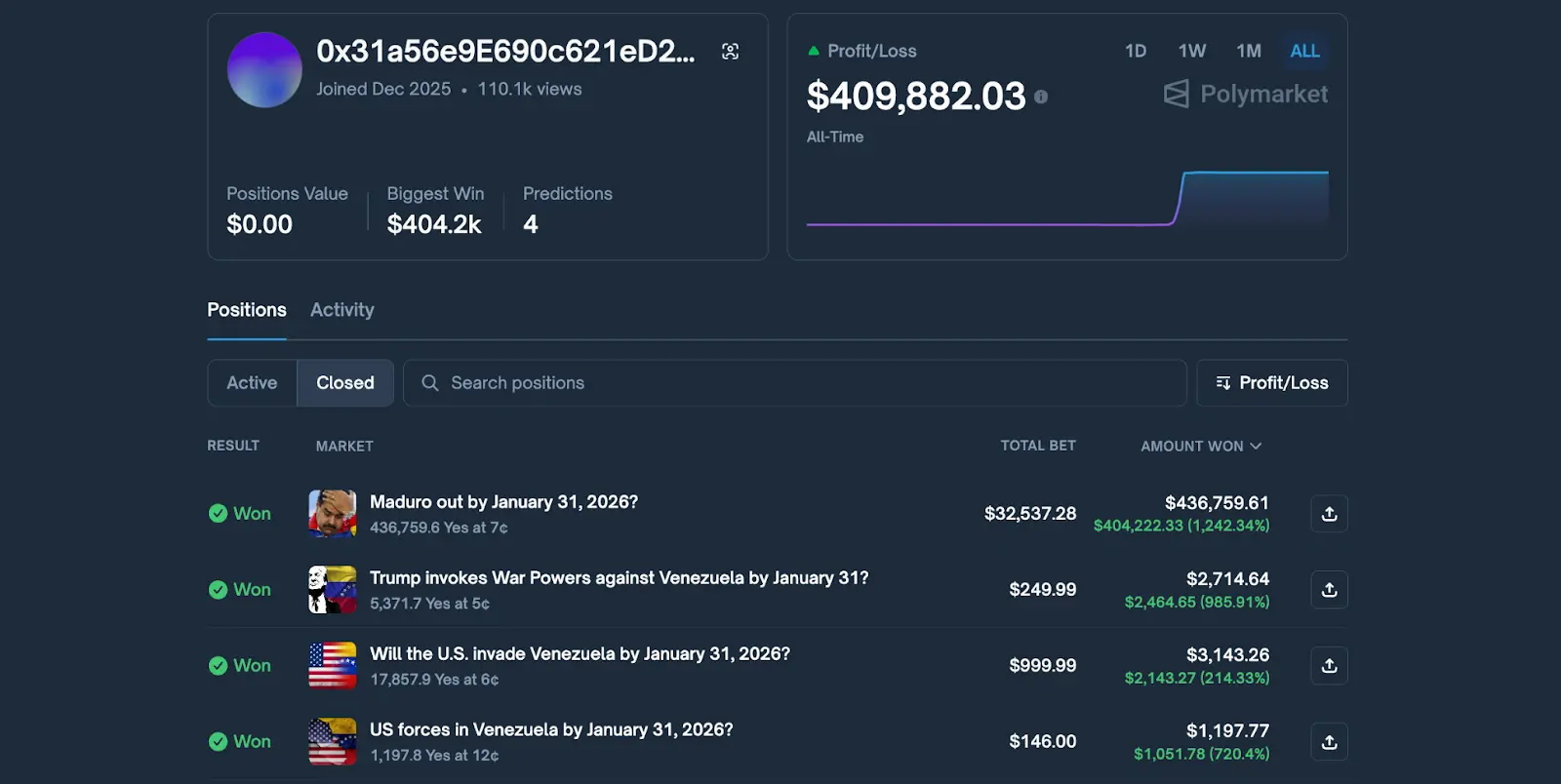
A new account created on Polymarket in late December 2025 seemed to have a god's-eye view, accurately predicting the event. The account made four predictions, all related to whether the U.S. would intervene in Venezuela, with the largest being a bet of $32,537 that "Maduro will step down before January 31." At the time, the market's expected probability for such an extreme event was only in the single digits, and the account swept up contracts at an extremely low price of 7 cents.

As news of Trump confirming military action emerged early Saturday, these contracts instantly surged to near the settlement price of $1. The account profited over $400,000 in less than 24 hours, with a yield of 1242%. This was not ordinary speculation but a precise sniper shot.
Mysterious Prophet or Insider Trading?

This god-like巨额获利 quickly became a focus in the community. As discussions heated up, accusations of insider trading followed:

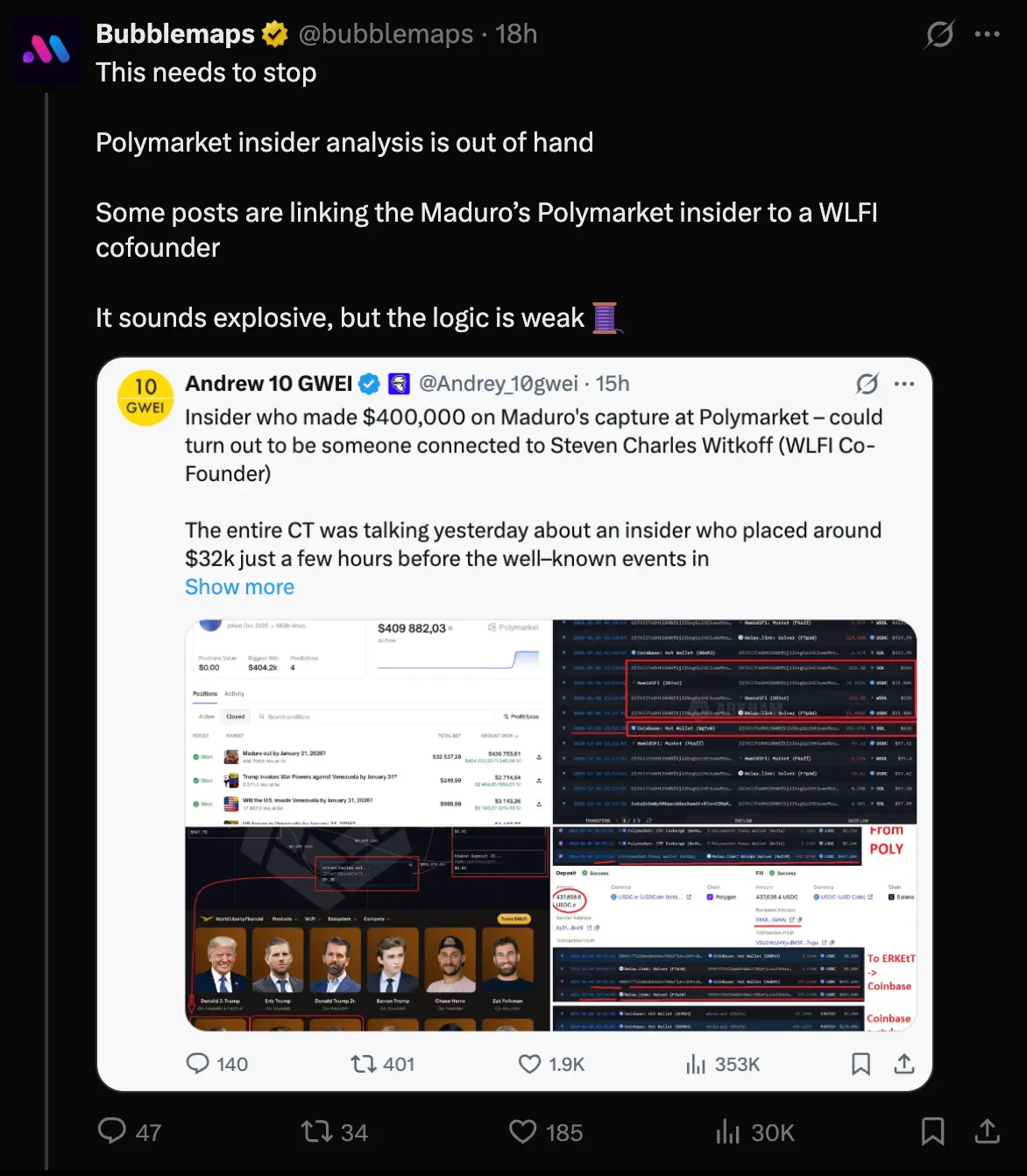
On-chain analyst Andrew 10 GWEI pointed out that the account's fund path showed extremely high similarity: 252.39 SOL withdrawn from Coinbase on January 1 closely matched 252.91 SOL deposited by another wallet the previous day in both amount and time (23 hours apart),疑似通过交易所进行中转断链. More controversially, the associated wallet registered domains like StCharles.sol and had large transactions with an address疑似 belonging to World Liberty Finance (WLFI) co-founder Steven Charles Witkoff. Given WLFI's close ties to the Trump family, this strongly raised suspicions: Was this insider trading using White House internal information?

On-chain analysis platform BubbleMaps later offered a different perspective. They argued that the "time and amount similarity" inference was too superficial, noting at least 20 wallets on-chain fit this pattern, and Andrew's argument lacked direct on-chain fund movement evidence, so there was no reliable proof linking the Polymarket account to the WLFI co-founder.
Representative Proposes Integrity Act: Aiming to Regulate Prediction Market Insider Trading

The incident also led U.S. Representative Ritchie Torres to propose the "2026 Financial Prediction Market Public Integrity Act." The core of the bill is to prohibit federally elected officials, politically appointed officials, and executive branch employees from trading in prediction markets related to government policies using "material non-public information" obtained through their official positions.

However, this bill faces a dual challenge in reality. First is the lengthy and uncertain legislative process; in the complex power dynamics of U.S. politics, such bills often undergo lengthy hearings and interest negotiations, ultimately容易沦为 political statements with little substantive impact.

Second is the enforcement blind spot in a decentralized environment. On-chain fund flows can easily be obscured through various privacy protocols or complex transfer mechanisms. Although the bill symbolizes the formal intrusion of traditional financial values into prediction markets, attempting to protect retail investors from information harvesting and maintain fair participation rights, we must consider: Will directly applying this regulatory logic to decentralized prediction markets create conflicts due to differing core values,甚至导致 prediction markets失灵?

The Core Value of Prediction Markets and the Paradox of Insider Trading

Returning to first principles, what is the purpose of prediction markets? Is it to give everyone a fair chance to profit, or to obtain the most accurate prediction results?

Traditional finance prohibits insider trading to protect retail investors' confidence and prevent capital markets from becoming cash machines for the powerful. But in prediction markets, the core value might be "truth discovery."

Prediction markets are machines that aggregate fragmented information into price signals. If a market about "whether Maduro will step down" prohibits informed participants, then the market's price will always reflect "laypeople's guesses" rather than "true probability," causing the prediction market to lose accuracy.

In the Maduro incident,假设 the profiteer was not an insider but a top information analysis expert. He might have pieced together the likelihood of military action by tracking abnormal radio signals at the Venezuela border, private jet movements, or even the U.S. Department of Defense's public procurement lists, after model inference. This behavior might be highly controversial in traditional regulation, but in the logic of prediction markets, it is an extremely valuable "information pricing behavior."

One mission of prediction markets is to break information monopolies. While各方 are interpreting ambiguous, lagging government diplomatic rhetoric, price fluctuations on prediction markets are already sending early warnings of the truth to the world. Therefore, rather than calling this insider trading, it is more apt to see it as a博弈 that rewards hidden information surfacing through trading, thereby providing real-time risk guidance for the public.

Prediction Markets Are Tools Born for Pursuing Truth, Not Fair Trading Venues

The emergence of the "2026 Financial Prediction Market Public Integrity Act" may reflect regulators' cognitive bias towards decentralized prediction platforms. If we pursue a "completely fair" prediction market, we will ultimately get a "completely ineffective" prediction market.

The Maduro incident深刻揭示了 the true value of prediction markets: It allows hidden truths to be transformed into on-chain signals visible to all through the traces of fund flow. Blockchain transparency breaks the black box; even if we cannot immediately identify the幕后推手, when mysterious accounts heavily build positions and probabilities fluctuate剧烈, the market is actually sending signals. This attracts smart money to quickly follow, rapidly leveling the originally unequal information gap, thereby transforming "insider information" into "public probability."

Prediction markets are not stock markets; they are essentially radars of collective human intelligence. To keep this radar precise, it is necessary to allow the friction cost brought by information arbitrage to a certain extent. Therefore, rather than trying to block signals with bans, should we not instead consider positioning prediction markets as tools born for pursuing truth, rather than fair trading venues?


Twitter:https://twitter.com/BitpushNewsCN

Bitpush TG Group:https://t.me/BitPushCommunity

Bitpush TG Subscription: https://t.me/bitpush

Original Link:https://www.bitpush.news/articles/7600733

İlgili Sorular

QWhat was the core event that sparked the debate around insider trading in prediction markets, as discussed in the article?

AThe core event was the arrest of Venezuelan leader Maduro, which was accurately predicted by a Polymarket account that achieved a 1242% return before mainstream media reported the news.

QWhat legislative response did the Maduro prediction incident trigger in the United States?

AIt prompted U.S. Representative Ritchie Torres to propose the 'Financial Prediction Market Public Integrity Act of 2026', aiming to regulate insider trading in crypto prediction markets by prohibiting federal officials from using material non-public information.

QAccording to the article, what is the fundamental purpose of prediction markets: fairness or accuracy?

AThe article argues that the core purpose of prediction markets is accuracy and 'truth discovery', as they are designed to aggregate fragmented information into price signals that reflect real-world probabilities, rather than ensuring fair profit opportunities for all participants.

QHow does the article differentiate between traditional financial markets and prediction markets regarding insider trading?

ATraditional financial markets ban insider trading to protect retail investors and maintain confidence, while prediction markets may benefit from informed trading because it helps produce more accurate predictions, turning hidden information into public signals.

QWhat technological challenge does the article highlight for enforcing insider trading regulations in decentralized prediction markets?

AThe article points out the enforcement blind spot in decentralized environments, where chain fund flows can easily be obscured through privacy protocols or complex transfer mechanisms, making it difficult to track and regulate insider trading.

İlgili Okumalar

In Conversation with Ray Dalio: We Are Currently in an AI Bubble, with 1% of My Portfolio in Bitcoin

Ray Dalio, founder of Bridgewater Associates, warns in an interview that the current AI boom shows classic bubble characteristics, which could lead to significant economic downturns as seen in past cycles like 1929 or 2000. He explains that speculative enthusiasm, fueled by debt and overvaluation, often precedes a crash when rising rates or taxation force asset sales, causing widespread losses and recession. Dalio also outlines his "Big Cycle" theory, describing an approximate 80-year pattern where widening wealth gaps, massive government deficits, and shifting geopolitical power (like China's rise) create internal conflict and global instability. He emphasizes that we are in a late-cycle, transitional phase where traditional powers like the US and UK face decline. For personal wealth protection, Dalio advises diversification beyond cash into assets like stocks, bonds, real estate, and particularly gold, which he prefers over Bitcoin. While he holds about 1% of his portfolio in Bitcoin as a non-printable hard asset, he views gold as more secure from technological or governmental threats. Regarding AI's impact, Dalio believes it will disproportionately benefit capital owners, worsening inequality by replacing both physical and cognitive labor. He suggests that human intuition and emotional intelligence, combined with AI, will be key for future workers. On taxation, Dalio argues that wealth taxes are impractical and risk triggering asset sell-offs, reducing productive investment. He points to the UK as a cautionary example of debt, low productivity, and political strife. Geopolitically, Dalio foresees a more regionalized world, with the US showing weakness in prolonged conflicts like with Iran, akin to past imperial declines. The ideal outcome, he suggests, is coexisting powerful blocs (e.g., Americas, China-Asia Pacific) without major war.

marsbit3 saat önce

In Conversation with Ray Dalio: We Are Currently in an AI Bubble, with 1% of My Portfolio in Bitcoin

marsbit3 saat önce

Daily 7.2 Trillion KRW: Foreign Capital's Record Net Buying on Friday! Wall Street Says Headwinds for Korean Stock Fund Flows Have Subsided

South Korean stock market sees a dramatic shift in fund flows. On July 31, foreign investors made a record net purchase of approximately KRW 7.2 trillion in KOSPI stocks, marking a fundamental reversal from the persistent large-scale net outflows seen in previous months. This contributed to a significant narrowing of foreign net selling in July to KRW 9.8 trillion, down sharply from KRW 48.4 trillion in June and KRW 44.5 trillion in May. Simultaneously, domestic institutional pressure eased. South Korean pension funds and asset managers turned to a net buying position in July, purchasing KRW 1.0 trillion worth of KOSPI shares, contrasting with net sales in May and June. Market volatility is expected to be dampened by new financial regulations. Effective July 31, the Financial Services Commission tightened access for retail investors to single-stock leveraged ETFs by raising the minimum cash deposit requirement. Trading volumes for these products subsequently dropped to about 50% of their monthly average. Citigroup Research maintains its year-end KOSPI target of 10,000 points. The firm cites several supportive factors: the substantial easing of headwinds from capital outflows, a robust fundamental outlook for the semiconductor sector, historically low market valuations, strong economic fundamentals, and the potential for policy support from financial authorities if needed.

marsbit3 saat önce

Daily 7.2 Trillion KRW: Foreign Capital's Record Net Buying on Friday! Wall Street Says Headwinds for Korean Stock Fund Flows Have Subsided

marsbit3 saat önce

Thanks to Dice Rolls, Bitcoin Keys Are Stored Offline, But Not Everyone Will Do It

The article discusses using dice rolls to generate secure Bitcoin wallet seeds, providing entropy independent of potentially flawed hardware random number generators. It explains that each fair dice roll offers about 2.585 bits of entropy, with around 50 rolls needed for a standard 12-word seed phrase and 99+ recommended for higher security. This method gained attention after a vulnerability was revealed in some Coldcard hardware wallets, where a faulty firmware RNG (dating back to 2021) compromised generated keys. The analysis notes that while a dice-generated main seed was safe from this specific flaw, other Coldcard functions (like creating paper wallets, backup keys, or passwords) could still be vulnerable if they used the defective RNG. The piece argues that while dice-based entropy is technically robust, the manual process is error-prone, tedious, and unrealistic for most new users, who might make mistakes in recording or inputting rolls. It concludes that while manual entropy generation should remain an option for advanced users, the long-term goal is to develop reliable, user-friendly hardware and software that securely generates randomness without requiring specialized knowledge. Coldcard users are advised to check their firmware version and replace any secondary secrets (like paper wallet keys) created with vulnerable devices, while also considering multi-signature setups with devices from different manufacturers for added security.

cryptonews.ru9 saat önce

Thanks to Dice Rolls, Bitcoin Keys Are Stored Offline, But Not Everyone Will Do It

cryptonews.ru9 saat önce

İşlemler

Spot
活动图片





