ING Now Allows Crypto Investments as SUBBD Token Soars

bitcoinist2026-02-03 tarihinde yayınlandı2026-02-03 tarihinde güncellendi

Özet

The cryptocurrency market is experiencing a divergence, with institutional players like ING adopting crypto services—adding legitimacy—while retail traders pursue high-risk assets. Tokens like SUBBD are surging, reflecting a strong risk-on appetite. SUBBD Token targets the $85 billion creator economy by offering a decentralized platform with AI tools, aiming to solve Web2 issues like high fees and limited control. It has raised $1.4M and offers a 20% APY staking reward to incentivize holding. This represents a shift toward utility-driven crypto projects.

The cryptocurrency market is showing a fascinating divergence: institutional giants are building the floor while retail traders are aggressively testing the ceiling.

Reports that major banking institutions like ING are warming up to direct crypto services signal a critical shift in market structure.

That’s not just about accessibility, it’s about the legitimization of digital assets as a standard portfolio component for conservative European wealth. (Frankly, when a legacy bank moves, it validates the asset class for risk-averse capital that has remained on the sidelines for a decade).

Meanwhile, the retail sector is operating with a totally different risk profile. Just look at the parabolic moves in assets like $SUBBD. The surge in these niche, community-driven tokens suggests that despite macroeconomic headwinds, risk-on appetite remains voracious.

The dichotomy is stark: while bankers analyze Bitcoin ETFs, the ‘degen’ economy is hunting for 100x multipliers in the AI infrastructure sector. This barbell structure, stability on one end, high volatility on the other, implies liquidity is returning to the system, but it’s bifurcated.

But the most astute capital is looking beyond the safety of banks or the casino-like nature of memes. Smart money is positioning itself in the middle ground: utility-driven protocols that solve tangible Web2 problems using Web3 infrastructure.

Specifically, the intersection of Artificial Intelligence and the creator economy is emerging as the next major growth narrative. Investors are increasingly rotating profits from high-volatility plays into infrastructure projects like SUBBD Token that offer sustainable revenue models.

Visit SUBBD Token’s official page.

SUBBD Token Targets the $85 Billion Creator Economy

While the broader market debates regulatory frameworks, SUBBD Token is executing a targeted strike on the $85 billion content creation industry. The current Web2 model? It’s fundamentally broken for creators. Platforms often extract up to 70% of earnings in fees, impose arbitrary bans, and enforce strict geographical payment restrictions.

SUBBD uses Ethereum-based EVM-compatible smart contracts to dismantle these barriers, offering a decentralized alternative where creators actually retain control over their content and revenue.

The project differentiates itself by integrating proprietary AI models directly into its ecosystem. This isn’t merely about payment processing, it’s about workflow automation. The platform features an AI Personal Assistant for automated interactions and advanced AI Voice Cloning technology, allowing influencers to scale their presence without scaling their workload.
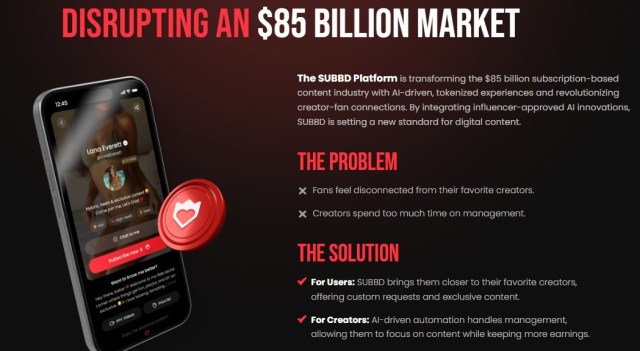
For fans, the utility is equally tangible: token-gated access creates an exclusive layer of interaction that fiat subscriptions can’t replicate.

From a portfolio standpoint, this represents a shift from speculative assets to productive ones. By merging Web3 transparency with AI-driven influencer tools, the project addresses the fragmentation of current software. Instead of subscribing to five different services for chatbots, voice generation, and payments, creators access a unified ecosystem. That consolidation of utility is precisely what transforms a token from a trading vehicle into a fundamental infrastructure play.

Explore the SUBBD ecosystem.

Early Capital Flows and Staking Metrics

The market’s appetite for this AI-Web3 hybrid model is reflected in the early capital inflows. According to official data, the project has already raised $1.4M, a figure that suggests significant conviction from early entrants despite the broader market’s volatility.
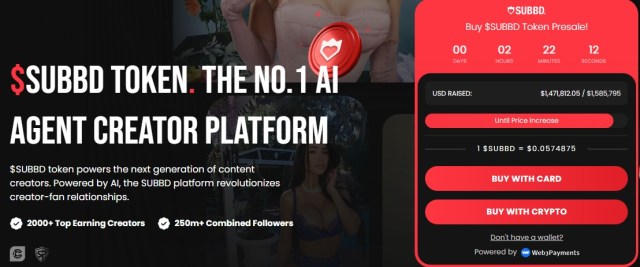
With tokens currently priced at $0.0574875, the entry point allows for position sizing that’s difficult to achieve in established large-cap assets.

Beyond the capital raise, the protocol’s retention mechanics are designed to mitigate the sell pressure often seen in new launches. The staking structure offers a fixed 20% APY for the first year, creating a compelling incentive for holders to lock supply. This isn’t just an inflationary reward; it’s a mechanism to align user behavior with long-term platform growth.

Stakers also gain access to XP multipliers and exclusive ‘behind the scenes’ content drops, gamifying the holding process.
This approach, combining high-yield staking with functional platform benefits, creates a liquidity sink that stabilizes the token economy.

While ING clients are limited to market-beta returns, SUBBD offers a third path: early-stage exposure to a utility protocol with built-in yield generation.

As the presale advances, the window to acquire tokens at the $0.0002802 valuation tightens, placing a premium on early decision-making.

View the official SUBBD presale site.

The information provided in this article does not constitute investment advice, financial advice, trading advice, or any other sort of advice and you should not treat any of the article’s content as such. Cryptocurrency markets are highly volatile and carry significant risk. Always conduct your own due diligence before making any investment decisions.


İlgili Sorular

QWhat major shift in the cryptocurrency market does the article highlight regarding traditional banking institutions like ING?

AThe article highlights that major banking institutions like ING are warming up to direct crypto services, signaling a critical shift in market structure. This move legitimizes digital assets as a standard portfolio component for conservative European wealth and validates the asset class for risk-averse capital.

QHow does SUBBD Token differentiate itself in the cryptocurrency market according to the article?

ASUBBD Token differentiates itself by targeting the $85 billion creator economy with a decentralized alternative that allows creators to retain control over their content and revenue. It integrates proprietary AI models for workflow automation, including an AI Personal Assistant and AI Voice Cloning technology, and provides token-gated access for fans.

QWhat is the current price of SUBBD Token and what incentive does the staking structure offer?

AThe current price of SUBBD Token is $0.0574875. The staking structure offers a fixed 20% APY for the first year, which incentivizes holders to lock supply and aligns user behavior with long-term platform growth. Stakers also gain access to XP multipliers and exclusive content.

QWhat problem in the current Web2 model for creators does SUBBD Token aim to solve?

ASUBBD Token aims to solve the problems in the current Web2 model where platforms often extract up to 70% of earnings in fees, impose arbitrary bans, and enforce strict geographical payment restrictions. It offers a decentralized alternative that allows creators to retain control and revenue.

QHow much capital has SUBBD Token raised according to the official data mentioned in the article?

AAccording to official data, SUBBD Token has raised $1.4M, indicating significant conviction from early entrants despite the broader market's volatility.

İlgili Okumalar

Must-Watch Events Next Week|CLARITY Act Could Face Senate Vote; SpaceX, Circle to Report Earnings (8.3-8.9)

**Summary: Key Events and Developments to Watch (August 3-9)** The upcoming week is marked by significant financial disclosures, key legislative deadlines, and notable product updates. **Major Financial Events:** Several companies are scheduled to release their Q2 2026 earnings. American Bitcoin (ABTC) will report on August 3, followed by SpaceX and Hut 8 Mining Corp. on August 4, and Circle on August 5. Notably, a significant portion of SpaceX shares (up to 12% of total shares) will be unlocked on August 6 following their earnings release. **Key Legislative Deadline:** The U.S. Senate faces an August 7 deadline to secure 60 votes for the CLARITY Act, a bipartisan bill aiming to establish a federal regulatory framework for cryptocurrencies. The Senate may hold a full vote on the bill during the week. **Economic Data:** The U.S. July Non-Farm Payrolls report will be released on August 7, providing crucial labor market data. **Technology & Product Updates:** * **Shutdowns:** DeFi portfolio tracker Zapper and wallet app Ctrl Wallet will cease operations on August 3. * **Upgrades:** LayerZero will deprecate its v1 relayers on August 3. XRP Ledger's new version 3.3.0, featuring five new functions, is expected next week. * **AI:** Elon Musk announced that the advanced Grok 4.6 AI model is set for release around August 7. * **Bitcoin:** The BIP-110 forced signaling for a potential Bitcoin network change is scheduled to begin around August 8. **Other Notable Events:** Chinese robotics firm Unitree Tech has set its preliminary price inquiry for its IPO for August 5. South Korean exchange Upbit will delist AQT and AERGO tokens on August 3.

marsbit1 saat önce

Must-Watch Events Next Week|CLARITY Act Could Face Senate Vote; SpaceX, Circle to Report Earnings (8.3-8.9)

marsbit1 saat önce

Stocks Are Plummeting More Sharply Than Cryptocurrencies. Where Has the Money Gone?

Stock Markets Plunge Deeper Than Cryptocurrencies: Where Did the Money Go? In late July, Seoul's Kospi index triggered circuit breakers for two consecutive days, plummeting over 40% from its June high. The collapse was led by heavyweight stocks like SK Hynix, whose record profits still disappointed investors, and devastating leveraged ETFs, with one major product losing over 83% of its value. This signaled a global, forced deleveraging targeting the most crowded trades. Interestingly, while stocks exhibited extreme volatility akin to crypto markets, Bitcoin rose nearly 15% in July after a prior steep drop. Analysis shows the money fleeing equities did not flow into Bitcoin. Instead, Bitcoin had already absorbed its sell-off in May-June, when U.S. spot Bitcoin ETFs saw historic outflows. The true safe-haven beneficiary was gold, whose price rose over 20% year-on-year, highlighting a decoupling between Bitcoin and gold as "digital gold." The sell-off was a targeted unwinding of leveraged positions in tech and semiconductors, accelerated by broker-dealer risk management and shifts in the AI narrative, including new competition from Chinese memory chipmakers. The retreat path was clear: from high-valuation tech stocks to cash and U.S. Treasuries, then to gold. For Bitcoin to attract sustained institutional inflows, conditions like eased global liquidity pressure, a "soft-landing" Fed rate cut, and U.S. regulatory clarity via legislation like the stalled CLARITY Act are needed. Currently, Bitcoin is not a safe haven but an already-cleared asset. Its low correlation with tech stocks, however, makes it a potential diversification play for institutional portfolios once the storm passes. The money isn't here yet, but the positioning is underway.

marsbit1 saat önce

Stocks Are Plummeting More Sharply Than Cryptocurrencies. Where Has the Money Gone?

marsbit1 saat önce

In Conversation with Ray Dalio: We Are Currently in an AI Bubble, with 1% of My Portfolio in Bitcoin

Ray Dalio, founder of Bridgewater Associates, warns in an interview that the current AI boom shows classic bubble characteristics, which could lead to significant economic downturns as seen in past cycles like 1929 or 2000. He explains that speculative enthusiasm, fueled by debt and overvaluation, often precedes a crash when rising rates or taxation force asset sales, causing widespread losses and recession. Dalio also outlines his "Big Cycle" theory, describing an approximate 80-year pattern where widening wealth gaps, massive government deficits, and shifting geopolitical power (like China's rise) create internal conflict and global instability. He emphasizes that we are in a late-cycle, transitional phase where traditional powers like the US and UK face decline. For personal wealth protection, Dalio advises diversification beyond cash into assets like stocks, bonds, real estate, and particularly gold, which he prefers over Bitcoin. While he holds about 1% of his portfolio in Bitcoin as a non-printable hard asset, he views gold as more secure from technological or governmental threats. Regarding AI's impact, Dalio believes it will disproportionately benefit capital owners, worsening inequality by replacing both physical and cognitive labor. He suggests that human intuition and emotional intelligence, combined with AI, will be key for future workers. On taxation, Dalio argues that wealth taxes are impractical and risk triggering asset sell-offs, reducing productive investment. He points to the UK as a cautionary example of debt, low productivity, and political strife. Geopolitically, Dalio foresees a more regionalized world, with the US showing weakness in prolonged conflicts like with Iran, akin to past imperial declines. The ideal outcome, he suggests, is coexisting powerful blocs (e.g., Americas, China-Asia Pacific) without major war.

marsbit5 saat önce

In Conversation with Ray Dalio: We Are Currently in an AI Bubble, with 1% of My Portfolio in Bitcoin

marsbit5 saat önce

İşlemler

Spot
活动图片




