In Just 70 Days, Polymarket Easily Rakes in Tens of Millions in Fees

Odaily星球日报2026-03-16 tarihinde yayınlandı2026-03-16 tarihinde güncellendi

Özet

Polymarket, a prediction market platform, has generated over $11.2 million in fees in just 70 days since introducing transaction fees on January 6. Initially applied only to "15-minute crypto up/down" markets, the fee structure charges more when odds are near 50% (up to 1.56%) and less when they approach 0% or 100%. By March 6, fees were expanded to all crypto-related markets, which now drive most of the revenue. Weekly fee income has shown consistent growth, reaching $1.84 million in a recent week. If current trading volume and structure continue, Polymarket’s annualized revenue is estimated at $58.4 million under a conservative model. A more aggressive projection—assuming fees are applied to all markets—could yield up to $360 million per year. The platform has also distributed $13.41 million in liquidity provider incentives, which March revenue is on track to cover entirely. Polymarket’s revenue potential hinges on two factors: continued growth in trading volume and further expansion of fee-based markets. The platform has effectively proven the profitability of the prediction market model, positioning it as a highly efficient revenue generator in the crypto ecosystem.

Original | Odaily Planet Daily (@OdailyChina)

Author | Azuma (@azuma_eth)

On January 6th of this year, Polymarket officially ended its "zero-fee" model, beginning a trial implementation of transaction fees starting with the "15-minute cryptocurrency up/down" markets. The specific fee rate varies with the market's real-time odds — the closer the odds are to 0% or 100%, the lower the fee; conversely, the closer the odds are to 50%, the higher the fee, up to a maximum of 1.56%.

Later, on January 28th, about three weeks after the fees were introduced, we published an article titled "Data Estimates Show Polymarket Could Easily Exceed $100 Million in Annual Revenue, Assuming...". The article provided a static estimate based on Polymarket's trading volume and activity structure at the time: in the most conservative scenario, if the scope of fee-charging markets remained unchanged, Polymarket was projected to generate approximately $38 million in annual income; in the most aggressive scenario, if Polymarket extended fees to all markets, it was projected to earn $418 million in annual fee revenue.

When we last estimated Polymarket's revenue, we were hampered by an overly short observation period and too few calculable samples. Now, nearly two months later, we have used richer data to re-estimate Polymarket's revenue expectations. The results show that the so-called "conservative" estimate was indeed too conservative, and the "aggressive" expectation isn't too exaggerated.

Changes in Revenue Data

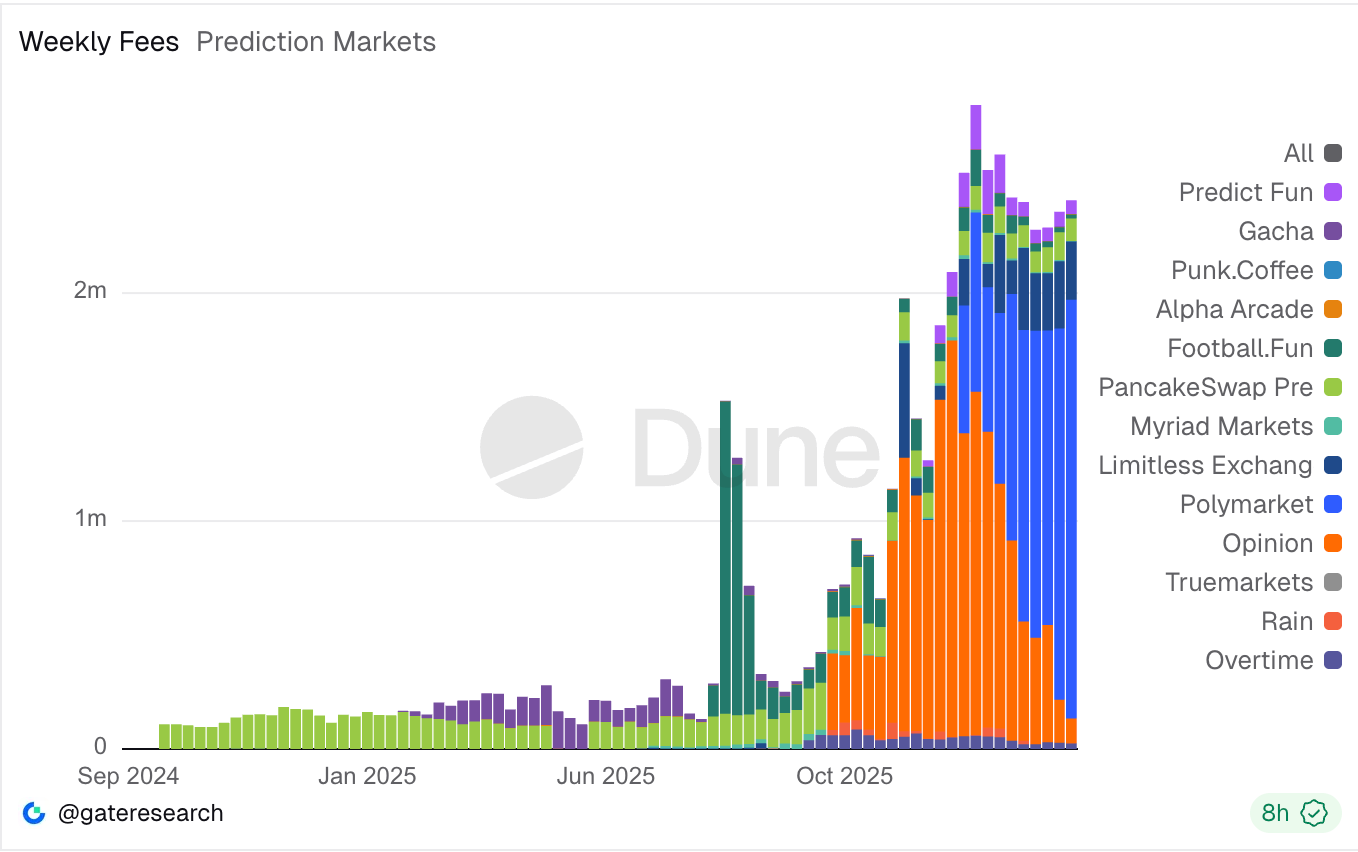
According to data compiled by Gate Research on Dune, since transaction fees were introduced on January 6th, Polymarket has accumulated over $11.2 million in fee revenue.

Using the most conservative method for another static estimate, assuming the trading volume and activity structure of the relevant markets remain unchanged, Polymarket is projected to generate approximately $58.4 million in annual revenue.
However, this estimation method does not accurately reflect Polymarket's revenue-generating capability.

The reason is that Polymarket's revenue data is clearly in a growth trend — over the past 10 weeks, the platform's weekly fee revenue has been $560,000, $786,000, $633,000, $749,000, $1.08 million, $1.28 million, $1.35 million, $1.29 million, $1.63 million, $1.84 million... showing almost weekly significant growth.

Reasons for Revenue Growth

There are two reasons for the growth in Polymarket's fee revenue. First, Polymarket has expanded the scope of fee-charging markets; second, Polymarket's overall trading volume and the trading volume in fee-charging markets have been growing continuously.

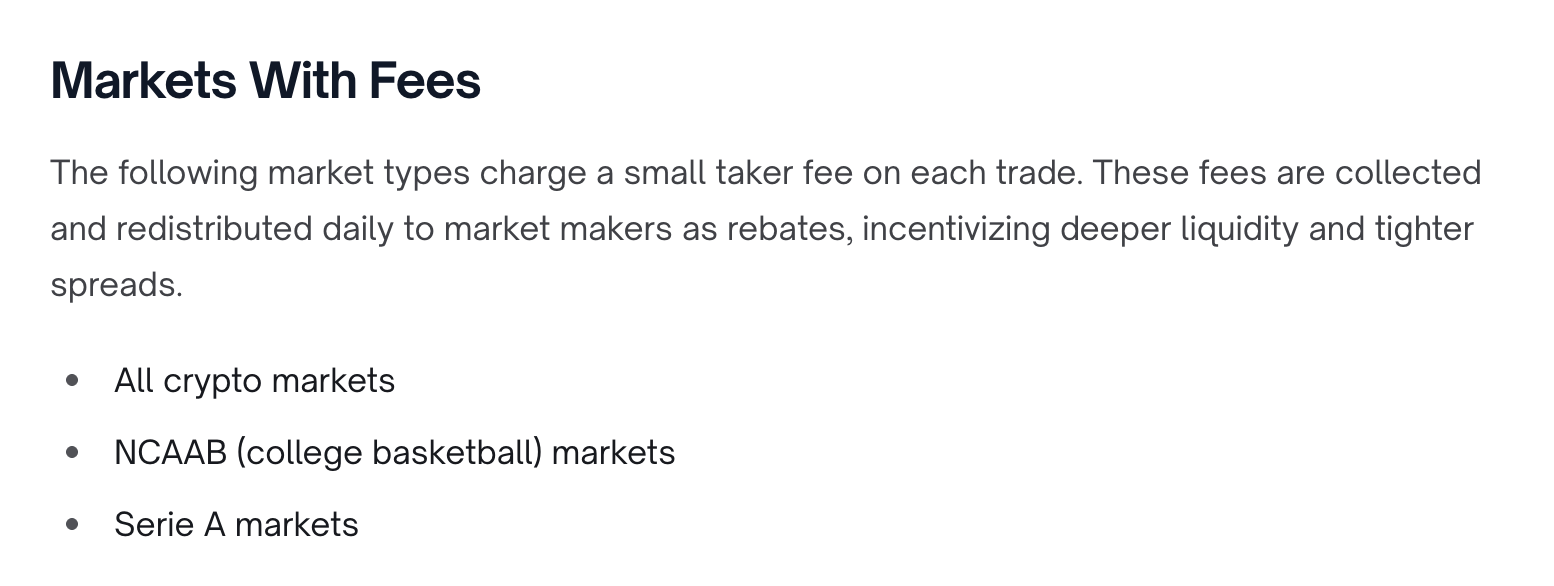
Regarding the scope of fee-charging markets, Polymarket extended the fee mechanism to all cryptocurrency-related markets on March 6th. Additionally, even earlier, it had begun trialing fee collection in sports markets like NCAA and Serie A. However, the former (cryptocurrency-related markets) currently remains the primary source of fee revenue.
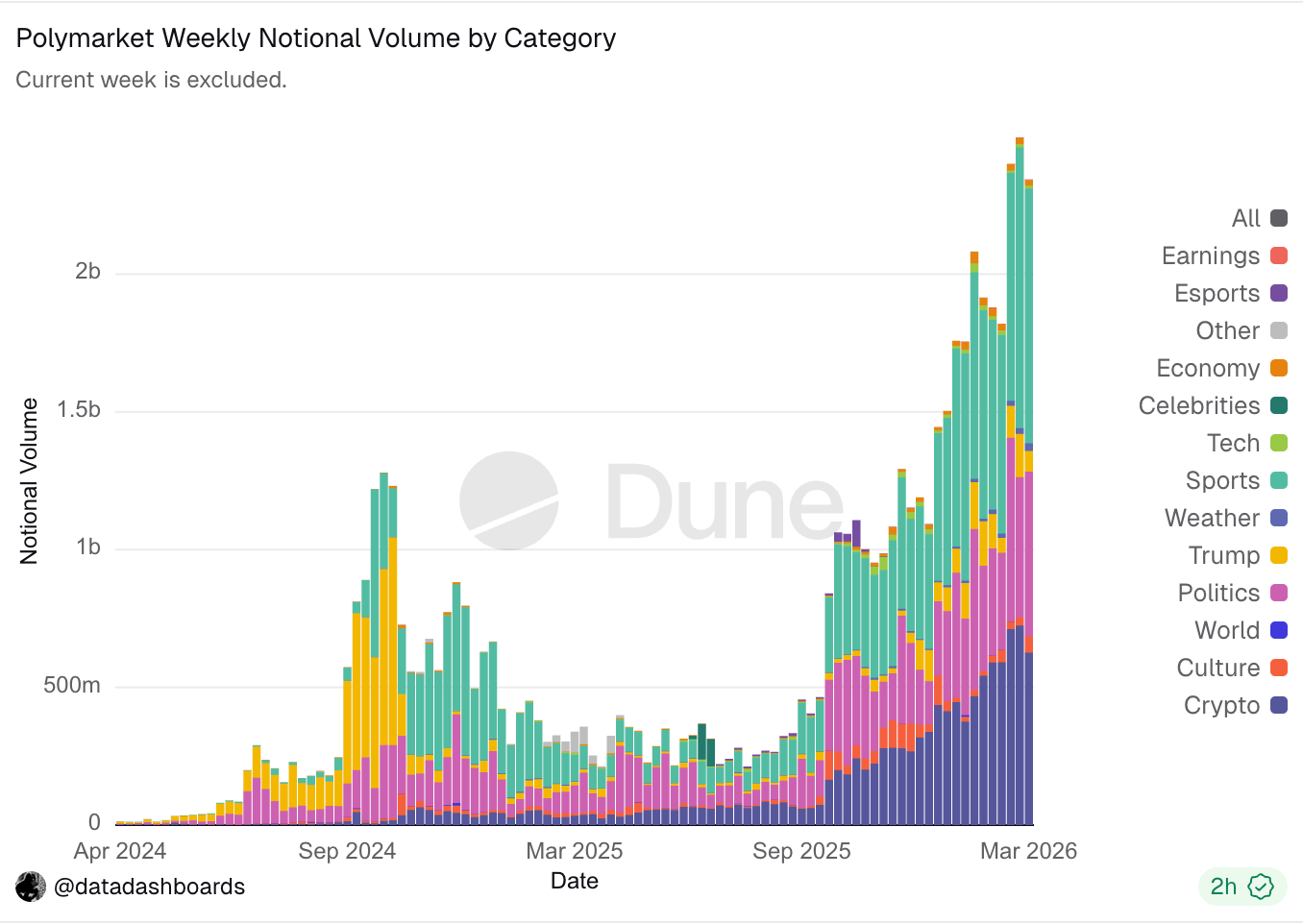
Regarding trading volume, the data dashboard compiled by Data Dashboards on Dune shows that Polymarket's weekly overall trading volume and cryptocurrency market volume (the bottom purple bars) have been growing steadily.
Future Revenue Projections

When we last projected Polymarket's revenue, we had to manually extract the trading volume proportion of "15-minute cryptocurrency up/down" related markets within all cryptocurrency-related markets. But now, since Polymarket extended fees to all cryptocurrency-related markets on March 6th, this estimation is much more straightforward. As for NCAA and Serie A, perhaps because the former hasn't entered the "March Madness" official tournament yet, and the latter has relatively low cultural attention in the US, the trading volume scale of these markets is significantly smaller compared to cryptocurrencies, so they are temporarily ignored here.

Taking data from the only full week after March 6th (March 9th-15th), the trading volume of cryptocurrency-related events accounted for 26.7% of the platform's total trading volume that week. In the same week, Polymarket's fee revenue was approximately $1.84 million. Based on this ratio for a static projection, under the current trading volume level and structure, if Polymarket introduces a similar fee model across all markets, it is projected to bring in $360 million in annual revenue for the platform.

The Money Printer is Already Running

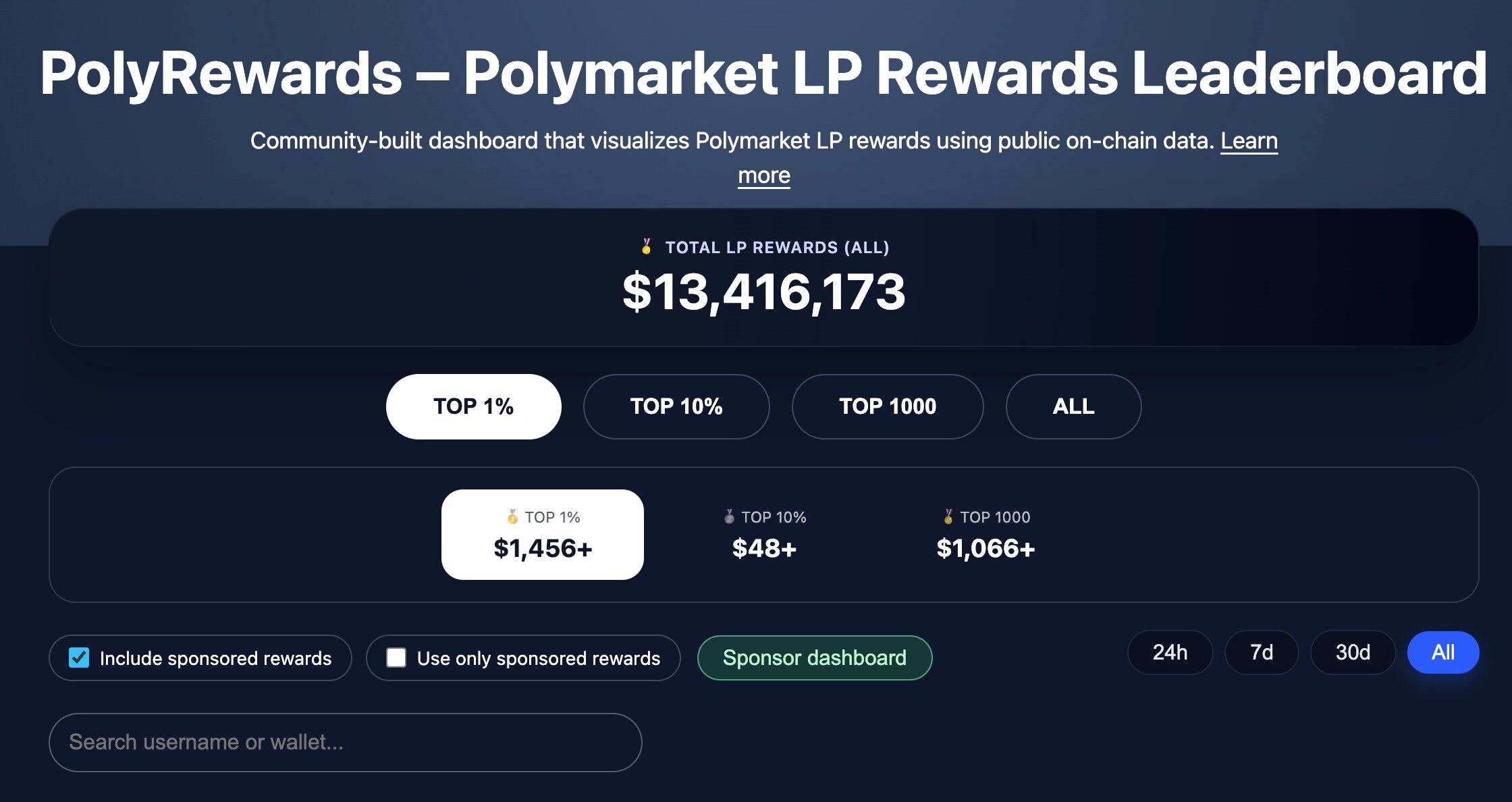
It is worth mentioning that, as a key measure for Polymarket to expand liquidity, the platform has so far distributed a total of $13.41 million in subsidies to liquidity providers (LPs). In contrast, if the data for the remainder of March can continue the performance of the first half, the fee revenue generated by Polymarket within this month alone could cover the total expenditure on liquidity subsidies.
Polymarket has largely proven the revenue-generating capability of this new form of prediction markets. Future revenue growth will mainly depend on two variables — how much more trading volume can grow, and whether fees can be further extended to more markets.

If these two variables continue to trend upwards, prediction markets might become the simplest and most direct "money printer" in the cryptocurrency industry.


İlgili Sorular

QWhen did Polymarket start charging transaction fees, and what was the initial market targeted?

APolymarket started charging transaction fees on January 6, beginning with the '15-minute cryptocurrency up/down' markets.

QHow much fee revenue has Polymarket accumulated since it began charging fees?

APolymarket has accumulated over $11.2 million in fee revenue since it started charging transaction fees.

QWhat are the two main reasons for the growth in Polymarket's fee revenue?

AThe two main reasons are the expansion of fee-charging markets to include all crypto-related markets and the continuous growth in overall trading volume, particularly in cryptocurrency markets.

QWhat is the estimated annual revenue for Polymarket if fees are extended to all markets, according to the latest data?

AIf fees are extended to all markets, the estimated annual revenue for Polymarket is approximately $360 million, based on current trading volume and structure.

QHow does Polymarket's fee revenue compare to the subsidies it has provided to liquidity providers (LPs)?

APolymarket has provided a total of $13.41 million in subsidies to LPs. If the revenue trend from the first half of March continues, the fee income for the month alone could cover the total subsidies paid to LPs so far.

İlgili Okumalar

NVIDIA Begins Adding Soap to the Bubble

NVIDIA is taking on a dual role: not just as a leading chip supplier, but as a massive capital allocator across the entire AI supply chain. In 2026, the company has committed over $40 billion in investments within five months, targeting everything from optical fiber manufacturing and data center operations to foundational AI model development. This investment spree, described as a systematic "sprinkler" approach, primarily funds companies that are major buyers of NVIDIA's own GPUs. Critics, including analysts from Goldman Sachs, label this a "circular revenue" loop—comparable to a supplier financing a customer to buy more of its products. A prominent example is NVIDIA's investment in OpenAI, which is expected to generate around $13 billion in revenue for NVIDIA, much of which may be reinvested back into OpenAI. While CEO Jensen Huang dismisses the "circular financing" critique as "absurd," arguing the investments are confidence votes in long-term generational shifts, some analysts express discomfort. They note that while investments in critical supply chain components like optics are strategically sound, funding new cloud providers like CoreWeave feels like "pre-paying for your own GPUs." The strategy carries significant risks. If the AI investment cycle turns, the market may question how much demand is genuine versus artificially sustained by NVIDIA's own balance sheet. Despite posting record-breaking earnings—$215.9 billion in annual revenue and $120 billion in net profit for FY2026—NVIDIA's stock fell after its report, signaling that "beating expectations" may no longer be enough to assure investors about the duration of the AI spending boom. The article concludes that while a bubble isn't necessarily a fraud, NVIDIA's actions resemble adding soap to a bubble—making it appear more robust and durable. This creates a complex scenario requiring extreme冷静 from investors to distinguish between real structural growth and financial engineering.

marsbit9 dk önce

NVIDIA Begins Adding Soap to the Bubble

marsbit9 dk önce

Short Positions Have Been Squeezed Out: Will the Next Leg of the U.S. Stock AI Rally Continue in Seoul?

"Short Squeeze Exhausted: Will the Next Leg of the AI Rally Continue in Seoul?" A Nomura report suggests the US AI stock rally, which saw the S&P 500 rise ~16.6% in 28 days largely driven by 10 key stocks, may be pausing. The fuel from short covering, CTA fund positioning, and volatility-control strategies is nearing its limit. For the rally to continue, new momentum from retail and sentiment-driven FOMO (Fear Of Missing Out) is needed. South Korea's market provided a potential answer on the very day the report was published. The KOSPI index surged 4.32%, triggering a buy-side circuit breaker, led by massive gains in chip giants SK Hynix (+11.98%) and Samsung. This surge is characterized by retail "hynix FOMO" and overseas funds precisely buying into AI themes via chip-focused ETFs, shifting from broad Korean market ETFs. The Korean rally is a high-beta extension of the US AI capital expenditure story, as major cloud providers plan massive infrastructure spending, directly benefiting memory chip leaders. However, this linkage also implies vulnerability. The sustainability of this next leg depends on whether US tech stocks correct, the trajectory of US inflation (with upcoming CPI data key), and geopolitical tensions around the Strait of Hormuz. Seoul has emerged as the new epicenter of the AI trade, but its fate remains tied to these broader macro and market dynamics.

marsbit14 dk önce

Short Positions Have Been Squeezed Out: Will the Next Leg of the U.S. Stock AI Rally Continue in Seoul?

marsbit14 dk önce

Borrowing Money from a Hundred Years Later, Building Incomprehensible AI

Tech giants like Alphabet, Amazon, Meta, and Microsoft are undergoing a radical financial transformation due to AI. Their traditional "light-asset, high-free-cash-flow" model is being dismantled by staggering capital expenditures on AI infrastructure—data centers, GPUs, and power. Combined 2026 guidance exceeds $700 billion, a 4.5x increase from 2022, causing free cash flow to plummet (e.g., Amazon's fell 95%). To fund this, they are borrowing unprecedented sums through long-dated, multi-currency bonds (e.g., Alphabet's 100-year bond). The world's most conservative capital—pensions, insurers—is now funding Silicon Valley's most speculative bet. This shift makes these companies resemble heavy-asset industrials (railroads, utilities) rather than software firms, threatening their premium valuations. Historically, such infrastructure booms (railroads, fiber optics) followed a pattern: genuine technology, overbuilding fueled by competitive frenzy, aggressive debt financing, and a crash triggered by financial conditions—not technology failure. The infrastructure remained, but many original builders and financiers did not survive. The core gamble is a "time arbitrage": using cheap debt today to build scale and lock in customers before AI capabilities commoditize. They are betting that AI revenue will materialize before debt comes due. Their positions vary: Amazon is under immediate cash pressure; Meta's path to monetization is unclear; Alphabet has a robust core business buffer; Microsoft has the shortest path from infrastructure to revenue. The contract is set: the most risk-averse global capital has lent its time to Silicon Valley, awaiting a future that is promised but uncertain.

marsbit1 saat önce

Borrowing Money from a Hundred Years Later, Building Incomprehensible AI

marsbit1 saat önce

İşlemler

Spot
Futures
活动图片




