In a Losing Bear Market, Who Is Quietly Making a Fortune?

marsbit2026-04-10 tarihinde yayınlandı2026-04-10 tarihinde güncellendi

Özet

In a bear market where most crypto participants are losing money, a few projects continue to generate significant revenue. A look at Defillama’s revenue rankings reveals that profitable projects share simple and clear revenue models, which fall into two main categories: spread and transaction fees. Spread-based revenue models, used by entities like Tether, Circle, Aave, and Lido, act as capital intermediaries. They profit from the difference between lower funding costs and higher returns from deployed capital, relying on the scale and duration of capital deposits. Transaction fee models, employed by platforms such as Hyperliquid, Polymarket, pump.fun, Aerodrome, and Jupiter, generate income by charging fees on trading activities. Their earnings depend on the size and frequency of transactions. Notable cases include Grayscale (traditional asset management fees), Chainlink (data service fees), and Titan Builder (which profited unusually from a major arbitrage incident). The analysis concludes that sustainable profitability in a bear market comes from straightforward revenue models combined with sophisticated product execution and operational excellence.

Author|Azuma(@azuma_eth)

The market continues to slump, with funds underperforming, protocols shutting down, whales staying silent, and retail investors bleeding... It seems like everyone from top to bottom in the industry is losing money. However, even in such a cold market environment, a very few projects are still running their money-printing machines at full throttle.

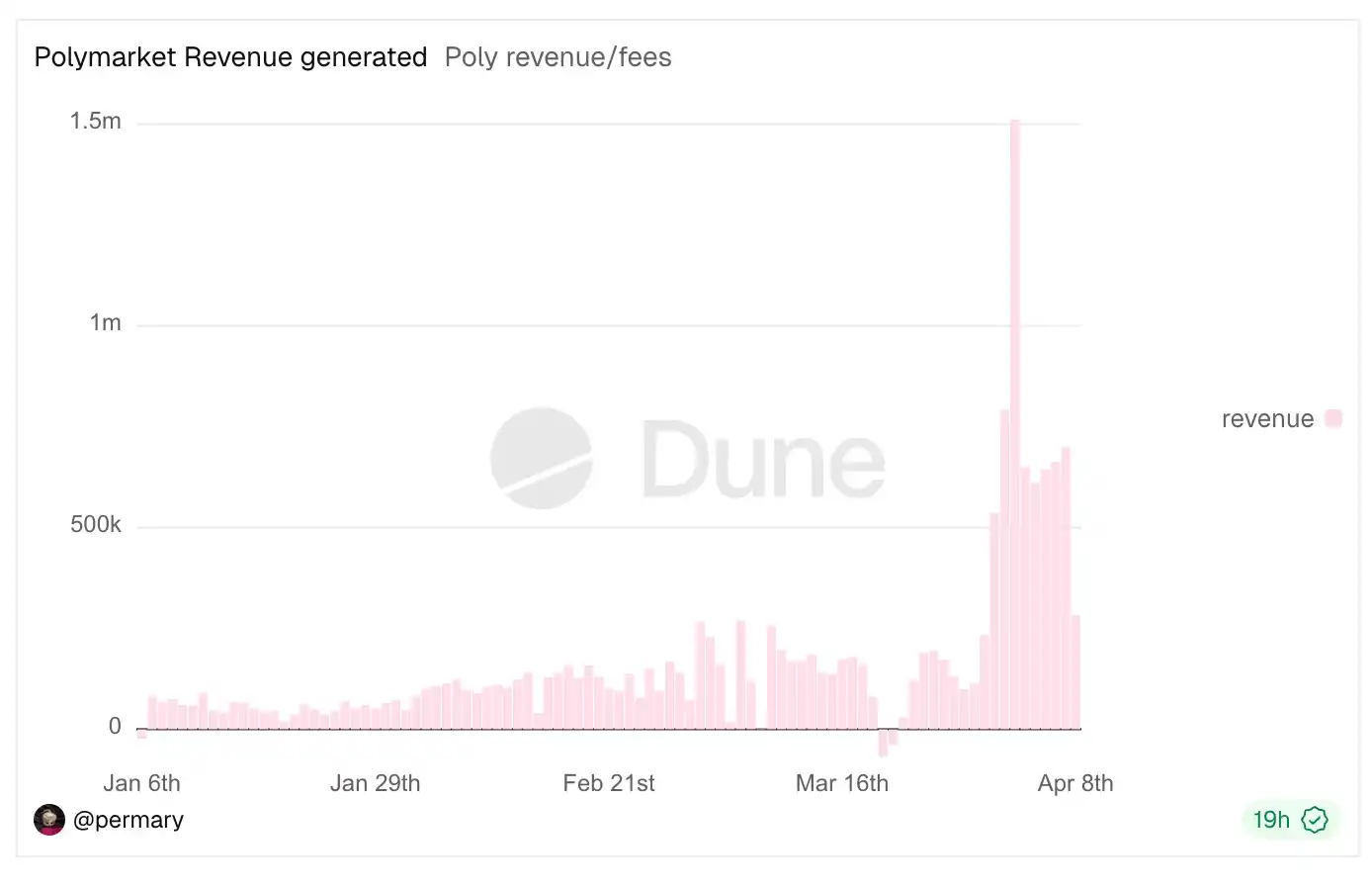
The latest example is Polymarket, which has fully opened its fee gates. Since recently expanding its fee scope and modifying its fee formula (Recommended reading: "Hardcore Analysis of Polymarket's Fee Formula: How Did the Extreme Rate of 90+% Pop Out?"), Polymarket's revenue generation capability has significantly surged; as of publication, Polymarket's total fee income has exceeded $24 million, with a single-day record of $1.5 million in revenue on April 2.
Taking this opportunity, the author checked the revenue rankings on Defillama to see which businesses are still making steady profits in the bear market, and the results were quite surprising: The core businesses and revenue sources of the listed projects are quite clear, even "simple."
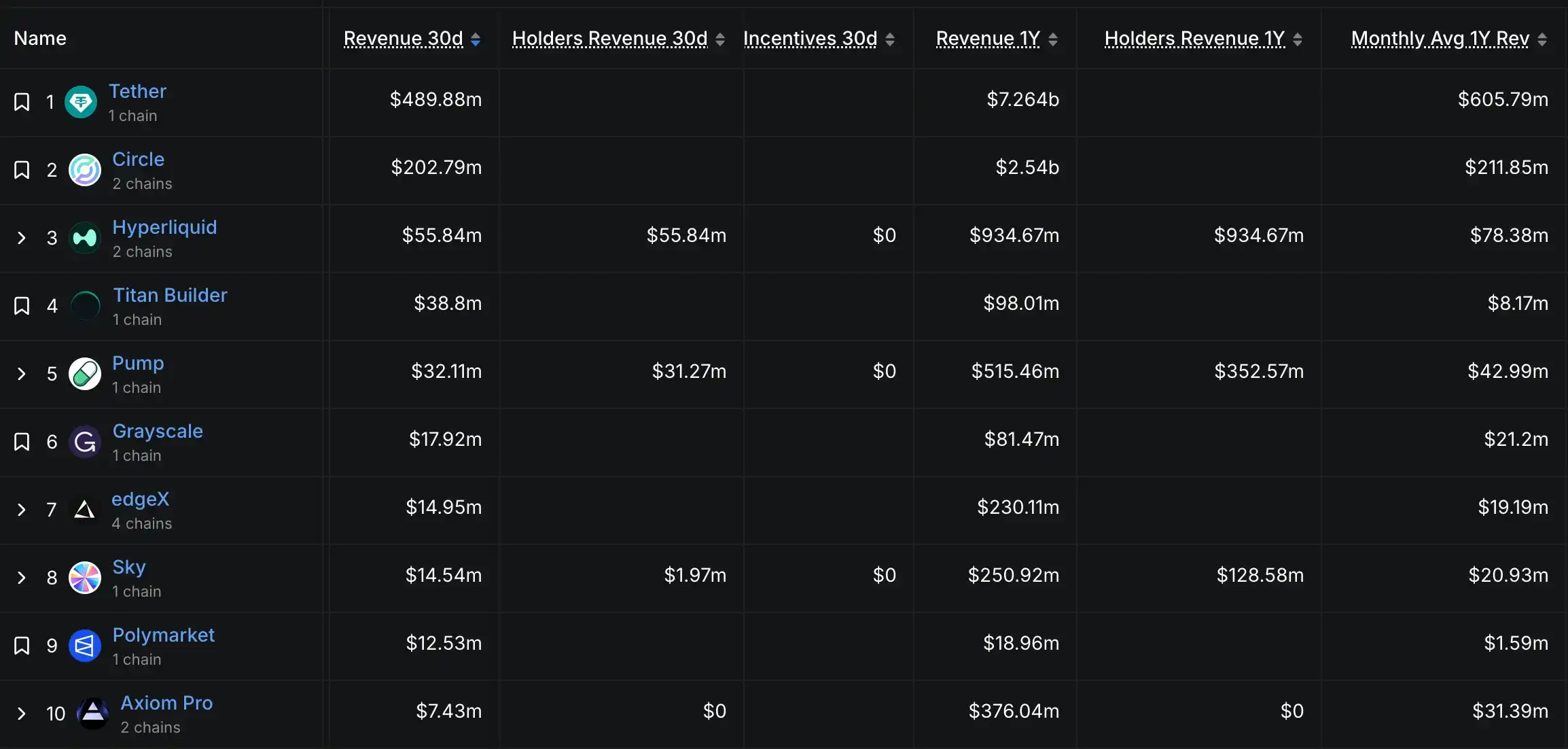
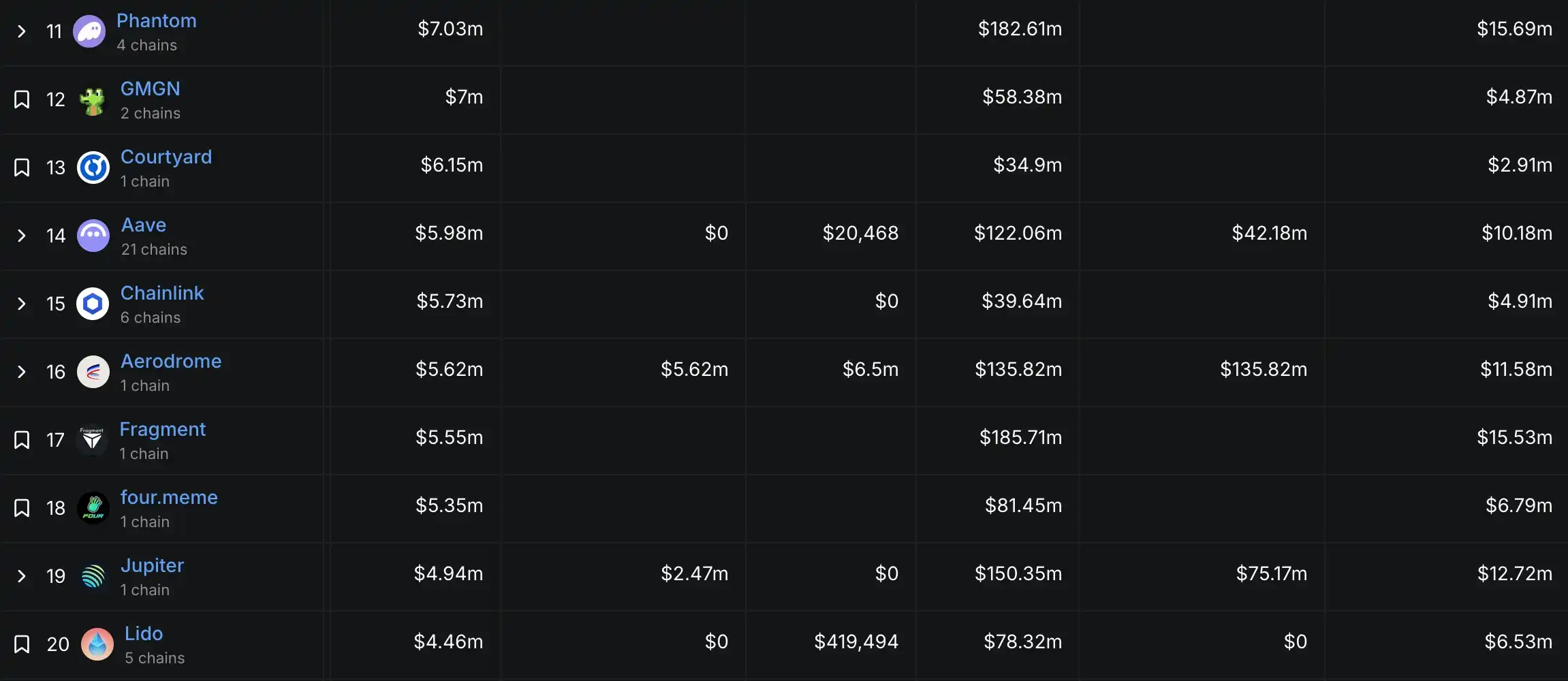
As shown above, I believe most players deeply involved in the crypto market could guess most of these names even without looking at the answers, and probably know exactly what they do. But when these names are neatly listed together, I suddenly realized that the main revenue sources of these profitable businesses are highly convergent, and can basically be summarized into two major categories: one is interest spread, and the other is transaction tax (fees).

First is interest spread, which is essentially acting as a "capital intermediary." The core logic is to absorb funds at a relatively low cost while deploying funds at a relatively high yield, using time to gradually accumulate the difference between the yield and the cost — the profit of such businesses depends on the scale and duration of the capital沉淀 (sedimentation), the larger the scale and the longer the time, the higher the profit.

Stablecoin issuers like Tether and Circle fall into this category. Their main income comes from the interest generated by deploying reserve funds into assets like U.S. Treasury bonds, while the costs mainly involve subsidies paid to partners and users. The difference between the two is the profit. Lending protocols like Aave also belong here; the spread is the difference between the relatively higher borrowing rate and the relatively lower deposit rate. Liquid staking services (LST) like Lido are no exception; they withhold a certain percentage from the native staking rewards as a service fee, which is also a form of interest spread.

Next is transaction tax. This type of business is easier to understand. As long as transaction-related activities (including token creation) occur, the business entity can "levy a tax" in the form of fees on each activity — the profit of such businesses depends on the transaction size per activity and the frequency of activities. The larger the size and the higher the frequency, the higher the profit.

Whether it's Hyperliquid and EdgeX focusing on perpetual contract trading, Polymarket focusing on event trading, pump.fun, GMGN, Axiom, and four.meme focusing on Meme trading, Aerodrome, Jupiter, and Phantom (whose main revenue comes from Swap fees on the wallet frontend) focusing on spot trading, or Courtyard and Fragment focusing on NFT trading (it's quite a surprise this category made the list), their primary revenue source is transaction tax.

The only few special cases in the rankings are Grayscale, Chanilink, and Titan Builder. Grayscale seems a bit out of place here; its core revenue comes from ETF and fund management fees, essentially a traditional asset management business focused on the cryptocurrency market. Chanilink is definitely worth mentioning; its main revenue comes from data service fees paid by projects calling its oracle (which can be categorized as a transaction tax to some extent). This is more like a To B on-chain SaaS business, but as you can see, the Matthew Effect in this path is more significant than in other tracks. Titan Builder is purely a sporadic phenomenon. It is a block builder service provider, not normally a particularly lucrative business. The reason it made the list is that Titan Builder got the biggest piece of the pie in last month's massive AAVE transaction sandwiching incident (see "50M USDT for 35K AAVE: How Did the Disaster Happen?").
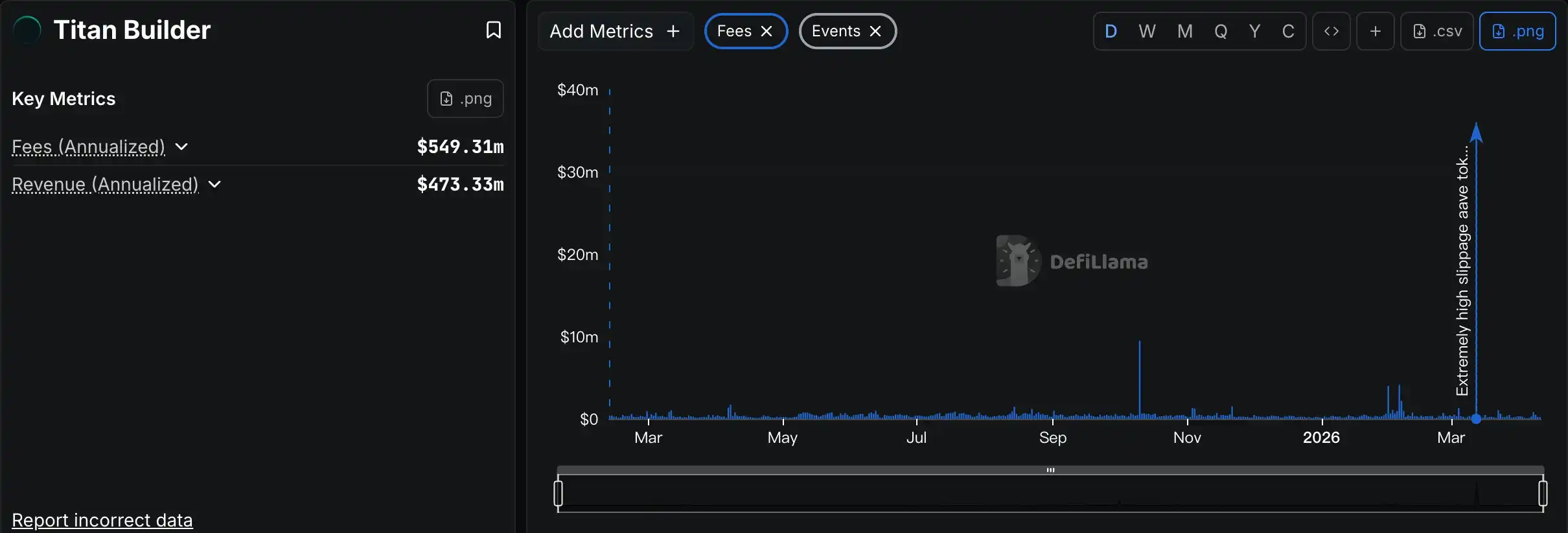
Odaily Note: See what it means to not open for business for three years, but eat for three years when you do.

So the conclusion is clear. The projects that continue to make money in the bear market are not those pursuing complex mechanisms and high-risk opportunities, but those that can operate continuously凭借 (relying on) simple and clear revenue models. In the still volatile cryptocurrency market, simpler revenue models have shown greater resilience and better withstand the test of market fluctuations.

However, a simpler revenue model absolutely does not mean these businesses are "easier to do." On the contrary, behind the simple revenue model often lie more complex product services and精细 (meticulous) operational management. This is where the leading players on the list have truly "competed" their way to differentiation. From interaction design, to liquidity accumulation, to risk management, to user communication and feedback... To stand out in the fierce competition of the存量 (stock) market, one must invest more effort into the product and service.

The crypto winter is not over yet. The projects that can truly survive and even profit are often those that flexibly combine simple revenue models with complex product services. Perhaps, this is the long-term code to穿越 (traverse) bull and bear markets.


İlgili Sorular

QWhat are the two main categories of revenue sources for profitable projects in the crypto bear market, as mentioned in the article?

AThe two main categories are spread (acting as a capital intermediary) and transaction tax (fees).

QWhich project set a single-day revenue record of $1.5 million on April 2nd, according to the article?

APolymarket set a single-day revenue record of $1.5 million on April 2nd.

QWhat is the core revenue source for stablecoin issuers like Tether and Circle, as explained in the article?

ATheir core revenue comes from the interest earned by deploying reserve funds into assets like U.S. Treasury bonds, minus the costs of subsidies to partners and users.

QName one project whose revenue primarily comes from data service fees for oracle calls, as highlighted in the article.

AChanilink primarily earns revenue from data service fees charged for project oracle calls.

QWhat does the article suggest is the key to surviving and profiting in the crypto bear market?

AThe key is combining simple revenue models with complex product services and refined operational management.

İlgili Okumalar

In Conversation with Ray Dalio: We Are Currently in an AI Bubble, with 1% of My Portfolio in Bitcoin

Ray Dalio, founder of Bridgewater Associates, warns in an interview that the current AI boom shows classic bubble characteristics, which could lead to significant economic downturns as seen in past cycles like 1929 or 2000. He explains that speculative enthusiasm, fueled by debt and overvaluation, often precedes a crash when rising rates or taxation force asset sales, causing widespread losses and recession. Dalio also outlines his "Big Cycle" theory, describing an approximate 80-year pattern where widening wealth gaps, massive government deficits, and shifting geopolitical power (like China's rise) create internal conflict and global instability. He emphasizes that we are in a late-cycle, transitional phase where traditional powers like the US and UK face decline. For personal wealth protection, Dalio advises diversification beyond cash into assets like stocks, bonds, real estate, and particularly gold, which he prefers over Bitcoin. While he holds about 1% of his portfolio in Bitcoin as a non-printable hard asset, he views gold as more secure from technological or governmental threats. Regarding AI's impact, Dalio believes it will disproportionately benefit capital owners, worsening inequality by replacing both physical and cognitive labor. He suggests that human intuition and emotional intelligence, combined with AI, will be key for future workers. On taxation, Dalio argues that wealth taxes are impractical and risk triggering asset sell-offs, reducing productive investment. He points to the UK as a cautionary example of debt, low productivity, and political strife. Geopolitically, Dalio foresees a more regionalized world, with the US showing weakness in prolonged conflicts like with Iran, akin to past imperial declines. The ideal outcome, he suggests, is coexisting powerful blocs (e.g., Americas, China-Asia Pacific) without major war.

marsbit2 saat önce

In Conversation with Ray Dalio: We Are Currently in an AI Bubble, with 1% of My Portfolio in Bitcoin

marsbit2 saat önce

Daily 7.2 Trillion KRW: Foreign Capital's Record Net Buying on Friday! Wall Street Says Headwinds for Korean Stock Fund Flows Have Subsided

South Korean stock market sees a dramatic shift in fund flows. On July 31, foreign investors made a record net purchase of approximately KRW 7.2 trillion in KOSPI stocks, marking a fundamental reversal from the persistent large-scale net outflows seen in previous months. This contributed to a significant narrowing of foreign net selling in July to KRW 9.8 trillion, down sharply from KRW 48.4 trillion in June and KRW 44.5 trillion in May. Simultaneously, domestic institutional pressure eased. South Korean pension funds and asset managers turned to a net buying position in July, purchasing KRW 1.0 trillion worth of KOSPI shares, contrasting with net sales in May and June. Market volatility is expected to be dampened by new financial regulations. Effective July 31, the Financial Services Commission tightened access for retail investors to single-stock leveraged ETFs by raising the minimum cash deposit requirement. Trading volumes for these products subsequently dropped to about 50% of their monthly average. Citigroup Research maintains its year-end KOSPI target of 10,000 points. The firm cites several supportive factors: the substantial easing of headwinds from capital outflows, a robust fundamental outlook for the semiconductor sector, historically low market valuations, strong economic fundamentals, and the potential for policy support from financial authorities if needed.

marsbit2 saat önce

Daily 7.2 Trillion KRW: Foreign Capital's Record Net Buying on Friday! Wall Street Says Headwinds for Korean Stock Fund Flows Have Subsided

marsbit2 saat önce

Thanks to Dice Rolls, Bitcoin Keys Are Stored Offline, But Not Everyone Will Do It

The article discusses using dice rolls to generate secure Bitcoin wallet seeds, providing entropy independent of potentially flawed hardware random number generators. It explains that each fair dice roll offers about 2.585 bits of entropy, with around 50 rolls needed for a standard 12-word seed phrase and 99+ recommended for higher security. This method gained attention after a vulnerability was revealed in some Coldcard hardware wallets, where a faulty firmware RNG (dating back to 2021) compromised generated keys. The analysis notes that while a dice-generated main seed was safe from this specific flaw, other Coldcard functions (like creating paper wallets, backup keys, or passwords) could still be vulnerable if they used the defective RNG. The piece argues that while dice-based entropy is technically robust, the manual process is error-prone, tedious, and unrealistic for most new users, who might make mistakes in recording or inputting rolls. It concludes that while manual entropy generation should remain an option for advanced users, the long-term goal is to develop reliable, user-friendly hardware and software that securely generates randomness without requiring specialized knowledge. Coldcard users are advised to check their firmware version and replace any secondary secrets (like paper wallet keys) created with vulnerable devices, while also considering multi-signature setups with devices from different manufacturers for added security.

cryptonews.ru8 saat önce

Thanks to Dice Rolls, Bitcoin Keys Are Stored Offline, But Not Everyone Will Do It

cryptonews.ru8 saat önce

İşlemler

Spot
活动图片




