In a Losing Bear Market, Who Is Quietly Making a Fortune?

Odaily星球日报2026-04-10 tarihinde yayınlandı2026-04-10 tarihinde güncellendi

Özet

Amid a prolonged bear market where most crypto participants are losing money, a few projects continue to generate significant revenue. A closer look at Defillama’s revenue rankings reveals that profitable projects share simple and clear revenue models, primarily falling into two categories: spread income and transaction fees. Spread-based revenue models involve acting as capital intermediaries—absorbing funds at lower costs and deploying them at higher yields. Examples include stablecoin issuers like Tether and Circle, which earn from interest on reserve assets like U.S. Treasuries; lending protocols such as Aave, which profit from the spread between borrowing and deposit rates; and liquid staking services like Lido, which retain a portion of staking rewards as fees. Transaction fee models generate revenue by taxing activities like trading, token creation, or other on-chain actions. Platforms such as Hyperliquid and EdgeX (perpetual trading), Polymarket (event prediction), pump.fun and GMGN (meme trading), Aerodrome and Jupiter (spot trading), as well as Phantom (via swap fees) and NFT marketplaces like Courtyard and Fragment, all rely heavily on transaction fees. Notable exceptions include Grayscale (traditional asset management fees), Chainlink (oracle data service fees), and Titan Builder (which profited unusually from a large MEV capture incident). The key insight is that sustainable profitability in a bear market comes from straightforward revenue models combined with...

Original | Odaily Planet Daily (@OdailyChina)

Author | Azuma (@azuma_eth)

The market remains sluggish, with funds performing poorly, protocols shutting down, major holders staying silent, and retail investors bleeding... It seems like everyone from top to bottom in the industry is losing money. However, even in such a cold market environment, a very few projects are still running their money-printing machines at full throttle.

The latest example is Polymarket, which has fully opened its fee gates. Since recently broadening its fee scope and revising its fee formula (recommended reading: "Hardcore Analysis of Polymarket's Fee Formula: How Did Extreme Rates of 90+% Emerge?"), Polymarket's revenue-generating capacity has significantly surged; as of publication, Polymarket's total fee income has exceeded $24 million, with a single-day record of $1.5 million in revenue on April 2.
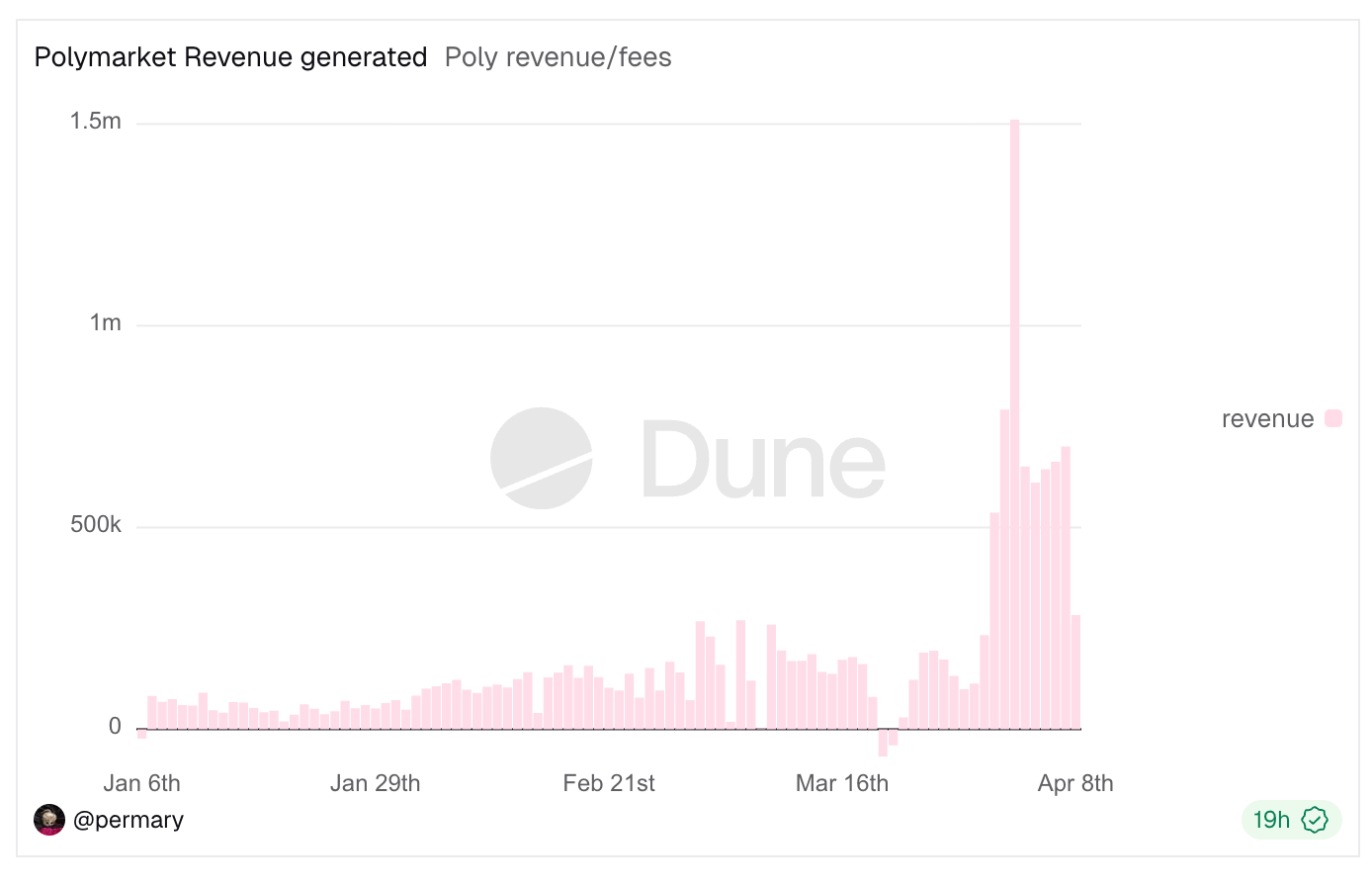
Taking this opportunity, I browsed the revenue rankings on Defillama to see which businesses are still consistently making money during the bear market, and the results were quite surprising: The core businesses and revenue sources of the listed projects are quite clear, even "simple."
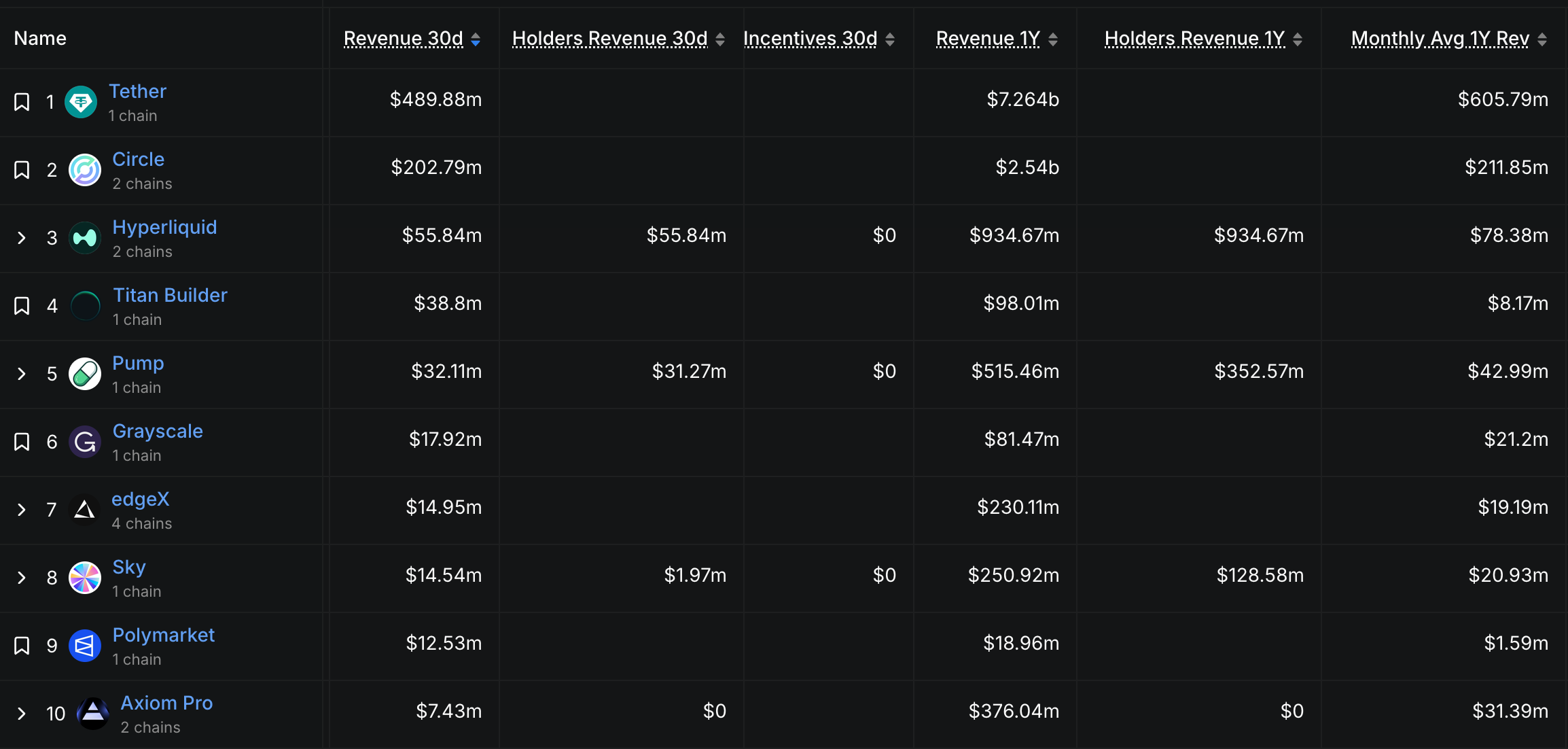
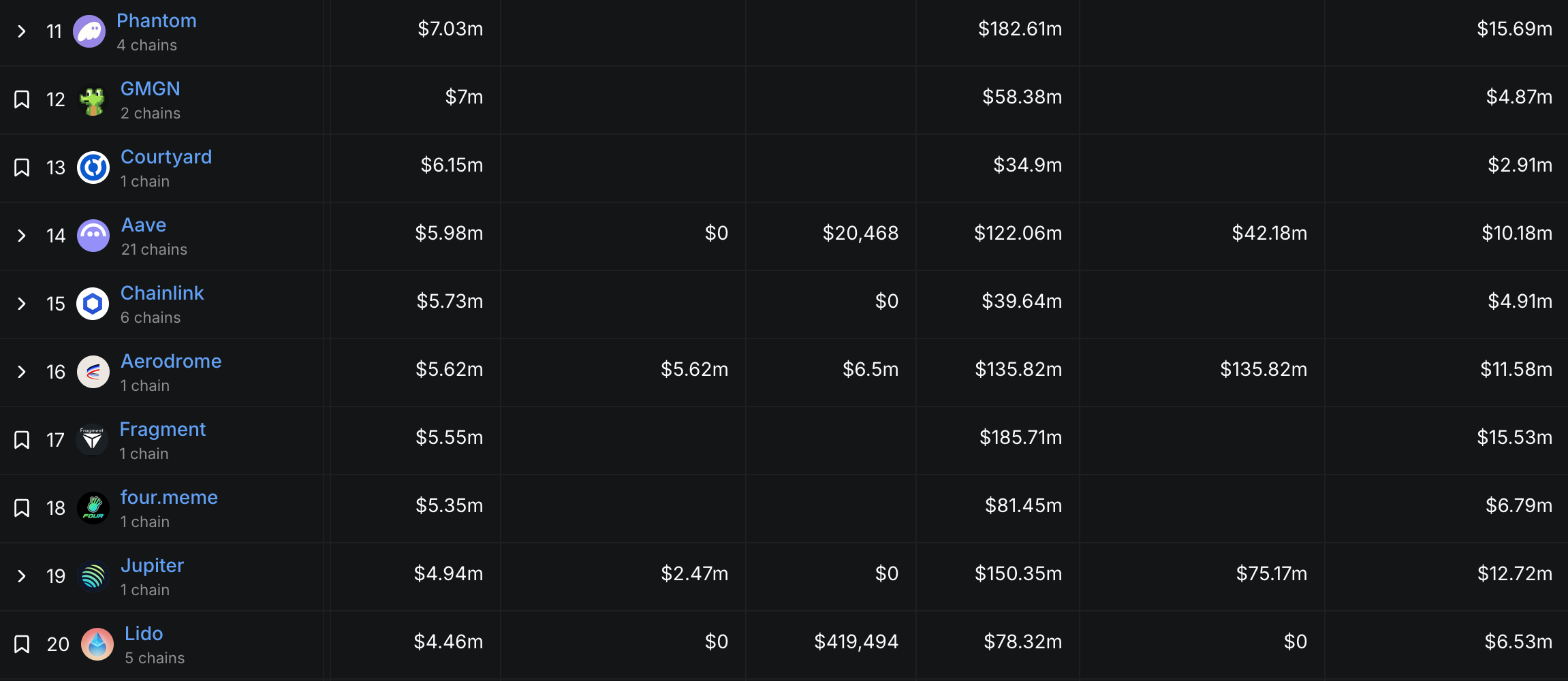
As shown above, I believe most players deeply involved in the crypto market could guess most of these names even without looking at the answers, and probably know exactly what they do. But when these names are neatly listed together, I suddenly realized that the main revenue sources of these profitable businesses are highly convergent, and can essentially be summarized into two broad categories: first, interest spreads, and second, transaction taxes (fees).

First, interest spreads: This is essentially acting as a "capital intermediary." The core logic is to absorb funds at relatively low costs and deploy them at relatively high returns, using time to gradually accumulate the difference between returns and costs — the profit of such businesses depends on the scale and duration of capital沉淀; the larger the scale and the longer the time, the higher the profit.

Tether, Circle, and other stablecoin issuers fall into this category. Their main income comes from the interest generated by deploying reserve funds into assets like U.S. Treasury bonds, while their costs mainly involve subsidies paid to partners and users. The difference between the two is the profit. Lending protocols like Aave also belong here, with the spread being the difference between the relatively higher borrowing rates and the relatively lower deposit rates. Liquid staking services (LST) like Lido are no exception; they withhold a certain percentage from ETH's native staking rewards as a service fee, which is also a form of interest spread.

Second, transaction taxes: This type of business is easier to understand. Whenever transaction-related activities (including token creation) occur, the business entity can "tax" the activity in the form of fees — the profit of such businesses depends on the transaction size per activity and the frequency of activities; the larger the size and the higher the frequency, the greater the profit.

Whether it's Hyperliquid and EdgeX focusing on contract trading, Polymarket focusing on event trading, pump.fun, GMGN, Axiom, and four.meme focusing on Meme trading, Aerodrome, Jupiter, and Phantom (whose main revenue comes from Swap fees on the wallet frontend) focusing on spot trading, or Courtyard and Fragment focusing on NFT trading (it's quite a surprise that this category even made the list), their primary revenue source is transaction taxes.

The only few special cases in the rankings are Grayscale, Chanilink, and Titan Builder. Grayscale is somewhat out of place here; its core revenue comes from ETF and fund management fees, essentially a traditional asset management business focused on the cryptocurrency market. Chanilink is definitely worth mentioning; its main revenue comes from data service fees paid by projects calling its oracle, making it more like a To B on-chain SaaS business. But as you can see, the Matthew effect in this path is more pronounced than in other sectors. Titan Builder is purely a sporadic phenomenon; it is a block-building service provider, not normally a particularly profitable business. The reason it made the list is because Titan Builder took the largest piece of the pie in last month's massive AAVE transaction sandwiching incident (details in "50 Million USDT for 35,000 AAVE: How Did the Disaster Happen?").
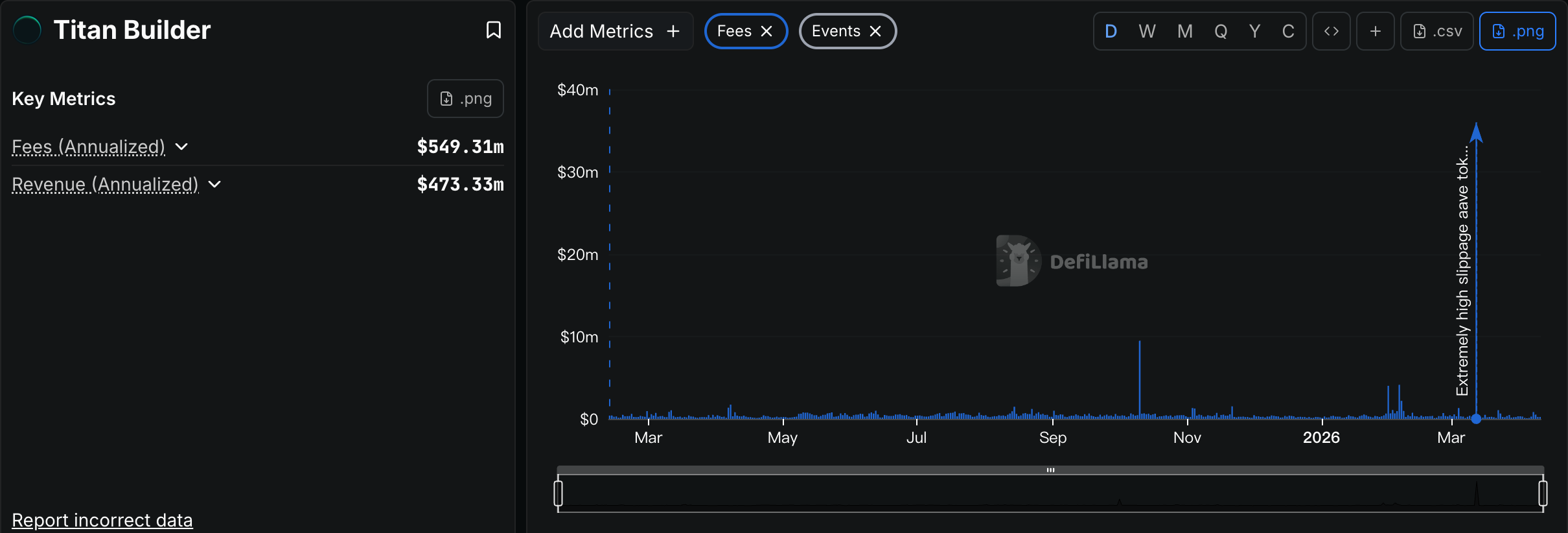
Odaily Note: See what it means to not open for business for three years, but eat for three years when you do.

So the conclusion is clear. Projects that continue to make money during the bear market are not those pursuing complex mechanisms and high-risk opportunities, but those that can operate consistently with simple, clear revenue models. In the still volatile cryptocurrency market, simpler revenue models have demonstrated greater resilience and better withstand the test of market fluctuations.

However, a simpler revenue model absolutely does not mean these businesses are "easier to run." On the contrary, behind the simple revenue models often lie more complex product services and meticulous operational management. This is where the leading players on the list have truly "differentiated" themselves through intense competition. From interaction design, to liquidity accumulation, to risk management, to user communication and feedback... To stand out in the fierce competition of the存量 market, one must invest more effort into product and service.

The crypto winter is not over yet. The projects that can truly survive and even profit are often those that flexibly combine simple revenue models with complex product services. Perhaps, this is the long-term code to navigate through bull and bear markets.


İlgili Sorular

QWhat are the two main categories of revenue sources for profitable projects in the crypto bear market, as mentioned in the article?

AThe two main categories are spread (acting as a capital intermediary) and transaction tax (fees).

QWhich project set a single-day revenue record of $1.5 million on April 2nd, according to the article?

APolymarket set a single-day revenue record of $1.5 million on April 2nd.

QWhat is the core revenue source for stablecoin issuers like Tether and Circle, as explained in the article?

ATheir core revenue comes from the interest earned by deploying reserve funds into assets like U.S. Treasury bonds, minus the costs of subsidies to partners and users.

QName one project whose primary revenue comes from data service fees paid for oracle services, as highlighted in the article.

AChanilink's primary revenue comes from data service fees paid by projects for using its oracle services.

QWhat does the article suggest is the 'long-term password' to survive and profit through market cycles in crypto?

AThe 'long-term password' is combining simple revenue models with complex product services and sophisticated operational management.

İlgili Okumalar

This Week's Key Events Preview | U.S. to Release April CPI Data; U.S. Senate Banking Committee to Review "Digital Asset Market Structure Act of 2025"

Weekly News Preview: Key events for May 12-16 include major economic and crypto industry developments. On Tuesday, May 12, the U.S. will release its April CPI data. Additionally, the gaming blockchain Ronin will begin a 10-hour migration to an Ethereum Layer 2, built on OP Stack with EigenDA for data availability. This aims to leverage Ethereum's security and settle RON's annual inflation below 1%. Base's first independent network upgrade, "Base Azul," is scheduled for mainnet activation on Wednesday, May 13, focusing on security, performance, and developer experience enhancements. Thursday, May 14, sees the U.S. Senate Banking Committee voting on the "Digital Asset Market Structure Act of 2025." In other news, Solana DeFi protocol Carrot will shut down, setting a final withdrawal deadline due to impacts from the Drift exploit. The Moscow Exchange will launch futures trading for Solana, Ripple, and Tron indices (RUB-settled) for qualified investors. Multiple service closures are scheduled for Friday, May 15. Dmail Network will begin winding down due to unsustainable infrastructure costs and failed commercialization. Users must export data before this date. Separately, the Cosmos-based lending blockchain UX Chain will fully shut down. Finally, on Saturday, May 16, gaming infrastructure provider Lattice will wind down operations, with its Redstone Layer 2 network ceasing. Users are urged to withdraw assets, especially from contracts like Uniswap pools, before the shutdown.

链捕手2 dk önce

This Week's Key Events Preview | U.S. to Release April CPI Data; U.S. Senate Banking Committee to Review "Digital Asset Market Structure Act of 2025"

链捕手2 dk önce

Morning Post | Trump Media Group Releases Q1 Financial Report; Top Three DeFi Applications Return Nearly $100 Million in Revenue to Token Holders in 30 Days; Michael Saylor Shares Bitcoin Tracker Info Again

**Title: Daily Briefing | Trump Media Group Releases Q1 Report; Top 3 DeFi Apps Return Nearly $100M to Token Holders; Michael Saylor Signals Potential Bitcoin Buy** **Summary:** Key developments in the past 24 hours include: * **Economic Outlook:** Goldman Sachs has pushed back its forecast for the next two Federal Reserve interest rate cuts to December 2026 and March 2027, citing persistent inflationary pressures from energy costs. This delayed timeline is expected to tighten liquidity flow into risk assets, including cryptocurrencies. * **DeFi & Revenue:** Data from DefiLlama shows that three leading DeFi applications—Hyperliquid, Pump.fun, and EdgeX—collectively distributed $96.3 million in revenue to their token holders over the last 30 days. This trend highlights a shift in the crypto community's focus towards real protocol earnings and sustainable economic models. * **Corporate Bitcoin Moves:** Michael Saylor, founder of MicroStrategy (note: referred to as 'Strategy' in the text, likely a typographical error), has signaled potential upcoming Bitcoin purchases by posting a "Bitcoin Tracker" update, following a pattern that typically precedes the company's official disclosure of new acquisitions. * **Market Integrity:** Prediction market platform Polymarket announced updates to address platform issues, including identifying and banning clusters of accounts involved in "ghost-fill" activities and implementing measures to prevent bulk account creation. * **Regulation:** The Bank of England Governor warned that stablecoin regulation could lead to tensions between US and international regulators. In South Korea, the National Tax Service has launched a pilot program to entrust seized virtual assets to private custody firms for management. * **Meme Token Trends:** GMGN data lists the top trending meme tokens on Ethereum (e.g., HEX, SHIB), Solana (e.g., FWOG, TROLL), and Base (e.g., SKITTEN, PEPE) over the past day. **Financial Note:** Trump Media & Technology Group reported a Q1 loss of approximately $4 billion, primarily attributed to unrealized losses on its Bitcoin and other digital asset holdings.

链捕手33 dk önce

Morning Post | Trump Media Group Releases Q1 Financial Report; Top Three DeFi Applications Return Nearly $100 Million in Revenue to Token Holders in 30 Days; Michael Saylor Shares Bitcoin Tracker Info Again

链捕手33 dk önce

Telegram Takes Direct Control of TON, Social Traffic Rewrites the Public Chain Narrative

Telegram founder Pavel Durov announced that Telegram will replace the TON Foundation as the core driver and largest validator of The Open Network (TON). Key initiatives include a sixfold reduction in transaction fees, performance upgrades, and improved developer tools within the next few weeks. This marks a strategic shift from Telegram merely providing user access to deeply integrating TON into its platform's core infrastructure. The goal is to transform Telegram's massive social traffic into sustainable on-chain activity. While viral mini-apps like Notcoin have demonstrated Telegram's ability to drive user adoption, TON aims to support frequent, low-value transactions inherent to social platforms—such as tipping, in-app payments, and game rewards. Ultra-low fees and sub-second finality (0.6 seconds) are crucial to making blockchain interactions seamless and nearly invisible within the Telegram user experience. However, Telegram's increased central role raises questions about network decentralization. Durov argues that Telegram's participation will attract more large validators, thereby enhancing decentralization. TON also offers high annual staking rewards (18.8%), aiming to retain capital within its ecosystem. The fundamental challenge for TON is no longer leveraging Telegram's user base, but becoming an indispensable, seamless infrastructure layer for Telegram's everyday applications—moving from an adjacent chain to an embedded utility.

marsbit34 dk önce

Telegram Takes Direct Control of TON, Social Traffic Rewrites the Public Chain Narrative

marsbit34 dk önce

Telegram Takes Direct Control of TON, Social Traffic Reshapes Public Chain Narrative

Telegram's founder, Pavel Durov, has announced a major shift in the development of The Open Network (TON). Telegram will now become the core driver of TON, replacing the TON Foundation and becoming its largest validator. The focus will be on technical upgrades over the next few weeks, including slashing network fees by six times to near-zero and improving finality time to 0.6 seconds. This move signifies a deeper integration between Telegram and TON, moving beyond just providing a user base. The goal is to transform Telegram's vast social traffic and built-in features—like Mini Apps, payments, and bots—into sustainable, on-chain usage scenarios. The reduced fees and faster speeds are crucial for enabling the small, frequent transactions typical of social interactions. While this promises stronger execution and product alignment, it raises questions about centralization. Durov argues Telegram's involvement will attract more validators, enhancing decentralization, but the outcome remains to be seen. Additionally, TON's high annual staking reward of 18.8% aims to retain capital within the ecosystem. The key challenge for TON is no longer just leveraging Telegram's entry point, but becoming an invisible, seamless infrastructure layer within Telegram's daily use. Its success hinges on converting viral attention into lasting, embedded utility.

Odaily星球日报44 dk önce

Telegram Takes Direct Control of TON, Social Traffic Reshapes Public Chain Narrative

Odaily星球日报44 dk önce

İşlemler

Spot
Futures
活动图片




