Illustrating Meta's Layoffs: Firing 700 Employees on the Same Day, Offering Executives a $9 Trillion Bet-Based Incentive

marsbit2026-03-26 tarihinde yayınlandı2026-03-26 tarihinde güncellendi

Özet

On March 25, Meta laid off approximately 700 employees across departments including Reality Labs, Facebook, recruiting, and sales. On the same day, the SEC disclosed an executive stock option plan for six top executives, tied to a $9 trillion market cap target—the first such grant since Meta’s 2012 IPO. This reflects Meta’s strategic shift: fewer but higher-value talent and massive AI investment. Since its 2022 peak of 86,482 employees, Meta has cut nearly 8,000 roles. Meanwhile, annual revenue grew 72% to $201 billion by Q4 2025, and revenue per employee surged 89% to $2.55 million. Meta’s 2026 capital expenditure is projected to reach $115–135 billion, part of a collective $650 billion AI infrastructure push by Amazon, Google, Microsoft, and Meta. This spending is prioritized over short-term cash flow, with free cash flow expected to drop nearly 90% in 2026. The executive options are structured with tiered targets: the highest requires Meta’s market cap to reach $9 trillion—six times its current $1.5 trillion—by 2031. If achieved, top executives could gain up to $2.7 billion each. The underlying formula is clear: reallocating resources from broad headcount to elite talent and AI infrastructure, with leadership incentives aligned to extreme growth.

On March 25, Meta notified approximately 700 employees to leave, affecting five departments including Reality Labs, Facebook social media, recruitment, and sales. On the same day, the SEC disclosed an executive stock option plan, where six core executives will receive stock options tied to a $9 trillion market cap. This is the first time Meta has issued options to executives since its IPO in 2012.

Laying off employees while rolling out the most aggressive executive incentive plan in Silicon Valley history. These two actions taken by Meta on the same day are not contradictory; they are two sides of the same strategy. The AI race doesn't need more people; it needs more expensive people and more machines.

Fewer People, Each More "Valuable"

2022 was Meta's peak year for employees, with 86,482 people company-wide. That year, Zuckerberg bet heavily on the metaverse, hiring frantically, only to see annual revenue drop from the previous year's $117.9 billion to $116.6 billion. Revenue per employee fell to a trough of $1.35 million.

What happened next is known to all. In November 2022, 11,000 people were laid off, followed by another 21,000 in 2023, cutting a quarter of the company's workforce. Zuckerberg named 2023 the "Year of Efficiency".

The results of efficiency are written in the numbers. According to Meta's Q4 2025 earnings report, by the end of 2025, the company had 78,865 employees, nearly 8,000 fewer than the peak. However, annual revenue grew from $116.6 billion to $201 billion during the same period, an increase of 72%. Revenue per employee soared from $1.35 million to $2.55 million, an 89% increase.
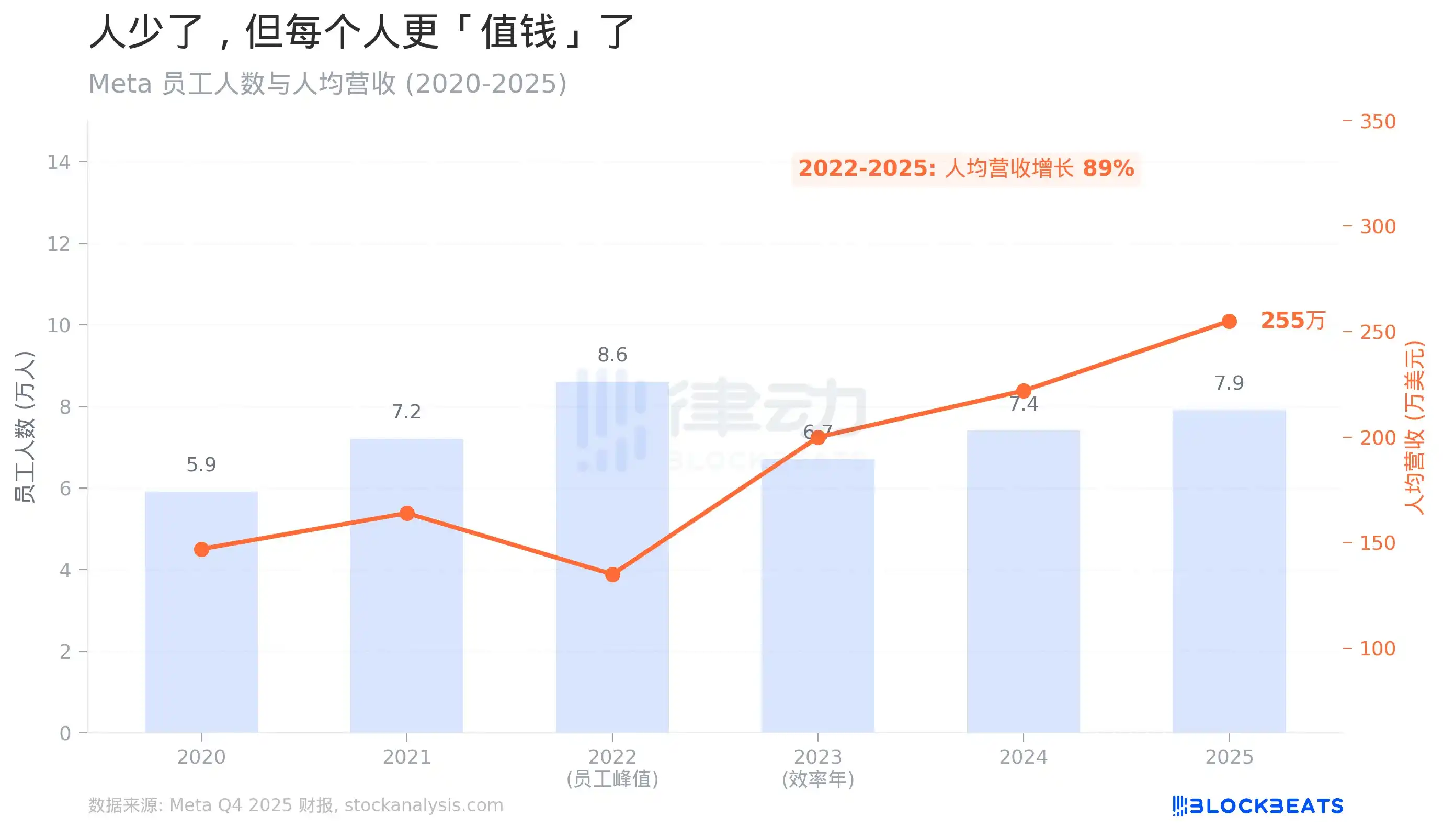
The meaning of these numbers is straightforward. Meta is making more money with fewer people. In 2022, the marginal revenue brought by each additional employee was declining. By 2024 and 2025, the revenue increase corresponding to each employee reduction was expanding. This is the typical scale effect of a technology company, but Meta accelerated this process through layoffs.

This is the background for this round of 700 layoffs in March 2026. According to The Register, this is already Meta's second round of layoffs this year, with about 1,000 people cut from Reality Labs in January. NBC News, citing informed sources, reported that there may be larger cuts later, potentially involving up to 20% of the total workforce, or about 15,000 people, which would bring Meta's total employee count back to 2021 levels.

Zuckerberg's exact words in the January earnings call were plans to "flatten teams," allowing excellent individual contributors to complete projects that previously required large teams. Meta's spokesperson's response was also templated, saying "teams periodically undergo restructuring or adjustments to ensure they are in the best position to achieve their goals."

Continuing to Bet on the AI Arms Race

Where did the money saved from the laid-off employees go? A look at capital expenditures makes it clear.

According to Q4 2025 earnings reports and public guidance from various companies, the combined capital expenditures of Amazon, Google, Microsoft, and Meta in 2026 will reach approximately $650 billion, a year-on-year increase of about 130%. This includes Amazon at about $200 billion (up 167%), Google at about $175 to $185 billion (up 140%), Microsoft annualized at about $145 billion (up 127%), and Meta at $115 to $135 billion (up 73%).

According to CNBC, this is the largest single-year capital expenditure in the history of the tech industry. The four companies' investment in AI infrastructure in one year exceeds Sweden's annual GDP.
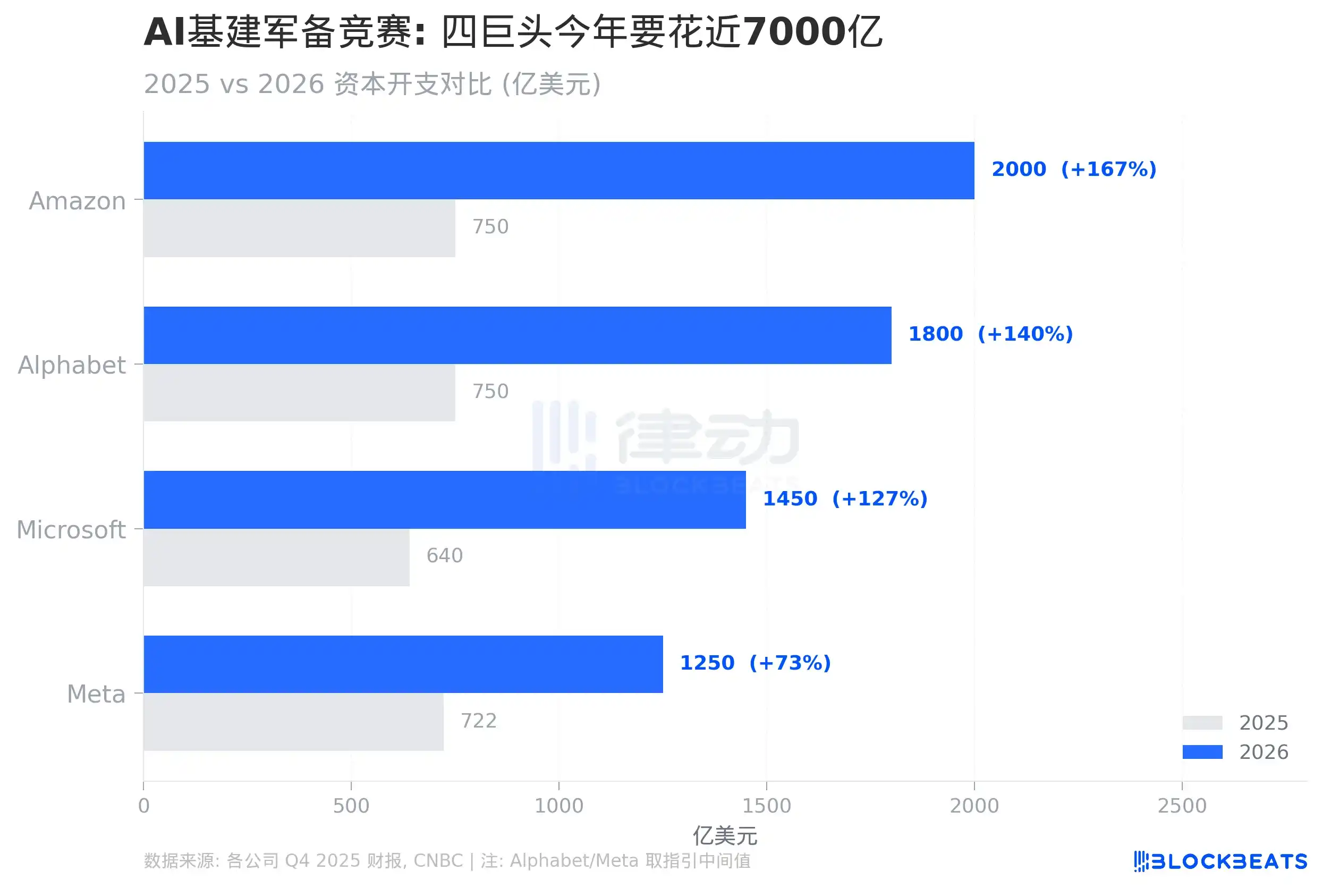
Meta's absolute value ranks fourth, but relative to its own size, the density of this investment is staggering. Calculated at the midpoint of $125 billion, Meta's AI infrastructure investment per employee is about $1.59 million, close to 62% of the revenue per employee ($2.55 million). Put another way, for every $100 Meta earns, it invests $62 into data centers.

The cost of this money is also direct. According to CNBC, citing Barclays analysts' estimates, Meta's free cash flow in 2026 will decline by nearly 90%. Amazon is even more aggressive; Morgan Stanley expects Amazon to have approximately negative $17 billion in free cash flow in 2026. All four giants are doing the same thing: trading today's cash flow for tomorrow's AI infrastructure.

The $9 Trillion Bet

Now look at the option plan. According to the SEC disclosure documents and analysis by Motley Fool, this plan covers 6 executives, including CTO Bosworth, CPO Cox, COO Olivan, CFO Susan Li, CLO Mahoney, and Vice Chairman McCormick. Zuckerberg is not on the list; his super-voting shares already make additional incentives unnecessary.

The option's exercise conditions are designed with tiered price thresholds. According to Motley Fool, the lowest exercise price is $1,116 per share, requiring the stock price to rise 88% from the current ~$615. The highest tier is $3,727 per share, corresponding to a market cap of about $9 trillion, six times the current $1.5 trillion. There is a five-year window for vesting before 2031. If Meta actually reaches a $9 trillion market cap, according to Motley Fool's calculations, the top four executives (Bosworth, Cox, Olivan, Susan Li) could each see potential gains of approximately $2.7 billion.

The signal of this plan is clear. Meta is not giving executives a bonus; it is using options to tie the core team to an extremely aggressive growth target. The current market cap is $1.5 trillion, the goal is $9 trillion. The difference of $7.5 trillion – Meta is betting that AI can create this value.
For a sense of scale: $9 trillion is roughly equivalent to the combined current market capitalization of Apple and Nvidia. No company in the world has ever reached this market cap. Meta has given its core executives five years to try and reach a number that doesn't exist in human commercial history.

One Formula

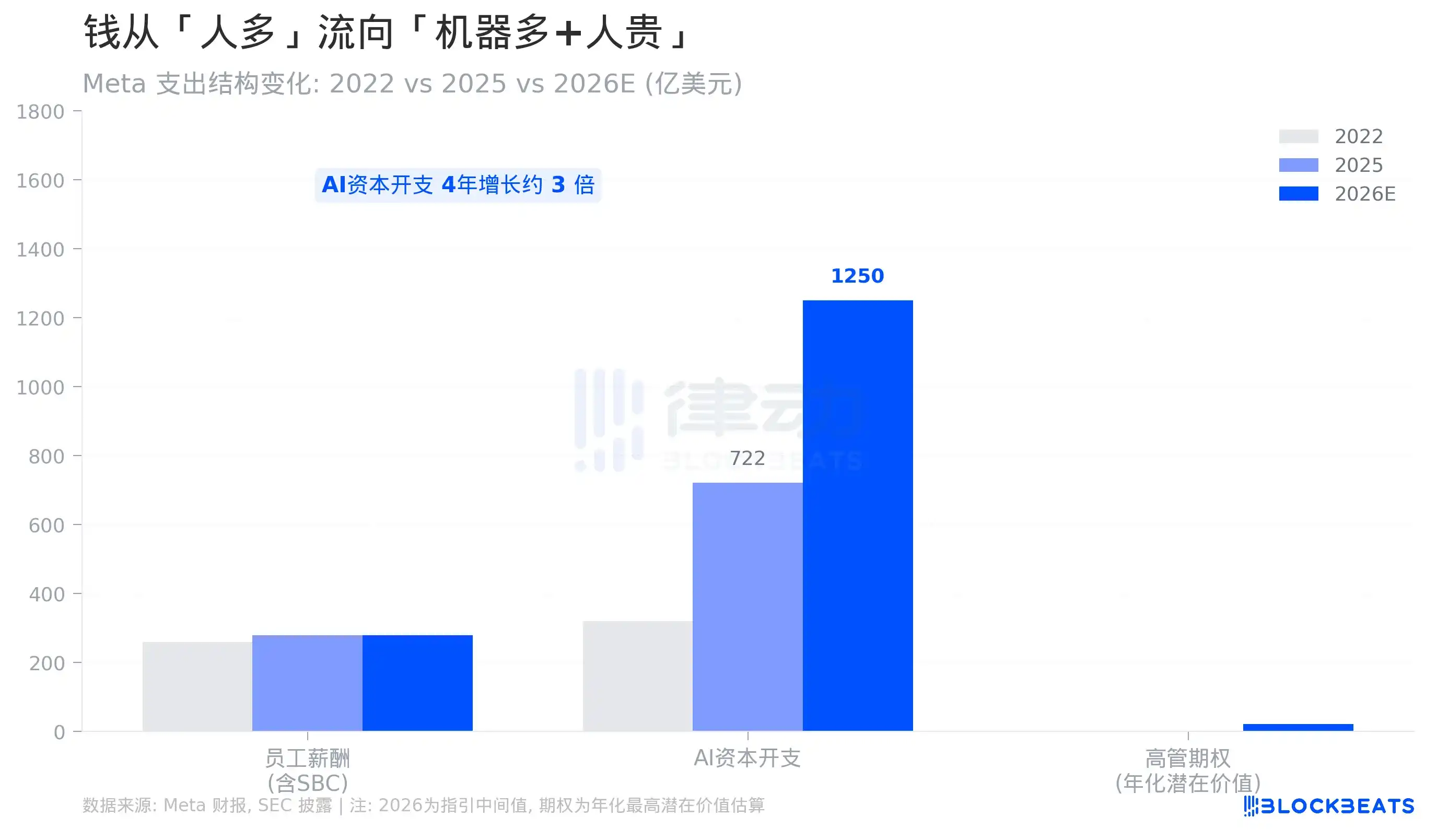
Looking at these three things together, Meta's logic is a simple resource allocation formula. Total employee compensation (including equity incentives) remained largely flat between 2022 and 2026, around $26 to $28 billion. But AI capital expenditures soared from $32 billion to $125 billion, a roughly 3-fold increase in four years. At the same time, a brand new executive option pool has appeared, locking the six most core people into the next five years.

According to Benzinga, Meta's stock-based compensation expense in 2025 was approximately $42 billion, already consuming most of its free cash flow. Signing bonuses for AI researchers have reached nine figures, with reports of researchers poached from OpenAI receiving packages in the $100 million range. The contrast between these numbers and the 700 laid-off employees makes Meta's pricing logic for "people" clear without any need for commentary.

The money saved from laying off 700 people is roughly equivalent to a day and a half of Meta's AI infrastructure spending.


İlgili Sorular

QWhat is the significance of Meta's dual actions on March 25th: laying off 700 employees while announcing a $9 trillion stock option plan for executives?

AThese actions represent two sides of the same strategic shift. Meta is reallocating resources from a larger, less focused workforce to massive AI infrastructure investments and highly compensated, elite talent. The layoffs improve efficiency (as seen in rising revenue per employee), while the unprecedented executive期权 plan aligns top leadership with an extremely aggressive growth target tied to AI's potential value creation.

QHow did Meta's employee count and financial performance change between its 2022 peak and the end of 2025?

AMeta's employee count decreased from a peak of 86,482 in 2022 to 78,865 by the end of 2025, a reduction of nearly 8,000 people. However, its annual revenue grew 72%, from $116.6 billion to $201.0 billion. Consequently, revenue per employee surged 89%, from $1.35 million to $2.55 million, demonstrating significantly improved efficiency.

QWhat are the scale and implications of the capital expenditure plans by major tech companies like Meta for 2026?

AAmazon, Google, Microsoft, and Meta plan a combined capital expenditure of approximately $650 billion in 2026, a 130% year-over-year increase. This represents the largest single-year capex in tech industry history, exceeding Sweden's GDP. For Meta specifically, its planned $115-135 billion capex translates to about $1.59 million in AI infrastructure investment per employee, which is roughly 62% of its revenue per employee.

QWhat are the specific terms and potential payouts of the new executive stock option plan at Meta?

AThe plan covers 6 core executives (excluding Zuckerberg). It features tiered exercise prices. The lowest tier requires the stock price to rise 88% from ~$615 to $1,116 per share. The highest tier is set at $3,727 per share, which would give Meta a market capitalization of approximately $9 trillion—six times its current $1.5 trillion value. If this top target is met within the 5-year window (by 2031), the top four executives could each see potential gains of around $2.7 billion.

QHow does Meta's resource allocation formula illustrate its new strategic priority towards AI?

AMeta's resource allocation has fundamentally shifted. Total employee compensation (including stock awards) remained flat at around $26-28 billion between 2022 and 2026. Meanwhile, AI capital expenditure skyrocketed nearly 3x, from $32 billion to $125 billion. This shows a massive reallocation of cash flow from human resources to AI infrastructure. Furthermore, the new executive期权 pool and reports of nine-figure signing bonuses for top AI researchers highlight a focus on investing in a smaller number of 'more expensive' people critical to AI development.

İlgili Okumalar

Qualcomm: AI Hype Subsides, When Will Smartphones Emerge from the Gloom?

Qualcomm reported its Q3 FY2026 results (ending June 2026), with revenue of $9.95B, down 4% YoY but above expectations. Gross margin declined to 53.1%, pressured by rising costs across manufacturing and memory. Key business segments showed mixed performance: Handset revenue fell 19.6% YoY to $5.09B, dragged by an 11% decline in non-Apple Android shipments and weaker high-end mix. Conversely, Automotive revenue surged 61% to $1.59B, and IoT grew 9% to $1.83B. Core operating profit dropped 41% YoY due to margin compression and higher expenses. Management's Q4 FY2026 guidance projects revenue of $9.7B-$10.5B, in line with consensus, but Non-GAAP EPS guidance of $2.05-$2.25 fell short of expectations. Amidst persistent weakness in its core handset market, Qualcomm is pursuing growth in AI, focusing on Edge AI (smartphones, PCs, automotive) and Data Center AI. Its data center strategy includes four pillars: AI accelerators (e.g., AI200), commercial CPUs (Dragonfly C1000), custom silicon, and connectivity solutions. While these initiatives initially boosted its stock, concerns over AI capital expenditure sustainability have since erased those gains. The company targets $5B in data center revenue for FY2027 and $15B for FY2029. The report concludes that with the traditional handset business still under pressure, the data center opportunity is currently viewed as a longer-term option, and a more conservative valuation based on core operations may be warranted until AI contributions materialize.

marsbit5 dk önce

Qualcomm: AI Hype Subsides, When Will Smartphones Emerge from the Gloom?

marsbit5 dk önce

From TPU to Self-Evolving Agents: How Jeff Dean Predicts the Next Step in AI

At the 2026 YC Startup School, Jeff Dean outlined his vision for AI's next phase, shifting focus from simply scaling models to building intelligent, autonomous systems. He believes AI's progress is no longer just about creating smarter models, but about integrating them into systems capable of long-term, iterative work, automated experimentation, and continuous learning. This evolution moves the competition from "who has the bigger model" to "who can best organize intelligence." Dean suggests AI capabilities are now comparable to a junior engineer, enabling the automation of complex workflows. However, the true challenge and opportunity lie in managing these AI "workers" at scale. He emphasizes the importance of **context engineering**—structuring tools, memory, and feedback loops—over raw model power. For startups, this means building deep expertise in niche domains where general models currently fail (near 0-1% success rates), leveraging proprietary data, specialized tools, and domain-specific evaluators. A recurring theme is re-examining fundamental constraints. Dean's past work, like moving Google's search index to memory or creating the TPU, stemmed from questioning outdated assumptions about hardware and cost. He sees similar inflection points today, particularly in **specialized inference hardware** to drastically reduce latency and energy consumption for real-time Agent operation. Notably, he points out that in modern AI systems, the dominant cost is often not computation but **data movement**. Reliable, long-running Agents require robust system design, borrowing concepts from distributed computing like checkpointing, state management, and parallel exploration to handle failures and maintain progress over days or weeks. As AI automates execution, the scarcest human skills will shift to **defining clear specifications**, **judging what problems are worth solving** (taste), and designing effective feedback loops. Ultimately, Dean's framework prioritizes understanding the problem deeply, identifying the true bottlenecks, and systematically building closed-loop systems where AI can not only perform tasks but also improve AI itself.

marsbit5 dk önce

From TPU to Self-Evolving Agents: How Jeff Dean Predicts the Next Step in AI

marsbit5 dk önce

İşlemler

Spot
活动图片