Illinois' 0.2% Cryptocurrency Tax Sparks Major Legal Battle

cryptonews.ru2026-08-22 tarihinde yayınlandı2026-08-22 tarihinde güncellendi

Özet

Blockchain Association and Crypto Council for Innovation filed a lawsuit on August 21 in an Illinois district court against state officials, seeking to declare the state's Digital Asset Tax Act unlawful and block its implementation. The lawsuit centers on Illinois' plan to impose a 0.2% tax on the value of a digital asset for certain transactions through a digital asset broker, effective January 1. Plaintiffs argue the tax applies even to non-sales activities like transferring assets between wallets or paying for custody services, which is unlike the treatment of traditional assets like stocks or gold. They contend this discriminates against digital assets, taxing the mechanism of storage or transfer rather than an economic gain. The complaint highlights multiple ambiguities: a single crypto purchase involving exchange, deposit, and custody could trigger multiple taxable events; the law doesn't define how to value the asset or determine a customer's residency for tax purposes, leaving brokers guessing. Businesses face potential civil and criminal penalties for non-compliance, possibly leading them to avoid Illinois customers. The groups also challenge the legislative process, noting the tax was added as a small part of a massive 1,624-page bill passed hastily, violating constitutional requirements. They claim the tax violates federal laws like the Internet Tax Freedom Act and the dormant Commerce Clause. The immediate goal is to obtain an injunction before the January 1 enf...

On August 21, the Blockchain Association and the Crypto Council for Innovation filed a lawsuit in the Sangamon County Circuit Court against Illinois Department of Revenue Director David Harris, Attorney General Kwame Raoul, and Sangamon County State's Attorney John Milhiser. They seek to have the Digital Asset Tax Act declared unlawful and to obtain a preliminary and permanent injunction to prevent it from taking effect.

Crypto Community Targets Unprecedented Tax

The dispute centers on how Illinois calculates the levy. Instead of taxing a customer's profit, the law imposes a 0.2% tax on the value of a digital asset when certain actions are taken through a digital asset intermediary. The lawsuit states that the tax could be triggered even when a customer "buys nothing, sells nothing, receives nothing, and transfers no ownership."

This means exchanging Bitcoin, moving it between accounts, or paying a storage service fee could incur the tax. The suit notes that Illinois previously treated digital assets much like other financial property for tax purposes: income or capital gains were potentially taxable, while the transactions or storage services themselves were generally not. That will change on January 1.
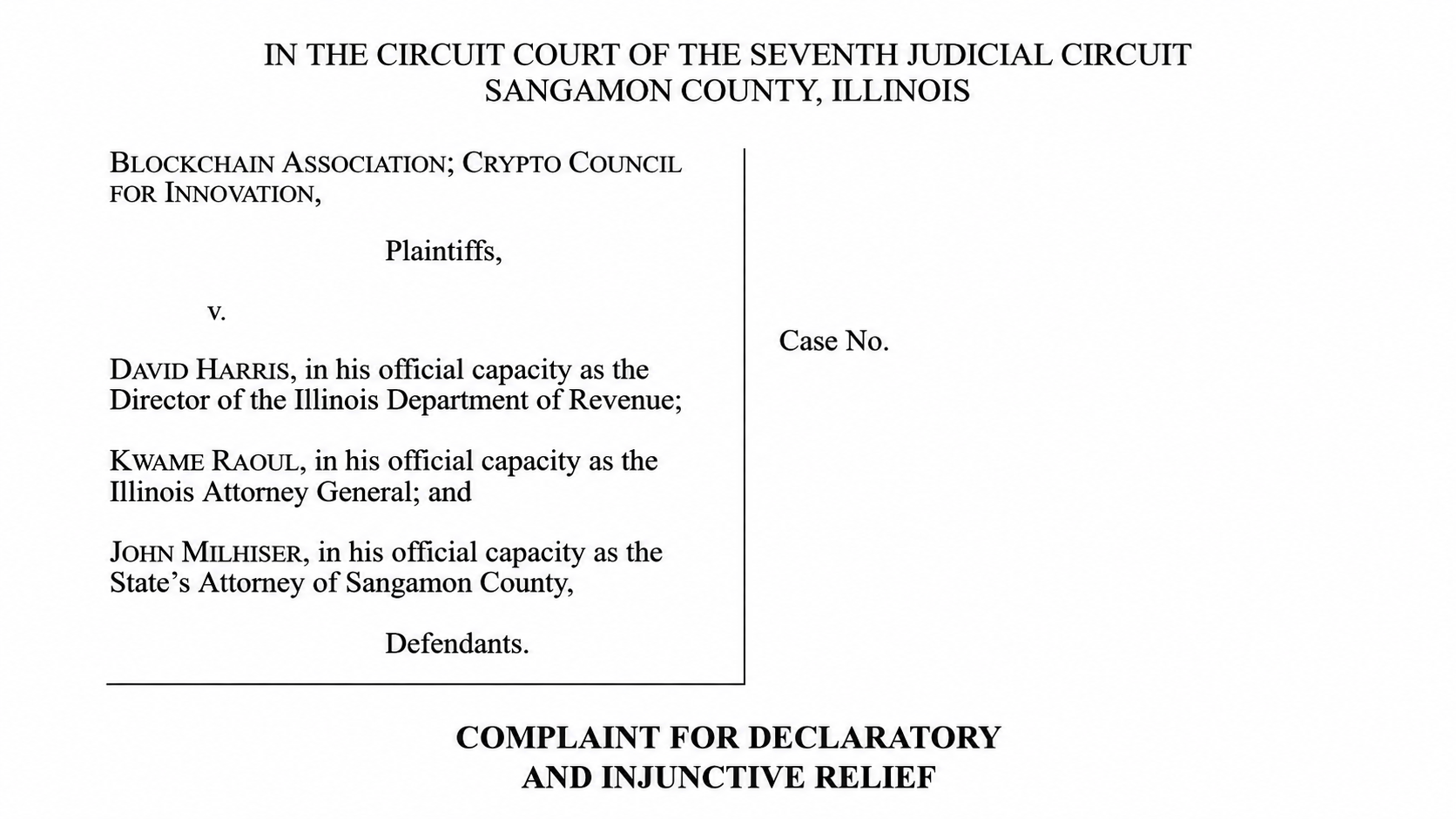
The initial filing page of the lawsuit against the State of Illinois.

This discrepancy is at the heart of the case. Illinois does not levy a comparable transaction tax on those who buy stocks, transfer money between personal accounts, or store cash, gold, or securities at a bank or broker. The plaintiffs argue the state is effectively taxing the mechanisms used to hold or move value, not the economic transaction itself.

A Single Crypto Transaction Could Open a Taxation 'Pandora's Box'

The situation becomes more complex when a platform provides multiple services at once. Buying cryptocurrency might involve an exchange trade, crediting the customer's account, and subsequent storage on the platform. The lawsuit notes the law never clearly states whether this common sequence creates one, two, or three taxable events.

Storage presents another issue because it is continuous, not a one-time event. The suit notes Illinois never clarifies whether a year of storage is one taxable event, whether each billing period creates a new event, or whether a change in account balance triggers a new cycle. The answer could affect the size of tax bills "by orders of magnitude," according to the lawsuit.

The law also leaves the plaintiffs questioning how the taxable "value" of an asset is actually calculated. The lawsuit states the law nowhere specifies whether valuation occurs when an order is placed, when the intermediary executes it, or at the final settlement of the transaction.

Illinois Location Rules Leave Intermediaries 'Holding the Bag'

Determining whether a customer is actually located in Illinois creates another pitfall. Account data, mailing addresses, IP addresses, and other information can trigger a presumption that the customer is in the state. The intermediary must then prove otherwise, and the complaint notes conflicting data could force platforms to rely on guesswork.

This guesswork carries serious consequences. The lawsuit says intermediaries face civil and criminal penalties for non-compliance, while companies are already spending heavily on lawyers, tax consultants, and system modifications even before the law takes effect. The plaintiffs argue some firms may ultimately refuse to serve customers who might be in Illinois rather than risk criminal liability.

1,624-Page Bill Intensifies Constitutional Fight

These groups also challenge how the tax became law. Senate Bill 3019 began as a two-page document concerning agricultural funding, but amendments filed by May 31 transformed it into a sprawling 1,624-page package covering numerous topics. The Digital Asset Tax Act comprised less than 20 pages of the final bill. This latest lawsuit follows one initiated by The Digital Chamber against Illinois in July.

According to the suit, legislators notified the public of committee hearings roughly an hour before the bill was approved by both chambers within a 24-hour period. The plaintiffs argue this process violated Illinois' constitutional requirements, resulting in a law whose core obligations remain unclear despite being backed by criminal penalties.

The lawsuit also claims the tax violates the federal Internet Tax Freedom Act by discriminating against electronic commerce, contravenes the Dormant Commerce Clause, and infringes on state and federal due process guarantees. The organizations also cite provisions of Illinois' Uniformity Clause and raise claims concerning the legislative process. They argue any one of these flaws may be sufficient to overturn the law.

In the immediate term, the crucial question is whether Illinois can begin collecting the tax on January 1. The Blockchain Association and Crypto Council for Innovation want the court to block the tax before businesses are required to register and start collecting it, turning the next four months into a test of whether one state can impose a special tax on financial activity simply because it is conducted using digital assets.


Trend Kriptolar

İlgili Sorular

QWhat is the core reason behind the lawsuit filed by the Blockchain Association and the Crypto Council for Innovation against the state of Illinois?

AThe core reason is their challenge of the Digital Asset Tax Act, which imposes a 0.2% tax on the value of a digital asset for certain actions via a broker, even when no sale or exchange of ownership occurs. They argue it unfairly targets the mechanisms of storing or moving value rather than economic transactions and lacks clear definitions, potentially violating constitutional and federal principles.

QHow does Illinois' proposed crypto transaction tax differ from its traditional taxation of financial assets?

ATraditionally, Illinois taxed income or capital gains from financial assets, not the transactions or custodial services themselves. The new law taxes the *value* of the asset (0.2%) during specific actions like transfers between accounts or paying for storage, which is a tax on the transaction mechanism itself—a levy not applied to similar actions with stocks, cash, gold, or securities.

QWhat are some of the key ambiguities in the Digital Asset Tax Act as highlighted in the lawsuit?

AKey ambiguities include: 1) How many taxable events occur in a single multi-step transaction (e.g., buying, depositing, storing). 2) How custodial services, which are continuous, trigger taxable events (e.g., per year, per billing period). 3) At which precise point the 'value' of the asset is determined for taxation. 4) How brokers must definitively determine a user's physical location in Illinois, risking liability based on conflicting data.

QWhat legislative process issues do the plaintiffs cite in their constitutional challenge to the law?

AThe plaintiffs argue the legislative process violated Illinois' constitution. The tax was added via amendments to a 2-page agriculture funding bill, ballooning it to 1,624 pages. Committee hearings were announced with roughly one hour's notice, and the bill was passed by both chambers within 24 hours, which they claim denied proper public scrutiny and led to an unclear law enforced by criminal penalties.

QWhat federal and state legal principles does the lawsuit claim the Illinois Digital Asset Tax Act violates?

AThe lawsuit claims the tax violates: 1) The federal Internet Tax Freedom Act by discriminating against electronic commerce. 2) The Dormant Commerce Clause of the U.S. Constitution by burdening interstate commerce. 3) Federal and state Due Process guarantees due to its vagueness. 4) Illinois' Uniformity Clause concerning taxation. They argue any of these defects could be sufficient to invalidate the law.

İlgili Okumalar

Mysterious "Whale" Sells $576 Million Worth of Bitcoin Amid BTC Price Approach to $80,000

An unidentified crypto "whale" sold 2,700 BTC (worth approximately $211.8 million) in a single transaction, bringing its total sales over three days to 7,700 BTC for roughly $576.6 million. This selling pressure occurs as Bitcoin trades near the $80,000 mark, having recently retreated from nearly reaching that level. While large holders often sell to realize profits during sharp rallies, on-chain data only confirms the movement of coins, not the motive. So far, these sales have had little impact on Bitcoin's upward momentum, with the asset posting double-digit gains recently and its strongest weekly increase since 2024. The rally was fueled by a U.S. Treasury Department announcement to at least double its long-term bond buyback operations starting September 9th, which lowered bond yields and pushed investors toward riskier assets like Bitcoin. This week's selling marks a reversal from a recent accumulation trend, where large holders had added about 43,000 BTC (worth ~$2.75B) over a 60-day period ending in mid-August, helping set the stage for the current price surge. As Bitcoin hovers around $80,000, traders are watching key factors: whether other major holders will follow suit and sell into strength, and if renewed institutional demand from ETFs can absorb the selling pressure. The outcome will likely determine Bitcoin's next major price move.

cryptonews.ru44 dk önce

Mysterious "Whale" Sells $576 Million Worth of Bitcoin Amid BTC Price Approach to $80,000

cryptonews.ru44 dk önce

Musk Awaits $50 Trillion: Is There a Limit to the U.S. National Debt and What Comes Next?

Elon Musk reacted to a projection of US national debt reaching $50 trillion by 2030, labeling it a "precise timeline" with a laughing emoji. The debt has recently passed the $40 trillion mark. Skeptics note that specific debt thresholds have been breached before without immediate collapse. However, analysts warn the focus should shift from the nominal debt amount to its affordability. A key metric is when the average interest rate on the debt exceeds the economy's growth rate, a point the US Congressional Budget Office projects for 2031. Once this "debt spiral" begins, interest costs grow self-reinforcing. Currently, interest payments have already surpassed defense spending, exceeding $1 trillion annually. Ray Dalio warns a debt crisis could occur within "three years, plus or minus two," advising portfolio diversification into gold and some Bitcoin. Potential outcomes if debt becomes unmanageable include: 1) Financial repression and monetization (the "Japanese path" of controlled yields and inflation), seen as the most likely; 2) Severe austerity (the "Greek path" of spending cuts/tax hikes), considered politically unlikely; or 3) Technical default/restructuring, which would cause global financial shock. The most probable path is a hybrid of moderate financial repression and gradual inflation, leading not to a sudden crash but to long-term economic stagnation and a declining standard of living. By 2056, debt could reach 175% of GDP. Ultimately, the limit for US debt is not a fixed number but a function of market confidence in the dollar.

cryptonews.ru2 saat önce

Musk Awaits $50 Trillion: Is There a Limit to the U.S. National Debt and What Comes Next?

cryptonews.ru2 saat önce

İşlemler

Spot

Popüler Makaleler

F Nasıl Satın Alınır

HTX.com’a hoş geldiniz! Synfutures (F) satın alma işlemlerini basit ve kullanışlı bir hâle getirdik. Adım adım açıkladığımız rehberimizi takip ederek kripto yolculuğunuza başlayın. 1. Adım: HTX Hesabınızı OluşturunHTX'te ücretsiz bir hesap açmak için e-posta adresinizi veya telefon numaranızı kullanın. Sorunsuzca kaydolun ve tüm özelliklerin kilidini açın. Hesabımı Aç2. Adım: Kripto Satın Al Bölümüne Gidin ve Ödeme Yönteminizi SeçinKredi/Banka Kartı: Visa veya Mastercard'ınızı kullanarak anında Synfutures (F) satın alın.Bakiye: Sorunsuz bir şekilde işlem yapmak için HTX hesap bakiyenizdeki fonları kullanın.Üçüncü Taraflar: Kullanımı kolaylaştırmak için Google Pay ve Apple Pay gibi popüler ödeme yöntemlerini ekledik.P2P: HTX'teki diğer kullanıcılarla doğrudan işlem yapın.Borsa Dışı (OTC): Yatırımcılar için kişiye özel hizmetler ve rekabetçi döviz kurları sunuyoruz.3. Adım: Synfutures (F) Varlıklarınızı SaklayınSynfutures (F) satın aldıktan sonra HTX hesabınızda saklayın. Alternatif olarak, blok zinciri transferi yoluyla başka bir yere gönderebilir veya diğer kripto para birimlerini takas etmek için kullanabilirsiniz.4. Adım: Synfutures (F) Varlıklarınızla İşlem YapınHTX'in spot piyasasında Synfutures (F) ile kolayca işlemler yapın.Hesabınıza erişin, işlem çiftinizi seçin, işlemlerinizi gerçekleştirin ve gerçek zamanlı olarak izleyin. Hem yeni başlayanlar hem de deneyimli yatırımcılar için kullanıcı dostu bir deneyim sunuyoruz.

344 Toplam GörüntülenmeYayınlanma 2024.12.21Güncellenme 2026.08.21

F Nasıl Satın Alınır

Tartışmalar

HTX Topluluğuna hoş geldiniz. Burada, en son platform gelişmeleri hakkında bilgi sahibi olabilir ve profesyonel piyasa görüşlerine erişebilirsiniz. Kullanıcıların F (F) fiyatı hakkındaki görüşleri aşağıda sunulmaktadır.

活动图片