Illicit Crypto Flows Hit Record $158 Billion In 2025, TRM Says

bitcoinist2026-01-30 tarihinde yayınlandı2026-01-30 tarihinde güncellendi

Özet

According to TRM Labs, illicit crypto flows reached a record $158 billion in 2025, driven by increasingly sophisticated scams using AI tools. Large language models, deepfakes, and voice cloning were employed to create believable messages and fake personas, helping fraudsters build trust before soliciting money through fake investments or false emergencies. These operations often function like small companies, using phishing kits and AI services to scale their efforts. While scam proceeds slightly decreased to $35 billion, the overall volume of criminal activity rose significantly. Despite improvements in scam-detection technology, the use of AI makes scams harder to identify and more convincing.

Scammers used new tools to widen their reach and to seem more real. According to TRM Labs, the use of large language models in scams jumped fivefold in 2025, helping fraudsters write believable messages, run many conversations at once, and trick people in different languages.

AI Tools Helping Con Artists Build Trust

Reports say AI images, voice cloning, and deepfakes are cutting the cost of making fake people who look and sound legit. These tricks have fed a pattern where criminals first make a target feel safe and then ask for money.

In some cases, a romance angle is used to win trust, and that trust is later turned into fake investment offers or bogus tax demands. This staged approach has let scams run longer and capture bigger sums from fewer victims.
A Rise In Industrial-Scale Fraud

Behind many of these schemes are groups that act like small companies. They hire people, sell tools, and reuse scripts to run campaigns in many places.

Some providers now sell phishing kits or offer AI-as-a-service to automate messages and replies, lowering the bar for new fraudsters and making scams easier to copy and spread.

Deepfake Calls And Targeted Hacks

Reports note that attackers have even used fake video calls to trick crypto workers into installing malware. In several incidents, victims were invited to what looked like normal Zoom meetings, only to find AI-generated faces on the screen.

When the meeting “needed a patch,” victims were urged to install what was actually malicious software. These methods have been linked to North Korea–connected groups and were flagged by security researchers last year.

BTCUSD now trading at $87,971. Chart: TradingView

Crypto Price Action Enters The Story

While the scams became more sophisticated, the market evolved too. Bitcoin was trading in the range of $88,000 to $90,000 in late January 2026 as investors considered macro news and policy developments.

This market context is important: as prices increase, the urgency and authenticity of crypto scams may seem more plausible, and the risks for both victims and law enforcement may be higher.

Scam Proceeds Compared To Illicit Flows Overall

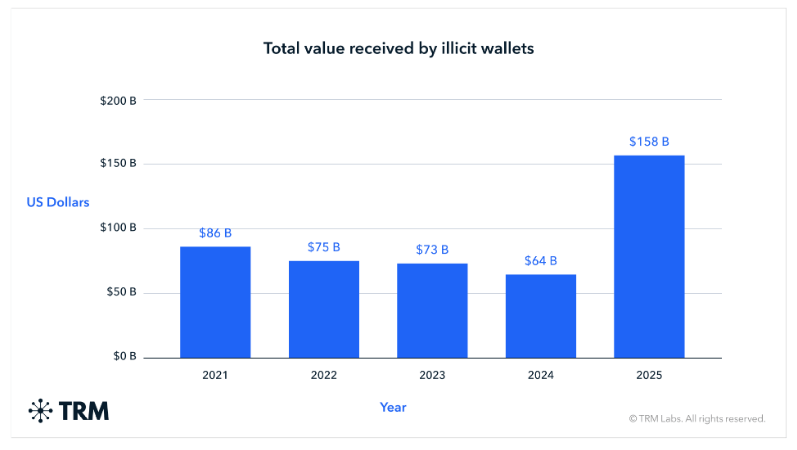
Illicit inflows to crypto assets reached a record high of $158 billion, a substantial increase due to improved monitoring that brought more illicit activity to light.

Meanwhile, scam-related wallets saw a slight decrease in proceeds to around $35 billion in 2025, from $38 billion in the previous year.

However, the total volume of criminal activity increased substantially, even as the portion attributed to scams increased marginally.

It appears that scam-detecting technology is improving, but scams are evolving rapidly. The increasing use of AI-based tools makes generic advice less helpful, as the scams now sound more authentic.

Featured image from Unsplash, chart from TradingView

İlgili Sorular

QWhat was the total value of illicit crypto flows in 2025 according to TRM Labs?

AIllicit crypto flows reached a record high of $158 billion in 2025.

QHow did the use of large language models in scams change in 2025?

AThe use of large language models in scams jumped fivefold in 2025.

QWhat was the approximate trading range of Bitcoin in late January 2026?

ABitcoin was trading in the range of $88,000 to $90,000 in late January 2026.

QHow much did scam-related wallet proceeds amount to in 2025?

AScam-related wallets saw proceeds of around $35 billion in 2025, down from $38 billion the previous year.

QWhat are some specific AI tools mentioned that are being used by scammers to build trust?

AScammers are using AI images, voice cloning, and deepfakes to create fake people who look and sound legitimate to build trust.

İlgili Okumalar

Bitcoin Withdrawals Continue: 8 Years of Storage in a Coldcard Cold Wallet Ended in Zero

Coldcard Hardware Wallet Hacked: Losses Mount Due to Vulnerable Seed Generation A critical vulnerability in Coldcard hardware wallets has led to a continued wave of fund thefts. According to Galaxy Research, the total stolen has reached 1,367.05 BTC (approx. $88.6 million) from 4,585 addresses, a significant increase from the initial 594.5 BTC reported on July 30, 2026. Most of the stolen funds remain on the attackers' addresses. The issue is not with the current firmware, which Coinkite has updated, but with seed phrases generated on vulnerable devices between March 2021 and the release of fixed firmware versions. Due to a programmer error, devices switched from using a hardware random number generator to the software-based Yasmarang generator, which was initialized with publicly accessible data like the chip's serial number. This made the seed phrases predictable through offline brute-force attacks, meaning wallets remain at risk until funds are moved to a new wallet generated with the patched firmware. Affected devices include Mk2/Mk3 with firmware 4.0.1–4.1.9 (and up to 5.0.3), Mk4/Mk5 up to version 5.6.0, and Q models up to 1.5.0Q. The only exceptions are seeds created with a high-entropy method like at least 50 independent dice rolls or a strong unique BIP-39 passphrase. All other owners must generate a new seed on the fixed firmware and transfer their assets. A case highlighting the human impact involves a 39-year-old long-term investor who lost 2 BTC (approx. $130,000) in minutes. He had accumulated the Bitcoin over eight years through physical labor, viewing it as a financial lifeline and a retirement plan in a country suffering from hyperinflation. His story underscores that even conservative "buy and hold in cold storage" strategies can be compromised by such underlying technical flaws. From a technical perspective, this incident echoes historical failures where weak random number generators undermined cryptographic security, challenging the assumption that offline storage is automatically foolproof.

cryptonews.ru3 saat önce

Bitcoin Withdrawals Continue: 8 Years of Storage in a Coldcard Cold Wallet Ended in Zero

cryptonews.ru3 saat önce

İşlemler

Spot
活动图片





