If U.S. Treasury Yields Soar Above 5%, Will Bitcoin Fall Below $50,000?

marsbit2026-03-25 tarihinde yayınlandı2026-03-25 tarihinde güncellendi

Özet

An article explores the potential impact of rising U.S. Treasury yields above 5% on Bitcoin's price, suggesting it could fall below $50,000. The analysis is prompted by the recent U.S.-Israel conflict with Iran, which has driven oil prices higher and fueled inflation fears, pushing bond yields up. Historically, prolonged oil-related conflicts lead to sustained yield increases and pressure on risk assets like stocks. Given Bitcoin's high correlation with the S&P 500, similar downward pressure is expected. Technical analysis indicates a bearish flag pattern for Bitcoin, with a break below it potentially leading to a drop to $50,000 or lower. Prediction markets also show a high probability of Bitcoin falling below $55,000 in 2026. However, BitMEX co-founder Arthur Hayes notes that prolonged conflict might force the Fed to print more money, which could ultimately benefit Bitcoin.

Written by: Cointelegraph

Compiled by: AiddiaoJP, Foresight News

During the war between the U.S. and Iran, Bitcoin has been one of the strongest performing assets. However, as the bond market shows signs of being 'out of control,' Bitcoin's upward momentum is beginning to show signs of exhaustion.

Key Points:

  • If the U.S.-Iran war prolongs, the benchmark U.S. Treasury yield could rise by 200 basis points.
  • Historical experience suggests that oil-related conflicts tend to push up inflation and suppress risk appetite. Based on this, it is speculated that Bitcoin's price could fall below $50,000 in 2026.

Oil Supply Shock Could Push U.S. Treasury Yields Above 5%

Since the U.S. and Israel launched attacks on Iran on February 28, the benchmark 10-year U.S. Treasury yield has climbed to about 4.42%, hitting a nine-month high.
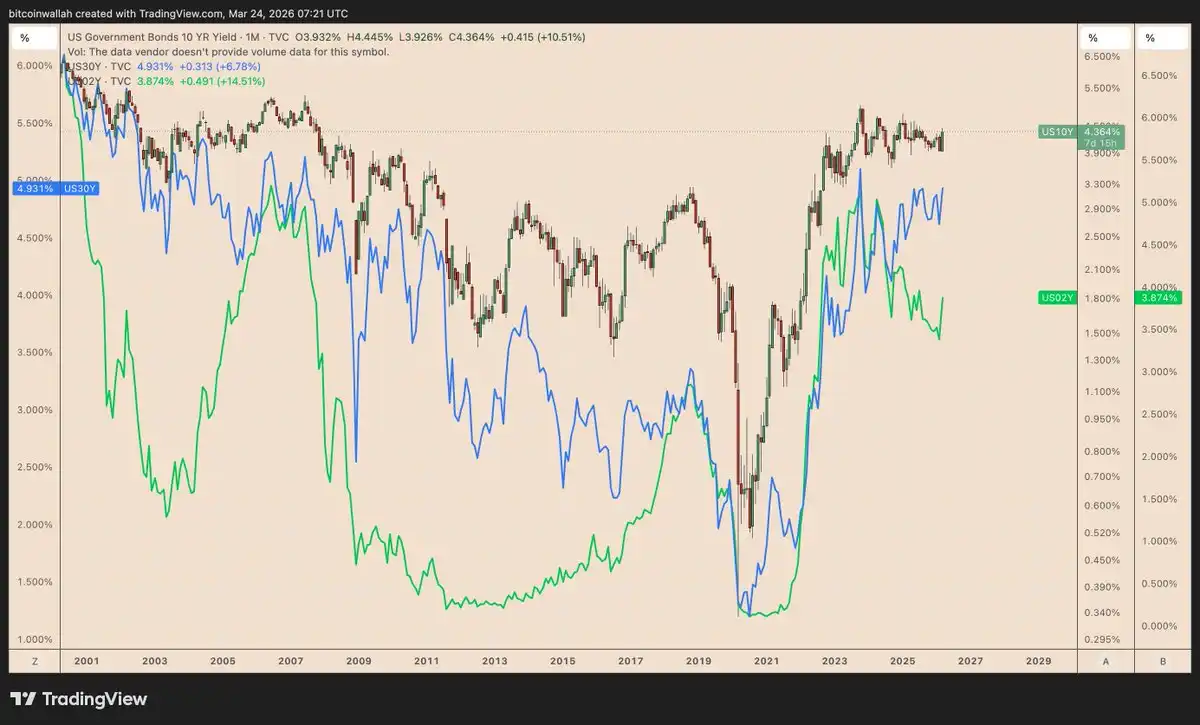
Monthly performance of U.S. 2-year, 10-year, and 30-year Treasury yields. Source: TradingView

Among them, the 30-year Treasury yield rose to about 4.97%, and the 2-year Treasury yield also increased to the range of 3.95% to 3.98%.

Affected by the war, oil prices have surged, exacerbating market concerns about rising inflation, thereby pushing Treasury yields higher. Against this backdrop, the market widely expects no rate cuts within 2026.

U.S. President Donald Trump announced a five-day suspension of operations, temporarily alleviating immediate concerns about strikes on Iranian energy facilities. However, as Iran denies any negotiations and cross-border attacks continue as of Tuesday, the conflict situation remains effectively uncontrolled.
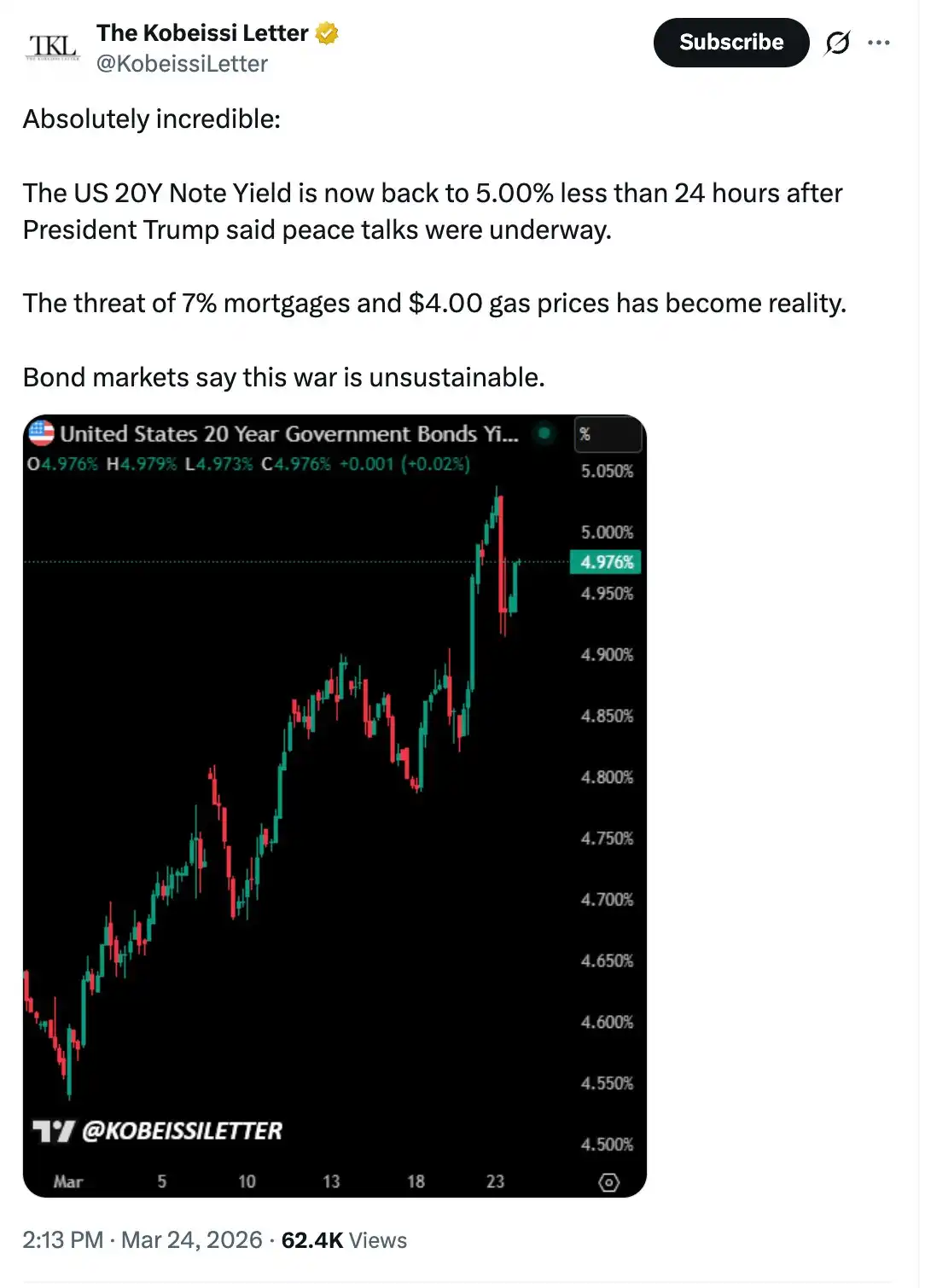
Source: X

Market observers have expressed concerns, believing that U.S. Treasury yields face further upside risks. Technical analysts further pointed out that if the 10-year Treasury yield breaks through the current symmetrical triangle pattern, it could rise by 200 basis points to 6.4%.
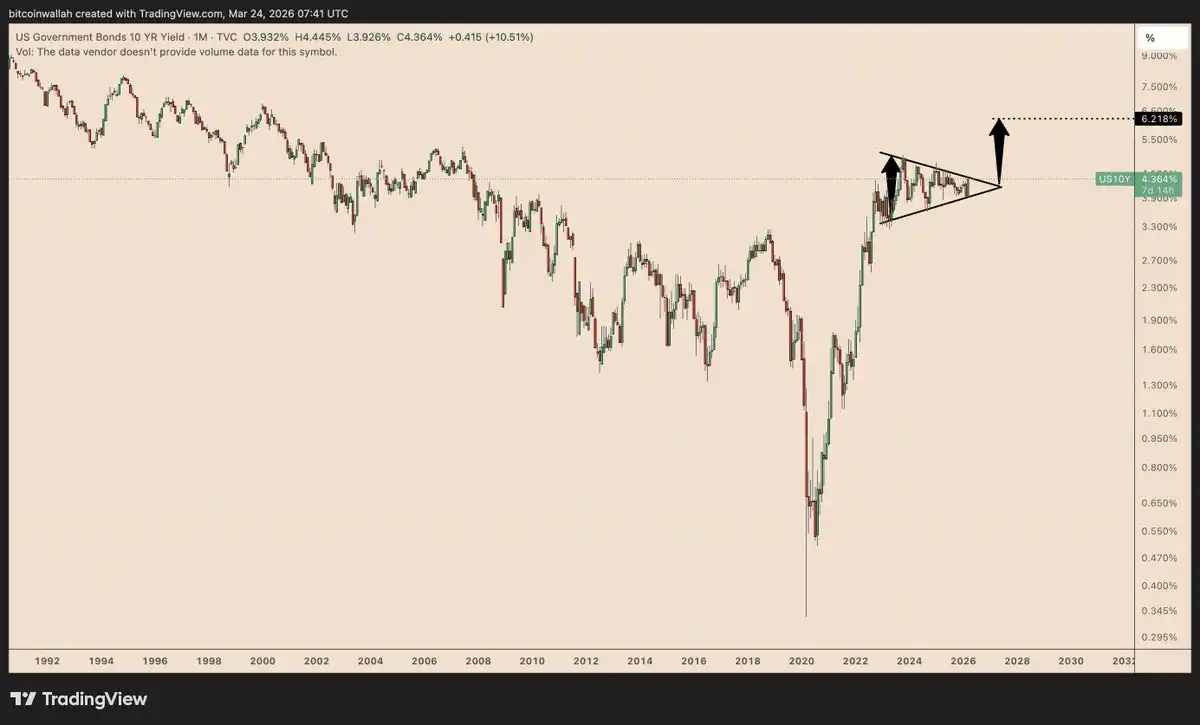
Monthly chart of U.S. 10-year Treasury yield. Source: TradingView

Rising yields increase the opportunity cost of holding risk assets such as stocks and Bitcoin. If Bitcoin continues to exhibit risk asset attributes, a break above 5% in the 10-year Treasury yield could trigger selling pressure in the Bitcoin market.

Historical Cases of Oil-Related Shocks

Historically, short-term oil-related conflicts typically cause sharp but brief fluctuations in Treasury yields and stock markets, while long-term supply shocks can push yields up persistently and suppress stock markets continuously.

During the 1973 Yom Kippur War and the Arab oil embargo, Treasury yields initially rose slightly, then climbed significantly as inflation intensified, with the S&P 500 index falling about 41% to 48% during the 'stagflation' phase.
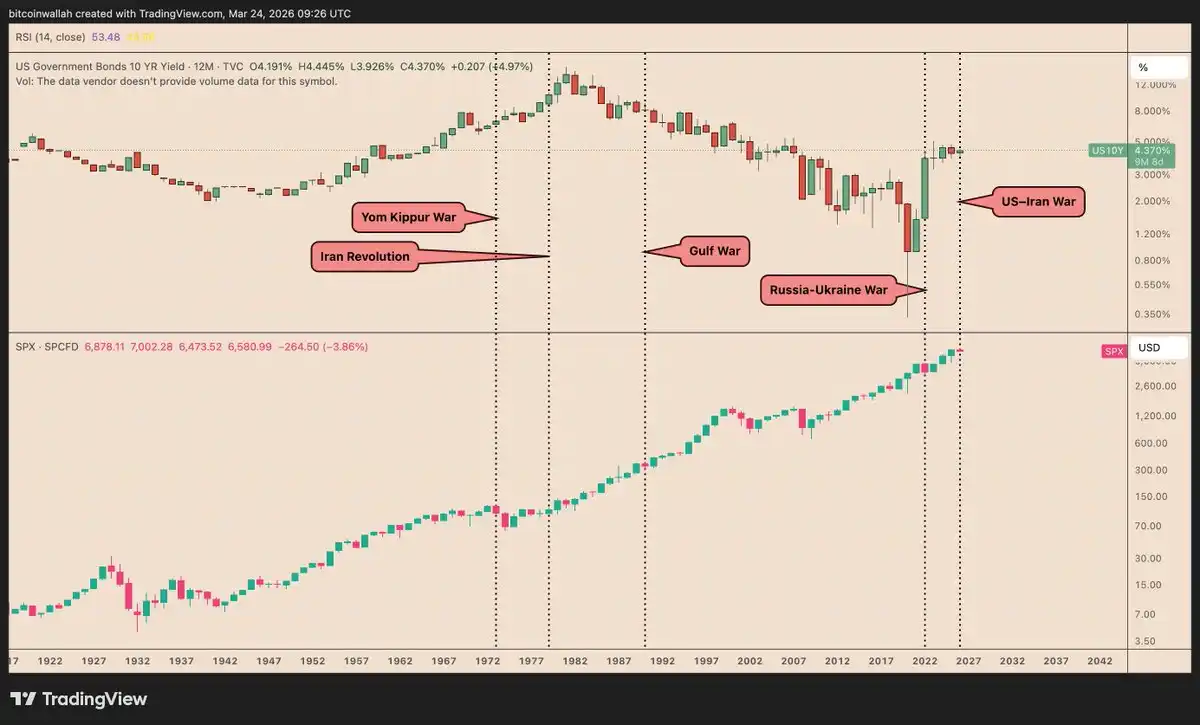
Annual chart of U.S. 10-year Treasury yield and S&P 500 index. Source: TradingView

During the 1979 Iranian Revolution, the bond market reaction was more intense, with the 10-year Treasury yield rising about 150 to 200 basis points in the following year, while the stock market correction was relatively moderate.

During the 1990-1991 Gulf War, the 10-year Treasury yield rose about 50 to 70 basis points, and the S&P 500 index fell about 16% to 20%, rebounding after the conflict was brought under control.

After the outbreak of the Russia-Ukraine conflict in 2022, there was also a rise in Treasury yields and a short-term drop of 5% to 10% in the S&P 500 index.

The current conflict between the U.S., Israel, and Iran seems to be in the early stages of these historical patterns. If the conflict escalates further and oil prices remain high, Treasury yields could rise further, and risk assets may face a new round of downward pressure.

Bitcoin still maintains a high correlation with the S&P 500 index. Therefore, unless the conflict situation eases quickly, Bitcoin's price is likely to face greater downward pressure.

To What Level Could Bitcoin's Price Drop?

From a technical analysis perspective, if Bitcoin's price breaks below the current bear flag pattern, it could further drop to $50,000 or even lower in the coming months.
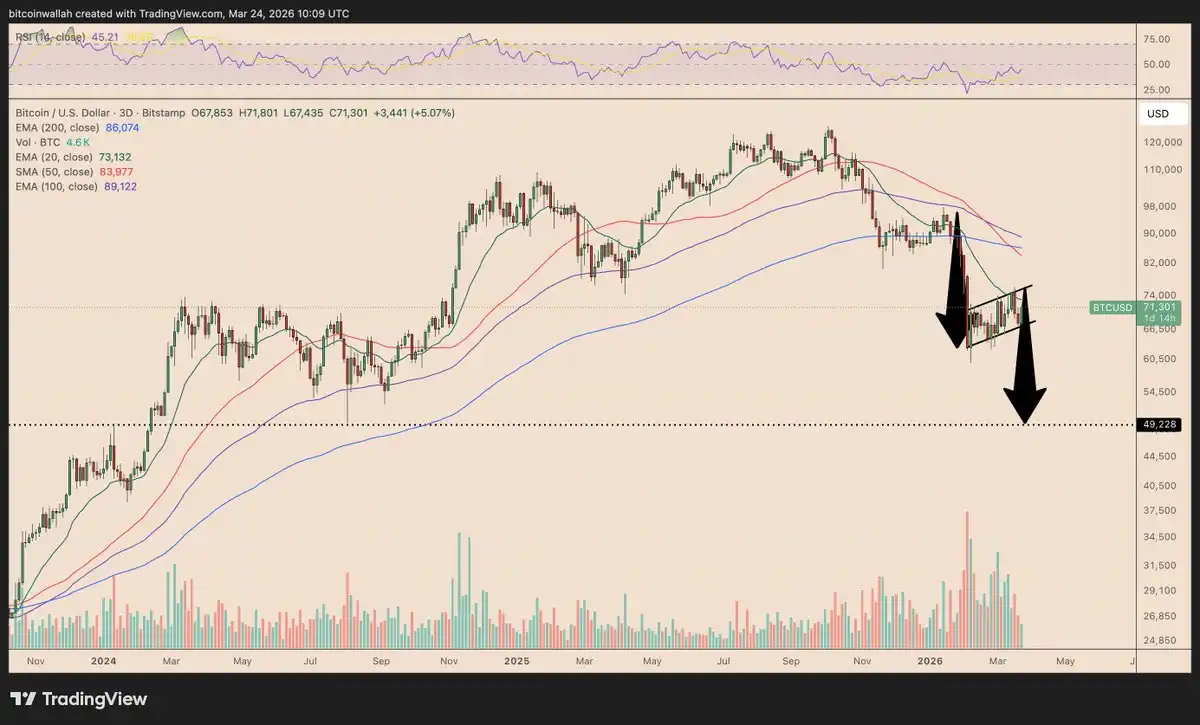
Bitcoin/USD three-day price chart. Source: TradingView

This technical expectation is largely consistent with trading data from prediction markets. Currently, traders estimate a 70% probability that Bitcoin will fall below $55,000 in 2026, and a 46% probability it will fall below $45,000.

BitMEX co-founder Arthur Hayes stated that if the U.S.-Iran war prolongs, it could force the Federal Reserve to adopt loose monetary policies, which would be a positive factor for Bitcoin.

He noted: 'The longer the conflict lasts, the more likely the Fed is to print money to support the U.S. war machine.' He further added:

'When central banks start printing money, I will choose to buy Bitcoin.'

Trend Kriptolar

İlgili Sorular

QWhat is the main concern regarding US Treasury yields and Bitcoin's price according to the article?

AThe article suggests that if the US 10-year Treasury yield rises above 5%, it could trigger selling pressure in the Bitcoin market, potentially causing its price to fall below $50,000.

QHow have oil-related conflicts historically impacted Treasury yields and risk assets like stocks?

AHistorically, short-term oil-related conflicts caused sharp but brief volatility in yields and stocks, while prolonged supply shocks led to sustained yield increases and prolonged stock market declines, as seen during the 1973 Yom Kippur War and the 1979 Iranian Revolution.

QWhat technical pattern does the article mention for Bitcoin's price, and what is the predicted downside target?

AThe article mentions a bearish flag pattern for Bitcoin's price. If this pattern breaks down, the price could decline to $50,000 or lower in the coming months.

QAccording to market traders, what is the probability of Bitcoin falling below $55,000 and $45,000 in 2026?

ATraders estimate a 70% probability of Bitcoin falling below $55,000 and a 46% probability of it dropping below $45,000 in 2026.

QWhat contrasting view does BitMEX co-founder Arthur Hayes present regarding the impact of prolonged US-Iran war on Bitcoin?

AArthur Hayes argues that a prolonged US-Iran war could force the Federal Reserve to adopt loose monetary policy and print money, which would ultimately be bullish for Bitcoin as he states, 'When central banks start printing money, I will choose to buy Bitcoin.'

İlgili Okumalar

In Jinjiang, Fujian, a Storage Super Unicorn Lies Quiet

In Fujian's Jinjiang, a city known for sportswear, lies a quiet semiconductor giant: Fujian Jinhua Integrated Circuit Co. (JHICC). Once a promising domestic DRAM manufacturer alongside Yangtze Memory and ChangXin Memory Technologies (CXMT), its journey was derailed in 2018 when the U.S. placed it on an Entity List and filed criminal charges for alleged trade secret theft. This halted production for years. A turning point came in February 2024 when a U.S. federal court found JHICC not guilty. However, it had lost crucial time. While CXMT soared to become a top-valued A-share company in 2024, JHICC, with an estimated valuation of 80 billion RMB, was just restarting. Its current output is primarily customized DDR4 chips, not the advanced DDR5/HBM demanded for AI, but it still benefits from the broader memory chip upcycle. JHICC's story is tied to Chen Zhengkun, a veteran engineer who left Micron to lead the venture. Founded in 2016 with state-backed funding, JHICC partnered with Taiwan's UMC to develop DRAM technology. Rapid progress was cut short by the U.S. actions, which Micron initiated, partly due to its heavy reliance on the Chinese market. Post-sanctions, Chen's team worked to rebuild the production line with reduced reliance on U.S. technology. According to its records, JHICC achieved small-scale production and revenue growth under immense pressure. It now focuses on the stable "niche" DRAM market (e.g., TVs, routers) with a monthly capacity of ~40,000 wafers, aiming for 60,000 by 2026. It holds over 1,000 patents but remains on the Entity List. For Jinjiang, investing in JHICC was a bold industrial leap. The local government provided unwavering financial and logistical support during the crisis, helping the company survive. JHICC has become the anchor for a growing local semiconductor cluster. Though its scale lags behind domestic peers, JHICC's persistence symbolizes a hard-won foothold in a global market long dominated by Samsung, SK Hynix, and Micron. Having missed one boom, it seeks a place in the new AI-driven memory supercycle.

marsbit1 saat önce

In Jinjiang, Fujian, a Storage Super Unicorn Lies Quiet

marsbit1 saat önce

İşlemler

Spot

Popüler Makaleler

WAR Nasıl Satın Alınır

HTX.com’a hoş geldiniz! WAR (WAR) satın alma işlemlerini basit ve kullanışlı bir hâle getirdik. Adım adım açıkladığımız rehberimizi takip ederek kripto yolculuğunuza başlayın. 1. Adım: HTX Hesabınızı OluşturunHTX'te ücretsiz bir hesap açmak için e-posta adresinizi veya telefon numaranızı kullanın. Sorunsuzca kaydolun ve tüm özelliklerin kilidini açın. Hesabımı Aç2. Adım: Kripto Satın Al Bölümüne Gidin ve Ödeme Yönteminizi SeçinKredi/Banka Kartı: Visa veya Mastercard'ınızı kullanarak anında WAR (WAR) satın alın.Bakiye: Sorunsuz bir şekilde işlem yapmak için HTX hesap bakiyenizdeki fonları kullanın.Üçüncü Taraflar: Kullanımı kolaylaştırmak için Google Pay ve Apple Pay gibi popüler ödeme yöntemlerini ekledik.P2P: HTX'teki diğer kullanıcılarla doğrudan işlem yapın.Borsa Dışı (OTC): Yatırımcılar için kişiye özel hizmetler ve rekabetçi döviz kurları sunuyoruz.3. Adım: WAR (WAR) Varlıklarınızı SaklayınWAR (WAR) satın aldıktan sonra HTX hesabınızda saklayın. Alternatif olarak, blok zinciri transferi yoluyla başka bir yere gönderebilir veya diğer kripto para birimlerini takas etmek için kullanabilirsiniz.4. Adım: WAR (WAR) Varlıklarınızla İşlem YapınHTX'in spot piyasasında WAR (WAR) ile kolayca işlemler yapın.Hesabınıza erişin, işlem çiftinizi seçin, işlemlerinizi gerçekleştirin ve gerçek zamanlı olarak izleyin. Hem yeni başlayanlar hem de deneyimli yatırımcılar için kullanıcı dostu bir deneyim sunuyoruz.

302 Toplam GörüntülenmeYayınlanma 2024.12.11Güncellenme 2026.06.02

WAR Nasıl Satın Alınır

Tartışmalar

HTX Topluluğuna hoş geldiniz. Burada, en son platform gelişmeleri hakkında bilgi sahibi olabilir ve profesyonel piyasa görüşlerine erişebilirsiniz. Kullanıcıların WAR (WAR) fiyatı hakkındaki görüşleri aşağıda sunulmaktadır.

活动图片












