If MSCI Removes MSTR, Will the Stock Price Actually Fall? Historical Backtesting Reveals a Surprising Answer

marsbit2025-12-15 tarihinde yayınlandı2025-12-15 tarihinde güncellendi

Özet

The article examines whether MSCI's potential removal of MicroStrategy (MSTR) from its index would actually cause a significant drop in its share price, based on historical backtesting. MSCI index changes can trigger forced selling by passive funds, reducing liquidity and investor confidence. However, historical data from the November 2025 MSCI rebalancing shows that most of the price decline for removed stocks occurred during the pre-announcement anticipation phase (average drop of 24.5%), not after the official announcement (average drop of only 0.7%) or on the effective date. Some stocks even rebounded after removal. MSTR has already fallen 51% from its October high, suggesting the market may have already priced in the risk of removal. Additionally, Nasdaq 100's recent decision to retain MSTR indicates strong fundamentals and liquidity. The core driver of MSTR’s price remains Bitcoin’s performance. If MSCI retains MSTR on January 15, it could be a positive surprise. The current setup may present an asymmetric risk-reward opportunity for MSTR.

The discussion about whether MSCI should remove MicroStrategy from its index has become a Sword of Damocles hanging over the company.

The market seems to be waiting for the official announcement on January 15th to deliver the final verdict on $MSTR.

How influential is MSCI really? If removed, will MicroStrategy's stock actually fall? I backtested historical data, and the answer is surprising.

Let's state the conclusion first: even if MSCI removes MSTR, it's highly likely that MSTR won't experience a significant drop because of it.

I. Why We Care About MSCI

First, we need to understand why MSCI's decision is so important.

The MSCI index is not just a simple list of stocks; it's the benchmark for trillions of dollars in global asset allocation.

1⃣ Forced Buying and Selling by Passive Funds:

Globally, trillions of dollars in ETFs (like iShares, Vanguard) and index funds strictly track the MSCI USA Index.

Once MSCI announces the removal of a stock, these funds must unconditionally sell that stock on the effective date (usually at the market close on the last day of the month), regardless of cost.

2⃣ A Double Blow to Liquidity and Attention:

Removal typically means the company is kicked out of the "core asset" club. Many actively managed funds, constrained by risk control rules (e.g., only allowed to invest in major index constituents), are also forced to follow suit and reduce their positions. This leads to decreased stock liquidity and a lower valuation benchmark.

II. Echoes from History: The Big Drop Often Happens *Before* the Announcement

However, based on my backtest of data from the last MSCI index review, the decline often doesn't begin on the day of the index adjustment.

The rule in financial markets is: the price always moves ahead of the news.

The most recent MSCI index adjustment occurred this November, removing companies like Whirlpool, Sensata, and ZoomInfo.

The timeline for an MSCI index adjustment is as follows:

November 5th: Announcement of the changes

November 25th: Changes become effective

Through calculation, I found that the maximum decline for the removed stocks did not occur *after* the removal took effect, but rather during the anticipation phase *before* the announcement.

The data is shown in the chart below
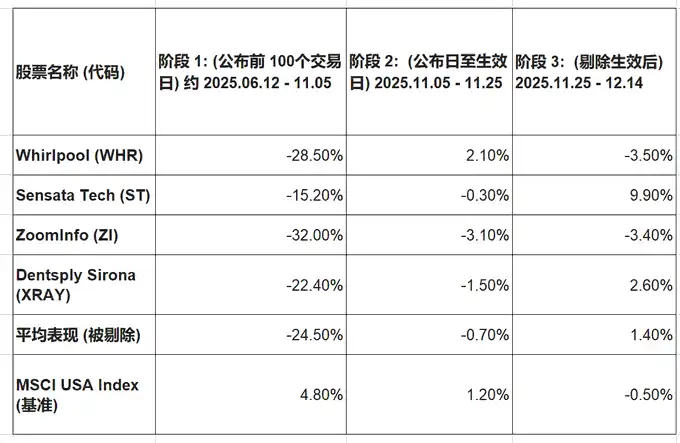
Phase 1 (Panic Brewing Period, 100 days before announcement):

During this period, stocks that were eventually removed fell by an average of 24.5%. The market anticipated the removal outcome in advance through deteriorating fundamentals and shrinking market capitalization.

Smart money had already front-run the move.

Phase 2 (Bad News Realization Period, Announcement day to Effective day):

When MSCI officially announced the removal list, stock performance was反而 stable, with an average decline of only 0.7%.甚至, individual stocks like Whirlpool (WHR)反而 saw a 2.1% rebound after the announcement.

Phase 3 (Post-Effect Recovery Period):

After the official removal took effect, some oversold individual stocks (like Sensata) even recorded gains of nearly 10%.

Overall, the average decline was 24.5% *before* the announcement, and 0.7% *after* the announcement.

Back to our protagonist 【MSTR】

MSCI announced in October that it was considering removing stocks of MSTR's type from the index.

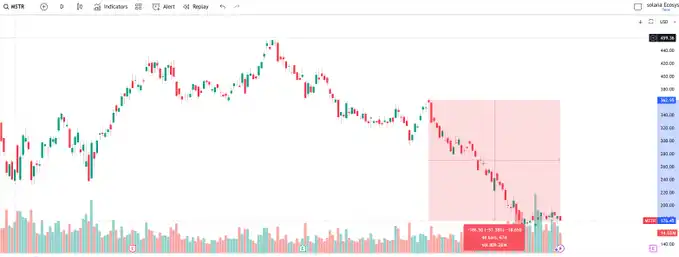
And MSTR's stock price has fallen 51% from its October high, far exceeding the decline in BTC over the same period.

Just like other companies removed from the MSCI index, the market has already started front-running the passive funds *before* MSCI's decision.
III. The Signal from the Nasdaq 100

When analyzing whether MicroStrategy will truly be removed by MSCI,

we cannot ignore a key leading indicator: the Nasdaq 100 index.

Although the Nasdaq 100 and MSCI USA indices have different construction rules, their core logic is highly overlapping: both place extreme importance on market capitalization and liquidity.

This past Friday, the Nasdaq 100 index announced it would retain MicroStrategy's constituent status.
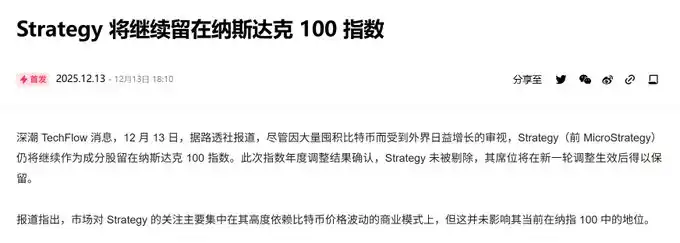
This means that, from an index compilation perspective, MicroStrategy's average daily trading volume and free-float market capitalization still meet the stringent standards for being among the top 100 largest non-financial technology companies in the US.

Since MicroStrategy managed to hold its ground in the Nasdaq 100, it indicates that its fundamentals and liquidity have not deteriorated to an irreparable point.

Although MSCI has its own qualitative industry classification considerations, in terms of hard metrics, MicroStrategy still possesses strong competitiveness.

Conclusion

MSCI potentially removing MSTR from its index is definitely a significant negative.

But negatives are often提前 priced in by the market. According to historical backtesting, the impact on the stock price after the negative news materializes is反而 not significant.

The core variable真正 affecting MSTR's direction right now is still the trend of BTC.

甚至, because MSCI's potential removal of MSTR is still only in the discussion phase, if the announcement on January 15th next year ends up retaining MSTR's constituent status, that would be a major positive. Retention = big rise! Removal = small fall. I believe MSTR presents an opportunity for asymmetric returns in the period ahead.


İlgili Sorular

QWhat is the main conclusion of the article regarding MSTR's stock price if it is removed from the MSCI index?

AThe main conclusion is that even if MSCI removes MSTR from its index, MSTR's stock price is unlikely to fall significantly, as the negative impact has likely already been priced in by the market.

QAccording to the historical backtest, when did the largest average price drop occur for stocks removed from the MSCI index?

AThe largest average price drop of 24.5% occurred during the 'panic fermentation phase,' which is the 100 days before the official announcement of the removal.

QWhat is the significance of the Nasdaq 100 index's recent decision regarding MSTR?

AThe Nasdaq 100 index's decision to retain MSTR as a component is a key leading indicator, suggesting that MSTR's average trading volume and free-float market cap still meet the stringent standards for a top-100 non-financial tech company, which could influence MSCI's decision.

QWhat does the article identify as the core variable that will truly influence MSTR's future price movement?

AThe article identifies the price movement of Bitcoin (BTC) as the core variable that will truly influence MSTR's future price direction.

QWhat potential asymmetric opportunity does the article suggest exists for MSTR?

AThe article suggests an asymmetric opportunity exists because if MSCI announces on January 15th that it will retain MSTR, it would be a major positive catalyst causing the stock to rise significantly, whereas a removal is expected to have only a minor negative impact, creating a favorable risk-reward scenario.

İlgili Okumalar

Gensyn AI: Don't Let AI Repeat the Mistakes of the Internet

In recent months, the rapid growth of the AI industry has attracted significant talent from the crypto sector. A persistent question among researchers intersecting both fields is whether blockchain can become a foundational part of AI infrastructure. While many previous AI and Crypto projects focused on application layers (like AI Agents, on-chain reasoning, data markets, and compute rentals), few achieved viable commercial models. Gensyn differentiates itself by targeting the most critical and expensive layer of AI: model training. Gensyn aims to organize globally distributed GPU resources into an open AI training network. Developers can submit training tasks, nodes provide computational power, and the network verifies results while distributing incentives. The core issue addressed is not decentralization for its own sake, but the increasing centralization of compute power among tech giants. In the era of large models, access to GPUs (like the H100) has become a decisive bottleneck, dictating the pace of AI development. Major AI companies are heavily dependent on large cloud providers for compute resources. Gensyn's approach is significant for several reasons: 1) It operates at the core infrastructure layer (model training), the most resource-intensive and technically demanding part of the AI value chain. 2) It proposes a more open, collaborative model for compute, potentially increasing resource utilization by dynamically pooling idle GPUs, similar to early cloud computing logic. 3) Its technical moat lies in solving complex challenges like verifying training results, ensuring node honesty, and maintaining reliability in a distributed environment—making it more of a deep-tech infrastructure company. 4) It targets a validated, high-growth market with genuine demand, rather than pursuing blockchain integration without purpose. Ultimately, the boundaries between Crypto and AI are blurring. AI requires global resource coordination, incentive mechanisms, and collaborative systems—areas where crypto-native solutions excel. Gensyn represents a step toward making advanced training capabilities more accessible and collaborative, moving beyond a niche controlled by a few giants. If successful, it could evolve into a fundamental piece of AI infrastructure, where the most enduring value in the AI era is often created.

marsbit6 saat önce

Gensyn AI: Don't Let AI Repeat the Mistakes of the Internet

marsbit6 saat önce

Why is China's AI Developing So Fast? The Answer Lies Inside the Labs

A US researcher's visit to China's top AI labs reveals distinct cultural and organizational factors driving China's rapid AI development. While talent, data, and compute are similar to the West, Chinese labs excel through a pragmatic, execution-focused culture: less emphasis on individual stardom and conceptual debate, and more on teamwork, engineering optimization, and mastering the full tech stack. A key advantage is the integration of young students and researchers who approach model-building with fresh perspectives and low ego, prioritizing collective progress over personal credit. This contrasts with the US culture of self-promotion and "star scientist" narratives. Chinese labs also exhibit a strong "build, don't buy" mentality, preferring to develop core capabilities—like data pipelines and environments—in-house rather than relying on external services. The ecosystem feels more collaborative than tribal, with mutual respect among labs. While government support exists, its scale is unclear, and technical decisions appear driven by labs, not state mandates. Chinese companies across sectors, from platforms to consumer tech, are building their own foundational models to control their tech destiny, reflecting a broader cultural drive for technological sovereignty. Demand for AI is emerging, with spending patterns potentially mirroring cloud infrastructure more than traditional SaaS. Despite challenges like a less mature data industry and GPU shortages, Chinese labs are propelled by vast talent, rapid iteration, and deep integration with the open-source community. The competition is evolving beyond a pure model race into a contest of organizational execution, developer ecosystems, and industrial pragmatism.

marsbit8 saat önce

Why is China's AI Developing So Fast? The Answer Lies Inside the Labs

marsbit8 saat önce

3 Years, 5 Times: The Rebirth of a Century-Old Glass Factory

Corning, a 175-year-old glass company, is experiencing a dramatic revival as a key player in AI infrastructure, driven by surging demand for high-performance optical fiber in data centers. AI data centers require vastly more fiber than traditional ones—5 to 10 times as much per rack—to handle high-speed data transmission between GPUs. This structural demand shift, coupled with supply constraints from the lengthy expansion cycle for fiber preforms, has created a significant supply-demand gap. Nvidia has invested in Corning, along with Lumentum and Coherent, in a $4.5 billion total commitment to secure the optical supply chain for AI. Corning's competitive edge lies in its expertise in producing ultra-low-loss, high-density, and bend-resistant specialty fiber, which is critical for 800G+ and future 1.6T data rates. Its deep involvement in co-packaged optics (CPO) with partners like Nvidia further solidifies its position. While not the largest fiber manufacturer globally, Corning's revenue from enterprise/data center clients now exceeds 40% of its optical communications sales, and it has secured multi-year supply agreements with major hyperscalers including Meta and Nvidia. Financially, Corning's optical communications revenue has surged, doubling from $1.3 billion in 2023 to over $3 billion in 2025. Its stock price has risen nearly 6-fold since late 2023. Key future catalysts include the rollout of Nvidia's CPO products and the scale of undisclosed customer agreements. However, risks include high current valuations and potential disruption from next-generation technologies like hollow-core fiber. The company's long-term bet on light over electricity, maintained even through the telecom bubble crash, is now being validated by the AI boom.

marsbit8 saat önce

3 Years, 5 Times: The Rebirth of a Century-Old Glass Factory

marsbit8 saat önce

İşlemler

Spot
Futures

Popüler Makaleler

CC Nasıl Satın Alınır

HTX.com’a hoş geldiniz! CC(Canton) (CC) satın alma işlemlerini basit ve kullanışlı bir hâle getirdik. Adım adım açıkladığımız rehberimizi takip ederek kripto yolculuğunuza başlayın. 1. Adım: HTX Hesabınızı OluşturunHTX'te ücretsiz bir hesap açmak için e-posta adresinizi veya telefon numaranızı kullanın. Sorunsuzca kaydolun ve tüm özelliklerin kilidini açın. Hesabımı Aç2. Adım: Kripto Satın Al Bölümüne Gidin ve Ödeme Yönteminizi SeçinKredi/Banka Kartı: Visa veya Mastercard'ınızı kullanarak anında CC(Canton) (CC) satın alın.Bakiye: Sorunsuz bir şekilde işlem yapmak için HTX hesap bakiyenizdeki fonları kullanın.Üçüncü Taraflar: Kullanımı kolaylaştırmak için Google Pay ve Apple Pay gibi popüler ödeme yöntemlerini ekledik.P2P: HTX'teki diğer kullanıcılarla doğrudan işlem yapın.Borsa Dışı (OTC): Yatırımcılar için kişiye özel hizmetler ve rekabetçi döviz kurları sunuyoruz.3. Adım: CC(Canton) (CC) Varlıklarınızı SaklayınCC(Canton) (CC) satın aldıktan sonra HTX hesabınızda saklayın. Alternatif olarak, blok zinciri transferi yoluyla başka bir yere gönderebilir veya diğer kripto para birimlerini takas etmek için kullanabilirsiniz.4. Adım: CC(Canton) (CC) Varlıklarınızla İşlem YapınHTX'in spot piyasasında CC(Canton) (CC) ile kolayca işlemler yapın.Hesabınıza erişin, işlem çiftinizi seçin, işlemlerinizi gerçekleştirin ve gerçek zamanlı olarak izleyin. Hem yeni başlayanlar hem de deneyimli yatırımcılar için kullanıcı dostu bir deneyim sunuyoruz.

187 Toplam GörüntülenmeYayınlanma 2026.04.21Güncellenme 2026.04.21

CC Nasıl Satın Alınır

BLEND Nasıl Satın Alınır

HTX.com’a hoş geldiniz! Fluent (BLEND) satın alma işlemlerini basit ve kullanışlı bir hâle getirdik. Adım adım açıkladığımız rehberimizi takip ederek kripto yolculuğunuza başlayın. 1. Adım: HTX Hesabınızı OluşturunHTX'te ücretsiz bir hesap açmak için e-posta adresinizi veya telefon numaranızı kullanın. Sorunsuzca kaydolun ve tüm özelliklerin kilidini açın. Hesabımı Aç2. Adım: Kripto Satın Al Bölümüne Gidin ve Ödeme Yönteminizi SeçinKredi/Banka Kartı: Visa veya Mastercard'ınızı kullanarak anında Fluent (BLEND) satın alın.Bakiye: Sorunsuz bir şekilde işlem yapmak için HTX hesap bakiyenizdeki fonları kullanın.Üçüncü Taraflar: Kullanımı kolaylaştırmak için Google Pay ve Apple Pay gibi popüler ödeme yöntemlerini ekledik.P2P: HTX'teki diğer kullanıcılarla doğrudan işlem yapın.Borsa Dışı (OTC): Yatırımcılar için kişiye özel hizmetler ve rekabetçi döviz kurları sunuyoruz.3. Adım: Fluent (BLEND) Varlıklarınızı SaklayınFluent (BLEND) satın aldıktan sonra HTX hesabınızda saklayın. Alternatif olarak, blok zinciri transferi yoluyla başka bir yere gönderebilir veya diğer kripto para birimlerini takas etmek için kullanabilirsiniz.4. Adım: Fluent (BLEND) Varlıklarınızla İşlem YapınHTX'in spot piyasasında Fluent (BLEND) ile kolayca işlemler yapın.Hesabınıza erişin, işlem çiftinizi seçin, işlemlerinizi gerçekleştirin ve gerçek zamanlı olarak izleyin. Hem yeni başlayanlar hem de deneyimli yatırımcılar için kullanıcı dostu bir deneyim sunuyoruz.

170 Toplam GörüntülenmeYayınlanma 2026.04.24Güncellenme 2026.04.24

BLEND Nasıl Satın Alınır

ACN Nasıl Satın Alınır

HTX.com’a hoş geldiniz! AITECH CLOUD NETWORK (ACN) satın alma işlemlerini basit ve kullanışlı bir hâle getirdik. Adım adım açıkladığımız rehberimizi takip ederek kripto yolculuğunuza başlayın. 1. Adım: HTX Hesabınızı OluşturunHTX'te ücretsiz bir hesap açmak için e-posta adresinizi veya telefon numaranızı kullanın. Sorunsuzca kaydolun ve tüm özelliklerin kilidini açın. Hesabımı Aç2. Adım: Kripto Satın Al Bölümüne Gidin ve Ödeme Yönteminizi SeçinKredi/Banka Kartı: Visa veya Mastercard'ınızı kullanarak anında AITECH CLOUD NETWORK (ACN) satın alın.Bakiye: Sorunsuz bir şekilde işlem yapmak için HTX hesap bakiyenizdeki fonları kullanın.Üçüncü Taraflar: Kullanımı kolaylaştırmak için Google Pay ve Apple Pay gibi popüler ödeme yöntemlerini ekledik.P2P: HTX'teki diğer kullanıcılarla doğrudan işlem yapın.Borsa Dışı (OTC): Yatırımcılar için kişiye özel hizmetler ve rekabetçi döviz kurları sunuyoruz.3. Adım: AITECH CLOUD NETWORK (ACN) Varlıklarınızı SaklayınAITECH CLOUD NETWORK (ACN) satın aldıktan sonra HTX hesabınızda saklayın. Alternatif olarak, blok zinciri transferi yoluyla başka bir yere gönderebilir veya diğer kripto para birimlerini takas etmek için kullanabilirsiniz.4. Adım: AITECH CLOUD NETWORK (ACN) Varlıklarınızla İşlem YapınHTX'in spot piyasasında AITECH CLOUD NETWORK (ACN) ile kolayca işlemler yapın.Hesabınıza erişin, işlem çiftinizi seçin, işlemlerinizi gerçekleştirin ve gerçek zamanlı olarak izleyin. Hem yeni başlayanlar hem de deneyimli yatırımcılar için kullanıcı dostu bir deneyim sunuyoruz.

109 Toplam GörüntülenmeYayınlanma 2026.04.28Güncellenme 2026.04.28

ACN Nasıl Satın Alınır

Tartışmalar

HTX Topluluğuna hoş geldiniz. Burada, en son platform gelişmeleri hakkında bilgi sahibi olabilir ve profesyonel piyasa görüşlerine erişebilirsiniz. Kullanıcıların A (A) fiyatı hakkındaki görüşleri aşağıda sunulmaktadır.

活动图片













