If MSCI Removes MSTR, Will the Stock Price Actually Fall? Historical Backtesting Reveals a Surprising Answer

marsbit2025-12-15 tarihinde yayınlandı2025-12-15 tarihinde güncellendi

Özet

The article examines whether MSCI's potential removal of MicroStrategy (MSTR) from its index would actually cause a significant drop in its share price, based on historical backtesting. MSCI index changes can trigger forced selling by passive funds, reducing liquidity and investor confidence. However, historical data from the November 2025 MSCI rebalancing shows that most of the price decline for removed stocks occurred during the pre-announcement anticipation phase (average drop of 24.5%), not after the official announcement (average drop of only 0.7%) or on the effective date. Some stocks even rebounded after removal. MSTR has already fallen 51% from its October high, suggesting the market may have already priced in the risk of removal. Additionally, Nasdaq 100's recent decision to retain MSTR indicates strong fundamentals and liquidity. The core driver of MSTR’s price remains Bitcoin’s performance. If MSCI retains MSTR on January 15, it could be a positive surprise. The current setup may present an asymmetric risk-reward opportunity for MSTR.

The discussion about whether MSCI should remove MicroStrategy from its index has become a Sword of Damocles hanging over the company.

The market seems to be waiting for the official announcement on January 15th to deliver the final verdict on $MSTR.

How influential is MSCI really? If removed, will MicroStrategy's stock actually fall? I backtested historical data, and the answer is surprising.

Let's state the conclusion first: even if MSCI removes MSTR, it's highly likely that MSTR won't experience a significant drop because of it.

I. Why We Care About MSCI

First, we need to understand why MSCI's decision is so important.

The MSCI index is not just a simple list of stocks; it's the benchmark for trillions of dollars in global asset allocation.

1⃣ Forced Buying and Selling by Passive Funds:

Globally, trillions of dollars in ETFs (like iShares, Vanguard) and index funds strictly track the MSCI USA Index.

Once MSCI announces the removal of a stock, these funds must unconditionally sell that stock on the effective date (usually at the market close on the last day of the month), regardless of cost.

2⃣ A Double Blow to Liquidity and Attention:

Removal typically means the company is kicked out of the "core asset" club. Many actively managed funds, constrained by risk control rules (e.g., only allowed to invest in major index constituents), are also forced to follow suit and reduce their positions. This leads to decreased stock liquidity and a lower valuation benchmark.

II. Echoes from History: The Big Drop Often Happens *Before* the Announcement

However, based on my backtest of data from the last MSCI index review, the decline often doesn't begin on the day of the index adjustment.

The rule in financial markets is: the price always moves ahead of the news.

The most recent MSCI index adjustment occurred this November, removing companies like Whirlpool, Sensata, and ZoomInfo.

The timeline for an MSCI index adjustment is as follows:

November 5th: Announcement of the changes

November 25th: Changes become effective

Through calculation, I found that the maximum decline for the removed stocks did not occur *after* the removal took effect, but rather during the anticipation phase *before* the announcement.

The data is shown in the chart below
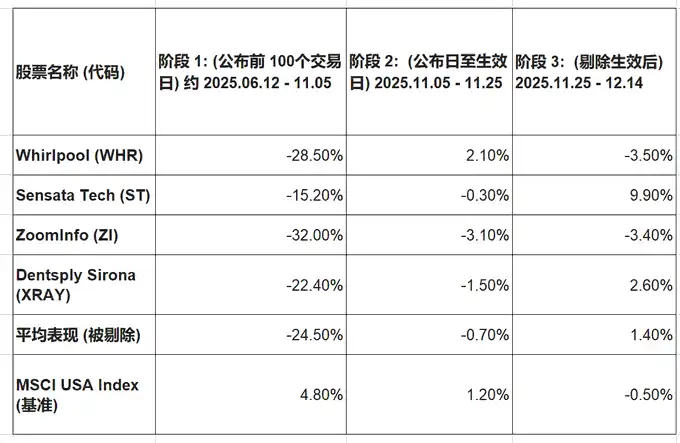
Phase 1 (Panic Brewing Period, 100 days before announcement):

During this period, stocks that were eventually removed fell by an average of 24.5%. The market anticipated the removal outcome in advance through deteriorating fundamentals and shrinking market capitalization.

Smart money had already front-run the move.

Phase 2 (Bad News Realization Period, Announcement day to Effective day):

When MSCI officially announced the removal list, stock performance was反而 stable, with an average decline of only 0.7%.甚至, individual stocks like Whirlpool (WHR)反而 saw a 2.1% rebound after the announcement.

Phase 3 (Post-Effect Recovery Period):

After the official removal took effect, some oversold individual stocks (like Sensata) even recorded gains of nearly 10%.

Overall, the average decline was 24.5% *before* the announcement, and 0.7% *after* the announcement.

Back to our protagonist 【MSTR】

MSCI announced in October that it was considering removing stocks of MSTR's type from the index.

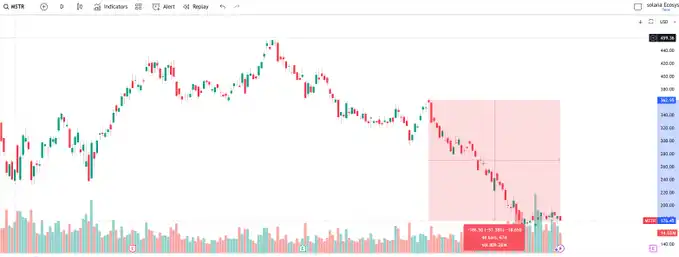
And MSTR's stock price has fallen 51% from its October high, far exceeding the decline in BTC over the same period.

Just like other companies removed from the MSCI index, the market has already started front-running the passive funds *before* MSCI's decision.
III. The Signal from the Nasdaq 100

When analyzing whether MicroStrategy will truly be removed by MSCI,

we cannot ignore a key leading indicator: the Nasdaq 100 index.

Although the Nasdaq 100 and MSCI USA indices have different construction rules, their core logic is highly overlapping: both place extreme importance on market capitalization and liquidity.

This past Friday, the Nasdaq 100 index announced it would retain MicroStrategy's constituent status.
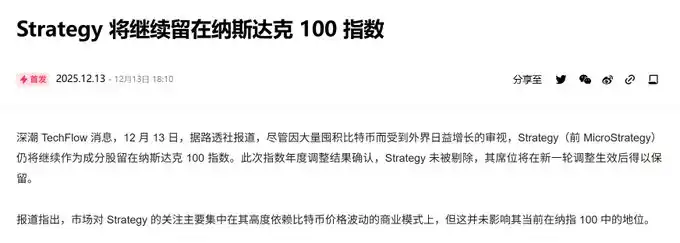
This means that, from an index compilation perspective, MicroStrategy's average daily trading volume and free-float market capitalization still meet the stringent standards for being among the top 100 largest non-financial technology companies in the US.

Since MicroStrategy managed to hold its ground in the Nasdaq 100, it indicates that its fundamentals and liquidity have not deteriorated to an irreparable point.

Although MSCI has its own qualitative industry classification considerations, in terms of hard metrics, MicroStrategy still possesses strong competitiveness.

Conclusion

MSCI potentially removing MSTR from its index is definitely a significant negative.

But negatives are often提前 priced in by the market. According to historical backtesting, the impact on the stock price after the negative news materializes is反而 not significant.

The core variable真正 affecting MSTR's direction right now is still the trend of BTC.

甚至, because MSCI's potential removal of MSTR is still only in the discussion phase, if the announcement on January 15th next year ends up retaining MSTR's constituent status, that would be a major positive. Retention = big rise! Removal = small fall. I believe MSTR presents an opportunity for asymmetric returns in the period ahead.


Trend Kriptolar

İlgili Sorular

QWhat is the main conclusion of the article regarding MSTR's stock price if it is removed from the MSCI index?

AThe main conclusion is that even if MSCI removes MSTR from its index, MSTR's stock price is unlikely to fall significantly, as the negative impact has likely already been priced in by the market.

QAccording to the historical backtest, when did the largest average price drop occur for stocks removed from the MSCI index?

AThe largest average price drop of 24.5% occurred during the 'panic fermentation phase,' which is the 100 days before the official announcement of the removal.

QWhat is the significance of the Nasdaq 100 index's recent decision regarding MSTR?

AThe Nasdaq 100 index's decision to retain MSTR as a component is a key leading indicator, suggesting that MSTR's average trading volume and free-float market cap still meet the stringent standards for a top-100 non-financial tech company, which could influence MSCI's decision.

QWhat does the article identify as the core variable that will truly influence MSTR's future price movement?

AThe article identifies the price movement of Bitcoin (BTC) as the core variable that will truly influence MSTR's future price direction.

QWhat potential asymmetric opportunity does the article suggest exists for MSTR?

AThe article suggests an asymmetric opportunity exists because if MSCI announces on January 15th that it will retain MSTR, it would be a major positive catalyst causing the stock to rise significantly, whereas a removal is expected to have only a minor negative impact, creating a favorable risk-reward scenario.

İlgili Okumalar

From StepFun to Galaxy Robots: The Capital Migration Path Behind WAIC Exhibiting Companies

From Stellar Steps to Galactic Generals: The Capital Migration Route Behind WAIC 2026 Exhibiting Enterprises The 2026 World Artificial Intelligence Conference (WAIC) in Shanghai showcased over 1100 exhibitors. Analyzing their financing activities over the past 18 months reveals key capital trends in China's AI industry, with the total raised exceeding 100 billion RMB. **Large Language Models: IPO Window Opens, Capital Concentrates on Leaders** This sector attracted the most capital. Companies like Zhipu and MiniMax have completed Hong Kong IPOs, setting exit benchmarks. StepFun (Stellar Steps), a star example, saw its valuation soar to an estimated $12B through rapid, escalating funding rounds—from millions in 2023 to a $2.5B Pre-IPO round in mid-2026 led by industrial players like ZTE. The trend shows a shift: IPO paths are clear, industrial capital is entering for strategic deployment, and large, concentrated funding rounds favor commercially viable leaders. **Embodied AI: Hyper-Compressed Financing Cycles** This field entered a capital explosion phase. Companies like Galbot (Galactic General) epitomize the trend, raising over 7B RMB across 5 rounds in under 2 years. Early VC backing quickly gave way to investments from industrial giants (Meituan, CATL, SAIC) and finally "national team" funds, signaling its status as a strategic industry. The compressed fundraising pace, as seen with other leaders, indicates high consensus on the sector's potential and intense competition. **AI Chips: Domestic Substitution Enters Deep Waters** Represented by companies like Moore Threads (which completed an 8B RMB IPO as the "first domestic GPU stock"), this sector differs. It faces longer R&D cycles, higher capital thresholds, and stronger policy reliance. Funding often involves state-backed capital and telecom operators, with lower VC participation compared to other AI sectors, reflecting the industry's inherent challenges. **Capital Flow Panorama: Five Key Trends** 1. **Winner-Takes-Most:** Funding is highly concentrated in top players within each sector. 2. **Embodied AI as a New Growth Pole:** It attracts rapid, large-scale funding from industrial chains, akin to the automotive sector. 3. **Industrial Capital Ascendancy:** Strategic investors like ZTE and SAIC are replacing pure financial VCs for technology synergy. 4. **"National Team" Prominence:** State-guided investment funds are actively co-investing, aligning AI with national strategy. 5. **Diversified Exit Paths:** Beyond IPOs, options like M&A and strategic investment are increasing. **Conclusion: Capital is Not Omnipotent** While massive capital influx signals strong market confidence in China's AI outlook, it brings risks: reduced ecosystem diversity due to concentration, potential compromise of corporate independence, and valuation bubble concerns amidst compressed financing. The investor's motive behind a company often reveals more than its technical specs.

marsbit1 dk önce

From StepFun to Galaxy Robots: The Capital Migration Path Behind WAIC Exhibiting Companies

marsbit1 dk önce

Before Second Attempt to List on HKEX, Performance of Semiconductor 'Little Giant' Suddenly Deteriorates

Shenzhen Vanguard Semiconductor, a state-level "little giant" specializing in power semiconductor devices, has once again filed for a listing on the Hong Kong Stock Exchange main board, with GF Securities as the sole sponsor. This is its second attempt this year. Backed by prominent investors like Intel Asia-Pacific, OPPO, Xiaomi, and CATL, the company's post-investment valuation soared over 500% to approximately RMB 2.9 billion in just two and a half years. However, a month before its application, China's securities regulator raised six inquiries, focusing on the fairness of share prices for recent new shareholders and potential conflicts of interest related to two employee incentive platforms, suggesting concerns over improper benefit transfers. Financially, the company's performance shifted in the first five months of 2026, recording a net loss of RMB 510,000 compared to a profit of RMB 26.53 million a year earlier. Its overall gross margin also dropped from 22.4% to 17.9%. This was attributed to a decline in revenue share from its high-margin WLCSP products, driven by conservative smartphone maker procurement plans amid market adjustments, leading to a situation of increased revenue but decreased profitability. Furthermore, Vanguard Semiconductor's distribution network underwent a significant overhaul, with the number of authorized distributors plummeting from 658 to 103 within three years, mostly terminated for failing performance metrics. Sales remain heavily reliant on distributors, accounting for 84.1% of revenue in early 2026. Concurrently, customer and supplier concentration risks are rising, with the top five customers contributing 67.9% of revenue. While industry observers note that high customer concentration is common, attention is drawn to whether shareholder relationships, such as with Huaqin Technology's affiliate holding a 2.12% stake, extend to the client level.

marsbit1 dk önce

Before Second Attempt to List on HKEX, Performance of Semiconductor 'Little Giant' Suddenly Deteriorates

marsbit1 dk önce

İşlemler

Spot

Popüler Makaleler

O Nasıl Satın Alınır

HTX.com’a hoş geldiniz! O1 exchange (O) satın alma işlemlerini basit ve kullanışlı bir hâle getirdik. Adım adım açıkladığımız rehberimizi takip ederek kripto yolculuğunuza başlayın. 1. Adım: HTX Hesabınızı OluşturunHTX'te ücretsiz bir hesap açmak için e-posta adresinizi veya telefon numaranızı kullanın. Sorunsuzca kaydolun ve tüm özelliklerin kilidini açın. Hesabımı Aç2. Adım: Kripto Satın Al Bölümüne Gidin ve Ödeme Yönteminizi SeçinKredi/Banka Kartı: Visa veya Mastercard'ınızı kullanarak anında O1 exchange (O) satın alın.Bakiye: Sorunsuz bir şekilde işlem yapmak için HTX hesap bakiyenizdeki fonları kullanın.Üçüncü Taraflar: Kullanımı kolaylaştırmak için Google Pay ve Apple Pay gibi popüler ödeme yöntemlerini ekledik.P2P: HTX'teki diğer kullanıcılarla doğrudan işlem yapın.Borsa Dışı (OTC): Yatırımcılar için kişiye özel hizmetler ve rekabetçi döviz kurları sunuyoruz.3. Adım: O1 exchange (O) Varlıklarınızı SaklayınO1 exchange (O) satın aldıktan sonra HTX hesabınızda saklayın. Alternatif olarak, blok zinciri transferi yoluyla başka bir yere gönderebilir veya diğer kripto para birimlerini takas etmek için kullanabilirsiniz.4. Adım: O1 exchange (O) Varlıklarınızla İşlem YapınHTX'in spot piyasasında O1 exchange (O) ile kolayca işlemler yapın.Hesabınıza erişin, işlem çiftinizi seçin, işlemlerinizi gerçekleştirin ve gerçek zamanlı olarak izleyin. Hem yeni başlayanlar hem de deneyimli yatırımcılar için kullanıcı dostu bir deneyim sunuyoruz.

169 Toplam GörüntülenmeYayınlanma 2026.06.19Güncellenme 2026.06.29

O Nasıl Satın Alınır

PROS Nasıl Satın Alınır

HTX.com’a hoş geldiniz! Pharos (PROS) satın alma işlemlerini basit ve kullanışlı bir hâle getirdik. Adım adım açıkladığımız rehberimizi takip ederek kripto yolculuğunuza başlayın. 1. Adım: HTX Hesabınızı OluşturunHTX'te ücretsiz bir hesap açmak için e-posta adresinizi veya telefon numaranızı kullanın. Sorunsuzca kaydolun ve tüm özelliklerin kilidini açın. Hesabımı Aç2. Adım: Kripto Satın Al Bölümüne Gidin ve Ödeme Yönteminizi SeçinKredi/Banka Kartı: Visa veya Mastercard'ınızı kullanarak anında Pharos (PROS) satın alın.Bakiye: Sorunsuz bir şekilde işlem yapmak için HTX hesap bakiyenizdeki fonları kullanın.Üçüncü Taraflar: Kullanımı kolaylaştırmak için Google Pay ve Apple Pay gibi popüler ödeme yöntemlerini ekledik.P2P: HTX'teki diğer kullanıcılarla doğrudan işlem yapın.Borsa Dışı (OTC): Yatırımcılar için kişiye özel hizmetler ve rekabetçi döviz kurları sunuyoruz.3. Adım: Pharos (PROS) Varlıklarınızı SaklayınPharos (PROS) satın aldıktan sonra HTX hesabınızda saklayın. Alternatif olarak, blok zinciri transferi yoluyla başka bir yere gönderebilir veya diğer kripto para birimlerini takas etmek için kullanabilirsiniz.4. Adım: Pharos (PROS) Varlıklarınızla İşlem YapınHTX'in spot piyasasında Pharos (PROS) ile kolayca işlemler yapın.Hesabınıza erişin, işlem çiftinizi seçin, işlemlerinizi gerçekleştirin ve gerçek zamanlı olarak izleyin. Hem yeni başlayanlar hem de deneyimli yatırımcılar için kullanıcı dostu bir deneyim sunuyoruz.

158 Toplam GörüntülenmeYayınlanma 2026.06.22Güncellenme 2026.06.29

PROS Nasıl Satın Alınır

VERONA Nedir

I. Proje Tanıtımı VERONA, zincir soyutlaması aracılığıyla herkes için, her yerde inşa edilmiş bir blok zinciridir. Genel Soyutlama katmanını kullanarak, VERONA, hesaplar, imzalar ve birlikte çalışabilirlik gibi karmaşık blok zinciri işlevlerini doğrudan protokol seviyesinde entegre ederek kendini ayırt eder. Bu yaklaşım, temel teknolojileri anlamaya gerek kalmadan blok zinciri uygulamalarıyla etkileşimde bulunmayı sağlar.1) Temel Bilgiler İsim: VERONA (VERONA)III. İlgili Bağlantılar Resmi web sitesi bağlantısı: https://xion.burnt.com/ Whitepaper: https://xion.burnt.com/whitepaper.pdf Keşif Araçları: https://explorer.burnt.com/ Sosyal Medya: https://x.com/burnt_xion Not: Proje tanıtımı, resmi proje ekibi tarafından yayımlanan veya sağlanan materyallerden alınmıştır, yalnızca referans içindir ve yatırım tavsiyesi teşkil etmez. HTX, ortaya çıkan doğrudan veya dolaylı kayıplardan sorumluluk kabul etmez.

147 Toplam GörüntülenmeYayınlanma 2026.06.22Güncellenme 2026.06.22

VERONA Nedir

Tartışmalar

HTX Topluluğuna hoş geldiniz. Burada, en son platform gelişmeleri hakkında bilgi sahibi olabilir ve profesyonel piyasa görüşlerine erişebilirsiniz. Kullanıcıların A (A) fiyatı hakkındaki görüşleri aşağıda sunulmaktadır.

活动图片