IBIT Records $1.3 Billion Outflow in a Single Week, Bitcoin's Largest ETF Becomes a Wall of Selling Pressure That Bulls Must Break Through

marsbit2026-06-29 tarihinde yayınlandı2026-06-29 tarihinde güncellendi

Özet

BlackRock's iShares Bitcoin Trust (IBIT), the largest U.S. spot bitcoin ETF, saw $1.3 billion in net outflows for the week ending June 26, accounting for roughly 73% of total ETF outflows ($1.79B). This significant, concentrated selling pressure from the primary vehicle that previously funneled institutional demand into bitcoin is now testing the market at a key support level near $60,000. The article notes a narrative shift: the same ETF that served as a major entry ramp for compliant investment is now operating in reverse as a potential exit lane. While ETF outflows represent a transmission risk rather than direct spot selling, they create a new structural headwind. Bitcoin's next move hinges on whether non-ETF buyers can absorb this pressure. Two scenarios are presented: if IBIT outflows slow and bitcoin reclaims the $59,000-$62,000 range, the event could be seen as a clearing of weak hands. However, if IBIT continues to lead significant redemptions while bitcoin struggles to hold $60k, the ETF complex itself may become a persistent source of selling pressure, challenging the long-held "institutional demand" thesis. The coming trading sessions will determine if this is a one-time purge or the start of sustained outflows.

Author: Liam 'Akiba' Wright

Compiled by: TechFlow

TechFlow Insights: BlackRock's IBIT accounted for nearly 73% of the net outflows from US spot Bitcoin ETFs last week, with a single-week redemption of $1.3 billion. When this major gateway, which once brought Wall Street buying power to Bitcoin, starts operating in reverse, the bulls at the $60,000 level are no longer facing retail selling pressure but structural ETF selling pressure. The fund flows over the next few trading days will determine whether this is a clearing event or the beginning of sustained bleeding.

BlackRock's iShares Bitcoin Trust (IBIT) is becoming a test that Bitcoin bulls least want to face. This ETF, which helped Bitcoin open compliant funding channels and turned 'institutional demand' into a simple narrative, is now where price-sensitive holders are making their presence felt.

Bitcoin ETF flow data from Farside Investors shows that during the trading week of June 22-26, US spot Bitcoin ETFs collectively saw a net outflow of approximately $1.789 billion. IBIT alone accounted for about $1.303 billion, close to 73% of the total weekly outflow.

The latest trading day's data makes the signal even clearer: Farside's data for June 26 shows a net outflow of $444.5 million from the ETF complex, with all negative values coming from IBIT.

This concentration changes the conditions for Bitcoin's rebound test. The ETF complex can still be a demand channel, but the largest spot Bitcoin ETF must now also be viewed as a redemption channel.

If this shell, which once helped Bitcoin gain acceptance from brokerage account investors, becomes the primary exit lane, then spot buyers outside the ETFs must absorb these exposures when ETF holders reduce their positions.

IBIT Leads ETF Fund Exodus

The reason Farside's data constitutes a market structure signal is that the pressure is concentrated on Bitcoin's most prominent ETF.
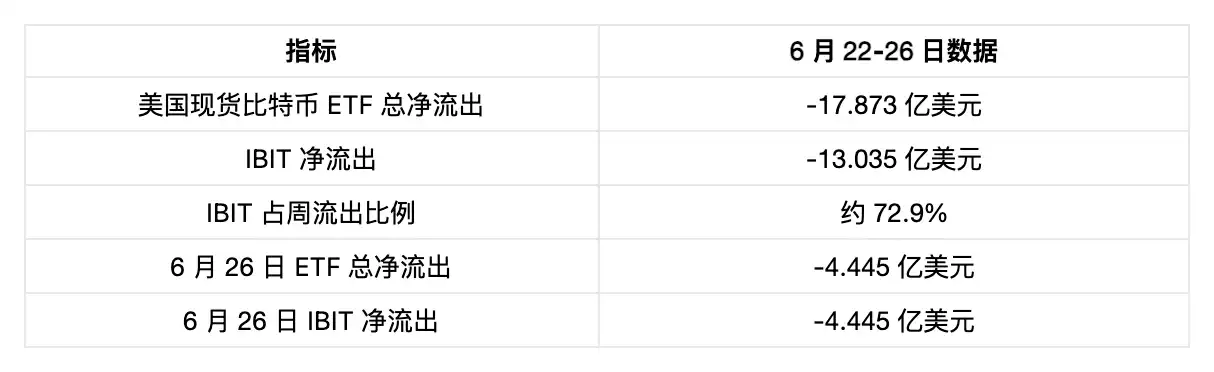
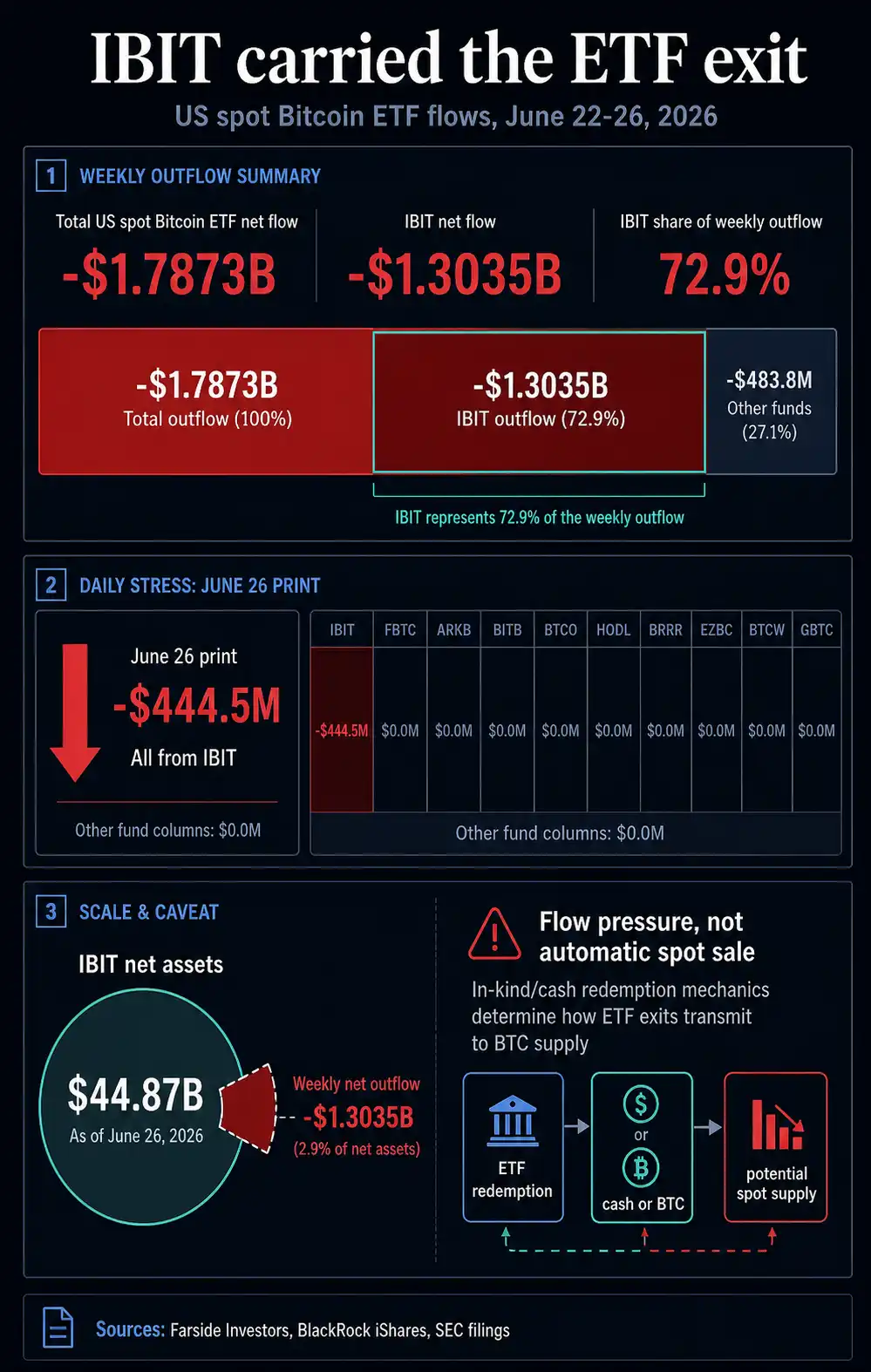
Caption: IBIT accounted for 72.9% of the total weekly outflows from US spot Bitcoin ETFs ($1.3035 billion / $1.7873 billion), data source Farside Investors.

IBIT is not just a ticker in the ETF complex. It is one of the clearest channels for Bitcoin to achieve compliant access through existing brokerage accounts. Its scale gives its fund flows more market weight than redemptions from smaller funds.

When this product contributes the majority of fund outflows in a week, the signal is no longer just 'the ETF market is cooling down.' It is a stress test on the strongest access channel Bitcoin has gained since the launch of spot ETFs.

These outflows occurred while Bitcoin itself was under pressure. CryptoSlate market data shows BTC was trading around $60,000 on June 28, with negative price changes over both 7-day and 30-day periods.

Previous CryptoSlate reports have tracked the broader context of collective ETF surrender and Bitcoin's struggle in the $58,000 to $60,000 range. The new added pressure now is that IBIT itself has become the marginal flow to watch.

Narrative Flip: The Same Channel, Operating in Both Directions

The early spot ETF story was simple: compliant channels broadened the buyer base, ETF demand reduced available supply, and Bitcoin gained a more familiar holding path for institutions and brokerage account investors.

The latest data preserves that history while revealing that the same entry point can operate in reverse when ETF holders decide to exit.

IBIT's scale is both why this week's outflow matters and provides a proportional reference. BlackRock iShares' official product page shows IBIT had net assets of $44.87 billion as of June 26, with a benchmark price around $59,813.

A $1.3 billion weekly outflow is enough to dominate the ETF complex but remains a small percentage relative to the fund's total assets. IBIT is still an important compliant Bitcoin wrapper. The market's question is what this scale means at the margin.

When IBIT was attracting capital, its scale reinforced the 'institutional demand' narrative. When IBIT is bleeding, its scale makes this outflow hard for the rest of the market to ignore.

Smaller funds can bleed continuously without altering the overall ETF narrative. IBIT cannot. Its redemptions indicate that ETF holdings may be becoming more price-sensitive near Bitcoin's support levels.

This distinction is crucial at the $60,000 level. The optimistic read: the largest redemptions have already worked through the system, outflows will slow from here, and Bitcoin reclaiming the $59,000-$62,000 range would mean the market has absorbed the selling pressure.

The cautious read: the next recovery rally must not only rebound from liquidation shocks but also withstand new ETF selling pressure.

This is the 'wall of selling pressure' version of the IBIT story. It doesn't require BlackRock to be bearish on Bitcoin or IBIT holders to exit all at once. It's a market structure argument: the largest access product can become where price-sensitive holdings surface first.

Precise Definition of the ETF Mechanism

ETF flow data is a pressure signal, not a record of direct on-chain selling.

In July 2025, the SEC approved a physical creation/redemption mechanism for crypto ETPs. IBIT's filings also show the redemption mechanism can involve cash proceeds from selling Bitcoin or Bitcoin in-kind, depending on the path used.

Therefore, ETF outflows should be seen as transmission risk, not direct evidence that for every dollar redeemed, a dollar is automatically dumped into the spot market.

The risk remains real. A large, liquid ETF can translate investors' de-risking moves into a recurring source of pressure on Bitcoin's supply side (or the expectation thereof), especially if redemptions are settled in cash or if the Bitcoin obtained from redemptions is subsequently sold.

The signal carries weight even without perfect mechanistic certainty. If IBIT continues to post large net outflow days, buyers must ask: who is absorbing these exposures when ETF holders exit?

If Bitcoin cannot reclaim $60,000 during this period, the old 'institutional demand' narrative weakens. If flows stabilize quickly, the same dataset may later be viewed as just a clearing of crowded trades.

The real test is: have ETF holdings matured into a two-way source of price pressure? Spot ETFs provided investors with a more convenient holding path. More convenient holding also means more convenient exiting.

IBIT's outflows last week placed this trade-off precisely at a fragile spot on Bitcoin's chart.

Two Scenarios

If IBIT outflows slow, Bitcoin holds the high $50,000s range, and reclaims the $59,000-$62,000 level, this week can be interpreted as a potential capitulation flush or flow reset.

In this version, the ETF holders who wanted to leave have done so, the market absorbed the transmission risk, and the largest compliant product remains a net positive for Bitcoin over a longer timeframe.

If IBIT continues to lead redemptions and Bitcoin persistently fails to re-establish a footing above $60,000, the interpretation changes. The ETF complex will define the conditions for the next recovery test: non-ETF spot buyers must hold the market on their own, without the help of the shell that once offered the simplest bullish narrative.

The IBIT-led capital withdrawal leaves Bitcoin with a live test, not a conclusion. One week of flow data cannot determine investor motives, and the redemption mechanism doesn't allow for simple 'one dollar out = one dollar spot sale' inference.

But the data does indicate that at a time when Bitcoin most needs demand from outside the ETF system, the market's most prominent Bitcoin ETF can become a primary source of outflow pressure.

For Bitcoin, the next few trading days carry unusual weight. If IBIT's bleeding slows, this week will be seen as a selling pressure exhaustion. Another round of large redemptions, and the 'wall of selling pressure' narrative becomes harder to ignore.


Trend Kriptolar

İlgili Sorular

QAccording to the article, which Bitcoin ETF was the main source of outflow for U.S. spot Bitcoin ETFs during the week of June 22-26, and how much did it contribute to the total outflow?

AAccording to the article, BlackRock's iShares Bitcoin Trust (IBIT) was the main source of outflow. It contributed approximately $1.3035 billion in outflows, representing about 72.9% of the total $1.7873 billion weekly outflow for U.S. spot Bitcoin ETFs during that period.

QWhat is the core change in the role of IBIT that the article highlights, and why is this significant for the Bitcoin market?

AThe article highlights that IBIT has transformed from being the primary compliant on-ramp bringing institutional demand into Bitcoin to now also becoming a significant off-ramp. This is significant because it means the largest and most visible Bitcoin ETF is now a source of structural selling pressure. When price-sensitive holders exit through IBIT, it creates a new challenge for the market, forcing non-ETF buyers to absorb that selling pressure, especially at a critical price point like $60,000.

QWhat are the two contrasting scenarios the article presents for Bitcoin's market depending on the future behavior of IBIT's flows?

AThe article presents two contrasting scenarios. Scenario 1 (Optimistic): IBIT outflows slow down, and Bitcoin holds the high $50,000s range and reclaims the $59,000-$62,000 area. This would be interpreted as a capitulation event or flow reset, where the selling pressure has been absorbed. Scenario 2 (Cautious): IBIT continues to dominate outflows, and Bitcoin fails to re-establish a footing above $60,000. This would confirm that the ETF complex, particularly IBIT, has become a structural headwind, forcing a market recovery without the support of its previously bullish narrative.

QDoes the article state that every dollar of ETF outflow directly results in a dollar of Bitcoin being sold in the spot market? If not, how should ETF outflows be interpreted?

ANo, the article clarifies that ETF outflow data is not a direct record of Bitcoin being sold on-chain. It explains that ETF redemptions can be settled in cash or in-kind (bitcoin), depending on the mechanism. Therefore, outflows should be interpreted as a transmission risk or a source of supply pressure, not as a 1:1 equivalent of spot market selling. The risk is that large, liquid ETFs can convert investor de-risking into recurring pressure on Bitcoin's supply side, especially if redemptions are cash-settled.

QWhat key price level is Bitcoin struggling with according to the article, and why is the timing of IBIT's significant outflows particularly problematic?

ABitcoin is struggling with the $60,000 price level. The timing of IBIT's significant outflows is problematic because it adds a new layer of selling pressure precisely when Bitcoin is trying to defend a crucial psychological and technical support area. Instead of facing just retail selling, the market must now contend with potential structural selling from the largest Bitcoin ETF, making a recovery at this level more difficult.

İlgili Okumalar

Margin Exhausted, "Brother Huang Li Cheng" Begins Selling Monkeys at a Loss

Taiwanese crypto whale "Machi Big Brother" Jeffrey Huang has been forced to sell his prized Bored Ape Yacht Club (BAYC) NFTs at significant losses to cover mounting losses from a highly leveraged ETH long position on Hyperliquid. Over the past month, Huang sold 34 BAYC NFTs for 326 ETH (approx. $514,000), realizing a loss of 399 ETH (approx. $631,000). The proceeds were transferred to Hyperliquid to replenish margin for his perpetual contract trades. One ape, BAYC #6057, bought for 76.84 ETH four years ago, was sold for just 7.65 ETH, a 90% loss in ETH terms. Huang began his high-leverage (25-40x) ETH long strategy in September 2025 when ETH was around $4,700. While his account once showed over $45 million in unrealized profit, the subsequent crash of ETH to the $1,600 range erased all gains. As of June 26, his cumulative losses on Hyperliquid reached $33.85 million, with over 335 liquidations earning him the community nickname "King of Liquidations." With conventional funds depleted, Huang's once-valuable NFT collection, which at its peak included around 200 BAYCs and was worth tens of millions, has become a lifeline. His remaining ~150 BAYCs, valued at roughly $1.6 million at current floor prices, provide only limited runway for his persistent high-stakes trading. Huang rose to prominence in crypto as a key figure in popularizing BAYC NFTs in Asia during the 2021 bull market. His pivot to perpetual contracts has now led to a cycle where his iconic "monkeys" are being sold to fund a failing trading strategy.

Foresight News36 dk önce

Margin Exhausted, "Brother Huang Li Cheng" Begins Selling Monkeys at a Loss

Foresight News36 dk önce

Quantum Computing Approaches "Q-Day": How Encryption Policy, Investment Logic, and Risk Management Are Reshaping the Landscape

Quantum Computing Nears 'Q-Day': Shaping Encryption Policy, Investment Logic, and Risk Management Quantum technology is increasingly intersecting with cryptocurrency policy and cybersecurity discussions as the potential 'Q-Day'—when quantum computers could break current encryption—approaches. While summer brings fast-paced crypto market dynamics, new U.S. legislation, and AI debates, the emerging dimension is how quantum advancements will reshape the digital asset landscape. The next phase of crypto investment is being shaped by two converging forces: clearer regulatory frameworks and cryptographic evolution driven by quantum computing. Investors stand to benefit from reduced uncertainty, but must also recognize that quantum readiness is becoming a core risk factor. Public blockchains rely on cryptography for security, and sufficiently advanced quantum machines could undermine these foundations. This does not mean imminent network collapse, but investors can no longer dismiss the timeline as irrelevant. Key questions now include whether projects have identified their cryptographic dependencies, formulated migration plans to post-quantum cryptography, and established governance for upgrades. For policymakers, the link is clear. Effective crypto policy must look beyond token classification and disclosure to address the underlying infrastructure. As stablecoins, tokenized assets, and blockchain payments integrate deeper into finance, cryptographic resilience becomes a systemic issue. Failure to prepare could lead to investor losses, operational failures, and legal disputes. Policy should encourage risk disclosure, require major intermediaries to maintain upgrade and response plans, and foster coordination across the ecosystem—rather than impose a single technical fix. The sustainability of cryptocurrencies will increasingly depend on their security infrastructure's ability to adapt to these accelerating technological pressures.

Foresight News1 saat önce

Quantum Computing Approaches "Q-Day": How Encryption Policy, Investment Logic, and Risk Management Are Reshaping the Landscape

Foresight News1 saat önce

Bitcoin's Five-Wave Adjustment Nears End, Opportunities Emerge in HYPE Support Zone | Invited Analysis

**Bitcoin's Five-Wave Adjustment Nears End, HYPE Support Zone Presents Opportunity | Guest Analysis** This week, Bitcoin (BTC) is in the final stage of a five-wave corrective structure. The formation of 'Endpoint 44' is key: a level above $58,110 suggests a high probability of a technical rebound, leading likely to wide-range consolidation. A break below $58,110 without bullish divergence warrants caution for further downside. Mid-term bearish positions are maintained at 20%, with 30% of capital reserved for short-term scalping opportunities based on predefined support/resistance levels and three scenario-based plans (A/B/C). Simultaneously, HYPE has entered the 55-56 segment of its own five-wave correction from its $76.94 high. If 'Endpoint 56' forms above the prior low (Endpoint 54), creating a double-bottom pattern, a rebound is significantly likely. A light long position (under 30% allocation) can be considered upon stabilization in the support zone. Last week's BTC short-term strategy, guided by proprietary quantitative models, successfully executed two short trades (1x leverage), yielding a total return of approximately 6.21%. The market move validated the prior weekly forecast of a retest towards the $59,100 support. **Core Trading Views Summary:** * **BTC:** Focus on the formation of 'Endpoint 44'. A scenario above $58,110 allows for tentative longs. Key resistances: $60,900-$62,300, ~$65,500, $67,300-$69,500. Key supports: ~$58,100, ~$55,000. * **HYPE:** Monitor the final position of 'Endpoint 56'. Key resistances: ~$65.5, ~$71.5. Key supports: ~$58.5, $52-$54 zone. Strategy favors buying on dips upon stabilization in support areas with confirmed model signals, with strict position control. **Risk Disclaimer:** Financial markets are volatile. All analysis, models, and strategies herein are based on personal technical analysis for journaling purposes only, not investment advice. Trade at your own risk.

Odaily星球日报1 saat önce

Bitcoin's Five-Wave Adjustment Nears End, Opportunities Emerge in HYPE Support Zone | Invited Analysis

Odaily星球日报1 saat önce

İşlemler

Spot

Popüler Makaleler

BITCOIN Nedir

HarryPotterObamaSonic10Inu (ERC-20)'yu ve Kripto Alanındaki Yerini Anlamak Son yıllarda, kripto para piyasası, hem ticaret yapanların hem de topluluk etkileşimi ve eğlence değeri arayanların ilgisini çeken meme coin'lerin popülaritesinde bir artış gördü. Bu benzersiz token'lar arasında, kripto para dokusuna kültürel referansları harmanlayan ilginç bir proje olan HarryPotterObamaSonic10Inu (ERC-20) bulunmaktadır. Bu makale, HarryPotterObamaSonic10Inu'nun temel yönlerini, mekanizmalarını, topluluk odaklı ethosunu ve daha geniş kripto manzarasıyla etkileşimini incelemektedir. HarryPotterObamaSonic10Inu (ERC-20) Nedir? Adından da anlaşılacağı gibi, HarryPotterObamaSonic10Inu, Ethereum blok zinciri üzerinde inşa edilen bir meme coin'dir ve ERC-20 standardı altında sınıflandırılmaktadır. Geleneksel kripto paraların pratik kullanılabilirlik veya yatırım potansiyeline odaklandığı durumların aksine, bu token eğlence değeri ve topluluğunun gücü üzerine kuruludur. Proje, bağlı kullanıcıların bir araya gelebileceği, fikirlerini paylaşabileceği ve çeşitli kültürel fenomenlerden ilham alan etkinliklere katılabileceği bir ortam yaratmayı hedeflemektedir. HarryPotterObamaSonic10Inu'nun dikkate değer özelliklerinden biri işlemlerde sıfır vergi olmasıdır. Bu çekici unsur, küçük ölçekli yatırımcıları caydırabilecek ek ücretlerden yoksun olarak ticareti ve topluluk katılımını teşvik etmeyi amaçlamaktadır. Coin'in toplam arzı bir milyar token olarak belirlenmiştir; bu, topluluk içinde önemli bir dolaşım sağlama niyetini göstermektedir. HarryPotterObamaSonic10Inu (ERC-20) Yaratıcısı HarryPotterObamaSonic10Inu'nun kökenleri bir miktar gizemlidir; yaratıcısı hakkında spesifik bilgilerin ne olduğu bilinmemektedir. Bu token'ın geliştirilmesi, belirli bir ekip veya açık bir plan eksikliği ile gerçekleşmiştir; bu durum, meme coin sektöründe oldukça yaygındır. Proje, topluluğunun heyecanı ve katılımına dayalı olarak organik bir şekilde ortaya çıkmıştır. HarryPotterObamaSonic10Inu (ERC-20) Yatırımcıları Dış yatırımlar ve destekler söz konusu olduğunda, HarryPotterObamaSonic10Inu da belirsiz kalmaktadır. Token, bilinen herhangi bir yatırım fonunu veya önemli bir kurumsal desteği listelememektedir. Bunun yerine, projenin can damarı, kolektif eylem ve kripto alanındaki katılım yoluyla büyüme ve sürdürülebilirlik sağlayan temel topluluğudur. HarryPotterObamaSonic10Inu (ERC-20) Nasıl Çalışır? Bir meme coin olarak, HarryPotterObamaSonic10Inu, genellikle varlık değerini yöneten geleneksel çerçevelerin dışında çalışmaktadır. Projenin nasıl çalıştığını tanımlayan birkaç özelliği vardır: Sıfır Vergi İşlemleri: İşlemlerde vergi ücreti olmadan, kullanıcılar gizli maliyet endişesi olmadan token'ı serbestçe alıp satabilirler. Topluluk Etkileşimi: Proje, topluluk etkileşimi üzerine kuruludur ve sosyal medya platformlarını kullanarak heyecan yaratarak katılımı kolaylaştırır. Tartışmalar, içerik paylaşımı ve katılım, projenin erişimini genişletmeye ve destekleyiciler arasında sadakat oluşturmaya yardımcı olan kritik unsurlardır. Pratik Kullanılabilirlik Yok: HarryPotterObamaSonic10Inu'nun mali ekosistem içinde somut bir kullanılabilirlik sunmadığı belirtilmelidir. Daha ziyade, eğlence ve topluluk etkinlikleri için bir token olarak sınıflandırılmaktadır. Kültürel Referans: Token, popüler kültürden unsurları zekice harmanlayarak ilgi çekmektedir ve hem meme meraklıları hem de kripto takipçileriyle bağlantı kurmaktadır. HarryPotterObamaSonic10Inu, meme coin'lerin, daha geleneksel kripto para projelerinden nasıl farklı çalıştığını örneklendirmektedir; bu projeler, utilitarist varlıklar yerine yenilikçi sosyal yapıların bir parçası olarak piyasaya girmektedir. HarryPotterObamaSonic10Inu (ERC-20) Zaman Çizelgesi HarryPotterObamaSonic10Inu'nun tarihi, birkaç dikkate değer kilometre taşı ile işaretlenmiştir: Oluşum: Token, birçok kripto meraklısının hayal gücünü yakalayan bir viral meme'den ortaya çıkmıştır. Spesifik yaratım tarihleri mevcut değildir ve bu onun organik yükselişini vurgulamaktadır. Borsa Listelemeleri: HarryPotterObamaSonic10Inu, topluluğun daha kolay erişim ve ticaret yapabilmesini sağlamak için çeşitli borsalarda yer bulmuştur. Topluluk Katılım İnisiyatifleri: Yarışmalar, sosyal medya kampanyaları ve hayranlar ile destekçilerden içerik üretimini içeren topluluk etkileşimini artırmayı amaçlayan devam eden etkinlikler. Gelecek Genişleme Planları: Projenin yol haritası, kültürel temalarına ilişkin bir NFT koleksiyonu, ticari ürünler ve bir e-ticaret sitesi başlatılmasını içermektedir; bu da topluluğun daha fazla katılımını sağlamayı ve ekosistemine daha fazla boyut kazandırmayı hedeflemektedir. HarryPotterObamaSonic10Inu (ERC-20) Hakkında Kilit Noktalar Topluluk Odaklı Doğası: Proje, kullanıcı katılımını geliştirme önceliği taşır ve böylece kullanıcıların sürecin en önünde yer almasını sağlar. Meme Coin Sınıflandırması: Eğlenceye dayalı kripto paranın doruk noktasıdır ve geleneksel yatırım araçlarından ayrılmaktadır. Bitcoin ile Doğrudan İlişki Yok: Ticker ismindeki benzeliğe rağmen, HarryPotterObamaSonic10Inu ayırt edicidir ve Bitcoin veya diğer yerleşik kripto paralarla herhangi bir ilişkisi yoktur. İşbirliğine Odaklanma: HarryPotterObamaSonic10Inu, sahipleri arasında işbirliği ve hikaye paylaşımı için bir alan oluşturmak üzere tasarlanmıştır ve bu da yaratıcılık ve topluluk bağlarını sağlamaktadır. Gelecek Beklentileri: Başlangıçta belirlendiği temalardan NFTs ve ticari ürünlere genişleme arzusu, projenin dijital kültürde daha ana akıma girebilmesi için bir yol haritası çizmektedir. Meme coin'ler, kripto para topluluğunun hayal gücünü çalmaya devam ederken, HarryPotterObamaSonic10Inu (ERC-20), kültürel bağları ve topluluk merkezli yaklaşımıyla öne çıkmaktadır. Geleneksel bir hizmet odaklı token modeliyle uyumlu olmasa da, özünde destekçileri arasında sağlanan neşe ve dostluğu vurgulayarak, giderek dijitalleşen bir çağda kripto paraların evrilen doğasını göstermektedir. Proje gelişmeye devam ettikçe, topluluk dinamiklerinin blockchain teknolojisi dünyasındaki seyrini nasıl etkilediğini izlemek önemli olacaktır.

2.0k Toplam GörüntülenmeYayınlanma 2024.04.01Güncellenme 2024.12.03

BITCOIN Nedir

BTC Nasıl Satın Alınır

HTX.com’a hoş geldiniz! Bitcoin (BTC) satın alma işlemlerini basit ve kullanışlı bir hâle getirdik. Adım adım açıkladığımız rehberimizi takip ederek kripto yolculuğunuza başlayın. 1. Adım: HTX Hesabınızı OluşturunHTX'te ücretsiz bir hesap açmak için e-posta adresinizi veya telefon numaranızı kullanın. Sorunsuzca kaydolun ve tüm özelliklerin kilidini açın. Hesabımı Aç2. Adım: Kripto Satın Al Bölümüne Gidin ve Ödeme Yönteminizi SeçinKredi/Banka Kartı: Visa veya Mastercard'ınızı kullanarak anında Bitcoin (BTC) satın alın.Bakiye: Sorunsuz bir şekilde işlem yapmak için HTX hesap bakiyenizdeki fonları kullanın.Üçüncü Taraflar: Kullanımı kolaylaştırmak için Google Pay ve Apple Pay gibi popüler ödeme yöntemlerini ekledik.P2P: HTX'teki diğer kullanıcılarla doğrudan işlem yapın.Borsa Dışı (OTC): Yatırımcılar için kişiye özel hizmetler ve rekabetçi döviz kurları sunuyoruz.3. Adım: Bitcoin (BTC) Varlıklarınızı SaklayınBitcoin (BTC) satın aldıktan sonra HTX hesabınızda saklayın. Alternatif olarak, blok zinciri transferi yoluyla başka bir yere gönderebilir veya diğer kripto para birimlerini takas etmek için kullanabilirsiniz.4. Adım: Bitcoin (BTC) Varlıklarınızla İşlem YapınHTX'in spot piyasasında Bitcoin (BTC) ile kolayca işlemler yapın.Hesabınıza erişin, işlem çiftinizi seçin, işlemlerinizi gerçekleştirin ve gerçek zamanlı olarak izleyin. Hem yeni başlayanlar hem de deneyimli yatırımcılar için kullanıcı dostu bir deneyim sunuyoruz.

8.0k Toplam GörüntülenmeYayınlanma 2024.12.12Güncellenme 2026.06.02

BTC Nasıl Satın Alınır

$BITCOIN Nedir

DİJİTAL ALTIN ($BITCOIN): Kapsamlı Bir Analiz DİJİTAL ALTIN ($BITCOIN) Tanıtımı DİJİTAL ALTIN ($BITCOIN), geleneksel değerli metallerin özelliklerini merkeziyetsiz teknolojilerin yeniliği ile birleştirmeyi amaçlayan Solana ağı üzerinde çalışan blockchain tabanlı bir projedir. Bitcoin ile aynı isme sahip olmasına rağmen, genellikle bir değer saklama aracı olarak algılandığı için “dijital altın” olarak anılmaktadır; DİJİTAL ALTIN, Web3 ortamında benzersiz bir ekosistem yaratmak için tasarlanmış ayrı bir tokendir. Hedefi, uygulanabilir bir alternatif dijital varlık olarak kendini konumlandırmaktır, ancak uygulamaları ve işlevleri ile ilgili ayrıntılar hala gelişmektedir. DİJİTAL ALTIN ($BITCOIN) Nedir? DİJİTAL ALTIN ($BITCOIN), Solana blockchain'inde kullanılmak üzere açıkça tasarlanmış bir kripto para tokenidir. Bitcoin'in yaygın olarak tanınan bir değer saklama rolü sağlamasının aksine, bu token daha geniş uygulamalara ve özelliklere odaklanıyor gibi görünmektedir. Dikkate değer yönler şunlardır: Blockchain Altyapısı: Token, yüksek hızlı ve düşük maliyetli işlemleri yönetme kapasitesi ile bilinen Solana blockchain'inde inşa edilmiştir. Arz Dinamikleri: DİJİTAL ALTIN'ın maksimum arzı 100 katrilyon token (100P $BITCOIN) ile sınırlıdır, ancak dolaşımdaki arzı ile ilgili ayrıntılar şu anda açıklanmamıştır. Kullanım Alanı: Kesin işlevler açıkça belirtilmemiş olsa da, token'ın merkeziyetsiz uygulamalar (dApps) veya varlık tokenizasyon stratejileri ile ilgili çeşitli uygulamalar için kullanılabileceğine dair işaretler bulunmaktadır. DİJİTAL ALTIN ($BITCOIN) Yaratıcısı Kimdir? Şu anda, DİJİTAL ALTIN ($BITCOIN) arkasındaki yaratıcıların ve geliştirme ekibinin kimliği bilinmemektedir. Bu durum, merkeziyetsiz finans ve meme coin fenomenleriyle uyumlu olan birçok yenilikçi proje arasında yaygındır. Böyle bir anonimlik, topluluk odaklı bir kültürü teşvik edebilirken, yönetişim ve hesap verebilirlik konusundaki endişeleri artırmaktadır. DİJİTAL ALTIN ($BITCOIN) Yatırımcıları Kimlerdir? Mevcut bilgiler, DİJİTAL ALTIN ($BITCOIN) için bilinen herhangi bir kurumsal destekçi veya önde gelen risk sermayesi yatırımı olmadığını göstermektedir. Proje, geleneksel finansman yolları yerine topluluk desteği ve benimsemeye odaklanan bir eşler arası modelde çalışıyor gibi görünmektedir. Faaliyetleri ve likiditesi esas olarak PumpSwap gibi merkeziyetsiz borsalarda (DEX'ler) yer almakta olup, bu da onun taban hareketine vurgu yapmaktadır. DİJİTAL ALTIN ($BITCOIN) Nasıl Çalışır DİJİTAL ALTIN ($BITCOIN) 'ın operasyonel mekanikleri, blockchain tasarımı ve ağ özellikleri temelinde açıklanabilir: Konsensüs Mekanizması: Solana'nın benzersiz tarih kanıtı (PoH) ile bir hisse kanıtı (PoS) modelini birleştirerek, proje ağın yüksek performansına katkıda bulunan verimli işlem doğrulamasını sağlar. Tokenomik: Belirli deflasyonist mekanizmalar kapsamlı bir şekilde detaylandırılmamış olsa da, geniş maksimum token arzı, henüz tanımlanmamış mikro işlemler veya niş kullanım durumlarına hitap edebileceğini ima etmektedir. Etkileşim: Solana'nın daha geniş ekosistemi ile entegrasyon potansiyeli bulunmaktadır; bu, çeşitli merkeziyetsiz finans (DeFi) platformlarını içermektedir. Ancak, belirli entegrasyonlarla ilgili ayrıntılar belirtilmemiştir. Önemli Olayların Zaman Çizelgesi DİJİTAL ALTIN ($BITCOIN) ile ilgili önemli kilometre taşlarını vurgulayan bir zaman çizelgesi: 2023: Token'ın Solana blockchain'inde ilk dağıtımı, sözleşme adresi ile işaretlenmiştir. 2024: DİJİTAL ALTIN, PumpSwap gibi merkeziyetsiz borsalarda işlem görmeye başladıkça görünürlük kazanır ve kullanıcıların bunu SOL karşısında ticaret yapmasına olanak tanır. 2025: Proje, topluluk odaklı etkileşimlere yönelik potansiyel ilgi ve ara sıra ticaret faaliyetleri görür, ancak şu ana kadar dikkate değer ortaklıklar veya teknik ilerlemeler belgelenmemiştir. Kritik Analiz Güçlü Yönler Ölçeklenebilirlik: Temel Solana altyapısı, yüksek işlem hacimlerini destekleyerek $BITCOIN'in çeşitli işlem senaryolarındaki faydasını artırabilir. Erişilebilirlik: Token başına potansiyel düşük ticaret fiyatı, perakende yatırımcıları çekebilir ve parçalı mülkiyet fırsatları sayesinde daha geniş katılımı kolaylaştırabilir. Riskler Şeffaflık Eksikliği: Kamuya açık olarak bilinen destekçilerin, geliştiricilerin veya bir denetim sürecinin olmaması, projenin sürdürülebilirliği ve güvenilirliği konusunda şüpheler doğurabilir. Piyasa Volatilitesi: Ticaret faaliyeti büyük ölçüde spekülatif davranışa dayanmakta olup, bu da yatırımcılar için önemli fiyat dalgalanmalarına ve belirsizliklere yol açabilir. Sonuç DİJİTAL ALTIN ($BITCOIN), hızla gelişen Solana ekosisteminde ilginç ama belirsiz bir proje olarak ortaya çıkmaktadır. “Dijital altın” anlatısını kullanmaya çalışırken, Bitcoin'in değer saklama rolünden ayrılması, amaçlanan faydasının ve yönetişim yapısının daha net bir şekilde tanımlanması gerekliliğini vurgulamaktadır. Gelecekteki kabul ve benimseme, mevcut belirsizliklerin giderilmesine ve operasyonel ile ekonomik stratejilerinin daha açık bir şekilde tanımlanmasına bağlı olacaktır. Not: Bu rapor, Ekim 2023 itibarıyla mevcut olan sentezlenmiş bilgileri kapsamaktadır ve araştırma döneminin ötesinde gelişmeler yaşanmış olabilir.

146 Toplam GörüntülenmeYayınlanma 2025.05.13Güncellenme 2025.05.13

$BITCOIN Nedir

Tartışmalar

HTX Topluluğuna hoş geldiniz. Burada, en son platform gelişmeleri hakkında bilgi sahibi olabilir ve profesyonel piyasa görüşlerine erişebilirsiniz. Kullanıcıların BTC (BTC) fiyatı hakkındaki görüşleri aşağıda sunulmaktadır.

活动图片