I Tested with $10,000: Zero Wear, 8% APY, and Earn Points (Full Tutorial + Screenshots Included)

链捕手2026-05-22 tarihinde yayınlandı2026-05-22 tarihinde güncellendi

Özet

**Title:** My $10,000 Real-World Test: Zero Wear-and-Tear, ~8% APY, Plus Earning Points (Full Guide + Screenshots Included) **Summary:** This article details a personal experiment with $10,000 on the StandX platform to verify its advertised ~8% APY for its stablecoin, DUSD, while earning trading points. The author created two accounts, each depositing $5,000 worth of DUSD, and used StandX's unique "Block Trade" feature to open perfectly offsetting long and short BTC positions (2x leverage each). This neutralized directional market risk. **Key Results (Over 8 Days):** * **Total Profit:** $16.91 (~7.8% annualized). * **Zero Net Directional P&L:** BTC price movements canceled out. * **Zero Wear-and-Tear:** No losses from fees, slippage, or gas from frequent trading. * **Points Earned:** 380+ trading points. **Source of the ~8.46% APY:** The yield is composed of three layers, all paid in DUSD (real USD value, not governance tokens): 1. **DUSD Base (~1.27%):** Derived from funding rates (similar to Ethena's USDe). 2. **SIP-2 Position Boost (~2.27%):** A protocol revenue-sharing mechanism. Users providing liquidity (via open positions) earn a share of platform trading fees. Leverage acts as a multiplier on this yield. 3. **SIP-3 Universal Fee Share (~4.92%):** A portion of all platform trading fees is distributed to *every* DUSD holder, regardless of whether they trade. **Sustainability Claim:** The author argues this yield is more sustainable than pure funding-rate...

Author:fiona.stand

The day the Dow hit 50,000, NVIDIA's market cap soared past $5.7 trillion, and the Nasdaq reached a new high. Wall Street seemed to have rediscovered the printing press. At the same time, BTC failed for the fourth time to break through 82,000, falling below 80,000.

U.S. stocks are celebrating, while the crypto market is bottoming out.

Over the past few years, crypto users have been conditioned by two things: one is 30% APY, but upon clicking, you find it's all governance token emissions, and the token price drops 90% before the rewards even arrive; the other is 3% stablecoin yield, safe but like a lukewarm cup of water handed over at a bank counter—not bad, but not exciting either.

By 2026, yields for mainstream stablecoins were mostly compressed into the narrow range of 3-4%. Coinbase 3.35%, Aave 3.31%, Ethena 3.60%—everyone is queuing under the same interest rate ceiling.

So, when I first saw DUSD showing around 8.46% APY, and with rewards settled in DUSD and not reliant on token subsidies, my reaction was likely the same as yours—is this number real?

After joining StandX, I decided to verify in the simplest and most honest way possible: test it with my own money. $10,000, two accounts, one set of BTC long/short hedging positions—no directional bets, no chasing trends, just to see if DUSD could really generate money on its own.

8 days later, the answer is here.

Test Result: $10,000 Principal, 8 Days, $17 Profit with Zero Directional Risk

Last week, I created two accounts on StandX, each depositing 5,000 DUSD. I used the unique Block Trade feature to hedge them against each other (one long, one short). The net directional risk is zero—BTC price movements are irrelevant to me.
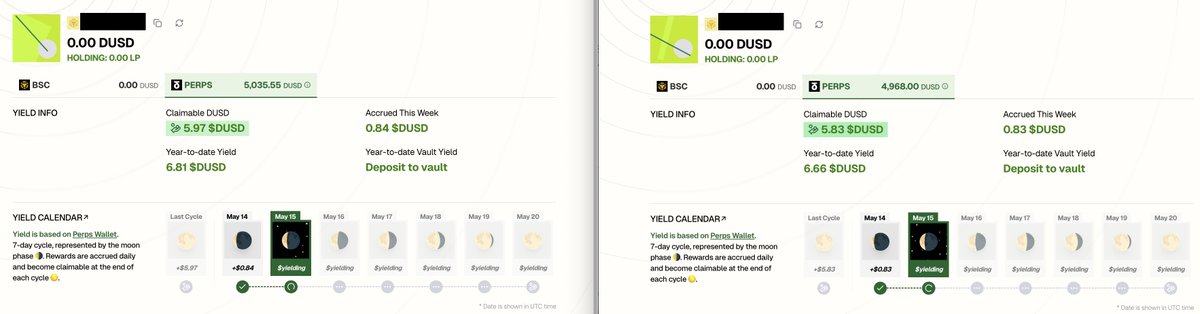
Current Account Summary (Two accounts combined):

  • 💰 DUSD Yield Earnings (Base + SIP-3):$13.47($6.81 + $6.66)

  • 💰 Position Yield Earnings (SIP-2):$3.44($1.72 \times 2)

  • 📊 Total Earnings:$16.91, annualized approximately 7.8%

  • 🎯 Trading Points: 380+ points

  • Directional Risk: Zero

  • 🔥 Wear and Tear: Zero

APY Stack is currently showing 8.46%, and earnings are still growing daily.

📌 Note: The total earnings of $16.91 translate to an annualized rate of about 7.8%, which differs from the APY Stack showing 8.46%. This is because 7.8% is the historical average for the 8-day period from May 7th to May 15th, whereas 8.46% is today's real-time snapshot—recent increases in platform trading volume have driven up fee income, so the current APY is higher than the average of the past 8 days. Over a longer timeframe, the two figures will converge.

Earnings Breakdown — Where Does the 8.46% APY Come From?
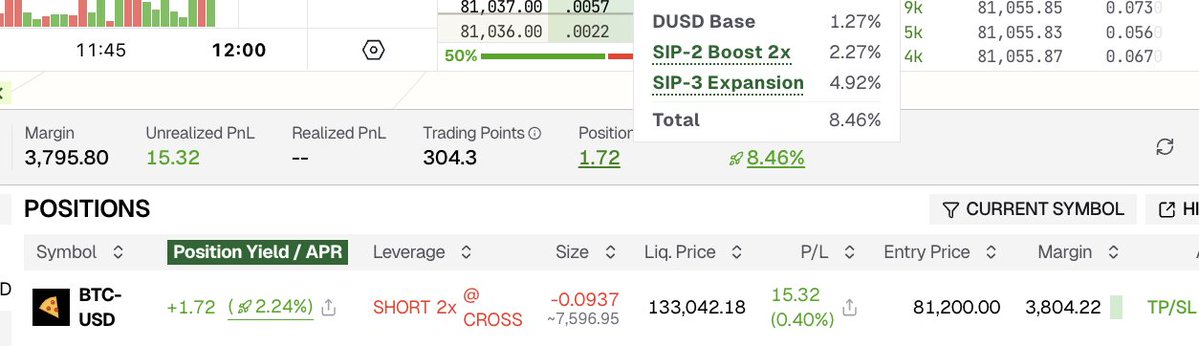
  • First Layer: DUSD Base — 1.27%

    The base yield that all DUSD holders receive, sourced from Funding Rate (similar to Ethena's USDe strategy).

  • Second Layer: SIP-2 Position Yield Boost — 2.27%

    This is a mechanism unique to StandX. Many people's first reaction is, "Isn't this just a subsidy?"—it's not. Behind SIP-2 lies a carefully designed flywheel logic:

    You Open a Position → Platform Liquidity Increases → Trading Volume Increases → Fee Income Increases → SIP-2 Earnings Increase → Attracts More Users to Open Positions

    Why does this flywheel work? Opening a position—whether long or short—provides the foundational liquidity for the platform. The essence of SIP-2 is protocol revenue sharing ( Protocol Revenue Sharing ): the platform shares real transaction fees back with users who provide liquidity, following the same logical framework as Hyperliquid's fee distribution.

    💡 Leverage = Earnings Amplifier: 2x leverage corresponds to 2x boost—you use 1,000 DUSD to open a 2x position, taking on a 2,000 DUSD risk exposure, and earnings are calculated based on risk exposure, not principal. Higher risk, higher reward. Logically fair—bigger waves bring bigger fish.

  • Third Layer: SIP-3 Universal Fee Distribution — 4.92%

    This is currently the largest source of earnings and also the most generous layer. A portion of the transaction fees generated by StandX is distributed directly to every DUSD holder—regardless of whether you have open positions, trade, or even log into the platform. As long as you have DUSD in your wallet, you automatically get a share. A true universal sunshine bonus.

Key Point: All three layers of earnings are settled in DUSD (a USD stablecoin). Every cent you earn is real, hard U, with no inflated governance token incentives.

In a World of 3% Yields, How Can 8% Be Sustainable?
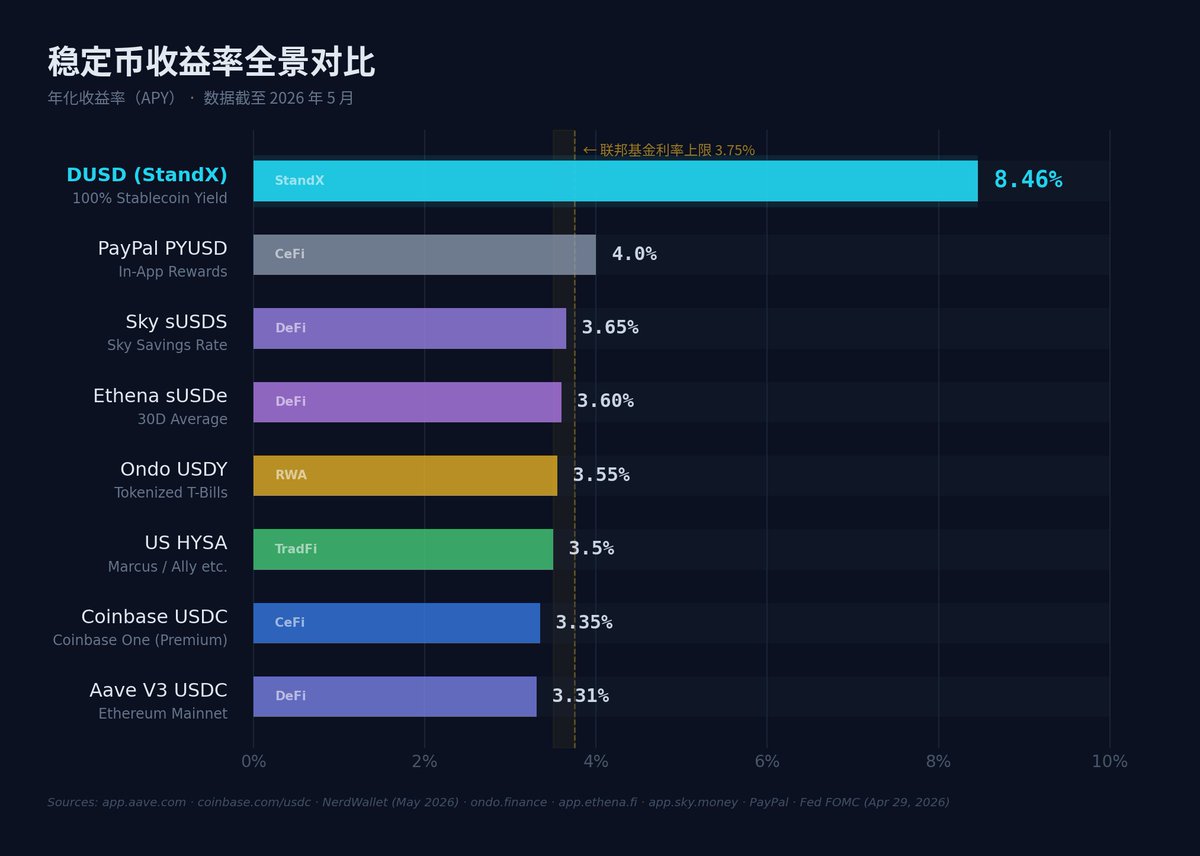
Just compare horizontally. After the Federal Reserve cut rates three times in a row by the end of 2025, the federal funds rate settled at 3.50–3.75%, pushing down the ceiling for "safe returns" across the market. From Aave's 3.31% to Ethena's 3.60%, all mainstream stablecoin yield products are squeezed into an extremely narrow range. DUSD's 8.46% is more than double that.

Moreover, this yield is sustainable, not cyclical. Most yield-bearing stablecoins (including Ethena sUSDe) heavily rely on funding rates—look good in bull markets, but get compressed in bear markets. DUSD is different: over 7% of its 8.46% comes from transaction fees ( SIP-2 + SIP-3 ), which is independent of market direction. As long as people trade, there is fee income, and there is yield. The introduction of SIP-3 is a structural upgrade that transcends bull and bear cycles—it transforms DUSD from "relying solely on funding rates" to being "driven by a dual-engine of fees + funding rates." This is unique among all yield-bearing stablecoins.

Replicate My Strategy in 3 Steps with Zero Wear and Tear

The whole process takes less than five minutes. You need two wallets, 5,000 USDT each, and a small amount of BNB for Gas.

  1. Obtain DUSD and Deposit into Perps Wallet

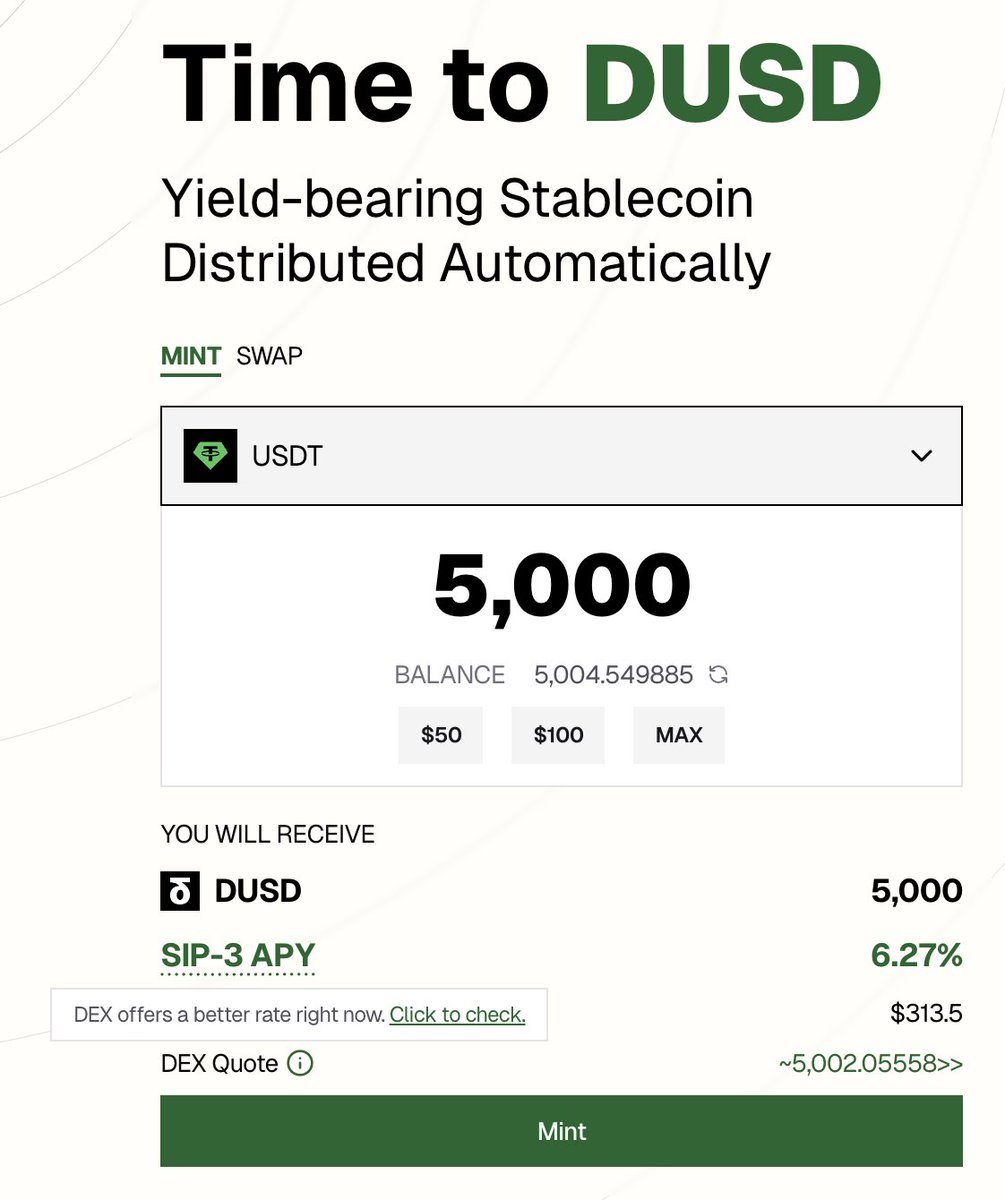
    Log in to both wallets at standx.com $DUSD page Select Swap (gets you a few extra dollars compared to Mint) Swap 5,000 USDT for approximately 5,002 DUSD. Note the prompt at the bottom of the page; our system helpfully informs you when the DEX quote is more favorable.
  1. Account A Creates a Block Trade Long Position

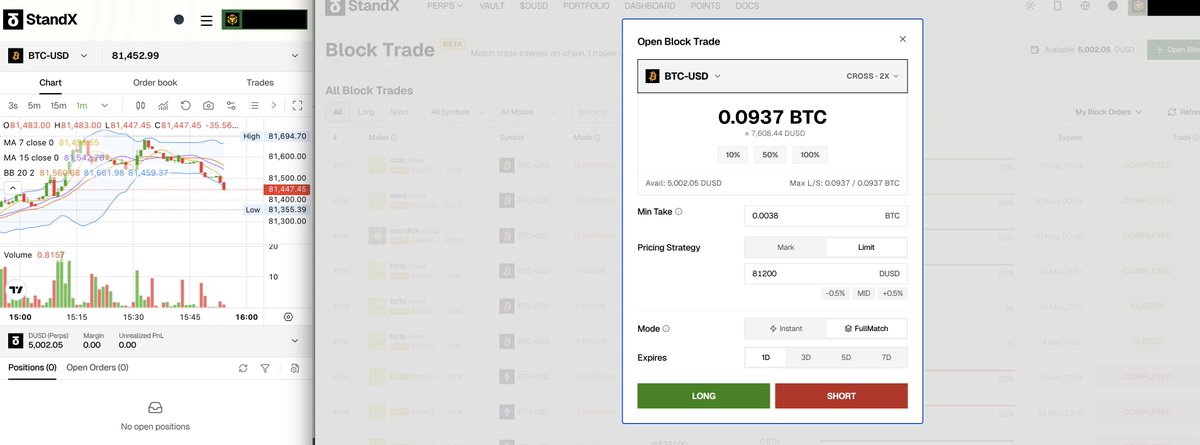
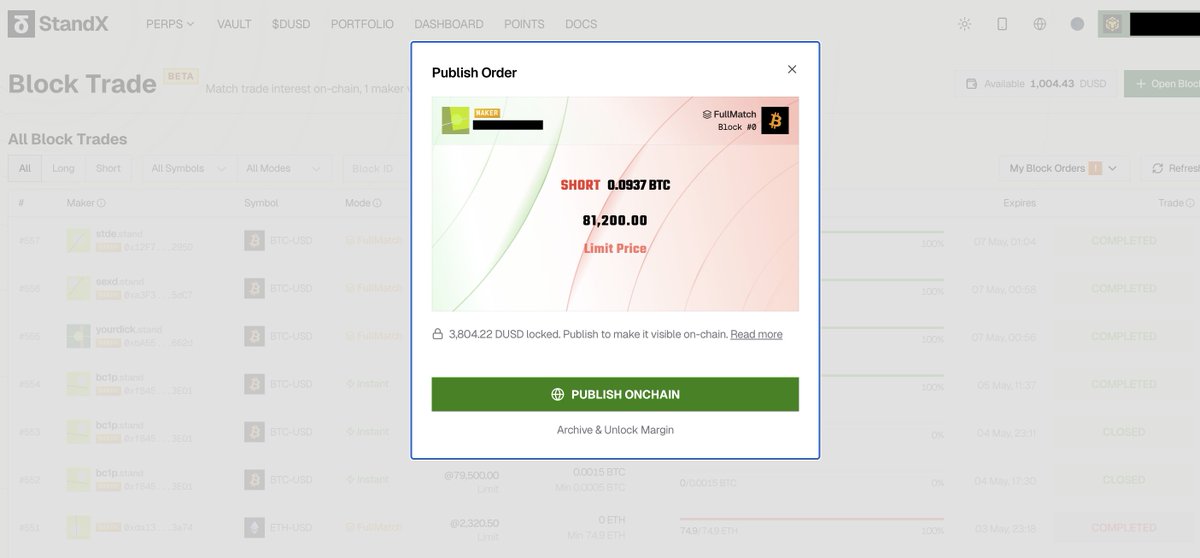
    PERPS Block Trade + Open Block Select BTC-USD, CROSS · 2X, Limit Price, FullMatch Click LONG PUBLISH ONCHAIN. After publishing, copy the share link and send it to the other wallet.
  1. Account B Accepts the Block Trade Short Position

    Switch to Wallet B Go to Block Trade Change the leverage to CROSS · 2X (default might be 10X) Click JOIN SHORT Confirm Publish Onchain.
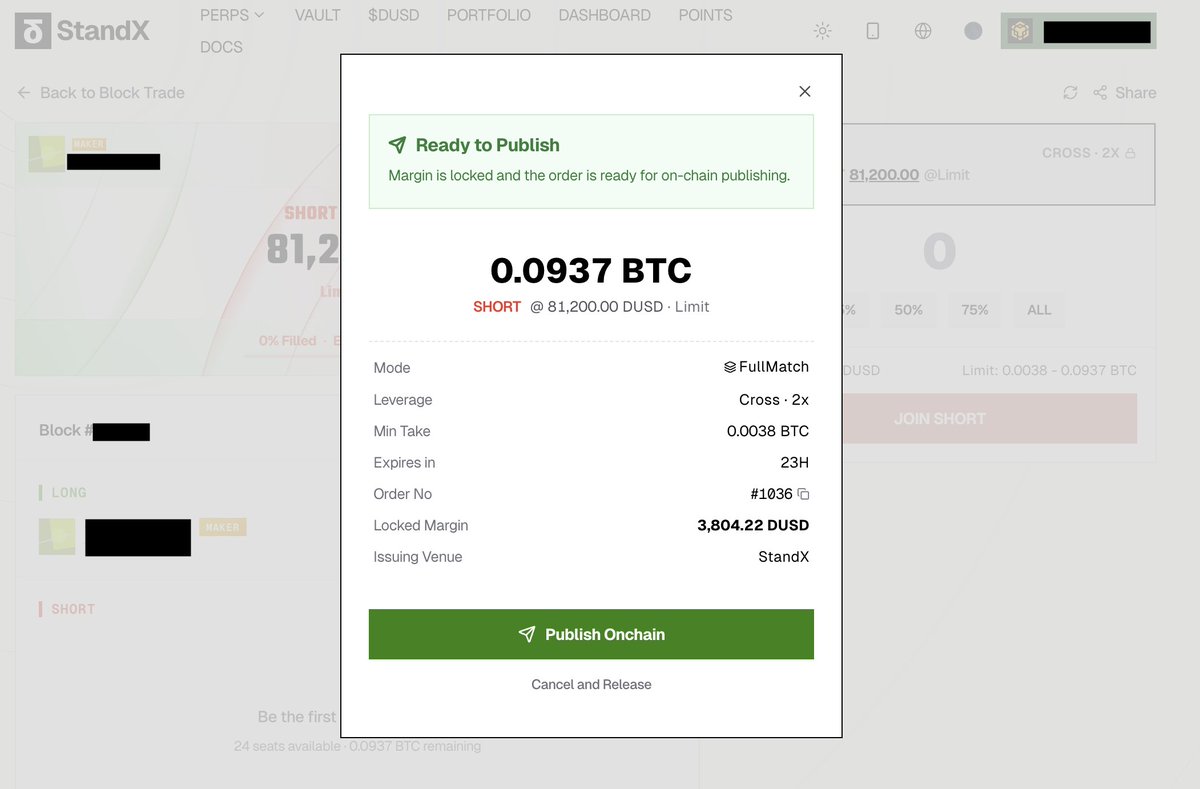
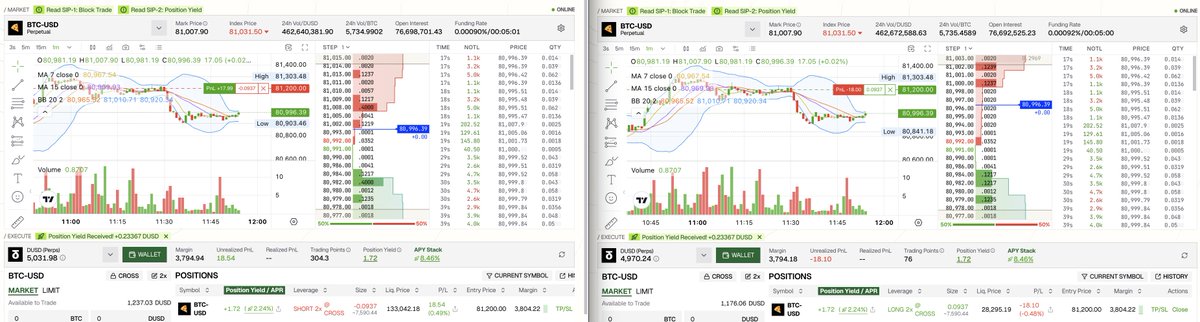
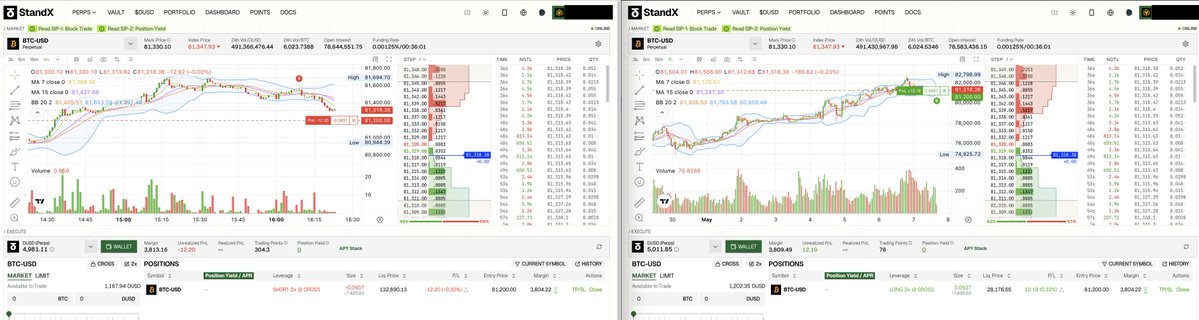
Done! The two accounts are perfectly hedged. On the left -$12.20, on the right +$12.19, net PnL is nearly $0.
Why is this strategy "zero wear and tear"?

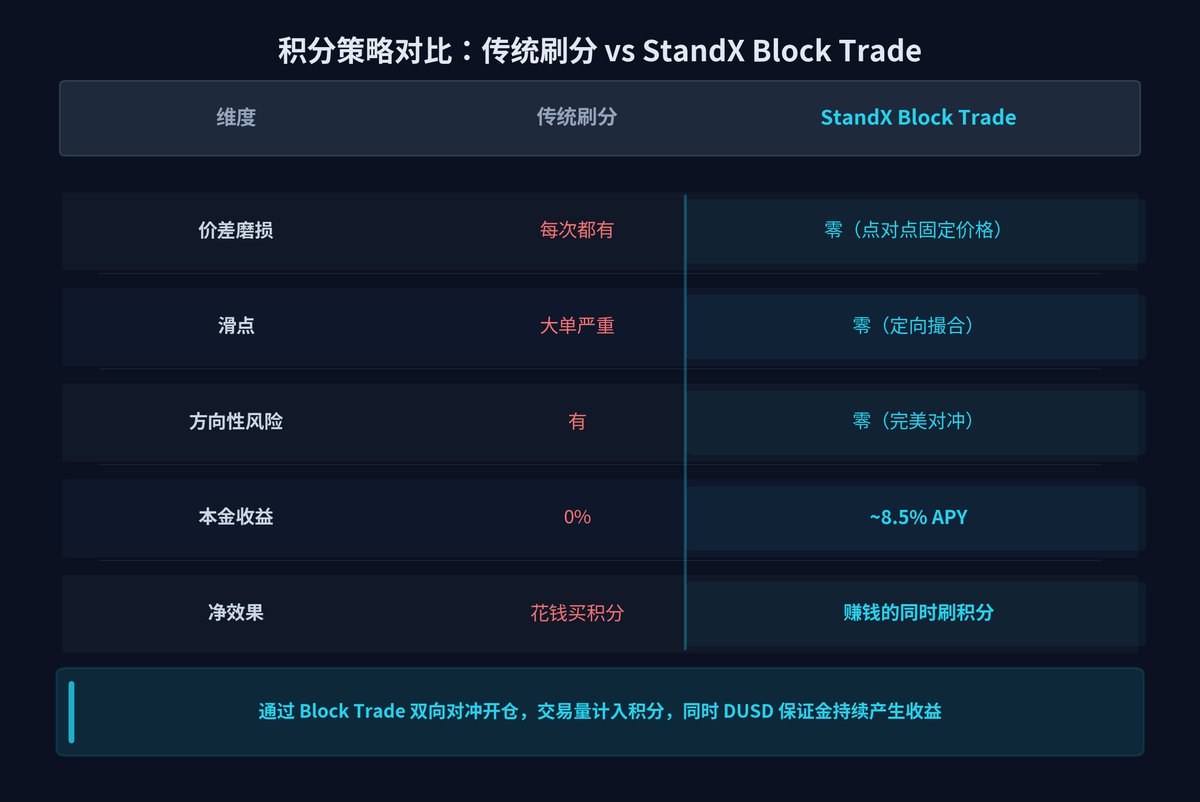
Airdrop farming used to be like factory work. You repeatedly open and close positions, trade volume, check in, transfer funds, twisting your wallet addresses into the machines designed by project teams like an assembly line worker. Finally, the airdrop arrives, and the project says: Thanks for participating, but this batch of addresses has low weighting. Worse, you didn't work for free—spreads, slippage, fees, Gas, all slowly wear down your principal. Block Trade is completely different—not only does it accumulate points with zero loss, but your principal also steadily generates earnings.
Risk Disclosure

  1. Smart Contract Risk: This is the underlying risk of all DeFi. StandX contracts are audited, but no protocol can guarantee 100% security.

  2. Yield Volatility: 8.46% is not a fixed yield. The Base layer fluctuates with funding rates; the SIP-2/3 layers depend on platform trading volume. However, the fee-driven structure offers better cyclical resilience than a pure funding rate model.

Preview of Next Article

I'd like to talk about StandX from a different angle. As someone who used to evaluate projects from the VC side and now works on Growth inside a project, I increasingly feel that this team has some severely underrated qualities. For instance, why some DEXes ranked higher than us on DefiLlama have price differences on BTC perpetual contracts that are $20-30 larger compared to StandX (high trading volume ≠ good trading experience), or the design logic behind each product proposal from SIP-1 to SIP-3. Having a great product but being unknown might be the most common and unfortunate thing in this sector. The next article will try to bridge that information gap.

If you try this strategy, feel free to share your earnings screenshots in the comments.

Disclaimer: I am responsible for Growth work at StandX. This article contains personal test data and industry analysis, and does not constitute investment advice. DeFi protocol risks include but are not limited to smart contract vulnerabilities, liquidity risk, funding rate volatility, etc. DYOR.

Data Source: StandX platform test data (May 7-15, 2026). All APY data is time-sensitive; please refer to real-time data.


İlgili Sorular

QAccording to the article, what is the main reason why the author decided to personally test the DUSD strategy on StandX?

AThe author's main reason was to verify the claimed yield, specifically whether DUSD could genuinely generate money with an APY of around 8.46% that is settled in DUSD and not reliant on token subsidies. Doubting the number's validity, they decided to use a direct, honest method of depositing $10,000 into two accounts to test it out.

QWhat are the three layers that make up the approximately 8.46% APY for DUSD, as explained in the article?

AThe three layers are: 1) DUSD Base (approx. 1.27%), derived from funding rates. 2) SIP-2 Position Yield Boost (approx. 2.27%), which is protocol revenue sharing for providing liquidity. 3) SIP-3 Universal Fee Distribution (approx. 4.92%), where trading fees are distributed to all DUSD holders, regardless of their trading activity.

QHow does the author's tested strategy achieve "zero directional risk"?

AThe strategy achieves zero directional risk by using two accounts to create offsetting positions. One account opens a LONG position on BTC-USD via Block Trade, while the second account uses the same Block Trade to open a SHORT position on BTC-USD with the same parameters. This creates a perfectly hedged pair where gains and losses from BTC price movements cancel each other out, leaving only the yield earnings from holding DUSD.

QWhy does the article argue that DUSD's yield is more sustainable and resilient across market cycles compared to other yield-bearing stablecoins like Ethena?

AThe article argues DUSD's yield is more sustainable because over 7% of its ~8.46% APY comes from trading fees (SIP-2 and SIP-3), which are not dependent on market direction or funding rates. This contrasts with models like Ethena's USDe, which are highly reliant on funding rates that can be strong in bull markets but compress in bear markets. The fee-based structure provides a more consistent revenue stream as long as there is trading activity on the platform.

QWhat are the two main risks mentioned by the author regarding the DUSD strategy on StandX?

AThe two main risks mentioned are: 1) Smart contract risk, which is the fundamental risk for all DeFi protocols. 2) Yield volatility, meaning the 8.46% APY is not a fixed return. The Base layer fluctuates with funding rates, and the SIP-2/SIP-3 layers depend on the platform's trading volume. However, the article notes the fee-driven model offers better cyclical resilience than pure funding rate models.

İlgili Okumalar

Trade.xyz's Rebase Refusal Sparks Controversy, On-Chain Pre-IPO Market Faces Major Pricing Test

The debate surrounding Trade.xyz's refusal to adjust its SPCX (SpaceX pre-IPO) perpetual contract pricing amid updated share count revelations highlights a key challenge for on-chain pre-IPO markets. While several centralized exchanges (CEXs) paused and repriced their contracts after SpaceX's filing showed a ~10% increase in total shares, Trade.xyz maintained its market-driven pricing logic, which tracks expected per-share price sentiment rather than fundamental valuation metrics like market cap. This discrepancy triggered cross-platform arbitrage and caused leveraged long positions on Trade.xyz to suffer significant losses, as the platform's HIP-3 architecture lacks a native "Rebase" mechanism to neutrally adjust all user positions following such corporate actions. The incident underscores the difficulty for decentralized perpetual exchanges (Perp DEXs) to implement Rebase—a process CEXs handle by centrally pausing markets and adjusting ledger data. On-chain, this requires complex smart contract modifications, increasing gas costs, complexity, and potential attack surfaces. While some DEXs have managed similar adjustments, Trade.xyz's current design does not natively support it, though the team is reportedly exploring solutions for future events like stock splits. Ultimately, the controversy serves as a critical case study for the nascent on-chain pre-IPO sector, raising questions about price discovery reliability, transparent rule disclosure, and the readiness of DeFi infrastructures to handle traditional corporate actions as real-world assets (RWAs) gain traction.

marsbit5 dk önce

Trade.xyz's Rebase Refusal Sparks Controversy, On-Chain Pre-IPO Market Faces Major Pricing Test

marsbit5 dk önce

The 'Middle Eastern Prince' Swindles a Wealthy Woman: Renting Planes and Rolls-Royces, Scamming 120 Million Over Three Years

Two brothers who posed as "Middle Eastern princes" have been sentenced in the United States to 24 and 23 years in prison, respectively, and ordered to pay over $21.2 million in restitution and back taxes. Over three years, they fraudulently obtained approximately $21 million, primarily by promoting fictitious investment projects, including a non-existent cryptocurrency mining operation in a former General Electric industrial park in East Cleveland. The brothers, aged 42 and 33, created elaborate personas: one claimed to be a wealthy royal family heir and the city's "International Economic Advisor," while the other posed as a hedge fund manager with expertise from watching the TV show *Billions*. They bolstered their image by renting luxury cars and private jets and cultivating a relationship with a local mayor's chief of staff, who provided official-looking documents and government event access. A significant portion of the victims' funds, about $18 million, came from a single Chinese investor, a woman from Sichuan with experience in Bitcoin mining. The brothers also defrauded several women, including one former girlfriend. Their scheme unraveled when the primary investor discovered her $6 million worth of mining equipment had been sold off. The case highlights a trend of impostors using fabricated "Middle Eastern royal" identities to target wealthy individuals. Similar incidents include a "Dubai prince" who recently promoted a $500 million family office in Hong Kong and a Colombian man who impersonated a Saudi prince for decades in the US before being caught and sentenced in 2019.

marsbit20 dk önce

The 'Middle Eastern Prince' Swindles a Wealthy Woman: Renting Planes and Rolls-Royces, Scamming 120 Million Over Three Years

marsbit20 dk önce

a16z Partner: Being in the Flow of Capital Is the True Moat

A16z Partner: Standing in the Cash Flow is the True Moat Historically, many of the strongest companies built their moats by positioning themselves within "cash flows"—facilitating value creation and transfer in a network and taking a cut. The more value flows, the larger they grow. Crypto is the first modern technology natively built for this. With open ledgers, programmable settlement, and stablecoins enabling internet-speed global value transfer, it allows startups to inherit network effects from day one. Well-designed tokens align users, developers, and the protocol towards network growth, distributing value to contributors. This model isn't new (e.g., railroads, Visa, Google, AWS) but Crypto democratizes it. It lets entrepreneurs target areas with high inefficiency and profit extraction—like traditional finance's payments, custody, FX, and settlement—to compress costs, increase speed, and redistribute value by standing in the new flow. The opportunity extends beyond finance to emerging markets like GPU/compute, AI training data, energy, and space, where new, programmable infrastructure can be built without legacy constraints. Key questions for founders: Are you already in the cash flow? Does your revenue scale 10x with network activity? Where is profit extraction highest relative to value created in your market? The strategy is clear: compress the old cost structure, position yourself in the new value stream, and let the network compound.

marsbit47 dk önce

a16z Partner: Being in the Flow of Capital Is the True Moat

marsbit47 dk önce

Capturing 15 Top-Tier Zero-Day Vulnerabilities: A Consensus Protocol Debug Agent Framework Built by 0G Lab in Collaboration with Teams from NUS, PKU, and BUPT

"Agents Capture 15 Critical Zero-Day Bugs: 0G Lab's Multi-Agent Framework Automates Debugging in Consensus Protocols" Distributed consensus protocols are notoriously difficult to debug due to complex, intertwined states. A novel framework, Agora, developed by 0G Labs with researchers from NUS, Peking University, and Beijing University of Posts and Telecommunications, tackles this by fusing deep domain expertise with a collaborative multi-agent LLM architecture. Agora moves beyond the limitations of single LLMs and traditional testing like fuzzing. It employs three specialized agents: an Orchestrator for global state, a Strategy agent for generating attack scenarios using distributed systems knowledge, and a TestGen agent that creates executable tests. A core innovation is its efficient "Succinct Memory & Communication" mechanism and a dynamic test harness. This allows the system to translate abstract hypotheses into concrete tests across languages like Go and Rust, run them, capture failures, and refine the approach in a closed loop—all with minimal token overhead. In rigorous evaluations on production-level protocols including Raft, EPaxos, and components from etcd and Sui, Agora discovered 15 previously unknown deep logic bugs (e.g., execution divergence, liveness violations). In stark contrast, powerful standalone LLMs like GPT-5.2 and Claude 4.5 found zero such bugs. Agora achieved this with a high precision of 73.9% and at an average cost of only about $40 per bug found. The framework demonstrates high generalizability. Its decoupled design allows the "Multi-Agent + Hypothesis-Driven Testing" paradigm to be applied to other complex domains like database concurrency control, OS kernels, and Web3 smart contract auditing. By enabling efficient, automated detection of deep logic flaws, Agora points the way for AI-powered security in critical infrastructure, aligning with the growing trends of agentic systems and automated quality control.

marsbit51 dk önce

Capturing 15 Top-Tier Zero-Day Vulnerabilities: A Consensus Protocol Debug Agent Framework Built by 0G Lab in Collaboration with Teams from NUS, PKU, and BUPT

marsbit51 dk önce

İşlemler

Spot
Futures
活动图片